An employee visits a branch office and pays a local vendor ₹500 for an urgent repair. Since the vendor only accepts UPI, the employee uses a personal account, saves the payment screenshot, collects the receipt, and returns to work.
A few days later, the employee submits the expense for reimbursement. The manager checks whether the purchase was approved, while the finance team verifies the receipt, confirms the payment, identifies the correct expense category, and records it in the accounting system. What began as a small and necessary purchase has now passed through several people and taken multiple days to process.
As businesses grow, this happens across hundreds of employees, branches, trips, and operational purchases. Receipts go missing, approvals remain pending, reimbursements get delayed, and finance teams struggle to understand how much has already been spent.
An expense management system brings every stage of this process into one connected workflow. It records expenses as they occur, applies company policies, routes approvals, processes reimbursements, and keeps financial records ready for reporting and audits.
This blog explains how an expense management system works, the challenges it addresses, its features and benefits, and how businesses can choose the right system.
What is an Expense Management System?
An expense management system is software designed to monitor and manage business costs, control expenses, reduce manual errors, streamline reimbursements, and provide clear insights into spending behaviour and trends across the organization. It captures expenses digitally, enforces policy rules, automates approvals, and generates real-time reports that help finance teams maintain budget control and improve financial visibility. Modern platforms also integrate with corporate cards, accounting systems, and payment tools, ensuring that every transaction is automatically recorded and reconciled faster. This structured approach strengthens compliance, prevents duplicate claims, and supports data-driven decision-making for cost optimization. EnKash Expense Management fits naturally into this framework by combining prepaid cards, UPI-based payments, automated receipt capture, and live dashboards into a single unified system. Businesses can set purpose-based limits, track branch and employee spending in real time, and automate approvals and reconciliation without manual follow-ups. This helps finance teams move from reactive expense tracking to proactive spend control while maintaining audit-ready records and operational efficiency.
Why Businesses Need an Expense Management System
As a business grows, expenses start occurring across more employees, departments, branches, projects, and payment methods. Managing these expenses through paper receipts, spreadsheets, and email approvals makes it difficult to track spending and maintain accurate financial records.
Businesses need an expense management system to:
- Record employee and operational expenses in one place
- Track spending without waiting for month-end reports
- Reduce errors caused by manual data entry
- Prevent duplicate, unsupported, and out-of-policy claims
- Apply consistent expense rules across teams and locations
- Speed up claim approvals and employee reimbursements
- Match receipts with corporate card, UPI, and other transactions
- Monitor departmental, project-wise, and branch-wise budgets
- Maintain complete records for accounting, audits, and compliance
- Reduce the time finance teams spend chasing receipts and reconciling expenses
An expense management system provides a structured process for capturing, reviewing, approving, and recording business expenses. This becomes increasingly important as transaction volumes and operational complexity grow.
How an Expense Management System Works
An expense management system connects every stage of business expense processing, from recording a transaction to reimbursing the employee and updating accounting records.
1. The expense is recorded
An employee makes an approved business purchase using a corporate card, prepaid card, business UPI, or personal funds. The payment may be recorded automatically when the payment method is connected to the system.
2. The receipt is captured
The employee uploads the receipt through a mobile app, web portal, or supported communication channel. OCR technology can extract details such as the merchant name, transaction date, amount, GSTIN, and tax value.
3. The expense report is created
The system combines the transaction and receipt details into an expense entry. The employee adds the business purpose, category, project, department, or cost centre before submitting it.
4. Policy rules are applied
The submitted expense is checked against company policies, including spending limits, permitted categories, required documents, and approval thresholds. Any missing information or policy violation is flagged.
5. The expense is approved
The expense is routed to the appropriate manager or finance team based on the employee’s role, department, expense category, or claim amount. The approver can approve, reject, or return it for correction.
6. Reimbursement or settlement is processed
Approved out-of-pocket expenses are reimbursed to the employee. Expenses made through corporate cards, prepaid cards, or business UPI move directly to reconciliation.
7. Records are reconciled and reported
Approved expenses are matched with payment records, assigned to the correct accounting codes, and synced with the accounting or ERP system. Finance teams can then review spending through reports and dashboards.
Key Features of an Expense Management System
- OCR Receipt Capture Automatically extracts merchant, date, amount, and GST details from uploaded bills, reducing manual entry and improving data accuracy.
- Policy Engine Enforces company expense rules such as category limits, travel caps, and eligibility checks before submission to prevent non-compliant claims.
- Automated Approval Workflows Routes expenses to the right manager based on role, amount, and cost centre, ensuring faster approvals and controlled spending.
- Sync with Corporate Cards Imports card transactions in real time, auto-matches receipts, and converts spends into compliant expense entries without manual reconciliation.
- UPI Expense Capture Track and make payments with UPI-based business payments with instant logging, enabling better control over small operational spends across locations.
- Real-Time Dashboards and Analytics Provides live visibility into department-wise, employee-wise, and category-wise spending for budget monitoring and variance analysis.
- ERP and Accounting Integration Maps approved expenses to general ledger codes and syncs directly with ERP systems, ensuring accurate and audit-ready financial records.
- GST-Ready Expense Data Captures GSTIN, tax amounts, and invoice details to support input tax credit tracking and compliant financial reporting.
Types of Expenses Managed by an Expense Management System
| Expense Category | What It Covers | Business Benefit |
|---|
| Travel & Expense (T&E) | Flights, hotels, meals, local travel, and client meetings | Controls travel budgets with policy checks and faster claim processing |
| Petty Cash & Low-Value Spend | Office supplies, courier, minor repairs, and daily branch expenses | Replaces manual registers with digital tracking and audit-ready records |
| Employee Reimbursements | Out-of-pocket business purchases and field expenses | Speeds up approvals, ensures accurate categorisation, and timely payouts |
| Vendor & Operational Expenses | Utilities payment, rent, maintenance, and professional services | Improves payment visibility and supports cash flow management |
| SaaS & IT Spend | Software subscriptions, cloud costs, licences, and hardware | Identifies unused tools and prevents duplicate subscriptions |
| Telecom Expenses | Mobile bills, broadband, data plans, and company devices | Enables usage monitoring and telecom cost optimisation |
Benefits of Expense Management
An expense management system simplifies how expenses are submitted, reviewed, approved, reimbursed, and analysed. Its benefits extend across employees, finance teams, and business leaders.
Benefits for Employees
- Simpler expense submission: Employees can upload receipts and submit claims digitally instead of completing spreadsheets or paper forms.
- Faster reimbursements: Automated approvals and payment workflows reduce the time employees wait to recover business expenses.
- Less personal spending: Corporate cards, prepaid cards, and business UPI reduce the need to use personal funds for approved purchases.
- Easy status tracking: Employees can check whether a claim is pending, approved, rejected, or reimbursed.
- Clear policy guidance: Built-in rules notify employees about missing documents, spending limits, and ineligible expenses before submission.
Benefits for Finance Teams
- Reduced manual work: Automated receipt capture, categorisation, and approval routing reduce data entry and follow-ups.
- Consistent policy enforcement: Every expense is checked against the same company rules before approval.
- Faster reconciliation: Transactions, receipts, claims, and accounting records can be matched through one system.
- Improved fraud detection: Duplicate, unusual, and unsupported expense claims can be identified earlier.
- Audit-ready records: Digital receipts, approval histories, and transaction details remain available for audits and compliance reviews.
- Faster month-end closing: Accurate and complete expense data reduces delays during financial reporting.
Benefits for Business Leaders
- Real-time spend visibility: Leaders can monitor expenses across employees, departments, branches, projects, and categories.
- Stronger budget control: Current spending data helps identify budget overruns before they become larger problems.
- Better financial planning: Categorised expense data supports more accurate budgets, forecasts, and cost decisions.
- Consistent processes across locations: Standard policies and approval workflows help businesses manage distributed teams.
- Reduced expense leakage: Better controls help limit unnecessary, duplicate, and out-of-policy spending.
- Scalable expense operations: Businesses can manage growing transaction volumes without increasing manual finance work at the same rate.
Common Challenges in Expense Management
Managing business expenses becomes difficult when transactions occur across multiple employees, departments, locations, and payment methods. Without a standard process, finance teams may struggle to maintain accurate records and control spending.
Delayed expense submissions
Employees may submit expense claims and receipts weeks after making a purchase. This delays reimbursements, accounting entries, and month-end closing.
Lost receipts, unclear business purposes, incorrect categories, and missing invoice details increase follow-ups and make expense verification difficult.
Manual data entry and errors
Entering receipt and transaction details into spreadsheets or accounting systems takes time and increases the risk of incorrect amounts, categories, and tax details.
Slow approval workflows
Claims may remain pending when approval responsibilities are unclear or managers must review expenses through emails and paper forms.
Inconsistent policy enforcement
Employees may exceed spending limits, use unapproved merchants, or claim ineligible expenses when policies are not applied consistently.
Limited visibility into spending
When expenses are recorded only after submission, finance teams and business leaders cannot see current spending or identify budget overruns early.
Duplicate and fraudulent claims
The same receipt may be submitted more than once, while unsupported or altered claims can be difficult to identify through manual reviews.
Difficult expense reconciliation
Matching receipts with reimbursements, corporate card transactions, UPI payments, and accounting entries can delay financial reporting.
Managing expenses across branches and field teams
Businesses with distributed operations may struggle to apply consistent approval rules, budgets, and documentation requirements across locations.
How to Choose the Right Expense Management System
Selecting the right expense management system is a strategic decision for finance leaders. The ideal platform should not only automate reimbursements but also enforce policy control, provide real-time visibility, and scale with business growth.
Here are the key evaluation criteria:
- Strong Policy Controls Look for configurable spend rules, category limits, merchant restrictions, and automated approval workflows to prevent out-of-policy expenses before they occur.
- UPI and Corporate Card Support Ensure the system supports UPI-based expense capture along with corporate cards and prepaid card integrations for seamless digital spend tracking across employees and branches.
- Multi-Branch and Role-Based Access The platform should allow branch-wise budgets, location-level reporting, and role-based permissions to manage distributed teams with centralised financial oversight.
- GST-Ready Expense Data Choose a solution that captures GST details from invoices, classifies input tax credits correctly, and generates GST-compliant reports for faster reconciliation.
- ERP and Accounting Integration Direct integration with accounting systems (such as Tally, SAP, or other ERPs) eliminates manual data entry and ensures accurate, real-time ledger posting.
- Scalability for Growing Businesses The system should handle increasing transaction volumes, new entities, and additional users without performance issues or process rework.
- Mobile and WhatsApp-Based Expense Capture Choose a system that allows employees to upload receipts and submit expenses through mobile apps or WhatsApp. OCR-based capture reduces manual entry and improves adoption among field and sales teams.
A well-chosen expense management system delivers policy enforcement, faster closures, and actionable spend intelligence, making it a core financial control layer rather than just a reimbursement tool.
How EnKash Simplifies Expense Management
Managing expenses across teams and locations becomes complex when payments happen through personal cards, cash, and scattered reimbursement processes. EnKash brings these flows into a controlled, digital framework that improves visibility and reduces manual work for finance teams.
UPI-Based Expense Capture
In many Indian businesses, employees pay vendors through UPI for small operational needs. EnKash enables official UPI-based expense allocation, so these transactions are recorded instantly with payer, purpose, and amount mapped to the correct cost centre. This removes dependence on personal UPI and post-facto reporting.
Prepaid Corporate Cards for Controlled Spend
Instead of issuing advances, finance teams can assign prepaid cards with predefined limits for travel, admin purchases, or branch operations. For example, a branch manager purchasing local supplies can pay using a capped card, ensuring the expense stays within policy without requiring reimbursement.
WhatsApp OCR Receipt Submission
Field employees often delay expense submission because they must log into a portal later. With EnKash, a receipt shared on WhatsApp is automatically read using OCR, itemised, and converted into an expense entry. This reduces missed claims and improves documentation quality.
Real-Time Dashboards for Finance Visibility
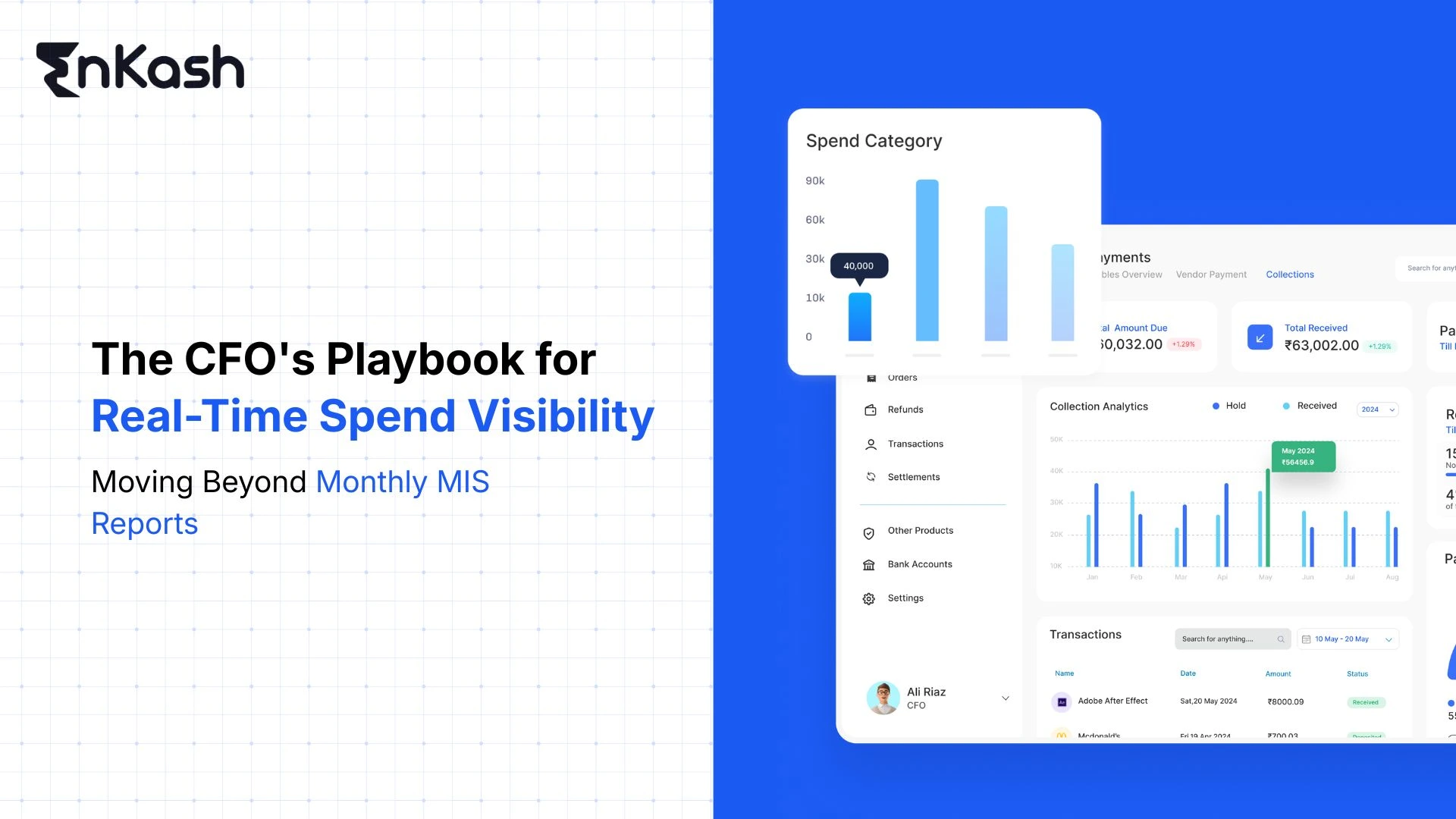
Finance teams no longer wait for month-end reports. Live dashboards show who is spending, where the budget is being used, and which branches are nearing limits. This helps identify unusual patterns early and improves forecasting accuracy.
Branch-Wise Budgets and Controls
Multi-location organisations can assign fixed budgets to each branch or department. If a location approaches its limit, alerts are triggered, allowing proactive control instead of retrospective correction.
Automated Reconciliation and Accounting Sync
Because expenses are captured digitally with receipts and payment data, reconciliation happens automatically. This shortens month-end close cycles and reduces manual matching of vouchers with bank statements. In practice, this approach replaces fragmented reimbursement cycles with policy-driven, real-time expense control, giving finance leaders structured oversight while allowing teams to make necessary operational payments without delay.
Conclusion
Modern expense management is a control function, not just a reimbursement process. Real-time capture, policy enforcement, and automated reconciliation give finance teams clear visibility into spend and reduce month-end workload. In India’s UPI-led payment environment, digital expense systems align with how businesses actually pay, improving accuracy and audit readiness. The result is stronger cost control, faster reporting, and better financial decision-making.
FAQs
1. What is Expense Management Software?
Expense management software is a digital tool that records, controls, and analyzes business expenses in one place. It automates submissions, approvals, reimbursements, and reporting for better financial visibility.
2. How does OCR work in expenses?
OCR scans uploaded receipts and extracts details like amount, date, merchant, and GST automatically. This converts bills into structured expense entries without manual typing.
3. Can UPI be tracked in the expense system?
Yes, UPI transactions can be captured and categorised as expenses when linked to the business expense platform. This provides real-time tracking and proper approval workflows.
4. Is expense management part of ERP?
Expense management can work as a standalone system or integrate with ERP. Integration ensures approved expenses automatically sync with accounting and financial records.
5. How do corporate cards integrate?
Corporate card transactions flow directly into the expense system in real time. Each spend is auto-matched with receipts and mapped to the correct expense category.
6. How to track monthly expenses?
Monthly expenses are tracked through dashboards that show department-wise, employee-wise, and category-wise spending. This helps monitor budgets and identify cost patterns.
7. How to manage petty cash using expense management software?
Petty cash can be digitised using UPI or prepaid cards with defined limits and approvals. Every small spend is recorded instantly, removing manual registers and improving control.