Business operations involve a lot of expenses on a daily basis. Petty cash supports these expenses at the ground level. Understanding what petty cash is helps businesses maintain financial clarity without slowing down any routine activity. From small office purchases to payments of immediate service, this controlled cash balance supports speed and accountability.
It also reduces unnecessary paperwork for low-value transactions that occur during normal working hours. Let’s dig in more about petty cash management, how businesses can control and track these expenses effectively, and how these expenses can be digitized.
What is Petty Cash?
Petty cash is a small amount that a business uses to manage its day-to-day expenses. It is mainly used for routine office needs like small celebrations, basic office equipment, stationery, and other requirements that do not require a formal payment process. Even though the amount is small, petty cash transactions are recorded in the company’s account books and reflected in financial statements.
From an accounting point of view, petty cash is classified as a current asset on the balance sheet because it is a highly liquid form of company funds. To ensure transparency and control, organizations maintain a petty cash book where all transactions are documented. This helps improve expense tracking, maintain accountability, and provide better visibility into small but frequent business expenses.
Petty Cash Example
Petty cash expenses are spread across multiple categories ranging from stationery to maintenance supplies to snacks. Follow the table below for petty cash examples.
Petty Cash Expense Types | Examples |
Stationery | Pens, paper, files |
Refreshments | Tea, coffee, snacks |
Local Travel | Taxi fare, fuel |
Courier Charges | Sending documents |
Minor Repairs | Fixing office equipment |
What is Petty Cash Management?
Petty cash management is a system that helps organizations record, monitor, and control all small day-to-day cash expenses. It ensures that funds allocated for petty expenses are used properly and efficiently, while maintaining clear visibility on how money is being spent in an organization. A structured petty cash management process supports controlled fund handling and reduces the chances of misuse and theft.
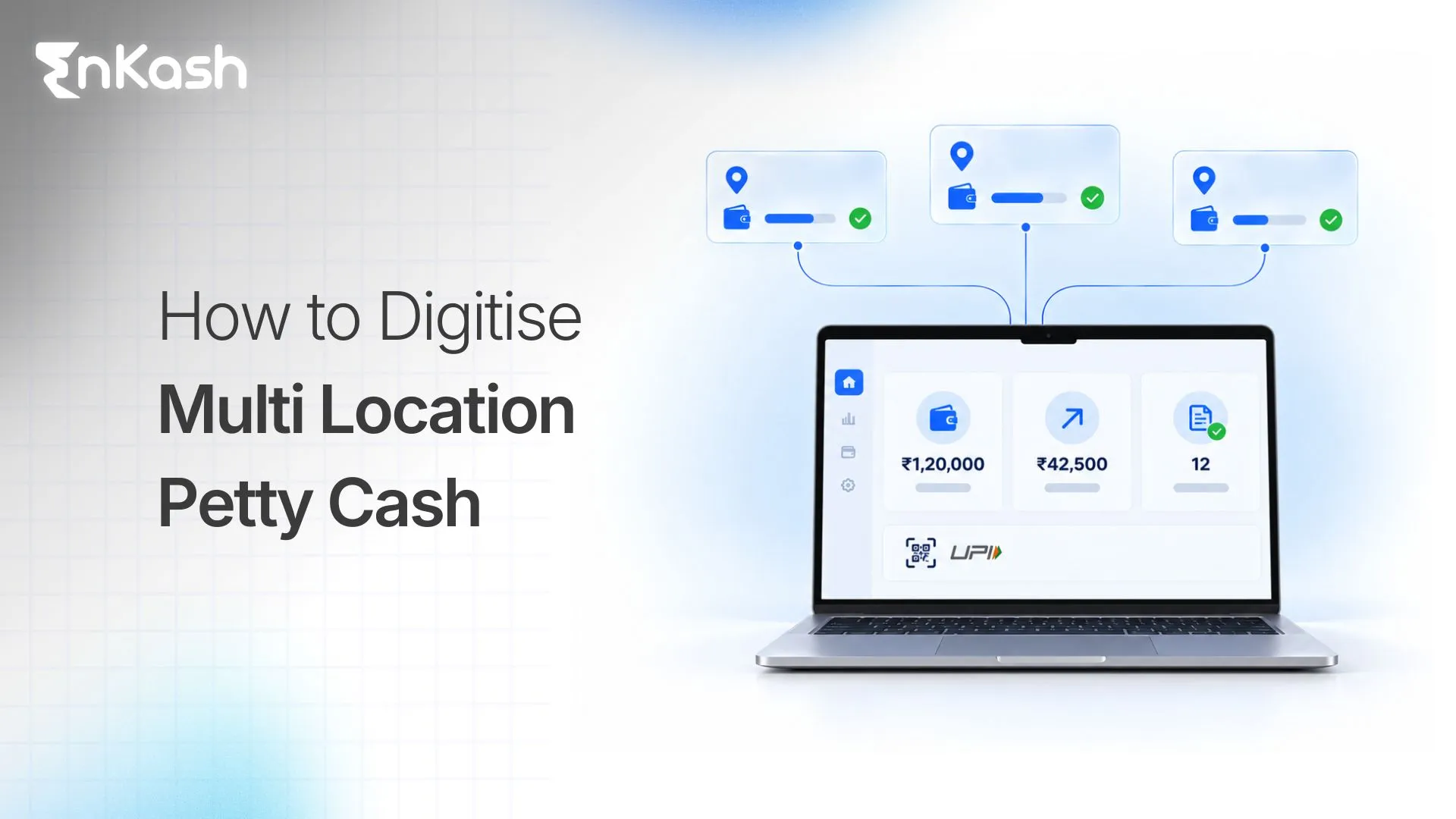
With EnKash petty cash management, businesses can digitally track and control petty cash across multiple branches and departments through a single unified dashboard. This centralized approach makes it easier to allocate funds branch-wise or department-wise, monitor spending patterns, and manage disbursements in a more organized way. A strong petty cash management system is important for proper documentation and financial accuracy of funds in an organization. Digital controls and internal tracking of petty cash expenses help businesses minimize risks such as theft, errors, or unrecorded expenses. It also supports organizations in maintaining accurate financial records and smooth reconciliation in the final accounts. Overall, effective petty cash management improves accountability, transparency, and financial discipline, ensuring that even small operational expenses are properly managed and aligned with company policies.
Why Do Businesses Need Petty Cash Management
Businesses need petty cash management:
For quick payments: Petty cash management systems can easily facilitate any immediate small expense for a business.
To balance workload: For every small expense, there is no dependency on processing complex invoices for small purchases.
To avoid out of pocket expenses: Employees don’t have to use their own money for small office expenses.
To prevent fraud: An efficient petty cash management system helps manage cash by using receipts and keeps a track of spends.
Importance of Petty Cash Management
Operational Continuity at the Point of Work
Petty cash supports continuity when routine payments require immediate settlement. Minor requirements can slow activity if teams must wait for approvals or payment processing. A limited cash fund removes this delay and allows work to proceed without interruption. This approach is relevant in physical operating environments. Offices, service counters, and active project locations face situations where instant settlement is necessary to keep tasks on schedule. Access to a defined cash balance allows teams to address these needs promptly. Responsibility for the fund is clearly assigned, preserving control while maintaining efficiency.
Purpose Driven Use of Minor Cash Payments
A petty payment is made for the purpose of settling low-value expenses that arise during regular business activity and require immediate action. These payments are narrow in scope and tied directly to operational requirements. The intent is precision and accountability. Each payment follows predefined limits and is recorded against a specific need. This structure reduces discretionary use and supports consistent expense discipline across teams.
Controlled Support for Structured Payment Systems
Petty cash functions alongside formal payment systems rather than replacing them. It addresses small transactions where structured processes are inefficient. Defined limits, clear ownership, and routine checks ensure alignment with financial controls. When governed properly, the fund improves operational efficiency while maintaining oversight.
How Petty Cash Management Works
Define a Fixed Cash Limit
Effective control starts with a predefined limit. Petty cash should be set at a level that reflects routine needs without creating excess exposure. The amount must align with the business's size, location, activity, and the frequency of minor payments.
Assign Clear Custodial Responsibility
A single custodian should manage petty cash at each location. This role includes safekeeping, issuing payments for approved purposes, and maintaining records. Clear ownership reduces ambiguity and strengthens accountability.
Enforce Usage Boundaries
Payments from petty cash must follow defined criteria. Only low-value, immediate requirements qualify. Planned or higher-value expenses should move through formal payment systems. This separation preserves discipline.
Maintain Real-Time Recording
Each payment should be recorded at the time it occurs. Delayed entries weaken visibility and control. Consistent recording keeps cash balances aligned with actual usage.
Schedule Periodic Verification
Regular checks confirm that physical cash matches recorded balances. These reviews identify gaps early and reinforce responsible handling of petty cash.
Review Relevance and Adjust Limits
Business needs change over time. Periodic review helps determine whether petty cash limits remain appropriate or should be reduced in favour of structured digital methods. Manage Petty Cash Expenses
How to Set Up a Petty Cash Management System
After Choosing EnKash Petty Cash Management System:
Step 1: Define Your Petty Cash Structure
Start by mapping how petty cash works across your organisation.
- Identify branches, offices, warehouses, or sites
- Decide who needs petty cash access at each location
- Define use cases (local travel, repairs, office supplies, daily ops)
Step 2: Create Locations & Assign Users
Set up each location as a unit.
- Add branches or locations
- Assign employees or managers to each location
- Set role-based access (spender, approver, finance admin)
Step 3: Choose the Petty Cash Mode (UPI or Prepaid Card)
Enable the right instrument based on usage:
- UPI-based petty cash for frequent, local transactions
- Prepaid petty cash cards for controlled, card-based spending
Step 4: Set Budgets, Limits & Policies
Automate control at the source.
- Define monthly or weekly petty cash budgets per location
- Set per-transaction limits
- Allow or block merchant categories
- Configure approval rules if needed
Step 5: Load Funds & Enable Auto Top-Ups
Distribute petty cash digitally.
- Load funds centrally
- Schedule automated top-ups
- Instantly pause, revoke, or reassign access
Step 6: Enable Automatic Expense Capture
Every spend becomes an expense automatically.
- Amount, date, merchant captured instantly
- Employees upload receipts via mobile
- Expenses flow into a unified petty cash register
Step 7: Track, Reconcile & Audit in Real Time
Monitor all locations from one dashboard.
- Live spend tracking across branches
- Automated receipt matching
- One-click reconciliation and exports
Challenges in Petty Cash Management
Although petty cash supports daily operations, managing it properly can be difficult without strong controls. Poor petty cash management can lead to financial gaps and reduced transparency.
- Limited Real-Time Visibility Manual recording delays expense tracking, making it harder to monitor spending instantly.
- Missing Receipts and Weak Documentation Incomplete bills or unrecorded expenses create reconciliation issues and weaken audit trails.
- Risk of Misuse Physical cash handling increases the chances of unauthorized spending, errors, or fraud.
- Time-Consuming Reconciliation Verifying receipts and cash balances manually takes time and is prone to human mistakes.
- Poor Spending Control Without defined limits and policies, petty cash may be used for non-essential expenses.
- Scalability Issues As transaction volume grows, manual petty cash systems become inefficient and harder to manage.
- Lack of Integration with Accounting Systems Disconnected processes delay financial reporting and reduce overall accuracy.
EnKash petty cash management helps businesses overcome common petty cash challenges by digital tracking, documentation, and control in a single centralized system. It provides real-time visibility into branch- and department-level spending, enables digital receipt uploads for accurate records, and enforces spending limits and approval workflows to reduce misuse. EnKash Automated tracking simplifies reconciliation, supports growing transaction volumes, and aligns petty cash data with accounting processes for better financial accuracy and transparency.
Final Thoughts
Petty cash continues to hold relevance in structured business environments when it is defined clearly and managed with discipline. Its role is narrow by design. It supports minor, immediate payments that formal systems are not suited to handle efficiently. When treated as a controlled fund rather than an informal convenience, it strengthens operational flow without weakening financial oversight. A clear distinction between the fund, the expenses paid from it, and the way it is recorded allows businesses to avoid confusion. Proper limits, assigned responsibility, and consistent recording ensure that small cash movements remain visible and accountable. As digital systems expand, the role of petty cash may reduce, but it does not disappear entirely. Used with intent and restraint, petty cash remains a practical support tool within a well-governed financial framework.
FAQs
1. Is petty cash considered an asset or an expense?
Petty cash is treated as an asset because it represents money still held by the business. The expense occurs only when cash is spent and recorded under the relevant cost category. Until then, petty cash remains part of available funds and appears within cash balances in financial records.
2. How is misuse of petty cash identified during reviews?
Misuse is identified when recorded payments do not align with approved purposes or when physical cash does not match recorded balances. Regular verification, clear documentation, and assigned responsibility make such issues visible early. Small discrepancies are easier to detect when reviews are scheduled consistently.
3. Can petty cash be maintained across multiple locations?
Yes, businesses can maintain petty cash at multiple locations if operational needs require it. Each location should have a separate fund, a designated custodian, and independent records. Central oversight ensures consistency while allowing local teams to handle immediate requirements efficiently.
4. Does maintaining petty cash increase audit risk?
Audit risk does not increase when petty cash is managed with discipline. Clear limits, proper records, and regular reconciliation reduce risk. Auditors focus on control quality rather than fund size. Well-documented petty cash systems are easier to verify than informal cash handling.
5. How frequently should petty cash be reviewed?
Review frequency depends on usage volume. High activity locations may require weekly checks, while low activity setups may be reviewed monthly. The key factor is consistency. Regular review ensures balances remain accurate and reinforces responsible handling of petty cash.
6. Can employees be reimbursed directly from petty cash?
Yes, employee reimbursements can be settled through petty cash when amounts are small and require immediate settlement. Such reimbursements should follow predefined rules, include proof of expense, and be recorded clearly to maintain transparency and accountability.
7. What happens if petty cash runs out before replenishment?
When petty cash reaches its minimum threshold, replenishment should be initiated based on verified records. If funds are exhausted unexpectedly, payments should pause until restoration. This prevents informal borrowing or undocumented usage that could weaken control.
8. Is petty cash suitable for service-based businesses?
Service-based businesses use petty cash for immediate operational needs such as local travel or minor supplies. Suitability depends on how frequently such expenses arise. When structured properly, petty cash supports service continuity without replacing formal payment systems.
9. How does petty cash support internal financial discipline?
Petty cash supports discipline by forcing a clear classification of small expenses. Defined limits, restricted use, and routine checks prevent casual spending. This structure reinforces cost awareness at the operational level while keeping financial records organised.
10. Should Petty cash be eliminated as digital payments grow?
Digital adoption reduces reliance on petty cash, but eliminating it depends on operational realities. Some situations still require immediate cash settlement. A reduced, well-governed petty cash fund allows businesses to balance efficiency with control rather than forcing unsuitable alternatives.