Key Takeaway
- Choose the right accounting software for your business stage. Platforms like Refrens, Zoho Books, and TallyPrime can automate bookkeeping, simplify GST compliance, generate financial reports, and save hours of manual work, making accounting far easier for small businesses.
- Good accounting is more than tax compliance. It helps you understand cash flow, track profitability, make smarter business decisions, secure loans, attract investors, and avoid costly financial mistakes.
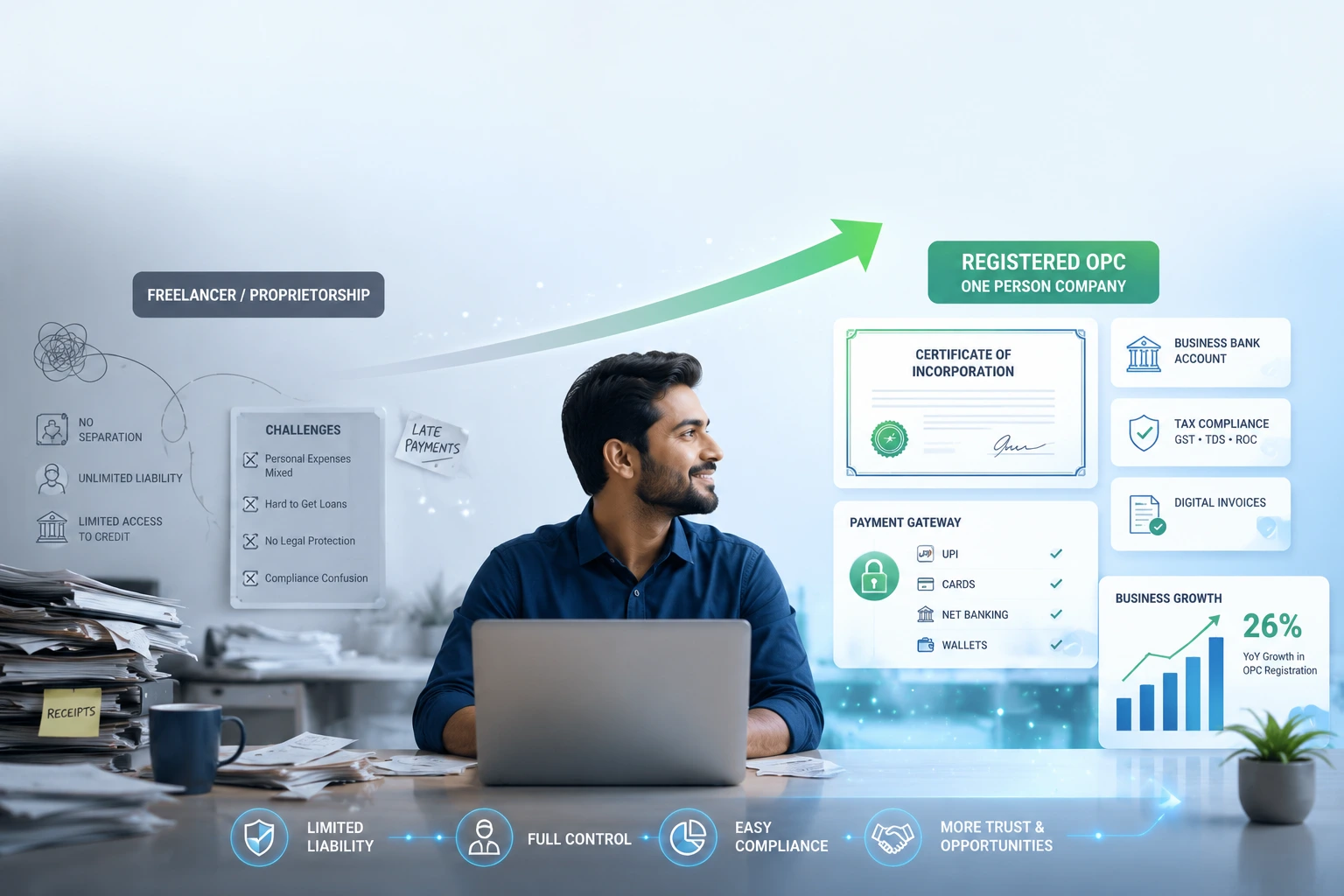
- Building strong accounting habits from day one, such as maintaining proper books, reconciling bank accounts monthly, and separating personal and business finances, prevents errors from becoming expensive problems later.
- Staying compliant with GST, income tax, TDS, and Udyam registration reduces penalties, protects your Input Tax Credit (ITC), and unlocks government benefits designed for MSMEs.
- The best accounting system is the one that grows with your business. Start simple, automate repetitive tasks as transaction volume increases, and review your financial reports regularly to make confident, data-driven decisions.
Every year, thousands of small businesses in India shut down not because their product failed or their customers left, but because their books were a mess. A missed GST return here, an unreconciled bank statement there, and suddenly a founder is staring at a penalty notice instead of a growth plan.
Here's the good news: accounting isn't the villain of the small-business story. Done right, it's the quiet infrastructure that tells you whether you're actually making money, keeps you out of trouble with the tax department, and makes your business "fundable" the day you decide to raise capital or apply for a loan.
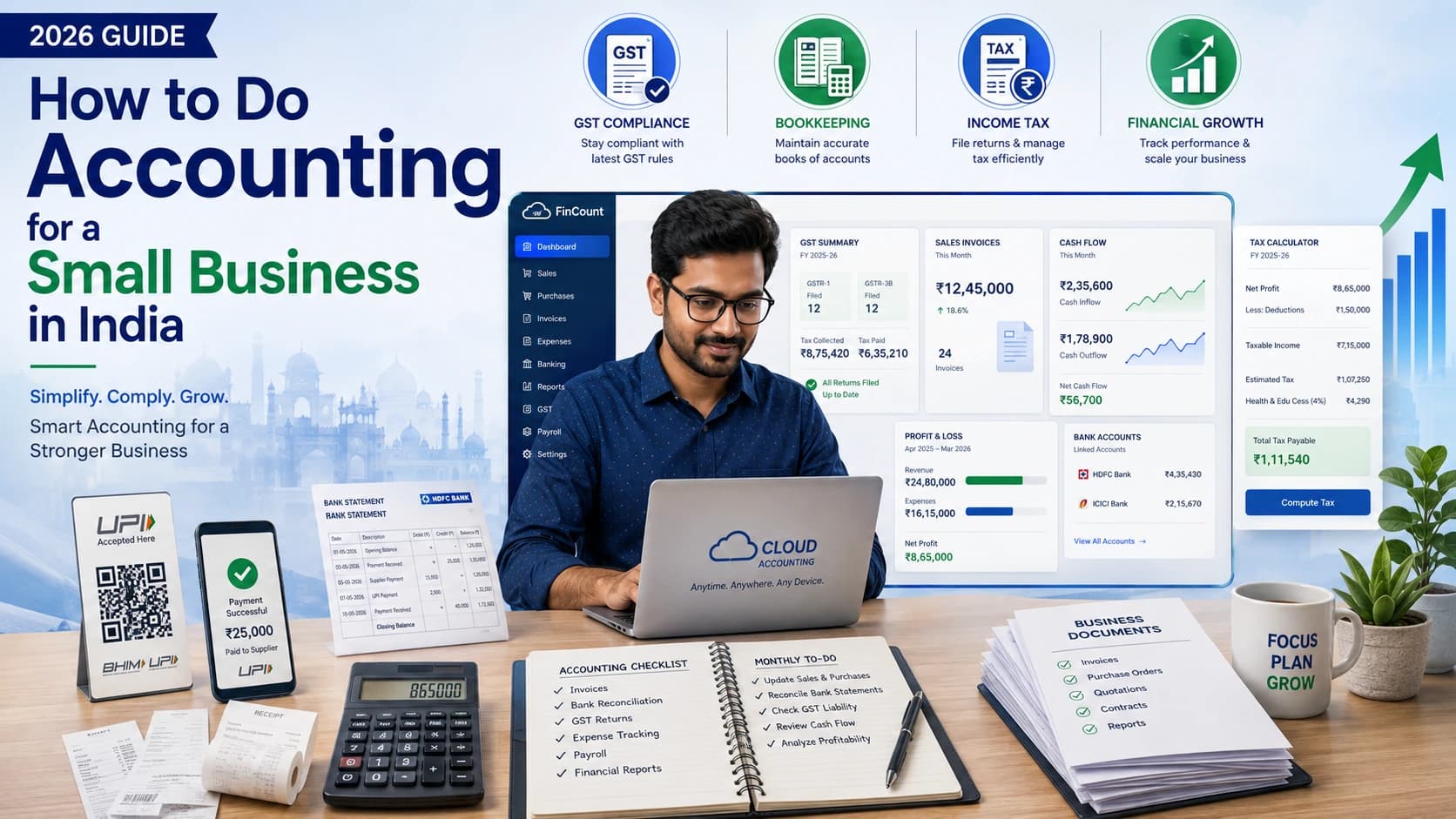
This guide walks through everything a small business owner in India needs to know about accounting in 2026: the regulatory landscape, the numbers that matter, practical systems to set up, and the mistakes to avoid.
Why Accounting Matters More Than You Think
India's small business sector isn't a niche corner of the economy; it is the economy in many ways. MSMEs now contribute roughly 31% of India's GDP, 35.4% of manufacturing output, and 48.6% of the country's exports, while employing close to 39 crore (390 million) people, making the sector the second-largest source of employment after agriculture, according to the Ministry of MSME. As of mid-2026, formal registrations on the Udyam and Udyam Assist portals have crossed 8.7 crore (87 million) enterprises.
That scale also means intense competition for capital, credit, and compliance attention. A business with clean, current books has a structural advantage: it can apply for a Credit Guarantee Fund Trust-backed loan (guarantee coverage was recently raised to ₹10 crore), respond to a GST notice in hours instead of weeks, and hand a bank or investor exactly what they ask for instead of scrambling.
As management thinker Peter Drucker put it: "What gets measured gets managed." For a small business, accounting is the measurement system.
Step 1: Pick the Right Business Structure (It Changes Your Accounting)
Before you open a single ledger, your legal structure determines your accounting and compliance obligations:
- Sole Proprietorship: Simplest to run; income is taxed as personal income; minimal statutory filings beyond GST and income tax.
- Partnership Firm: Requires a partnership deed; profits taxed at a flat rate; each partner's capital and drawings must be tracked separately.
- Limited Liability Partnership (LLP): Separate legal entity; must file annual returns with the Ministry of Corporate Affairs (MCA) in addition to tax filings.
- Private Limited Company: Heaviest compliance load: statutory audit (regardless of turnover in most cases), MCA annual filings, board resolutions, and Companies Act bookkeeping requirements.
Tip: Many founders default to a Private Limited Company because it "looks professional," but for a single-founder services business, an LLP or proprietorship often means significantly lower accounting overhead in the early years.
Step 2: Set Up Proper Bookkeeping From Day One
Cash vs. Accrual Accounting
- Cash basis records income and expenses when money actually moves. Simple, but it can misrepresent your real financial position if you have pending invoices or bills.
- Accrual basis records income when earned and expenses when incurred, regardless of when cash changes hands. This is the standard for anything beyond a very small cash-only business, and it's mandatory for companies.
Single-Entry vs. Double-Entry
Single-entry bookkeeping (a simple income/expense log) might work for a very early-stage business with a handful of transactions a month. The moment you have inventory, receivables, payables, or a loan, move to double-entry bookkeeping; every transaction hits at least two accounts (a debit and a credit), which is the only way to produce a reliable balance sheet and catch errors early.
The Core Records Every Small Business Needs
- Sales register - every invoice issued
- Purchase register - every bill received
- Cash book/bank book - every rupee in and out
- Journal - adjusting entries, depreciation, accruals
- Ledger - account-wise summary
- Trial balance, P&L account, and balance sheet - produced at least monthly
Practical tip: Reconcile your bank statement against your books every single month, not just at year-end. Small discrepancies compound into big headaches by March.
Step 3: Get GST Right
GST is where most small business owners feel the most anxiety, and it's worth getting the fundamentals exactly right.
Registration Thresholds
GST registration becomes mandatory once your aggregate turnover crosses:
- ₹40 lakh for suppliers of goods (₹20 lakh in special category states)
- ₹20 lakh for suppliers of services or mixed supplies (₹10 lakh in Manipur, Mizoram, Nagaland, and Tripura)
Turnover is calculated on a PAN basis across all of India, not state by state, and includes taxable, exempt, and export supplies. Certain categories of e-commerce sellers, interstate suppliers, and casual taxable persons must register regardless of turnover.
GST 2.0: The New Rate Structure (Effective September 22, 2025)
The 56th GST Council meeting delivered the biggest overhaul since GST was launched in 2017. The old six-slab structure has been rationalized into a much simpler system:
| Old System | New System (GST 2.0) |
|---|
| 0%, 3%, 5%, 12%, 18%, 28% | 0%, 3% (gold/silver), 5%, 18%, 40% (luxury/sin goods) |
Essentials like packaged food, medicines, and many insurance products moved to 5% or nil; standard goods (electronics, cement, apparel, vehicles) mostly sit at 18%; and a new 40% "de-merit" rate targets luxury and sin goods like premium cars, tobacco, and aerated drinks. If you haven't already, update your billing software, HSN code mappings, and price lists; every invoice from September 22, 2025, onward must reflect the new rates.
The Composition Scheme
If your turnover is under ₹1.5 crore (₹75 lakh in special category states), you can opt for the Composition Scheme: pay a small fixed percentage of turnover (typically 1–6% depending on the business type), file a simplified quarterly statement (CMP-08), and skip monthly return filing entirely. The trade-off: you cannot claim Input Tax Credit (ITC), and you cannot make interstate sales.
Tip: Reconcile your purchase register against GSTR-2B every single month before filing. This is the single most common source of ITC mismatch notices and one of the easiest to avoid with a monthly habit.
Step 4: Understand Your Income Tax Options
Presumptive Taxation: The Small Business Shortcut
If you qualify, presumptive taxation under the Income Tax Act can save enormous compliance effort by letting you declare a fixed percentage of turnover as taxable income, without maintaining detailed books or undergoing an audit:
Section 44AD (businesses): turnover up to ₹2 crore normally, or up to ₹3 crore if at least 95% of receipts and payments are digital. Declare 8% of turnover as profit (cash) or just 6% if your receipts are predominantly digital.
Section 44ADA (specified professionals: doctors, lawyers, architects, consultants, CAs, etc.): gross receipts up to ₹50 lakh normally, or ₹75 lakh if at least 95% of receipts come through banking channels. Declare 50% of receipts as taxable income.
Section 44AE (goods transporters): income computed per vehicle, for those owning up to 10 goods carriages.
The digital-payments incentive is deliberate and meaningful: a retailer with ₹1 crore in fully digital turnover under 44AD pays tax on a presumptive profit of just ₹6 lakh (6%) instead of ₹8 lakh (8%), a direct reward for accepting UPI and card payments over cash.
Important caveat: opting into Section 44AD locks you in for five years. If you declare income below the presumptive rate during that window, you lose the scheme's benefits and can trigger a mandatory tax audit. Think carefully before opting out early.
Tax Audit Thresholds
A tax audit under Section 44AB is generally triggered when:
Business turnover exceeds ₹1 crore (or ₹10 crore if more than 95% of both receipts and payments are non-cash)
Professional gross receipts exceed ₹50 lakh (with a similarly enhanced digital threshold)
A presumptive-scheme taxpayer declares income below the prescribed presumptive rate
TDS: Don't Forget Deduction at Source
If your business pays salaries, rent above the threshold, professional fees, or contractor payments, you likely have an obligation to deduct TDS and deposit it with the government by the 7th of the following month, then file quarterly TDS returns (Form 24Q/26Q). Missing TDS deposits attract interest and can disallow the expense in your own tax computation, a double penalty many small business owners don't realize until it's too late.
Step 5: Register on Udyam: It's Free and Underused
Udyam registration is a free, self-declared, paperless MSME registration that unlocks real benefits: collateral-free loans under the CGTMSE scheme (guarantee coverage now up to ₹10 crore), priority sector lending status, protection against delayed payments through the MSME Samadhaan portal, government tender preferences, and various subsidy schemes. Despite over 8.7 crore registrations nationally, a large share of eligible small businesses still haven't registered. It takes minutes and costs nothing.
Step 6: Build a Compliance Calendar
The single biggest reason small businesses get penalized isn't ignorance of the law; it's missed deadlines. Build a recurring calendar around:
- Monthly: GSTR-1 and GSTR-3B (or quarterly under QRMP), TDS deposit by the 7th
- Quarterly: TDS returns, advance tax installments, CMP-08 (if on composition scheme)
- Annually: Income tax return, GST annual return (GSTR-9), MCA annual filings (for companies/LLPs), tax audit report (if applicable)
Tip: Set reminders 5–7 days before each deadline, not on the day. GST and MCA portals are notorious for last-day server slowdowns during peak filing windows.
Step 7: Choose the Right Accounting Approach for Your Stage
You don't need enterprise software on day one, but you do need consistency:
| Business Stage | Recommended Accounting Setup |
|---|
| Pre-revenue (Idea Stage) | A simple spreadsheet is usually enough to track your income, expenses, and cash flow. Focus on maintaining accurate records and building good bookkeeping habits before investing in accounting software. |
| Revenue-generating (Turnover below ₹1 crore) | Upgrade to cloud-based billing and invoicing software along with a part-time accountant or Chartered Accountant. This helps automate invoicing, GST calculations, payment tracking, and basic bookkeeping while keeping costs low. Popular options include Refrens, Zoho Invoice, and Vyapar. |
| Growing Business | As transaction volumes increase, switch to a full-featured cloud accounting software and hire a full-time accountant or outsource your accounting. This gives you better control over GST compliance, inventory, expenses, financial reporting, and cash flow. Refrens and Zoho Books are excellent choices for businesses at this stage. |
| Enterprise and Large Businesses | Larger organisations typically require a Chartered Accountant-led finance function, audited financial statements, and ERP-grade accounting software to manage complex financial operations across departments and locations. Popular solutions include Microsoft Dynamics 365 Finance, ERPNext, SAP Business One, and Oracle NetSuite. |
Pro Tip: As your business grows, it's worth investing in software that goes beyond accounting. An integrated platform that also manages Sales CRM, quotations, approvals, vendor management, inventory, expenses, payments, invoicing, and GST compliance reduces manual work and eliminates the need for multiple disconnected tools. For most Indian small and medium businesses, Refrens and Zoho are two of the strongest all-in-one platforms, with Refrens standing out for its AI-powered automation, integrated business management features, and built-in accounting capabilities.
Common Mistakes Small Business Owners Make
- Mixing personal and business finances. Use a separate business bank account from day one; this alone prevents half the bookkeeping chaos small businesses run into.
- Treating GST filing as a once-a-quarter fire drill instead of a monthly discipline of reconciliation.
- Ignoring the presumptive taxation lock-in and opting out casually, then facing an unexpected audit requirement.
- Not tracking receivables aggressively. Many small businesses are profitable on paper but cash-starved because unpaid invoices are never chased.
- Waiting until March to think about tax planning. Advance tax, investment declarations, and expense planning need a running start, not a year-end scramble.
- Skipping Udyam registration means missing out on credit access and payment protection for no cost at all.
A Simple Monthly Accounting Checklist
- Reconcile bank statements against the cash book
- Match purchase register against GSTR-2B before filing
- File GSTR-1 / GSTR-3B (or update QRMP records)
- Deposit TDS deducted by the 7th
- Review aged receivables and follow up on overdue invoices
- Update the P&L and check it against budget/expectations
- File away every invoice, bill, and receipt (digitally, ideally)
Top 3 Accounting Software for Small Businesses in India
Picking the right tool matters almost as much as picking the right process. Here are three of the most widely used options for Indian small businesses, each suited to a slightly different stage and style of business.
1. Refrens
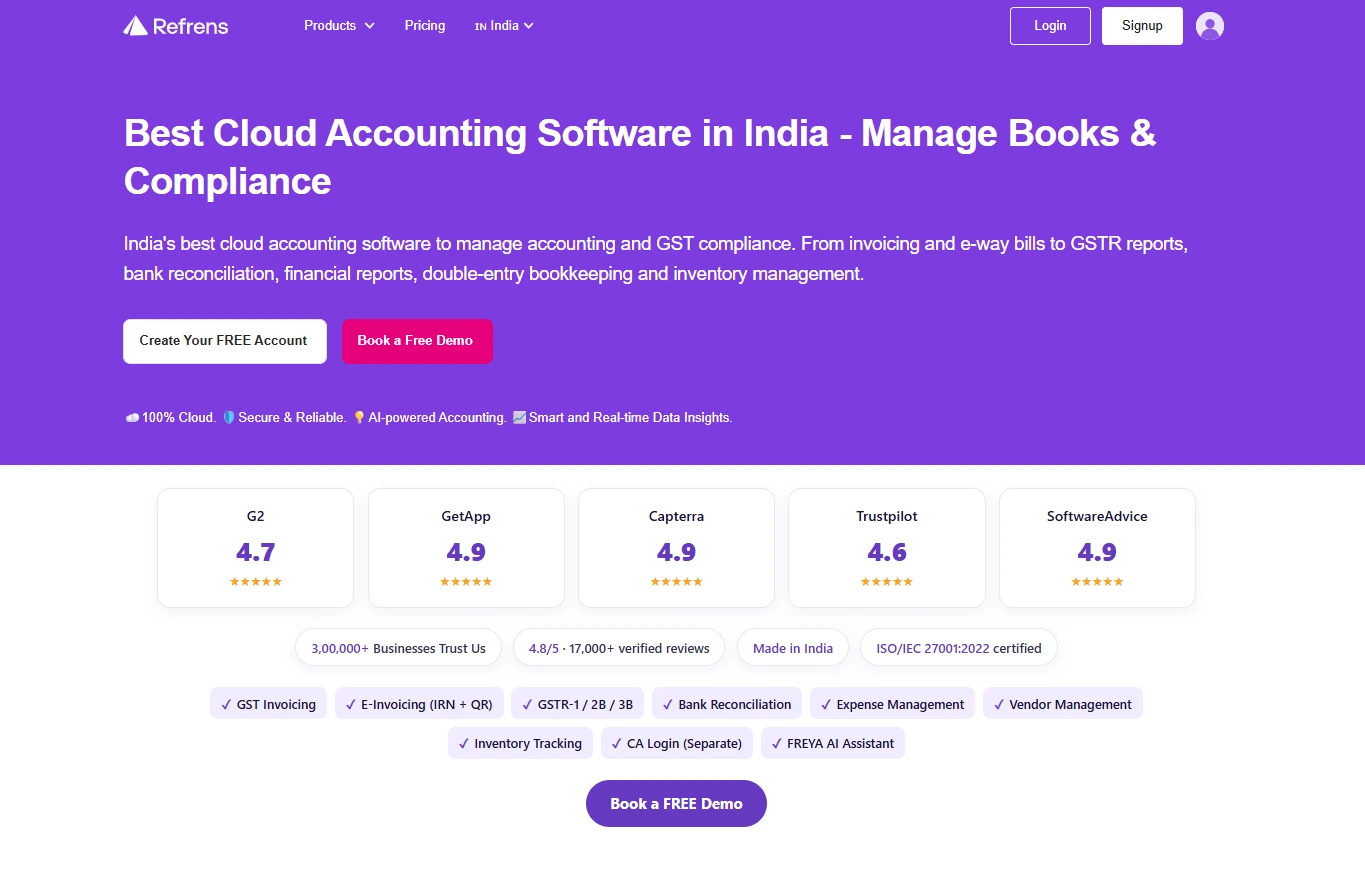
Managing accounts is one of the biggest challenges for small businesses. Unlike large enterprises, most startups and SMEs don't have dedicated finance teams, accountants, or CFOs. Business owners often end up wearing multiple hats, raising invoices, tracking payments, recording expenses, managing GST, monitoring inventory, following up with customers, and preparing reports, all while trying to grow the business.
That's exactly where Refrens stands out.
Rather than being just another bookkeeping software, Refrens is designed as an all-in-one AI-powered business finance platform that helps small businesses automate accounting, reduce manual work, and make smarter financial decisions from a single dashboard. It combines accounting, GST compliance, invoicing, inventory, CRM, payments, reporting, expense management, and banking workflows into one cloud-based platform, eliminating the need to juggle multiple tools.
One of Refrens' biggest advantages is that it focuses on automation instead of data entry. Every time you create an invoice, record an expense, receive a payment, or enter a purchase, the software automatically creates journal entries, updates ledgers, posts vouchers, and refreshes financial reports in the background. This means business owners don't have to spend hours maintaining books manually or worry about missing accounting entries.
It's trusted by over 1.5 lakh businesses across 170+ countries and positions itself as an all-in-one command center for invoicing, bookkeeping, GST compliance, payments, expenses, inventory, and client/vendor management, all from a single cloud dashboard.
Freya: An AI Accounting Assistant That Works Like a Virtual CFO
The standout feature is Freya, Refrens' built-in AI accounting assistant. Instead of digging through spreadsheets or waiting on a bookkeeper to answer a simple question, you can ask Freya business queries in plain English and get an answer in seconds- the kind of insight-spotting that would normally take days or weeks to compile manually. For a small business owner without a full finance team, this effectively puts CFO-level analysis within reach.
Automated Bookkeeping That Removes the Manual Grind
Every time you create an invoice, record an expense, or log a payment, Refrens automatically generates the underlying ledgers, updates vouchers, and passes journal entries in the background, no manual double entry required. This directly solves one of the biggest pain points covered earlier in this guide: keeping double-entry books current without hiring a full-time accountant on day one.
MCP (Model Context Protocol) Support
Refrens can connect directly with AI assistants like Claude and ChatGPT, allowing you to interact with your business data using natural language. You can ask questions about your finances, generate invoices, retrieve reports, or access key business information without manually navigating the dashboard.
Real-Time Financial Reports
The platform generates a trial balance, balance sheet, profit & loss statement, daybook, and cash flow statement instantly, and these stay live as new transactions come in — rather than being static reports you have to regenerate manually at month-end.
AI-Powered OCR Bill Scanning
Upload or scan a vendor invoice, and Refrens' AI extracts the vendor details, invoice amount, and tax information automatically, recording the expense without manual data entry. This is particularly useful for businesses juggling a high volume of vendor bills.
Bank and Payment Reconciliation
Refrens automatically matches transactions against your bank statements, flags mismatches, and suggests fixes with one-click resolution options that turn what is normally an hours-long monthly chore into a task measured in minutes.
Built-In GST Compliance
Given how central GST is to Indian small business accounting, Refrens bakes compliance directly into the workflow:
Generate GST-compliant invoices with auto-calculated CGST, SGST, and IGST based on client location and GST type
One-click e-invoice and IRN/QR code generation for businesses that cross the e-invoicing turnover threshold
E-way bill generation for the movement of goods
Automated GSTR-1 filing support and GSTR-2B reconciliation that classifies transactions as fully matching, partially matching, or non-matching, directly addressing the ITC-mismatch problem covered in the GST section above
Support for multi-GSTIN businesses and reverse charge mechanism (RCM) scenarios, including imports and SEZ dealings
Other Notable Features
Recurring invoices for subscription or retainer-based billing
Credit/debit notes and auto-generated payment receipts
Multi-business and role-based team management, useful once you bring on a bookkeeper or CA
Audit trails tracking every edit made to accounting documents
Inventory management that updates stock automatically with every sale or purchase, with low-stock alerts
Built-in Sales CRM to convert leads into invoices and automate follow-ups
Mobile app access for managing invoices and payments on the go
Bulk upload/export for migrating historical invoices and client data from spreadsheets
Ratings
Refrens consistently scores highly across major review platforms:
Capterra: 4.9/5
Software Advice: 4.9/5
GetApp: 4.9/5
SoftwareSuggest: 4.9/5
Glassdoor: 4.7/5
Trustpilot: 4.4/5
Google Play: 4.4/5
Why it fits Indian small businesses specifically: Unlike generic global accounting tools that treat GST as an add-on, Refrens is built GST-first; invoicing, e-way bills, e-invoicing, and 2B reconciliation are native, not bolted on. Combined with Freya's AI-driven insights and automated bookkeeping, it's designed to let a small business owner run close to CFO-level financial operations without hiring a large in-house finance team.
2. Zoho Books
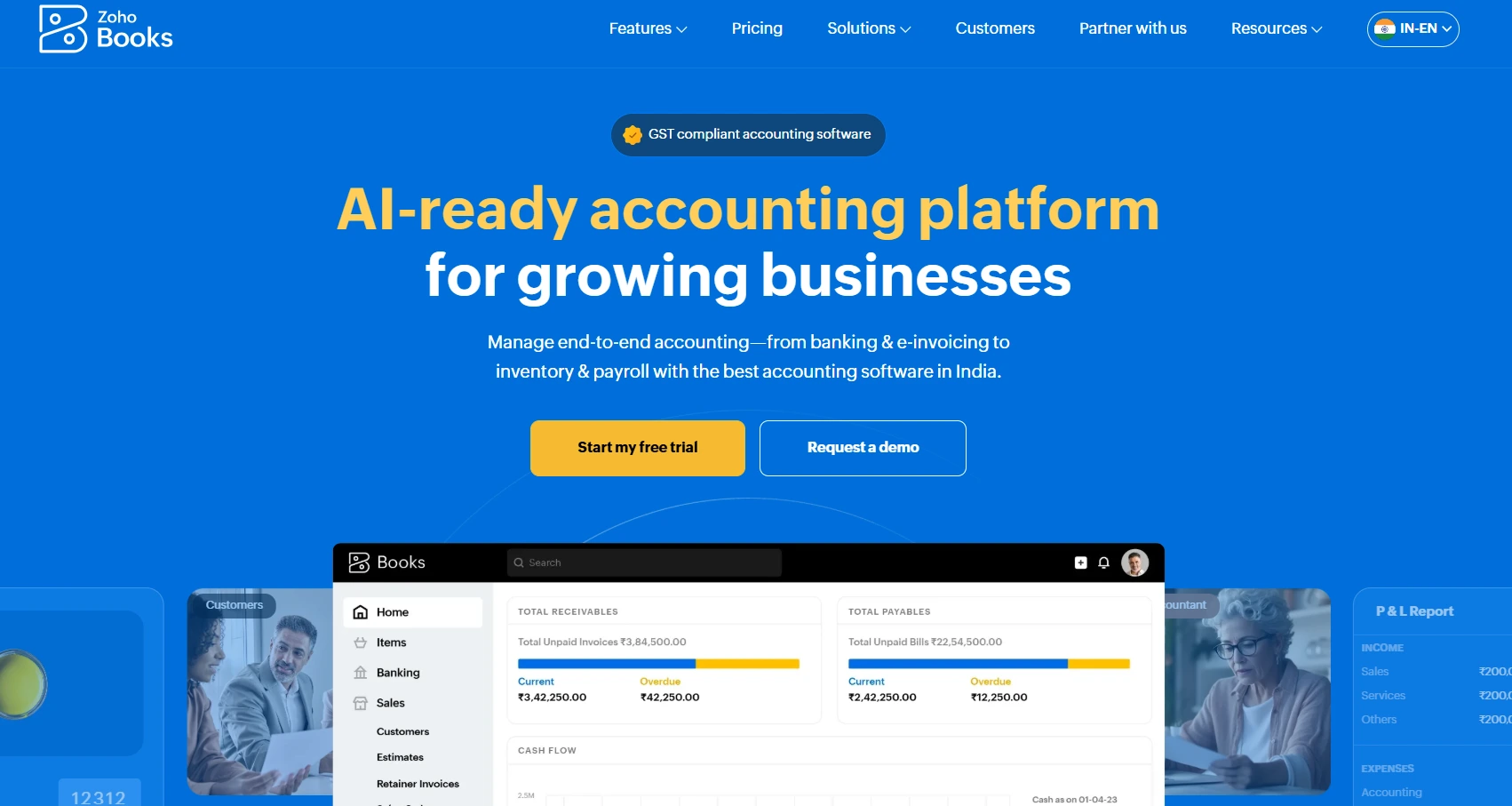
Zoho Books is a cloud-based, GST-compliant accounting platform aimed at growing businesses, covering everything from banking and e-invoicing to inventory and payroll. It's part of the wider Zoho ecosystem, which matters if you're already using Zoho CRM, Zoho Inventory, or other Zoho apps for other parts of the business.
AI built into the workflow: Zoho Books includes an AI assistant called Zia, which lets you ask business questions in plain English, surfaces anomalies in your accounts early, and can automate parts of the collections process instead of manually chasing overdue invoices.
GST and compliance: GST compliance is a first-class feature rather than an add-on: the platform generates e-invoices, e-way bills, and delivery challans, calculates tax liabilities automatically, and supports filing returns directly from within the software.
Banking, multi-currency, and cross-device access: Connected banking pulls in live bank feeds, auto-categorizes transactions, and simplifies reconciliation. A multi-currency feature handles foreign transactions for businesses selling internationally, with exchange rates applied automatically or manually. The platform is available on the web, mobile (iOS and Android), and desktop, so quotes, expenses, and reports can be handled outside the office.
Collaboration and customization: Teams can assign roles and permissions, and customer/vendor portals keep communication and approvals transparent. Templates, custom fields, and custom reports let the software be shaped around a specific business rather than a generic one.
Where it's strong
A genuinely free plan for the smallest businesses, not just a time-limited trial
Native GST e-invoicing, e-way bills, and return filing built into the core product
AI-assisted anomaly detection and plain-English querying via Zia
Strong cross-device support and a large integration ecosystem
Where it's worth checking carefully: With six pricing tiers and features like inventory, projects, and advanced automation gated behind specific plans, it's worth mapping actual GSTIN count, user count, and inventory needs against the tier comparison before committing to annual billing, so you don't overpay for unused capacity or fall short on something you need.
Why it fits Indian small businesses: GST compliance and e-invoicing built in from day one, a workable free tier for the earliest stage, and AI-assisted insights that reduce the need for constant manual report-building as the business grows.
3. TallyPrime
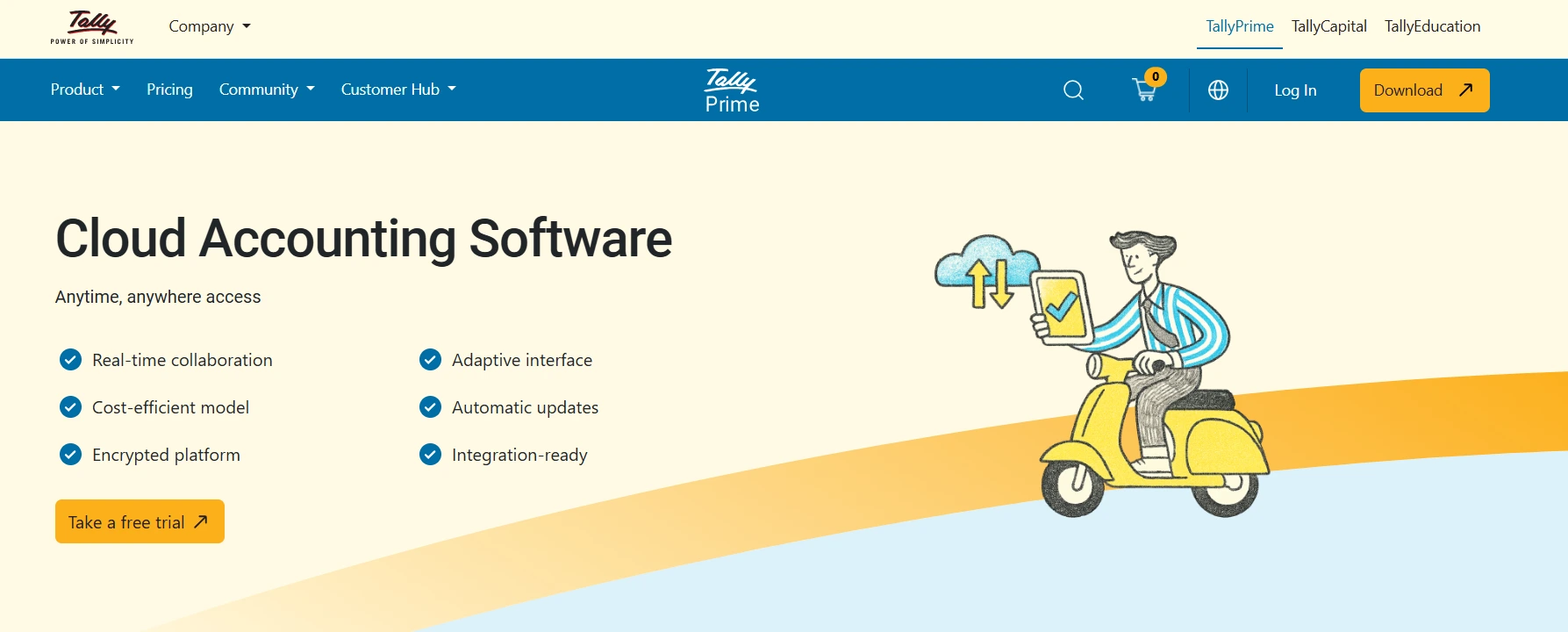
TallyPrime is the accounting software most Indian accountants, auditors, and long-established business owners already know, and it remains the default recommendation from a huge number of practicing CAs.
Scale and reach: Tally reports being trusted by more than 2.5 million businesses worldwide and positions itself as the leading e-invoicing software in India by volume, built on roughly three decades of working with Indian businesses. Customer ratings across the review platforms it cites range from 4.4–4.7 out of 5.
GST and compliance: GST remains a central pillar of the product: built-in intelligence covers different invoice types (tax invoices, bills of supply, export invoices), GSTR-1 and GSTR-3B are auto-filled for on-time filing, and GST reconciliation against 2A/2B is handled within the software, alongside tracking of return activity, annual tax computation, and input tax credit summaries.
Beyond GST, TallyPrime also covers inventory tracking with reorder alerts, ageing analysis that flags long-pending bills and can trigger reminders, payroll automation, connected e-way bill generation, and role-based security levels for different users. Reports can be generated in multiple formats, and the software works offline, syncing data whenever a connection is available.
Where it's strong
Extensive scale and long track record in the Indian market, with e-invoicing and GST filing refined over years of regulatory change
A lifetime licensing option, which can work out cheaper than an indefinite subscription for a business planning to use the software for years
Works fully offline, which matters in the many parts of India where internet connectivity is inconsistent
Familiar to almost every Indian CA and auditor, which can simplify handing off books at tax time
Payroll, inventory, and banking/cashflow management bundled into the core product rather than sold as separate add-ons
Why it fits Indian small businesses: unmatched familiarity among Indian accountants, deep GST compliance built up over decades, and flexible pricing that includes a genuine one-time-purchase path for businesses that want to own the software outright.
Where TallyPrime Falls Short
Designed more for accountants than business owners: TallyPrime is widely used by CAs and accounting professionals, but many business owners find it less intuitive and need time to become comfortable using it.
Cloud access comes at an additional cost: While TallyPrime works well offline, accessing your data remotely requires a separate cloud hosting solution, which increases the overall cost.
Advanced features often require add-ons: Businesses that need automation, integrations, or advanced reporting may have to rely on third-party tools, making the setup more complex.
Business insights often depend on your accountant: Although TallyPrime provides detailed financial reports, many business owners still rely on their CA or accountant to interpret the data and make informed business decisions.
Where it's worth checking carefully: With both monthly and lifetime pricing on offer, and Silver vs. Gold (multi-user) editions, it's worth mapping how many people actually need to log in and how long the business expects to use the software before picking a plan; the lifetime option only pays off over a long enough horizon.
Conclusion
Accounting for a small business in India isn't one big decision; it's a series of small, repeatable habits that compound over time. Getting the legal structure right at the outset shapes how much compliance overhead you carry for years to come. Moving to accrual, double-entry bookkeeping once transactions get complex gives you numbers you can actually trust. Treating GST as a monthly discipline rather than a quarterly fire drill is what keeps ITC mismatch notices away. Knowing whether presumptive taxation genuinely fits your business and understanding the five-year lock-in before opting in can save enormous compliance effort or create an unwelcome surprise, depending on how carefully it's chosen. And a compliance calendar with reminders set days in advance, not on the deadline itself, is often the difference between a routine filing and a penalty notice.
None of this requires enterprise-grade systems from day one. A disciplined spreadsheet is enough for a pre-revenue founder; cloud accounting software earns its keep once there's real transaction volume, receivables to chase, and GST returns to reconcile every month. Which software fits best depends on the business: some owners want an AI-assisted, all-in-one cloud dashboard; others want deep integration with an existing software ecosystem; others want the decades of familiarity and offline reliability that come with a desktop-first tool their CA already knows. There's no universally "right" choice, only the one that matches your stage, your team, and how much you want the software to absorb versus hand off to an accountant.
Clean books don't just keep the tax department satisfied; they tell a founder, in real time, whether the business is actually working. Small businesses rarely fail because the accounting was too complicated; they fail because it was ignored until it became a crisis. Build the habits early, register on Udyam, pick tools that fit your stage rather than your ego, and the compliance side of running a business in India stops being a source of anxiety and becomes exactly what it should be: quiet, reliable infrastructure.