Key Takeaways
- Payment gateway migration affects checkout, payment confirmation, saved credentials, recurring mandates, webhooks, refunds, settlements, reconciliation, and support workflows.
- Parallel operation can help avoid migration-induced payment downtime by keeping an existing payment path available while the replacement setup is validated under live conditions.
- Saved-card continuity depends on the applicable token architecture and the supported migration path.
- Recurring mandates need separate handling because card subscriptions, UPI AutoPay, and bank mandates follow different continuity rules.
- Historical payments remain connected to the provider that originally processed them.
- Sandbox success cannot prove live payment, settlement, or reconciliation performance.
- Rollback needs defined triggers before production traffic begins moving.
- The previous gateway should remain available until unresolved obligations close.
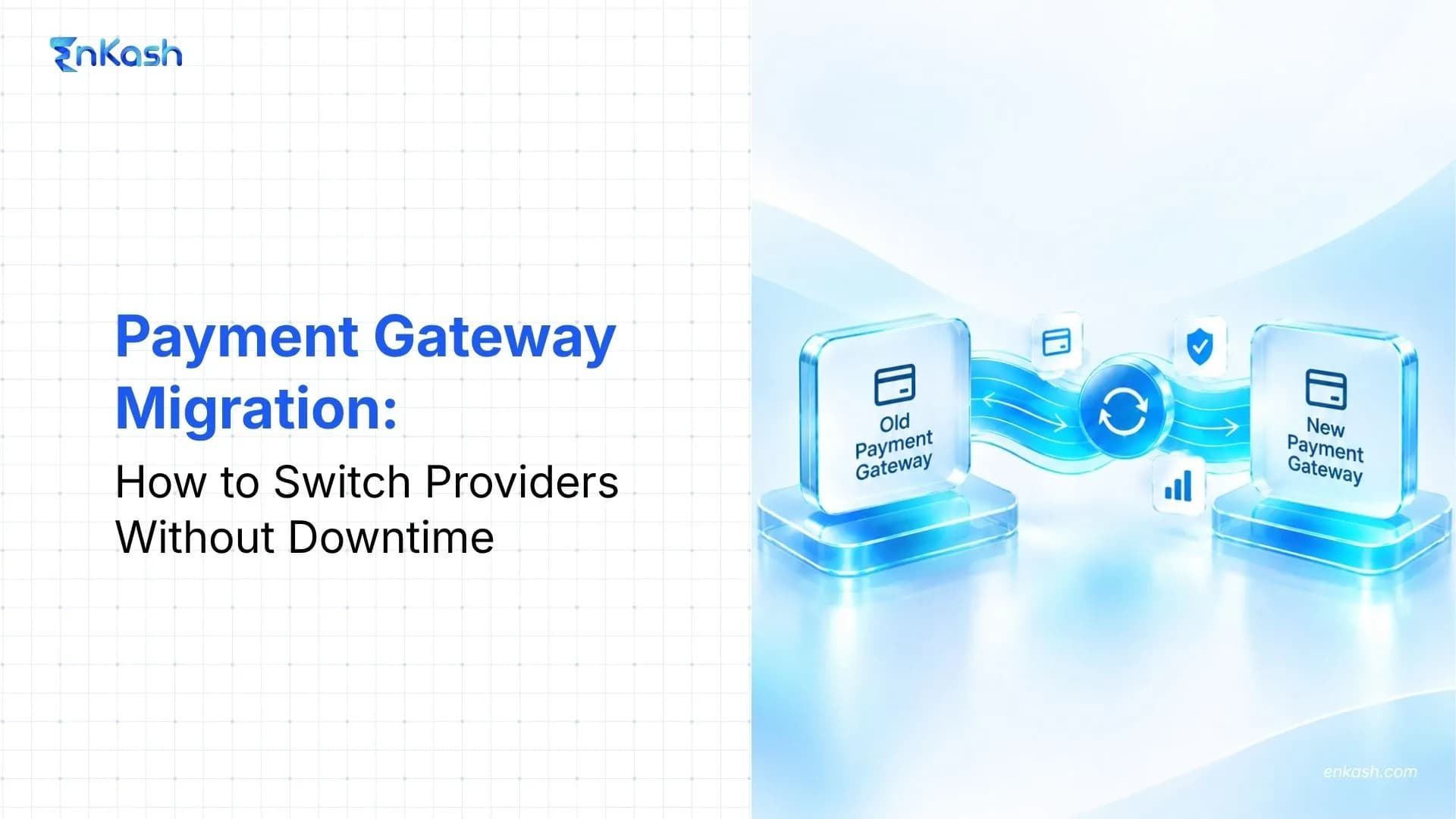
The moment a merchant sends the first live transaction through a new gateway, two payment histories can begin running side by side. New payments start building on the replacement environment while refunds, recurring collections, disputes, and settlement records may remain with the earlier one. Payment gateway migration has to keep both histories accurate until every unfinished obligation has a clear owner. Indian merchants face the added complexity of UPI, cards, net banking, tokenized credentials, and recurring mandates, which makes continuity far more important than a simple checkout cutover. The discussion ahead moves through dependency mapping, technical remapping, credential and mandate continuity, live traffic movement, rollback, reconciliation, final cutover, and retirement of the old gateway.
What Does Payment Gateway Migration Without Downtime Mean
The simplest way to define migration without downtime is through availability. Customers should continue to have a working payment path while the merchant moves future processing into the new environment.
During a payment gateway migration, that continuity can come from parallel operation, controlled traffic movement, and delayed shutdown of the previous setup. The phrase does not mean every payment will succeed during the transition. It means the migration plan avoids creating its own period of payment unavailability while the replacement system is introduced and validated.
What Must Be Audited Before Switching Payment Gateways
Migration planning starts with the current payment estate. Missing a dependency here can create failures after checkout appears healthy. The audit should cover every place where payment data enters, moves, or remains open.
Payment Entry Points
Map website checkout, mobile applications, payment links, e-commerce integrations, and other customer payment surfaces.
List UPI, cards, net banking, wallets where used, recurring rails, and every enabled payment method.
Backend Dependencies
Document order creation, status APIs, callbacks, webhooks, refund APIs, retries, and payment-state logic.
Business-System Dependencies
Include accounting, customer support, fraud systems, reporting, data warehouses, and notification services.
Open Legacy Obligations
Record pending payments, unsettled transactions, refunds, disputes, active mandates, saved-card relationships, and historical reporting needs.
What Must the New Payment Provider Support Before Migration Begins
The replacement environment should be checked against the merchant’s actual operating model before engineering work expands. Feature lists matter less than coverage of existing payment journeys. The following four areas need confirmation before implementation moves further.
Payment and Integration Coverage
Confirm not only headline support for UPI, cards, and net banking, but also the specific payment variants the business depends on, such as supported card networks, recurring flows, tokenised cards, refund behaviour, and other enabled payment features.
Credential and Mandate Continuity
Confirm the available path for saved cards, UPI AutoPay, bank mandates, and provider-managed subscription objects.
Finance and Reporting Coverage
Settlement reports, transaction exports, refund records, fee fields, tax fields, and reconciliation data should remain usable.
Regulatory and Security Readiness
Confirm that the payment service provider meets the regulatory, authorisation, security, and data-handling requirements applicable to the services it performs. In India, this includes verifying RBI authorisation where the provider operates as a regulated Payment Aggregator, along with applicable payment-system, tokenisation and security requirements.
What Can and Cannot Be Migrated Between Payment Gateways?
| Asset | Typical migration treatment |
|---|
| Merchant order IDs | Keep stable in merchant systems |
| Provider transaction IDs | Remain tied to original provider |
| Saved card credentials | Depends on token architecture and supported portability |
| UPI AutoPay mandates | Eligible mandates may support prescribed portability paths |
| Bank mandates | Depends on rail/provider/bank migration support |
| Provider subscription objects | Often recreated or remapped |
| Historical payment records | Retain for operations, audit and reconciliation |
| Open refunds/disputes | Usually continue against the originating transaction/provider |
| Settlement history | Retain and reconcile separately |
Big Bang vs Parallel vs Hybrid Migration
A merchant can move through one cutover, run both environments together, or divide migration by payment flow. Complexity and business exposure should guide the choice.
| Migration Model | How It Works | Main Consideration |
|---|
| Big bang | Old processing stops at a defined cutover | Concentrated cutover risk |
| Parallel | Both environments remain active during traffic movement | Supports live validation and traffic rollback |
| Hybrid | Selected flows move at different times | Useful when dependencies cannot move together |
A merchant may move one-time payments before existing recurring customers. Selected payment methods can also move ahead of others.
What Needs to Change in the Technical Integration
A payment gateway migration changes the boundaries between the merchant application and the payment provider. A resilient migration isolates provider-specific differences behind the payment integration layer rather than spreading them across order, checkout, and finance systems.
API and Authentication Layer
New credentials are only the first change. Authentication logic, API endpoints, request formatting, response parsing, and idempotency handling all need fresh implementation.
Payment and Order Identifiers
Merchant order references should remain consistent before and after the switch. Provider payment IDs should be stored independently so every attempt can be traced back correctly.
Payment Status and Error Taxonomy
Different gateways describe the same outcome in different ways. Build one internal taxonomy and map provider statuses into it across customer failures, issuer declines, technical errors, timeouts, and unresolved cases.
Webhooks and Callbacks
The event contract also changes. Signature methods, event types, payload fields, webhook IDs, retry logic, and callback behavior need to be understood again from the new provider’s documentation.
How Should Saved Card Credentials Be Handled During Migration
Saved cards need a separate workstream because payment credentials cannot be treated like ordinary database fields. India’s card-token framework makes continuity dependent on the token architecture involved.
The merchant should identify the current token arrangement, confirm the supported transfer or retokenization path, and determine whether customer card re-entry may be required. Merchants should never bypass the applicable tokenisation framework by transferring or storing prohibited card credentials such as full card-on-file data or CVV/security codes. A supported migration path must follow the applicable token and security framework.
How Should Recurring Mandates and Subscriptions Be Migrated
Recurring collections need their own continuity plan because each rail carries different rules, identifiers, and operational dependencies.
UPI AutoPay Mandates
NPCI's enhanced UPI AutoPay framework supports portability of eligible mandates across participating Payee PSPs, subject to the prescribed merchant identifier, mandate parameters, and implementation requirements. Merchants should confirm that their existing mandates and new provider support the required portability flow before relying on continuity at migration.
Bank Mandates
Bank-mandate continuity depends on the mandate rail, existing registration, sponsor or banking relationships, and whether the incoming provider supports an approved continuation or migration process. Existing mandates should not be assumed to be portable simply because their reference data is available.
Subscription Objects
Subscription IDs, billing dates, customer references, and mandate links may need recreation or internal remapping.
Legacy Recurring Customers
Customers whose recurring setup cannot move safely should remain on the previous environment until a valid continuity path is ready.
What Must Be Tested Before Live Traffic Moves
Pre-production testing should cover the complete payment lifecycle. A successful test payment cannot prove refund, webhook, mandate, settlement, or reconciliation behavior.
A focused payment gateway migration checklist should include these cases.
- UPI, card, and net-banking success and failure should map correctly.
- Pending payments should resolve into valid final states.
- Timeouts and interrupted API responses should not create duplicate payment attempts while the original transaction remains unresolved.
- Customer retries should create separate payment attempts.
- Status APIs should return enough information to resolve the merchant's current internal payment state.
- Valid, delayed, and duplicate webhooks should process safely.
- Full refunds and partial refunds, where supported, should be mapped to and processed against the correct original transaction.
- Recurring debits should continue through the intended mandate path.
- Settlement reports and reconciliation exports should match internal records.
- Support teams should trace payments across the complete lifecycle.
How Should Live Traffic Be Shifted to the New Gateway
Live migration should start with a controlled production cohort while both environments remain available. Traffic share can then be increased as the new environment meets agreed performance and operational thresholds.
Traffic should move in stages. Compare payment success, technical errors, latency, payment-method coverage, and webhook reliability against the existing baseline. Hold the current share until results stabilize, then expand carefully. There is no universal percentage schedule. Transaction volume, payment mix, risk tolerance, operational complexity, and statistical usefulness should determine the ramp.
How Do You Keep Payment State Correct While Two Gateways Are Live
Parallel operation can create several legitimate payment attempts against one merchant order. Internal payment identity must remain stable across both environments.
Keep one merchant order ID, while every attempt retains its provider, provider transaction ID, amount, status, and timestamps. Delayed results from one environment may arrive after another attempt has started elsewhere. Merchant-owned payment logic should resolve those events without duplicate fulfillment. Provider events should update one stable internal payment model while preserving the history of each attempt.
Which Gateway Handles Refunds and Disputes After Traffic Moves
Post-payment actions should remain linked to the environment and transaction reference that originally processed the payment unless a supported migration mechanism explicitly changes that relationship. Moving future checkout traffic does not relocate earlier payment obligations.
Refunds against older payments may need to continue through the original processing environment. Disputes and chargebacks can also surface after checkout traffic moves. Support teams should retain access to provider references, payment history, evidence, and operational records so each post-payment action reaches the correct transaction.
How Should Settlement and Reconciliation Work During Migration
Two active gateways can create parallel finance records and settlement streams. Settlement and reconciliation need separate checks during that period.
Settlement Validation
Track settlement ID, amount, date, fees, taxes where reported, adjustments, and destination account for each environment. Finance should verify that expected net settlement amounts were credited to the correct destination account and reconcile any deductions or adjustments.
Transaction Reconciliation
Match merchant orders to payment attempts, provider transactions, refunds, adjustments, and settlement records.
Exception Reconciliation
Create a controlled queue for missing refunds, unmatched settlements, duplicate records, unexplained adjustments, and provider-successful payments that remain unresolved internally.
What Should the Payment Gateway Rollback Plan Include
Rollback should exist before payment gateway migration traffic starts moving. It returns future traffic to the earlier processing path while preserving payments created elsewhere.
Rollback Triggers
Define thresholds for payment-success deterioration, severe latency, integration failures, webhook failures, reconciliation mismatches, and material customer impact.
Rollback Mechanism
Specify who can activate the change, how traffic moves back, which controls are used, and how teams receive the update.
Rollback Boundary
Payments created through the new environment retain their original payment history for status, refunds, settlements, and disputes.
What Must Pass Before Full Traffic Moves
A migration becomes risky when checkout gets all the testing, and everything after payment is assumed to work. Full traffic should wait until the new gateway has proved the less visible parts of the operation as well.
- Each payment method required for launch has been validated through the strongest available production or provider-supported test path, with live production validation completed where feasible.
- Cross-environment payment states have been checked for conflicts and missing updates.
- The business knows exactly how existing saved-card customers will continue.
- Recurring mandates have either been preserved, migrated, or given another approved continuity path.
- Older refunds and disputes can still be handled without losing access to the original transaction.
- At least one representative production settlement has been received and reconciled by finance.
- Reconciliation exceptions are understood and remain below the agreed cutover limit.
- Production webhook delivery, verification, and processing have remained within agreed error and latency thresholds under representative traffic.
- Support and finance have used the new tools for the cases they will handle after migration.
- The team can move traffic back if a serious cutover issue appears.
When Can the Old Payment Gateway Be Safely Retired
Moving all new traffic does not complete payment gateway migration. The old environment may retain unresolved payments, refunds, disputes, recurring collections, settlement exceptions, and historical records.
Retirement should follow obligation closure. Required historical transaction, settlement, refund, dispute, reconciliation, and audit data should remain accessible. Obsolete credentials, webhook endpoints, secrets, and routing dependencies should be removed only after operational use ends. A business preparing to change payment gateway provider should use obligation closure as its retirement trigger instead of an arbitrary number of days.
The Final Measure of a Successful Payment Gateway Migration
A safe payment gateway migration is a controlled transfer of payment operations, not a credential replacement exercise. Checkout, tokens, mandates, webhooks, refunds, transaction state, settlement, reconciliation, and historical support all need continuity. Parallel operation creates room for live validation and controlled reversal while unfinished obligations remain visible. Businesses that migrate payment gateway infrastructure in stages can move future traffic without losing ownership of earlier transactions, then retire the previous setup after its remaining work has genuinely ended.
FAQs
Can Two Payment Gateways Run at the Same Time During Migration?
Yes. Parallel operation lets both gateways remain available while controlled live traffic moves to the replacement environment. It also gives teams space to compare transaction performance and reverse future traffic when required.
Do Customers Need to Enter Their Card Details Again After Gateway Migration?
Some customers may need to, and some may not. If saved credentials can move through a supported token migration, the payment experience can continue. If they cannot, the customer will need to provide the card again or complete fresh tokenization.
What Happens to Refunds After a Payment Gateway Is Changed?
Refunds continue to follow the payment that created them. An older transaction processed by the previous gateway should still be refunded through that environment, which is why its reference data cannot disappear at cutover.
How Long Should the Old Payment Gateway Remain Active After Cutover?
The old gateway should remain available until unresolved payments, refunds, disputes, recurring collections, settlement exceptions, reporting needs, and contractual obligations have been closed or moved through a supported process.
Can Payment Gateway Migration Be Completed Without Downtime?
A migration can avoid planned payment-acceptance downtime when the old and new environments operate in parallel during validation. This approach cannot guarantee that every transaction succeeds during the migration period.