The way we do business has changed a lot since the demonetization and the lockdown due to the pandemic. While the process of digital transactions has become more accessible, easier, and secure than ever, there are some areas that many of us may not be aware of even now. In this blog, we will look at what chargebacks mean and why it is critical for all businesses to be aware of them, especially for startups and smaller companies. It is essential to learn about chargebacks, how to claim them (for customers), how to prevent them (for merchants), and other details.
What is Charge back?
A chargeback is the return of money to a customer, usually involving an online transaction using a debit or credit card. In most cases, it is a dispute that the customer raises with the bank that has issued the card, which, in turn, requests the merchant to reverse the payment.
Examples of chargeback
Example 1: The goods that the customer has received are damaged and the customer takes this up as a reason for a chargeback. Example 2: Customer made the payment but it is not reflecting and does it again to ensure the transaction is complete. However, both payments go through and the customer ends up paying twice. This is another instance of a chargeback being raised. Chargebacks vs refunds and how they are different. Often chargebacks are confused with refunds. But the fundamental difference between chargebacks and refunds is that refunds are claimed from the merchant and chargebacks are claimed from the bank. In some instances, if the merchant or seller rejects the refund request, the customer may appeal to the bank to facilitate a chargeback. Usually, the process of chargeback takes longer than the refund.
Types of Charge backs
There are multiple types of charge backs.
Merchant Error Chargebacks
Merchant error chargebacks are when the mistake is from the business’s end during the transaction process which gives the cardholder the opportunity to dispute the charge. These mistakes could be anything from human errors to technical challenges. If the business is responsible for the error, the cardholder can initiate a chargeback to rectify the situation.
Chargeback Fraud
This is a relatively serious fraud because in this case the cardholder's account is compromised, and a third party uses the card to undertake unauthorised transactions without the cardholder's consent. In chargeback fraud, the cardholder is not liable for the fraudulent charges. In fact, they can initiate a chargeback to reclaim their funds.
Friendly Fraud
First party fraud or friendly fraud happens when a cardholder initiates a chargeback for a real transaction. This chargeback could be intentional or due to a misunderstanding or dispute. Friendly fraud means the cardholder initiates the chargeback often without a valid reason.
What are the possible reasons for chargebacks?
Poor quality or damaged product: A customer may often request a chargeback when the product quality is not as described at the time of purchase. Or if the product is different in terms of specifications from when the purchase was made. Product shipping issues: When the product is lost or damaged during the shipping process or delayed beyond a reasonable time, then the customer may request a chargeback. Delayed refund: The customer is not happy with the purchase and has requested a refund, which the merchant has either not responded to or refused, then the customer may request a chargeback. Unauthorised card transaction: The customer may raise a chargeback when there is unauthorized or improper use of the credit card or debit card. Technical issues: In some instances, there could be cases of incorrect or duplicate billing, for which the customer has paid more than the billing amount. In such instances, the customer may raise a chargeback request.
How do chargebacks affect the seller or merchant?
If a merchant or seller has too many instances of chargebacks, it is going not only to affect the merchant in terms of cash flow but also affect their reputation. What is more, there are penalties that are associated with the chargeback that will be applied, causing further damage.
Best practices for merchants to avoid high volume of chargebacks
The key to avoiding too many chargeback requests is to establish a solid infrastructure in terms of payment and ensure that all the goods and services delivered are of good quality.
The other best practices include:
Detailed information: Merchants or sellers need to provide detailed information about the order paid for, to the customer. This way any confusion about the quality, quantity, specifications, and pricing can be avoided. Order confirmation: The merchant can also ask customers for an explicit confirmation of the order before starting the packing and dispatching processes. This way, any changes the customer wants can be made before dispatch. Regular updates: In an online world where convenience is the key motivation, often mistrust also lurks behind the minds of customers. One of the easiest ways to mitigate this is by updating customers on a regular basis. Explicit information given upfront can help avoid chargebacks. Take measures: Merchants also need to ensure that they keep a lookout for red flags like a repetitive pattern from customers or many cards being used for orders to be delivered to the same address, and so on. Chargebacks are a part of online transactions and have been enabled to protect the interest of customers, but there’s a chance it can be misused. Information updates, ethical business practices, and robust technology can help optimize the occurrence of too many chargebacks and minimize the associated costs.
How does chargeback work?
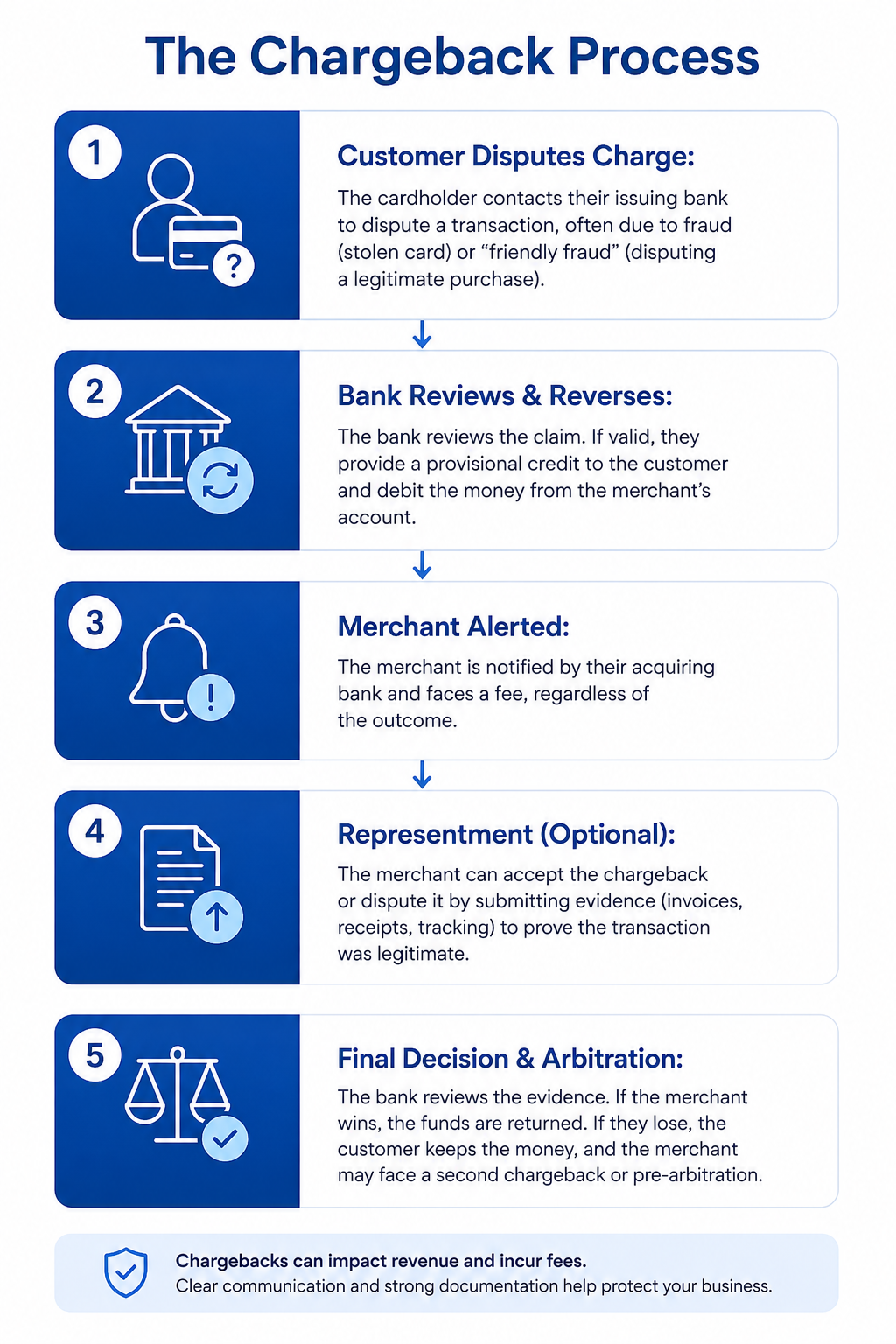
How to reduce chargebacks?
Billing Transparency: Businesses must use a clear, recognizable name and contact number in the transaction descriptor to prevent customers from forgetting the purchase and filing a claim as "fraud". Enhance Communication: It is advisable to send automated email confirmations for product orders, shipping, and cancellations to customers. Security Protocols: Use security measures to protect online transactions.
- 3D Secure/2FA: Use 3D Secure to add a second layer of authentication.
- Address Verification System (AVS) & CVV: Check these for every transaction.
- Fraud Detection Tools: Use tools to raise alert, detect and block suspicious transactions.
Customer Support: Always offer accessible, and fast customer service to resolve disputes directly. Product Information: Ensure to post detailed product descriptions and images for customers to know exactly what they are buying. Define Policies: It is important to post clear refund, return, and cancellation policies on the website. Keep Records: Store all important transaction data, including IP address, delivery proof, and client communication to challenge fraudulent claims, if any.
How to raise chargebacks?
Contact the Merchant: Resolve the issue directly with the merchant, as it will be faster and needed before a formal bank dispute. Contact Your Bank: If the merchant is of no help, reach out to your credit/debit card issuing bank's customer service to report the fraudulent or incorrect transaction. Find Dispute Form: Fill the bank’s formal chargeback or dispute form, mentioning the transaction date, amount, and reason. Provide Proof: Ensure supporting documents like screenshots of conversations, emails, invoice copies, or cancellation confirmation are attached. Maintain Patience: The bank will investigate the issue which may take up to 90 days. Keep your patience intact for resolution.
How to dispute chargebacks?
Proof Collection: Collect all important documentation like delivery proof, signed receipts, transaction logs, and customer emails. Letter Submission: Submit a rebuttal letter with proof to your acquiring bank, which then passes it to the customer’s issuing bank for a final decision. Follow Time Limits: Ensure to respond within the specific time limit as mentioned in the chargeback notification. Connect With Customer: Directly reaching out to the customer can resolve the issue, allowing them to contact their bank to reverse the chargeback. Be Mindful: If the chargeback is due to a genuine fraud, better to accept it.
Conclusion
Chargebacks exist to protect customers but they can cause huge damage to businesses as they are time consuming and costly. Moreover, revenue losses and reputational risks can seriously damage the business in the long run. Businesses can minimise chargebacks by keeping their communication transparent, using secure payment processors, maintaining strong customer support and relationships, and using advanced technology to prevent fraud.
FAQs
What is a chargeback? A chargeback is when a customer disputes a transaction with their issuing bank and gets the amount reversed. The customer directly goes to the bank instead of reaching out to the business for a refund. How is a chargeback different from a refund? Refund is initiated by the business and chargeback is initiated by the customer through the bank. Chargebacks have penalties, fees, and reputational impact, which is not the case with refunds. Why do chargebacks happen? Common reasons for chargebacks include:
- Fraudulent transactions
- Product/service not received
- Item not as described
- Duplicate or incorrect charge
- Customer doesn’t recognise the transaction
What is the chargeback process?
- Customer raises a dispute with their issuing bank
- Bank temporarily reverses the transaction
- Merchant is notified and asked to respond
- Merchant submits evidence
- Bank reviews and decides the outcome
What is a chargeback fee? A chargeback fee is charged to the merchant when a chargeback is raised regardless of whether the dispute is won or lost. Can a business fight a chargeback? Yes, a business can fight a chargeback through a process called representment. Merchants need to submit proof like:
- Transaction records
- Delivery confirmation
- Customer communication
- Terms & conditions acceptance
What is a chargeback ratio? Chargeback ratio is the percentage of transactions that turn into chargebacks. High chargeback ratios can:
- Trigger penalties
- Lead to monitoring
- Can result in account suspension by payment processors
How long does a chargeback take? It typically takes 30 to 90 days but it can take longer depending on the bank and complexity. What is friendly fraud? When a legitimate customer raises a chargeback either by mistake or intentionally to avoid paying. How can businesses reduce chargebacks?
- Clear billing descriptors
- Strong fraud detection systems
- Easy refund policies
- Proactive customer support
- Timely delivery and communication
- Transaction alerts & confirmations
What is the reason code in chargebacks? A code assigned by the bank explaining why the chargeback was raised is the reason code. Can digital payment businesses prevent chargebacks completely? No, but they can reduce and manage them with better systems, visibility, and processes. What’s the biggest mistake businesses make with chargebacks? Ignoring them or responding late to chargebacks can lead to major issues later. Timely action and proper documentation also make a huge difference in outcomes.