Key Takeaways
- Payment gateway webhooks carry payment-event updates directly from the gateway to the merchant server.
- A redirect, callback, webhook, and status API should not be treated as four names for the same step. Each has a separate role.
- A failed payment is different from a failed webhook delivery, and both are different again from an event that reached the merchant but failed during merchant-side processing.
- Successful, failed, pending, abandoned, and delayed payment outcomes should not all follow the same state logic.
- Every incoming event needs to be checked before it is allowed to change an order or financial record.
- A retry may describe another webhook delivery, another customer payment attempt, or another API request from the merchant.
- Gaps in payment information should be resolved through direct status checks and reconciliation before records are corrected.
- Once the integration is live, teams also need monitoring, clear ownership, and tested procedures for failure and exception scenarios.
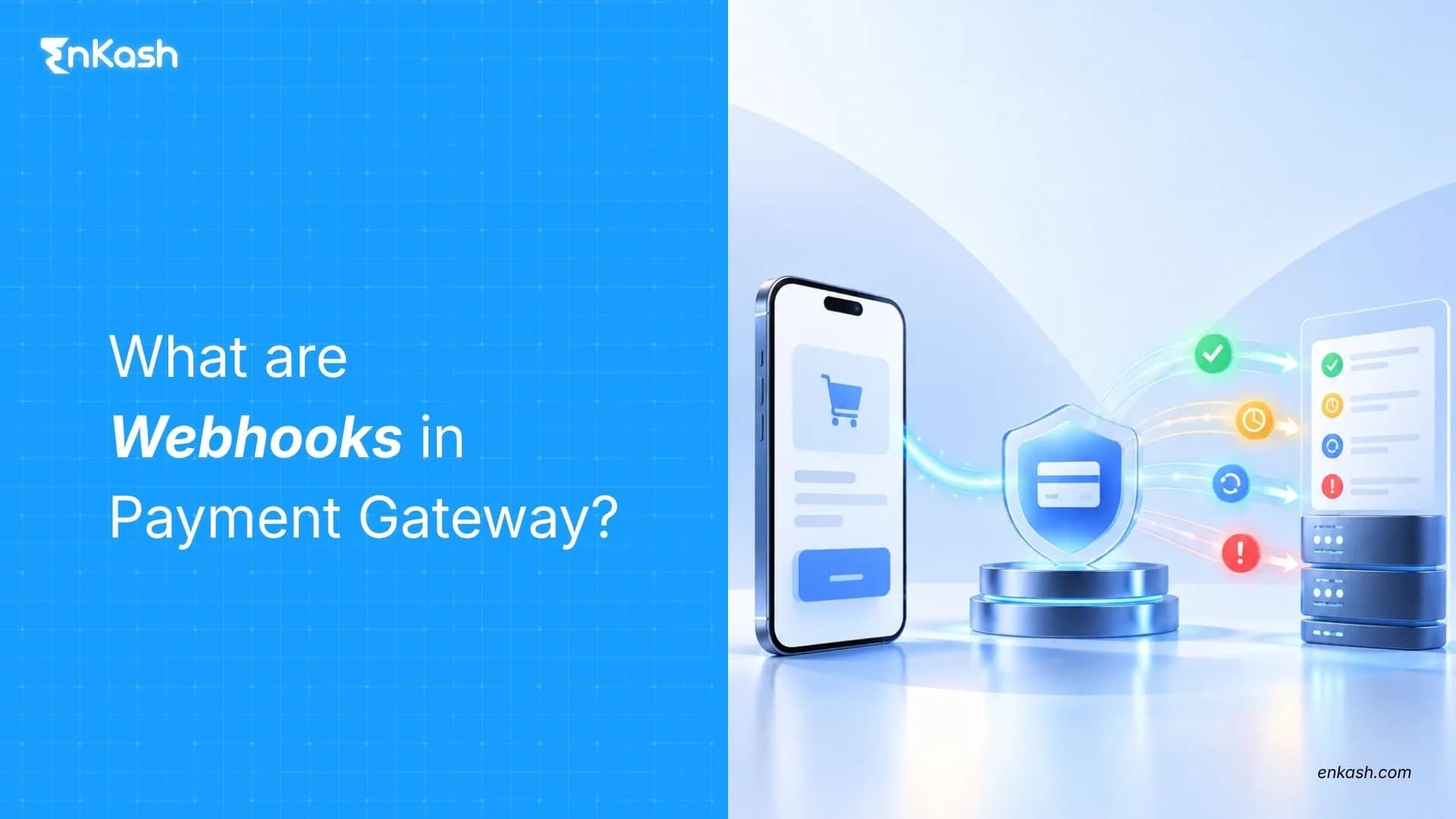
Payment gateway webhooks are server-to-server notifications that tell a merchant's backend when events such as payment success, failure, refund updates or other supported payment-state changes occur. Unlike browser redirects, they do not depend on the customer returning to the merchant website after payment. The browser can close, connectivity can disappear, or the return flow can stop midway. Payment processing may continue after that session ends. Payment gateway webhooks give the backend an asynchronous path to receive the outcome without depending on the shopper's browser. This blog follows that path from event receipt to verification, retries, recovery, monitoring, and production testing.
What is a Payment Gateway Webhook
| A payment gateway webhook is an HTTP notification sent from a payment system to a merchant-controlled backend endpoint after a subscribed event occurs. Its payload may include an event ID, payment reference, order reference, state, timestamp, and other defined fields. The webhook reports an event without becoming part of the underlying financial transaction. |
Get Payment Webhooks (CTA)
Payment Gateway Webhook at Glance
| Question | Answer |
|---|
| What is a payment webhook? | A server-to-server notification triggered by a payment-related event |
| Who sends it? | The payment gateway or payment provider |
| Where does it go? | A merchant-configured backend endpoint |
| What can trigger it? | Payment success, failure, refund, dispute, subscription or other supported events |
| Does a webhook process the payment? | No. It reports an event related to the payment |
| Can a webhook be delivered more than once? | Yes. Integrations should safely handle duplicate delivery |
| Can events arrive out of order? | Yes, depending on provider and delivery conditions |
| What if the webhook is missing? | Verify payment state through the provider's status API and reconciliation process |
| Should the request be verified? | Yes, using the gateway's documented verification method |
How Does a Payment Gateway Webhook Work?
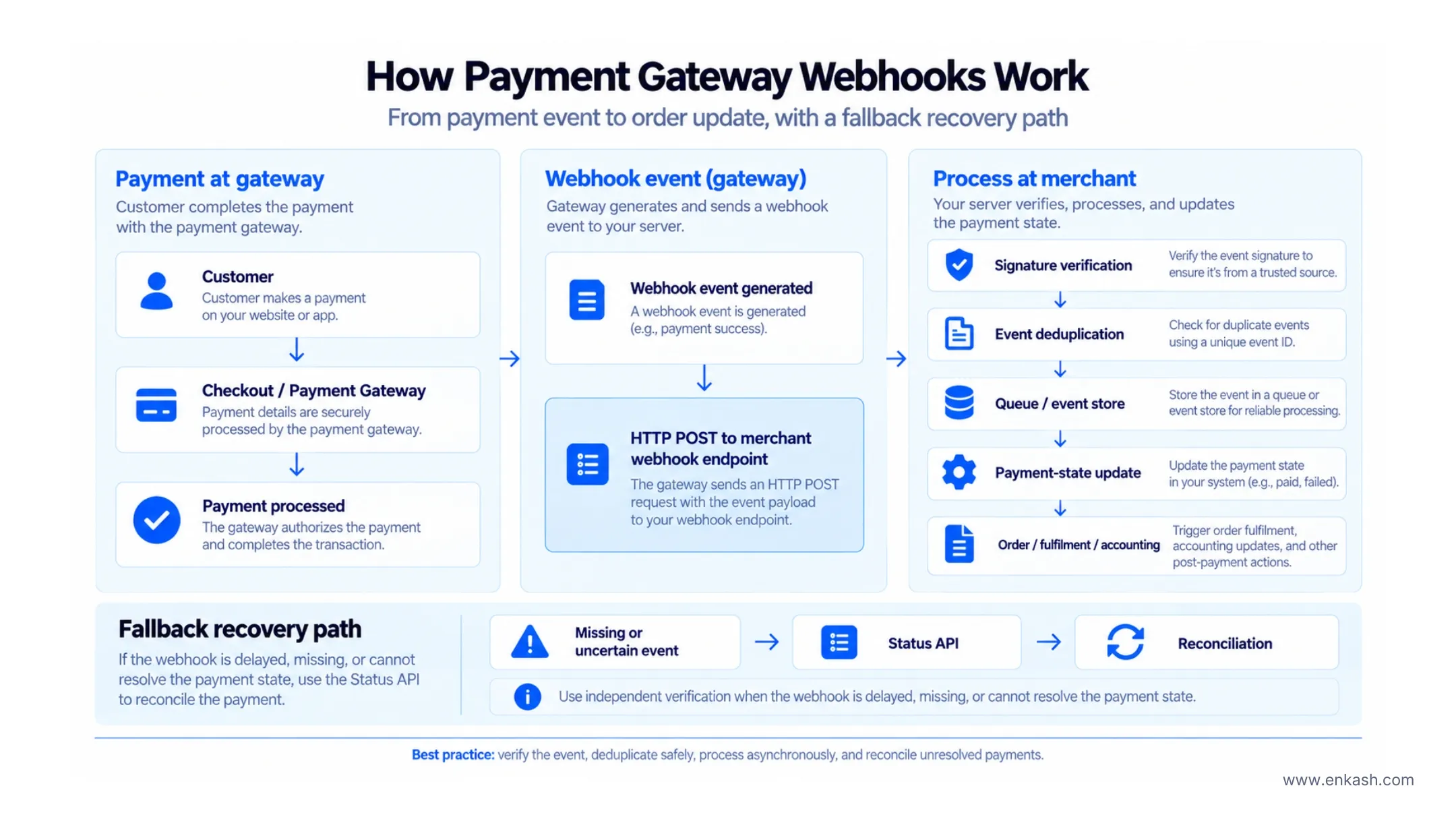
A payment gateway webhook works by sending a server-to-server notification from the payment gateway to a merchant's backend when a subscribed payment event occurs.
A typical payment webhook flow follows these steps:
- A payment event occurs. A payment may succeed, fail, remain pending, be refunded, or move into another supported state.
- The payment gateway creates an event. The event contains information such as the payment ID, order reference, event type, payment status, amount, currency and timestamp, depending on the gateway.
- The gateway sends the webhook. The event is sent as an HTTP request to the webhook endpoint registered by the merchant.
- The merchant verifies the request. The backend validates the webhook using the authentication or signature-verification method specified by the payment gateway.
- The event is matched with the merchant's records. Payment and order identifiers, amount, currency and other relevant fields are checked against the merchant's internal data.
- The merchant acknowledges the webhook. The endpoint returns the success response required by the gateway once the event has been safely accepted.
- The backend processes the event. The application can then update the payment record and trigger the appropriate downstream workflow.
The exact payload, authentication method, acknowledgement requirement and retry behaviour vary by payment gateway. Merchants should therefore follow the current integration documentation for the provider they use.
Webhook vs Callback, Redirect and Payment Status API
Several communication channels can appear in one checkout, yet each serves a different purpose.
| Channel | Direction | Primary Job | Limitation |
|---|
| Browser redirect | Browser to merchant | Returns the shopper | Depends on session completion |
| Callback | Integration-specific | Returns transaction information | Meaning varies by integration |
| Webhook | Server to server | Pushes subscribed events | Needs backend handling |
| Status API | Merchant to payment system | Retrieves current payment state | Needs an outbound request |
Terminology differs across payment gateways. Some providers use “callback” for browser-return communication, while others use it for server-side notifications. Merchants should follow the specific definitions used in their gateway's integration documentation.
A front-end return supports the customer journey, while server-side confirmation covers a broken return path.
What is a Payment Status Webhook?
| A payment status webhook is a server-to-server notification that informs a merchant when the status of a payment changes. Depending on the payment gateway, a webhook may report states such as successful, failed, pending, authorised, captured, refunded, or another provider-defined payment state. |
For example, when a customer's payment moves from pending to successful, the gateway can send a payment-status event to the merchant's webhook endpoint. The merchant backend can verify the event, match it with the relevant payment or order, and update its internal record.
A payment status webhook should not be treated as the payment itself. It communicates information about a payment event. For critical unresolved states, merchants can use the gateway's server-side status API or reconciliation process to independently confirm the current payment state.
Which Payment Gateway Webhook Events Can a Merchant Receive
A webhook can report activity across several payment-related objects. The event type tells the merchant what changed, while the payment status explains the current state of the relevant transaction or object.
Webhook coverage varies by payment gateway and by the products a merchant has enabled. Common event families include the following.
Payment Events
A payment status webhook can report success, failure, or another defined change affecting a payment attempt.
Refund Events
These report refund creation, success, failure, pending states, or later status changes.
Dispute Events
These notify the merchant when a chargeback or dispute is created or updated.
Subscription Events
These cover mandate activity and recurring-payment lifecycle changes.
Payment Link Events
Where supported, these can report lifecycle changes related to payment links, such as successful payment, expiry, cancellation, or other provider-defined updates.
Operational Events
These cover provider-defined service or operational changes affecting payment processing that may affect transaction handling.
How Should Successful, Failed, Pending and Late Payments Be Handled
Each payment attempt should be classified as final, unresolved, abandoned, or reaches a final state later. The commercial order remains a separate record.
| Payment State | Meaning | Merchant Treatment |
|---|
| Successful | Final success reached | Move the eligible order workflow forward |
| Failed | One attempt ended unsuccessfully | Close that attempt only |
| Pending | Final outcome remains unresolved | Keep the attempt open |
| Abandoned | Customer left the journey | Record separately from decline |
| Delayed success | Earlier uncertainty later becomes success | Apply final state once |
Pending remains unresolved until a final state arrives. One failed attempt does not close every payment path for the order.
Payment Failure vs Webhook Failure
A payment can succeed even when its webhook never reaches the merchant endpoint. A webhook can also arrive correctly while reporting an unsuccessful payment.
The financial attempt fails to reach a successful final state. The problem exists inside the payment journey.
Webhook Delivery Failure
The payment system has an event, but the merchant endpoint does not receive it successfully or return the expected acknowledgement.
Webhook Processing Failure
The event reaches the merchant server, yet processing breaks inside the application, database, queue, or another downstream service.
How Should a Payment Webhook Be Verified
Webhook authentication mechanisms vary by gateway. Signature or HMAC verification is common, while some integrations may also support authentication credentials, IP or domain controls, timestamps, or other provider-specific protections. Use the security controls documented for the exact webhook type rather than assuming the same verification model applies across gateways.
The endpoint receiving the event does not make the event trustworthy. Before acting on a payment gateway webhook, the merchant needs enough evidence that the message is authentic and refers to the right transaction.
- Preserve and verify the webhook payload exactly as required by your payment gateway. Some gateways calculate the signature over the raw request body, while others define specific fields or canonicalisation rules for signature verification.
- Locate the signature, timestamp, or other verification information in the location specified by the gateway, such as the request headers or webhook payload.
- Validate that signature exactly as the gateway specifies.
- Check whether the event type, references, and payload format belong to the expected contract.
- Look up the corresponding order or payment inside the merchant system.
- Verify that amount, currency, and other key commercial values agree with the internal record.
- Do not allow the event to change payment, order, fulfilment, or financial records if verification fails. Record the failure securely for monitoring and investigation according to your security and retention policies.
How Do You Make Webhook Processing Idempotent and Order-Safe
Dependable webhook idempotency assumes that valid events may repeat and may arrive out of chronological order.
Deduplicate the Event
Store a stable event identifier when one is available. A processed-event record can then recognize repeated delivery.
Protect the Business Action
Repeated delivery must never create duplicate fulfillment, inventory deduction, service activation, or accounting entries.
Separate Event Time and Arrival Time
The payment system may record the state change before the merchant receives the event. Keeping both timestamps protects payment chronology.
Enforce Valid State Transitions
An older intermediate event should never overwrite a later final state. Conflicting states should move into independent verification before irreversible work continues.
How Do Retries Work in a Payment Gateway Integration
The word retry can refer to very different actions inside a payment flow. Treating them as the same process can create duplicate events, repeated requests, or several payment attempts against one order.
The difference becomes clearer when each retry is separated by who starts it.
Webhook Delivery Retry
The payment system resends an existing event after an earlier delivery does not complete successfully. The main risk is processing the same event again.
Customer Payment Retry
The customer starts another payment attempt. A single order may then have several genuine transaction attempts.
Merchant API Retry
The merchant backend repeats an outbound API request after a timeout or uncertain response. Supported idempotency controls should be used where the API provides them.
Retry timing, acknowledgement requirements, delivery guarantees, and redelivery behaviour vary by payment gateway. Merchants should follow the provider's documented webhook retry policy rather than assuming a fixed retry interval.
Common Payment Gateway Webhook Problems and What They Usually Mean
| Problem | What it can indicate |
|---|
| Payment succeeded but webhook is missing | Delivery failure, endpoint outage or delayed event |
| Same webhook received multiple times | Provider redelivery or duplicate event delivery |
| Signature verification fails | Wrong secret, altered payload or incorrect verification procedure |
| Endpoint repeatedly times out | Too much synchronous processing |
| Order remains pending | Missing final event, delayed payment state or reconciliation gap |
| Older state replaces newer state | Events processed without transition/order safeguards |
| Duplicate fulfilment occurs | Business action is not idempotent |
Why Should a Webhook Endpoint Respond Quickly
A webhook endpoint should complete only essential work before returning the required acknowledgement. Long tasks increase timeout and redelivery risk.
Keep the Request Path Small
Perform the minimum verification required before acceptance, persist or enqueue the event safely, and return the acknowledgement required by the gateway. Move non-essential processing outside the request path.
Move Heavy Work Away
Fulfillment, invoicing, customer communication, and external service calls belong outside the time-sensitive request path.
Prepare for Event Bursts
Queues and workers should absorb concurrent deliveries and backlogs that appear after traffic spikes or service interruptions.
How Should Orders, Payment Attempts and Webhook Events Be Stored
An order, payment attempt, and webhook event represent different records. Combining them complicates retries and late state changes.
Order Record
The order represents the commercial purchase and can hold or derive the expected amount, currency, fulfilment state, and overall payment outcome according to the merchant's data model.
Payment Attempt Record
Each attempt keeps its payment ID, order relationship, amount, payment state, timestamps, and useful transaction references.
Webhook Event Record
The event record holds the event ID, event type, linked payment, gateway event timestamp, received timestamp, and processing result.
Several Attempts Can Belong to One Order
A customer may try again after an earlier attempt fails or remains unresolved. Fulfillment should follow the order outcome.
What If a Webhook Is Delayed, Missing, or Cannot Resolve the Payment
Payment truth should never depend on one notification delivery. The payment status API provides direct verification when a payment remains unresolved or conflicting.
Query Current Payment Status
Use a server-side lookup when the current payment state is required before a critical business action.
Run Scheduled Reconciliation
Compare merchant records with external payment records to find missing successes, long-running pending attempts, refund mismatches, and unmatched references.
Repair Records Safely
Apply verified payment truth with an audit trail and avoid repeating any commercial action that has been completed earlier.
What Should Teams Monitor After Payment Webhooks Go Live
Webhooks should not be treated as a single endpoint metric once the system is live. Teams need to follow the event into the application and then into the payment record. Reconciliation provides the final check that payment gateway webhooks and transaction data agree.
Webhook Delivery Health
Monitor how much traffic arrives, whether duplicate deliveries are increasing, how quickly the endpoint answers, and where delivery or acknowledgement is failing.
Processing Health
Look beyond the HTTP response. Queue depth, worker failures, processing time, unsuccessful jobs, and duplicate-event counts show whether the application is keeping up.
Payment-State Health
Pending payments should have an age threshold, not remain open indefinitely. Late successes, missing final states, order-payment mismatches, and abnormal retry activity should be surfaced for review.
Reconciliation Health
Reconciliation tells you what the earlier layers missed. Unmatched records, open differences, a growing backlog, or discrepancies that remain unresolved for days should be visible.
Best Practices for Running Payment Webhooks in Production
Production webhook reliability depends on secure configuration, controlled change management, monitoring and clear incident ownership. These webhook best practices give teams a clearer baseline.
- Treat sandbox and live as separate systems rather than two variations of the same configuration.
- Remove event subscriptions the application does not process.
- Keep an internal record of each external event and how it was processed inside the application.
- Revisit the record whenever the gateway introduces schema, status, naming, or API-version changes.
- Make escalation ownership obvious. Someone should know who takes the incident first and where it goes next.
- Keep signing-key rotation controlled and auditable.
- Decide what webhook data genuinely needs to be retained and for how long.
- Store outage and incident runbooks where engineers can find them during an active problem.
What Should Be Tested Before Payment Webhooks Go Live
| Test area | What should be verified |
|---|
| Success | One payment produces one commercial outcome |
| Failure | A failed attempt does not incorrectly close the order |
| Pending | Later success/failure resolves safely |
| Abandonment | Checkout abandonment is not treated as a decline |
| Delayed success | Fulfilment does not occur twice |
| Duplicate events | Repeated delivery is harmless |
| Out-of-order events | Older states cannot regress a valid final state |
| Security | Invalid signatures create no business-state changes |
| Timeout | Provider retry/redelivery behaviour is handled correctly |
| Missing webhook | Status lookup/reconciliation can recover the record |
| Multiple attempts | One order reaches the correct commercial outcome |
| Refund/dispute | Events map to the correct internal records |
- Successful payments should create exactly one expected commercial outcome.
- Failed attempts should close without damaging the underlying order record.
- Pending payments should resolve safely into later success or failure.
- Customer abandonment should remain separate from an actual payment decline.
- Late authorization should never duplicate a completed commercial action.
- Duplicate delivery should become harmless after the first valid processing.
- Out-of-order events should never regress an accepted final payment state.
- Invalid signatures should create zero business-state changes inside the system.
- Endpoint timeouts should follow the configured redelivery behavior correctly.
- Missing webhooks should be recoverable through an independent status check.
- Multiple payment attempts should produce one correct commercial order outcome.
- Refund and dispute events should reach the correct internal records.
Conclusion
Reliable payment gateway integrations are designed to handle uncertainty.. Browsers disappear, events repeat, attempts remain unresolved, and notifications can arrive late. A strong backend verifies incoming events, separates attempts from orders, protects commercial actions from duplication, and preserves valid state progression. Missing information moves into controlled recovery and reconciliation. Monitoring and failure-path tests complete the model, keeping payment records dependable when individual messages or customer journeys break.
FAQs
Can a Payment Succeed Even if the Webhook Fails?
Yes. A missing payment gateway webhook can leave the merchant uncertain even though the customer’s payment was completed. The webhook only reports the event to the merchant system. When that message is missing, the transaction should be checked directly before any failure action is taken.
Why Does a Payment Gateway Send the Same Webhook More Than Once?
A payment gateway may resend an event when an earlier delivery does not receive the required acknowledgement or when its delivery mechanism retries the notification. Merchants should therefore design webhook processing to tolerate duplicate events, regardless of the provider's exact delivery guarantee. The merchant should identify previously processed events and prevent the same notification from triggering the business action again.
What Happens if a Payment Webhook Never Arrives?
A missing webhook should move the payment into an independent verification process. The merchant can retrieve the current payment status through the appropriate server-side API and use reconciliation to find unresolved mismatches. A single webhook delivery should never remain the only path to payment truth.
Is a Webhook Retry the Same as a Payment Retry?
No, one repeats communication, and the other repeats the payment attempt. A webhook retry carries an existing event back toward the merchant, while a payment retry creates another customer-side attempt that must be tracked separately.
Should a Merchant Trust a Payment Webhook Without Verification?
A merchant should verify an incoming webhook before allowing it to change an order or trigger fulfillment. The usual checks include authenticity verification, required identifiers, payment amount, currency, and the relationship with the merchant’s own order record. Invalid or unmatched events should never trigger an irreversible business action.
What HTTP response should a webhook endpoint return?
The required response code and acknowledgement format depend on the payment gateway. Merchants should return the provider-defined success response promptly after completing the minimum safe processing required by that integration.
Can webhooks arrive out of order?
Yes. Payment integrations should not assume events always arrive in the same order in which the underlying state changes occurred. Store event timestamps where available and enforce valid payment-state transitions so that an older event cannot overwrite a newer confirmed state.