Key Takeaways
- Payment routing is the decision layer that determines which configured processor or path receives a payment.
- Static routing follows predefined rules or priorities, while smart routing can adjust route selection using current transaction or performance information. Smart payment routing can respond to the transaction and available processing options.
- Routing logic is payment-method specific. Cards, UPI and net banking expose different processing paths, signals and failure conditions.
- Routing rules may consider transaction amount, payment method, issuer or bank context, route availability, recent performance, merchant priorities and traffic-allocation rules.
- Fixed rules are only one approach. Priority, weighted, dynamic, and predictive models can be used for other decision patterns.
- A fallback after processor trouble should not be confused with a customer starting another payment.
- Better routing can cut failures caused by the selected processing path. It cannot repair genuine issuer declines or problems with the customer’s account or payment instrument.
- Teams need to review actual performance and control rule changes as carefully as other production payment changes.
The probability of payment success can be influenced even before a transaction reaches the issuing bank. The initial processing path can expose a payment to provider downtime, congestion, latency or route-specific performance differences. The first processing path chosen for a UPI, card, or net-banking payment can expose the transaction to congestion, degraded infrastructure, or a route that performs poorly for that specific profile. In a multi-provider setup, always using the same processing path may leave performance, resilience or cost benefits from alternative routes unused.. Payment routing turns that flexibility into a decision layer, choosing among available paths before downstream processing begins.
In this blog, the discussion centers on how route selection works, where it can improve transaction success, where its influence ends, and how Indian merchants can measure the outcome.
What is Payment Routing
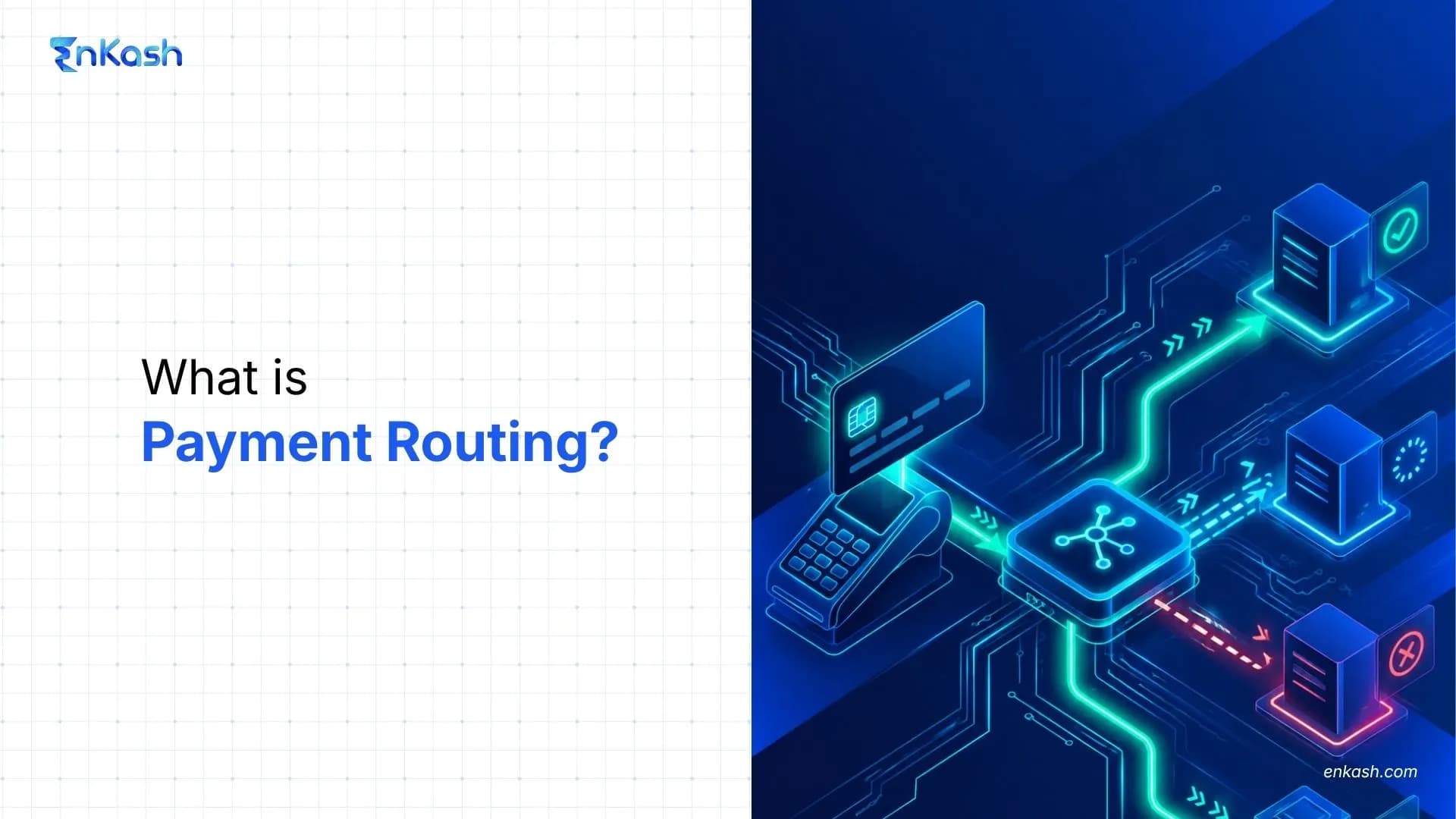
Payment routing is the logic that determines which available processor, payment gateway, acquiring connection, or other configured processing path should handle a transaction.
It is the process of selecting which available and configured processing path should receive an eligible payment transaction. The path may involve a gateway, processor, payment provider, or acquiring connection, depending on the merchant’s architecture. Selection happens before downstream processing. The router can choose only among paths that exist inside the merchant setup, while downstream network, bank, and issuer decisions remain outside the router's control.
Payment Routing at a Glance
Smart or intelligent payment routing goes a step further. Instead of sending every eligible transaction through one fixed route, it can use transaction context, route availability, recent performance, merchant rules, and other supported signals to choose an appropriate path.
| Question | Answer |
|---|
| What does payment routing do? | Selects an eligible processing path for a transaction |
| What is smart payment routing? | Routing that uses rules, transaction data, performance signals, or predictive logic instead of one fixed path |
| When does routing happen? | Before the transaction is sent down the selected processing path |
| What can influence the route? | Payment method, issuer or bank context, amount, route availability, performance, merchant policy and other supported signals |
| Can routing reduce failed payments? | It can reduce avoidable route-related failures when another suitable processing path is available |
| Can routing fix every decline? | No. Insufficient balance, authentication failure, blocked instruments and genuine issuer declines may remain unaffected |
| Does smart routing require multiple paths? | Yes. A router can only choose among processing paths that are actually available to the merchant |
Static vs Smart Payment Routing
In this article, “adaptive routing” refers broadly to routing that can change based on transaction or route information. “Smart routing” is used as the broader industry term for rule-based, performance-driven, or predictive route selection. Product terminology varies across payment providers.
Fixed routing follows a predetermined path or hierarchy. Adaptive routing evaluates available information before selecting among usable options.
Comparing the two makes the architectural difference easy to see:
| Dimension | Static Routing | Smart Routing |
|---|
| Selection method | Predetermined configuration | Evaluates available information |
| Decision flexibility | Limited | Adaptive |
| Changing conditions | Needs configuration changes | Can alter route selection |
| Traffic control | Basic allocation | Supports richer allocation |
| Suitable environment | Simpler setup | Multi-route setup |
How Does Smart Routing Work
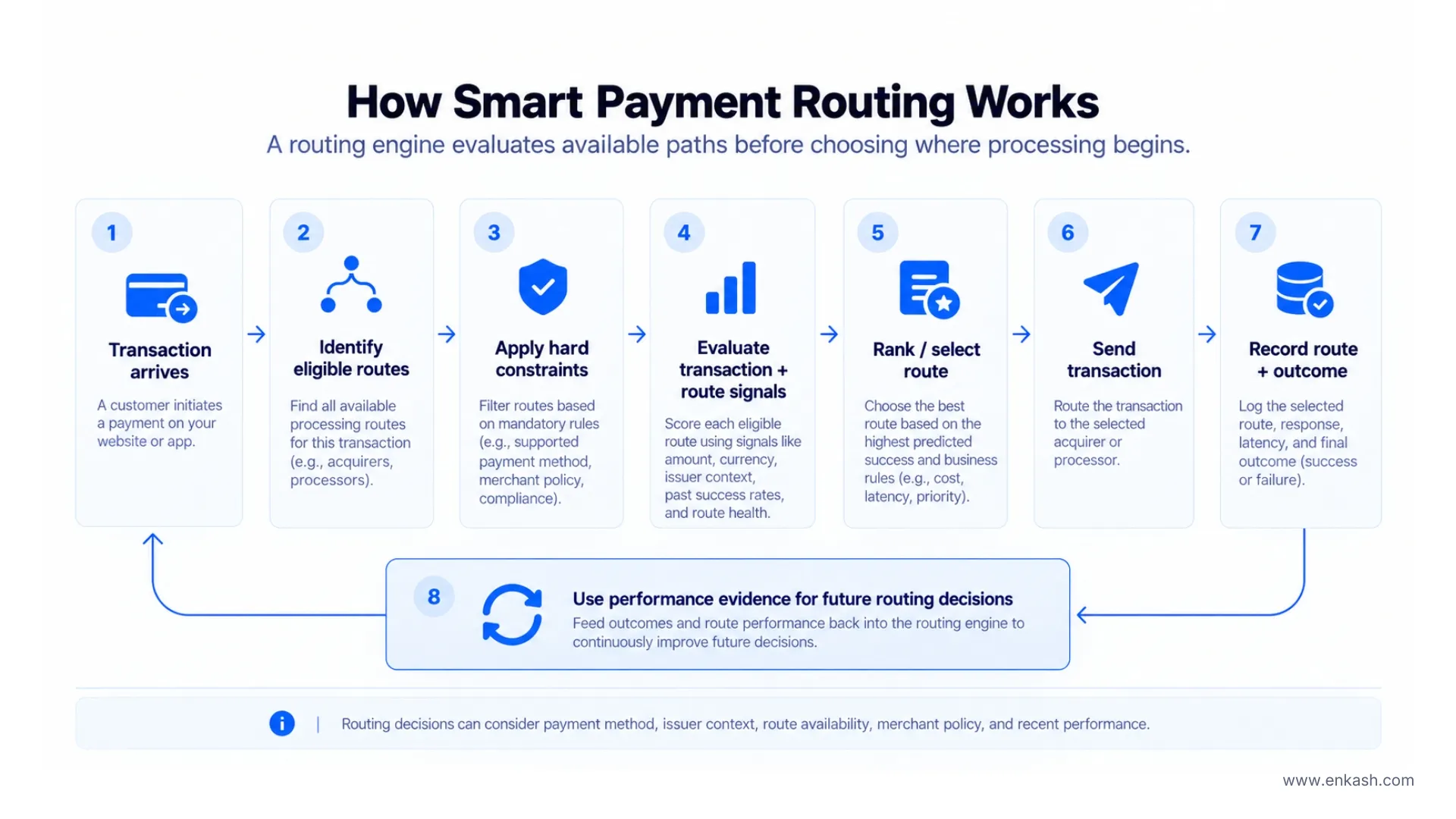
Smart payment routing chooses the initial route before downstream processing begins. The engine works only with paths available inside the merchant setup.
The decision generally follows this sequence:
- The payment request arrives with its method and transaction context.
- The router removes unavailable or incompatible processing paths from consideration.
- The router evaluates the transaction signals and merchant rules available for that payment.
- Configured decision logic evaluates the remaining eligible processing paths.
- One route receives the transaction as the selected initial processing path.
- Downstream systems then process the payment through the relevant rail.
Example: How a Smart Payment Routing Decision Can Work
Suppose an online merchant has three configured payment processing routes for eligible card transactions.
A customer initiates a ₹12,000 card payment.
The routing layer may evaluate:
- whether each route supports the payment
- the card network and issuer context
- current route availability
- recent performance for comparable transactions
- merchant-configured priority
- traffic-allocation rules
- applicable commercial constraints
Assume Route A is normally the merchant's preferred route but is currently degraded. Route B is available and has stronger recent performance for comparable eligible transactions. Route C is healthy but has been assigned a lower merchant priority.
The router can therefore select Route B as the initial processing path.
The selected processor then sends the transaction into the downstream card network and issuer-authorisation process.
The router has influenced where the payment started, but it has not guaranteed approval. The issuer still makes the applicable authorisation decision.
This distinction is important: smart routing optimises route selection; it does not override the payment network, bank, issuer, customer account, or payment instrument.
Why Does Smart Payment Routing Matter?
Payment routing becomes valuable when a merchant has more than one viable processing path, and those paths do not perform identically for every transaction.
Improve Payment Success
Different processing routes can perform differently across payment methods, issuers, banks, transaction profiles, or changing operating conditions. Routing gives the merchant a way to select between those available paths rather than sending every eligible transaction through the same one.
Reduce Dependence on One Processing Path
A multi-route setup can reduce concentration on a single provider or connection. If one route becomes unavailable or materially degraded, eligible traffic can be directed elsewhere according to the merchant's routing and recovery rules.
Smart payment routing can use current or recent route-health information to change route preference when operating conditions change.
Control Processing Economics
Where several eligible routes can process the same transaction, commercial rules can also influence route selection. Merchants can evaluate routing using cost per successful payment, rather than looking only at the processing fee of an individual route.
Manage Traffic Deliberately
Weighted or policy-based routing can distribute transactions between available processors for controlled testing, migrations, capacity management, contractual allocation, or operational reasons.
The objective is not simply to send a transaction through a different gateway. It is to make the initial processing-path decision more deliberate, measurable, and resilient.
Why Does Smart Payment Routing Matter?
Payment routing becomes valuable when a merchant has more than one viable processing path, and those paths do not perform identically for every transaction.
Improve Payment Success
Different processing routes can perform differently across payment methods, issuers, banks, transaction profiles, or changing operating conditions. Routing gives the merchant a way to select between those available paths rather than sending every eligible transaction through the same one.
Reduce Dependence on One Processing Path
A multi-route setup can reduce concentration on a single provider or connection. If one route becomes unavailable or materially degraded, eligible traffic can be directed elsewhere according to the merchant's routing and recovery rules.
Smart payment routing can use current or recent route-health information to change route preference when operating conditions change.
Control Processing Economics
Where several eligible routes can process the same transaction, commercial rules can also influence route selection. Merchants can evaluate routing using cost per successful payment, rather than looking only at the processing fee of an individual route.
Manage Traffic Deliberately
Weighted or policy-based routing can distribute transactions between available processors for controlled testing, migrations, capacity management, contractual allocation, or operational reasons.
The objective is not simply to send a transaction through a different gateway. It is to make the initial processing-path decision more deliberate, measurable, and resilient.
A router needs enough context to identify compatible paths and determine which eligible route best matches the merchant's routing objective. The available inputs depend on the merchant architecture and the payment rail.
| Signal Category | Examples | Decision Use |
|---|
| Payment context | UPI, card, net banking | Filter compatible routes |
| Issuer context | Bank or card issuer | Compare issuer-specific routing performance where available |
| Card context | Network and supported characteristics | Rank eligible card-processing routes |
| Transaction context | Amount and other supported transaction attributes | Apply conditions |
| Route state | Available, degraded, unavailable | Remove unusable paths |
| Route health | Recent health indicator | Prefer healthier or better-performing routes |
| Merchant policy | Preferred route hierarchy | Apply business constraints |
| Traffic allocation | Configured distribution share | Divide eligible traffic |
| Commercial constraint | Cost or contract preference | Apply cost or contractual routing rules |
What Are the Main Routing Models
Routing models turn transaction information into a path choice, and several methods can coexist.
Rule-Based Routing
Explicit conditions determine the path. Payment method, issuer or payer-bank context, transaction amount, card network, and other supported attributes can shape the rule set.
Priority-Based Routing
Eligible routes receive a predefined order. The router selects the highest-priority path that remains usable when the payment arrives.
Weighted Routing
Configured percentages distribute eligible traffic across paths for testing, balancing, migration, or contractual allocation.
Current or recent route-health information changes which eligible path receives preference. The selected route can shift as operating conditions change.
Predictive Routing
Predictive routing can use historical performance data together with available transaction and route signals to estimate which configured path is most likely to meet the merchant's routing objective. Predictive logic remains one model within the wider design.
How Does Routing Work for UPI Payments in India
UPI payment routing stays within the merchant’s available processing architecture. The selected path then carries the transaction into the wider UPI ecosystem.
Merchant-Level Route Selection
A merchant or orchestration layer can choose among configured UPI processing paths. The chosen route handles the transaction through the applicable downstream infrastructure.
Issuer Context Can Affect Selection
Performance can vary across bank and processing combinations. Where alternatives exist, permitted issuer context can influence route ranking.
Customer Bank Choice Remains Separate
The merchant routing layer chooses its own available processing path. The customer’s selected bank account remains outside that routing decision.
How Does Routing Work for Cards and Net Banking
The same payment routing principle applies outside UPI, although each rail offers different route inputs.
Card Routing
Payment gateway routing for cards can consider issuer context, card network, compatible paths, merchant rules, and route state before authorization. The selected path cannot control the issuer’s approval decision.
Net-Banking Routing
Net-banking selection depends on configured connections that support the customer’s bank. Availability and merchant preference can guide the choice when several paths exist.
Smart Routing vs Failover vs a New Payment Attempt
Initial routing, failover, and a customer retry happen at different points in the payment journey. Mixing them can create unsafe assumptions about transaction identity.
| Mechanism | Timing | Function |
|---|
| Initial routing | Before first processing | Selects the first eligible path |
| Failover | After an eligible route problem | Moves processing to another configured path |
| New payment attempt | Customer starts again | Creates a separate payment attempt |
Initial routing chooses where processing begins. Failover handles an eligible path problem, while a fresh customer attempt creates a separate record.
What Is Payment Cascading?
Payment cascading is a form of controlled fallback in which a transaction is sent to another configured processing path after the first path returns a failure that is eligible for retry. Cascading should not be triggered when the first attempt's outcome is uncertain unless the integration can safely resolve that state.
Which Payment Failures Can Smart Routing Improve
Routing can influence an outcome only when another configured path has a realistic chance of behaving differently. Failed payments can originate with the route, customer, instrument, account, or issuer. Recovery potential changes with the source.
| Failure Condition | Routing Potential | Reason |
|---|
| Gateway degradation | Strong | Another path may remain usable |
| Route-specific timeout | Possible | Another path may avoid degradation |
| Weak segment performance | Possible | Another route may behave differently |
| Provider concentration issue | Possible | Multi-route setup adds resilience |
| Insufficient customer balance | Minimal | Funding problem remains unchanged |
| Customer authentication failure | Minimal | Changing the processing route generally cannot correct a failed or incomplete customer authentication step |
| Blocked or expired instrument | Minimal | Instrument condition remains unchanged |
| Bank transaction limit | Minimal | Account restriction remains active |
| Genuine issuer decline | Uncertain | Another route cannot force approval |
| Customer abandonment | Minimal | Customer stopped the payment journey |
| Bank unavailable across paths | Minimal | Merchant routing cannot restore the bank |
The limits of routing matter here. It can reduce avoidable route-related failures without becoming a cure for every failed payment.
Smart Routing vs Payment Orchestration
Routing selects a transaction path. Payment orchestration manages a broader multi-provider environment where routing may operate.
| Capability | Smart Routing | Payment Orchestration |
|---|
| Select processing path | Core function | Can include |
| Apply route logic | Core function | Can include |
| Manage several integrations | Limited scope | Broader scope |
| Refund operations | Outside core scope | Can include |
| Settlement visibility | Outside core scope | Can include |
| Reconciliation | Outside core scope | Can include |
| Unified payment operations | Outside core scope | Broader platform capability |
Transaction routing is one decision layer inside that wider architecture. Orchestration can provide the surrounding operating environment without changing the purpose of route selection.
Routing should be evaluated using both route-level metrics and commercial outcomes because blended success numbers can hide weak paths.
First-Attempt Success Rate
First-attempt success rate = successful payments on the initial processing attempt ÷ eligible initial attempts × 100
This measures how frequently the initial selected route produces a successful payment.
Recovered Success Rate
Recovered success rate = payments successfully completed through an eligible recovery/fallback path ÷ eligible payments sent to recovery × 100
This measures successful transactions recovered through an eligible fallback or recovery path.
Success Rate by Route
Route-level results expose weaker and stronger processing paths across comparable segments.
Success Rate by Payment Method
UPI, cards, and net banking should be reviewed separately because their processing environments differ.
Success Rate by Issuer or Bank
Issuer-level analysis can expose segments that behave differently across configured paths.
Availability shows route uptime, while latency shows processing responsiveness.
Cost per Successful Payment
Cost per successful payment accounts for both processing cost and success rate, helping teams compare routes on economic outcome rather than headline transaction pricing alone.
Use checkout conversion as a business outcome metric, not as a standalone routing-performance metric.
When Does a Business Need Adaptive Routing
A merchant has a stronger case when route choice becomes commercially meaningful. Several operating signals can indicate that point.
- Transaction volume makes small performance differences financially meaningful.
- Several processing paths are genuinely available for the same payment rail.
- Gateway incidents repeatedly affect checkout performance or payment continuity.
- Success varies materially by payment method, issuer, bank, or transaction segment.
- Operations teams manually move traffic during payment incidents.
- Provider concentration creates measurable resilience concerns.
- Peak-sale periods require stronger payment continuity.
- Blended reporting hides weak route-level performance.
Low volume and a single usable path can make sophisticated routing unnecessary. Added complexity should solve a measurable problem.
How Should Adaptive Routing Be Implemented
Implementation should begin with evidence and expand gradually.
- Confirm that avoidable route-related failures genuinely affect payment outcomes.
- Map every processing path that can carry the relevant eligible transactions.
- Identify the transaction information available to the routing layer.
- Choose a primary objective such as success, resilience, allocation, or economics.
- Begin with explainable decision logic supported by the available data.
- Define which failure conditions qualify for controlled failover.
- Launch with limited traffic before expanding the routing allocation.
- Compare results against the agreed route-performance measurement framework.
- Add predictive logic only when sufficient data supports the change.
- Document rollback controls and authorized manual overrides before expansion.
A staged deployment keeps routing behavior visible before traffic expands.
How to Control Payment Routing After Deployment
Live routing changes payment paths, so ownership and change control become essential.
Assign Routing Ownership
Named owners should control rule changes, provider priorities, emergency overrides, and rollout approvals.
Control Rule Changes
Every meaningful change should retain its approval, effective date, reason, audit history, and rollback option.
Govern Manual Overrides
Emergency changes need an authorized owner, a defined duration, a review point, and a documented return to normal routing.
Resolve Commercial and Technical Conflicts
Set conditions under which automated routing should fall back to a known-safe configuration or require manual intervention, particularly when route-health signals become unreliable or conflicting.
Control Route Introduction and Retirement
New paths should enter through controlled allocation. Weak or obsolete routes need a documented retirement process.
Final Word
Payment Routing gives Indian merchants a structured way to choose among available processing paths before downstream processing begins. Smart logic can use transaction context, route health, merchant policy, allocation, and historical performance to improve that choice. Failover adds a recovery layer when defined conditions permit it. Routing cannot repair customer, account, instrument, or genuine issuer problems. Strong results come from route-level evidence, controlled deployment, and governance connected to measurable payment outcomes.
FAQs
Can Payment Routing Reduce Failed Transactions?
Routing can reduce failures caused by weak, degraded, or unavailable processing paths when another usable route exists. Customer authentication problems, insufficient balance, blocked instruments, and genuine issuer declines remain outside routing control.
Is Payment Routing the Same as Failover?
Routing selects the initial processing path before the transaction begins. Failover occurs later when defined conditions permit processing to move from the selected path to another configured option.
How Does Payment Routing Work for UPI in India?
For UPI transactions, merchant-side routing can select among the payment providers or processing connections configured for that merchant. The payer still chooses the bank account used for the transaction, while subsequent UPI processing follows the applicable participant and NPCI infrastructure.
A router can use payment method, issuer context, card network, transaction amount, route availability, recent route health, traffic-allocation rules, merchant preferences, and permitted commercial constraints when selecting an eligible path.
Is Smart Routing the Same as Payment Orchestration?
Smart routing focuses on selecting a processing path for a transaction. Payment orchestration covers a broader payment environment that can include routing, provider integrations, reconciliation, refunds, settlement visibility, and operational controls.