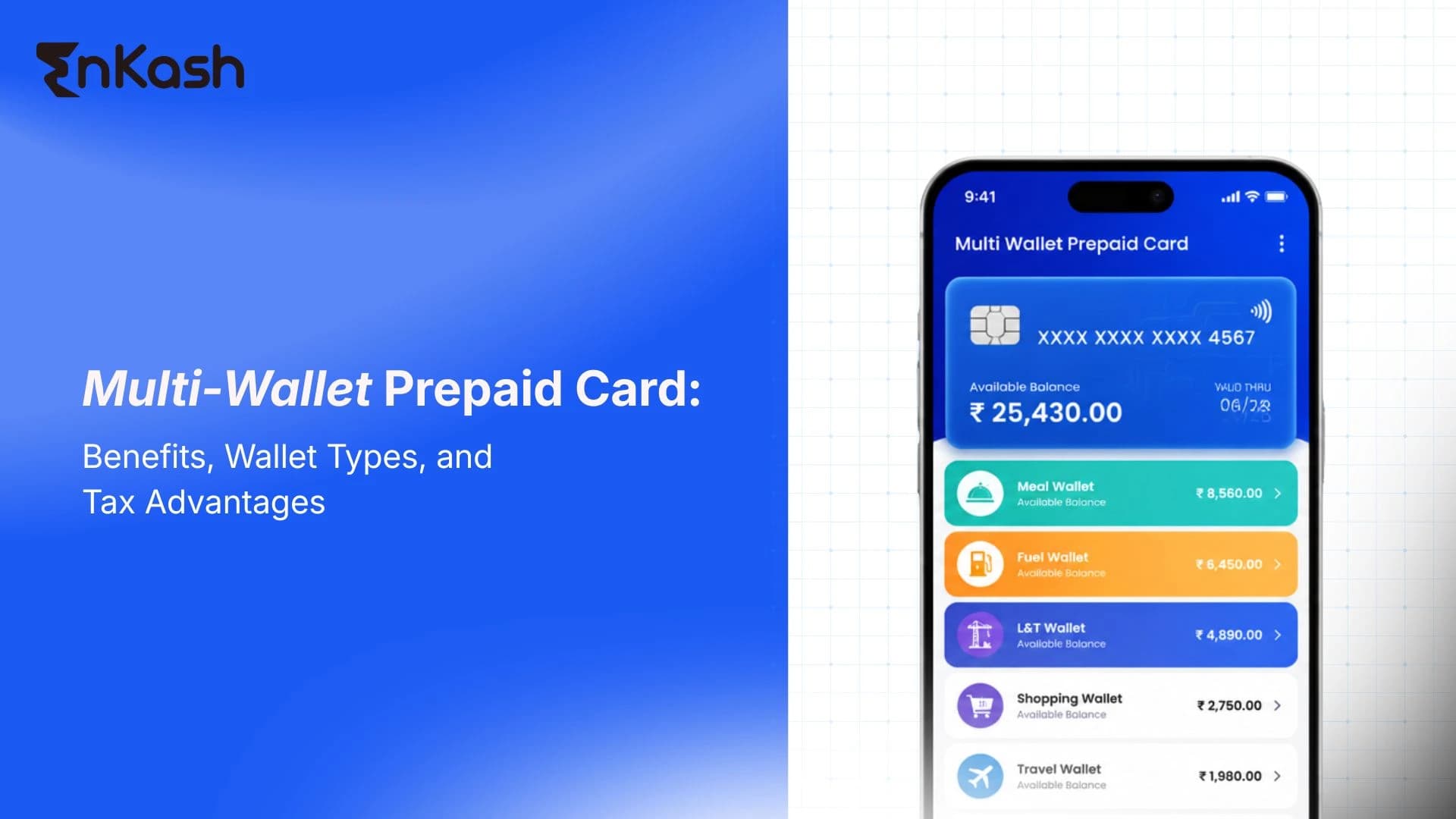
A multi-wallet prepaid card lets an employer place different employee benefits in separate digital wallets linked to one card. Each balance serves a defined purpose, such as meals, fuel, gifts, mobile expenses, or eligible leave travel costs.
Let’s understand this with an example: An employee may receive ₹6,000 in a meal wallet, ₹3,000 in a fuel wallet, and ₹1,500 in a telecom wallet. The card uses the relevant balance when the employee pays an eligible merchant.
However, the card itself does not make every benefit tax-free. Tax treatment depends on the benefit category, current income-tax rules, actual usage, supporting records, and the employee’s chosen tax regime.
This blog explains the following points:
- How a multi-wallet card works
- Purpose of each employee benefit wallet
- Multi-wallet flexi benefits for employees
- Tax conditions effective from April 2026
- Advantages for employees and employers
- Records and controls needed for compliance
What is a Multi-Wallet Prepaid Card
A multi-wallet prepaid card is an employer-funded card that keeps different employee benefits in separate balances on one payment instrument. Each wallet, such as meal, fuel, gift, telecom, or LTA, follows its own usage rules, limits, and documentation requirements. The card can simplify benefit distribution, but tax treatment depends on the underlying benefit and applicable income-tax rules.
The term “multi-wallet” describes the card’s internal structure. It is not a separate category of prepaid payment instruments under the Reserve Bank of India rules. The individual wallets also do not operate as independent bank accounts.
Multi-wallet prepaid cards are useful for companies that offer structured employee benefits, manage distributed teams, process meal, fuel, telecom, or LTA allowances, or want cleaner payroll and benefit reporting.
This structure helps payroll and finance teams keep each benefit separate for allocation, usage tracking, and year-end review.
How Does a Multi-Wallet Prepaid Card Work
A multi-wallet card follows a structured flow from benefit setup to transaction review.
Employer Selects Benefit Categories
Human resources or payroll selects the wallets covered by the company policy, such as meals, fuel, telecom, gifts, or leave travel assistance.
Employee Completes Onboarding
The provider verifies the employee’s details and completes the required KYC process before activating the card.
Company Assigns Wallet Limits
Payroll sets the amount available under each wallet based on the employee’s role, grade, location, or approved benefit plan.
Employer Loads Approved Funds
The company adds funds to each designated wallet rather than placing the full amount in a single unrestricted balance.
Card Checks Transaction Eligibility
The platform’s wallet controls assess whether the payment matches the relevant wallet and whether enough balance remains.
The system captures the employee, wallet, merchant, amount, and remaining balance for payroll and finance review.
These controls help enforce company policy, but they do not establish tax eligibility on their own. Employers must still keep the records required for each benefit category.
Types Of Wallets In A Multi-Wallet Card
A multi-wallet card divides employee benefits into separate balances, with each wallet reserved for a defined expense. Employers set the permitted categories and usage conditions through the benefit policy.
Meal Wallet
A meal wallet supports qualifying food and non-alcoholic beverage benefits during working hours, where provided at office/business premises or through qualifying paid vouchers usable only at eating joints. From 1 April 2026, qualifying employer-provided meals may be treated as nil perquisites up to ₹200 per meal, subject to Rule 15 conditions when offered at the workplace or through qualifying paid vouchers usable only at eating joints.
The exemption depends on each eligible meal, not on the amount loaded for the month. Transactions must also meet the working-hour and permitted-use conditions.
Fuel Wallet
A fuel wallet can fund vehicle running expenses connected with official duties. Nil perquisite valuation may apply when the vehicle serves wholly official purposes, and the employer maintains journey dates, destinations, mileage, expenditure details, and the required certification.
A fuel-station transaction proves that the employee purchased fuel, but it does not establish official use. Fuel consumed during documented client visits may meet the conditions, while fuel used for personal travel will not.
Gift Wallet
A gift wallet allows employers to provide non-cash gifts, vouchers, or tokens for festivals, milestones, and recognition programs. The perquisite value may remain nil when the aggregate value of such gifts, vouchers, or tokens stays below ₹15,000 during the tax year.
If the aggregate value is ₹15,000 or more, payroll should evaluate the taxable value under the applicable Rule 15 treatment. This tax threshold differs from the ₹10,000 limit that the RBI applies to an individual, standalone Gift PPI.
A telecom wallet can help track employer-approved telephone and mobile expenses, subject to the company’s policy and supporting bills.
Employers should retain bills and payment records to confirm the nature of the expense. A fixed cash allowance added to a salary does not automatically receive the same tax treatment as an employer-paid telephone bill.
LTA Wallet
An LTA wallet can help employers allocate and track eligible domestic travel fares under the leave travel assistance scheme. Employees may claim exemption for two journeys during the current 2026–2029 block, subject to actual travel and the prescribed fare limits.
The employee must support the claim with valid travel evidence and use a tax regime that permits LTA exemption. Hotel charges, meals, sightseeing expenses, and journeys outside India remain ineligible.
Multi-Wallet Summary
| Wallet | Main Use | Current Tax Position | Key Requirement |
|---|
| Meal wallet | Food and non-alcoholic beverages | Up to ₹200 per qualifying meal | Working-hour use at eligible outlets |
| Fuel wallet | Official vehicle expenses | Depends on official, personal, or mixed use | Journey records and expense proof |
| Gift wallet | Non-cash employee gifts | Nil value when the annual total stays below ₹15,000 | The employer must track the yearly aggregate |
| Telecom wallet | Mobile and telephone costs | Employer-incurred expenses receive favourable treatment | Valid bills and a clear benefit policy |
| LTA wallet | Eligible domestic travel fare | Available under applicable LTA rules | Tickets, journey proof, and eligible tax regime |
How the Multi-Wallet Card is Different from a Single Wallet Card
Multi-wallet prepaid cards give businesses one card with separate balances for different employee benefits, while a single-wallet prepaid card usually holds one common balance. This makes multi-wallet cards more useful for companies that want category-wise controls, cleaner payroll records, and better tracking of meal, fuel, telecom, gift, or LTA benefits.
| Feature | Multi-wallet prepaid card | Single-wallet prepaid card |
|---|
| Wallet structure | Separate balances for each benefit category | One common balance |
| Best suited for | Meal, fuel, telecom, gift, LTA, and flexi benefits | General-purpose payments or single-use benefits |
| Spending control | Category-wise rules and merchant controls | Limited or broad spending rules |
| Employee experience | One card for multiple approved benefits | One card for one balance or purpose |
| Payroll tracking | Easier wallet-wise reporting and reconciliation | Manual tracking may be needed |
| Tax review | Benefit-wise records support tax assessment | Harder to separate benefit usage |
| Employer control | Limits can be set for each wallet | One overall card limit usually applies |
Multi-Wallet Flexi Benefits For Employees
Multi-wallet flexi benefits for employees allow them to use approved benefit value across different categories such as meals, fuel, telecom, gifts, and LTA. The available wallets, limits, expiry rules and tax treatment depend on the employer’s compensation policy.
- Role-based benefit selection: Employees can choose benefits that match their work pattern. For example, field employees may need higher fuel or travel support, while hybrid employees may use telecom benefits more often.
- Separate wallet balances: Each wallet shows a dedicated balance, making it easier for employees to track meal, fuel, telecom, gift, or LTA benefits without checking multiple salary records.
- Lower upfront spending: Employees can use approved wallet balances for eligible expenses instead of paying first and waiting for reimbursement.
- Digital transaction records: Every card transaction creates a record of the wallet used, merchant, amount, and date, helping employees and payroll teams track benefit usage.
- Better annual planning: Employees can select eligible benefits during the company’s enrolment cycle based on expected yearly needs.
- Clear usage rules: Employers should explain wallet limits, lock-in periods, expiry rules, unused balance treatment, and taxable adjustments before employees make their selection.
Tax Benefits For Multi-Wallet Cards
A multi-wallet card does not make every loaded amount tax-free. Payroll must assess each wallet under the rule that applies to the underlying benefit.
- Meal wallet: Food and non-alcoholic beverages may be treated as nil perquisites up to ₹200 per meal when provided during working hours at the workplace or through qualifying vouchers usable only at eating joints.
- Fuel wallet: Vehicle expenses used wholly for official duties may carry nil perquisite value when the employer maintains journey details, mileage, expenditure records, and the required certificate. Personal or mixed use follows separate valuation rules.
- Gift wallet: Non-cash gifts, vouchers, or tokens may be treated as nil perquisite value only when their combined value remains below ₹15,000 during the tax year. Once the total reaches ₹15,000, the nil valuation no longer applies.
- Telecom wallet: Employer-paid or reimbursed telephone and mobile-phone expenses remain outside the residual perquisite valuation rule. Employers should still retain bills and payment records.
- LTA wallet: Eligible fare for travel within India may qualify for two journeys during the 2026–2029 block, subject to actual expenditure and prescribed limits. Employees using the default new tax regime cannot claim this exemption.
Note: Tax treatment may vary based on the applicable Income-tax Act, rules, employee tax regime, documentation and employer policy. Employers should verify current rules before payroll processing.
Benefits Of Multi-Wallet Prepaid Cards
A multi-wallet prepaid card can reduce fragmented benefit administration by consolidating several approved allowances into a single controlled program.
Benefits For Employees
- Employees use one card instead of carrying separate meal cards, gift vouchers, or paper coupons.
- Clear wallet balances help employees avoid using the wrong benefit for a purchase.
- Direct access to approved funds reduces dependence on personal money for eligible expenses.
- Digital transaction records make it easier to identify failed payments, reversals, or incorrect deductions.
- A lost card can be blocked without canceling every benefit allocation separately.
For example, an employee can pay a mobile bill and buy an eligible meal with the same card while keeping both balances separate.
Benefits For Employers
- Central loading allows payroll teams to distribute approved benefits to many employees in a single cycle.
- Category-based restrictions reduce spending outside the purpose defined by company policy.
- Wallet-level reports show which benefits employees use and which balances remain unused.
- Human resources teams can suspend access quickly when an employee leaves or changes roles.
- A single program can reduce dependence on several benefit vendors and disconnected reporting systems.
- Transaction records provide a clearer audit trail for payroll review and internal checks.
These benefits depend on accurate employee data, reliable system integration, and clear rules for expiry, reversals, and unused balances.
Conclusion
A multi-wallet card can simplify employee benefit delivery when every wallet has a clear purpose, defined limits, and the right supporting records. Employees gain easier access to approved benefits, while payroll and finance teams receive cleaner transaction data for review. However, the card does not decide the tax outcome. Each benefit must still meet the applicable conditions on use, evidence, and employee eligibility. The program works best when company policy, wallet controls, payroll treatment, and employee communication remain consistent throughout the benefit year.
FAQs
1. Who can issue a multi-wallet prepaid card?
Banks and entities authorized to issue prepaid payment instruments can offer these cards. The employer chooses the benefit program and allocates funds, while the authorized issuer manages KYC, payment processing, and regulatory limits.
2. Is a multi-wallet card the same as a salary account?
A multi-wallet card holds employer-funded benefits for defined uses, whereas a salary account receives wages and supports regular banking transactions.
3. How long does a multi-wallet prepaid card remain valid?
Card validity depends on the issuer and selected program. Employers should also review wallet expiry dates, renewal charges, and the treatment of unused balances before the card reaches its expiry date.
4. Can employees use a multi-wallet card through UPI?
UPI usage may be available for a full-KYC prepaid payment instrument when the issuer enables it. Wallet and merchant restrictions continue to apply to every transaction.
5. Can an employer add funds during the month?
Many programs allow additional loading during an active benefit period. Each load must comply with company policy, issuer limits, payroll treatment, and the rules associated with that wallet.
6. What happens when a wallet balance is insufficient?
The payment may fail when the relevant wallet lacks enough funds. Some merchants allow the employee to pay the remaining amount separately, depending on the payment system and program settings.
7. Where does a merchant's refund go?
The refund generally returns to the card or wallet used for the original purchase. Processing time depends on the merchant, card network, issuer, and transaction status.
8. Can contract workers or interns receive these cards?
Employers may include contract workers or interns when company policy and issuer rules permit their participation. Each person must complete the required onboarding before receiving funds.
9. Can an employer view an employee’s personal bank activity?
The employer generally sees only transactions completed through the company-funded card program. Personal account balances, transfers, and unrelated purchases remain outside the employer dashboard.
10. Is there a minimum company size for using multi-wallet cards?
No single legal minimum applies across all providers. Each provider may set onboarding criteria based on employee count, expected transaction volume, business documents, and commercial terms.
11. Is a multi-wallet prepaid card tax-free?
No. A multi-wallet prepaid card is not automatically tax-free. Tax treatment depends on the benefit category, applicable income-tax rule, actual usage, supporting documents, and the employee’s tax regime.