An employee may receive five benefits from one employer and still need five different ways to use them. A meal card for food. A fuel card for travel. A gift voucher for a reward. A reimbursement portal for mobile bills. Another form for an eligible trip.
From payroll’s perspective, these are separate categories for good reasons. Each benefit can have a different budget, purpose, tax treatment, and documentation requirement. From the employee’s perspective, the arrangement feels unnecessarily scattered. The same employer has given the money, yet every balance comes with a different process.
Employee benefits have traditionally been designed around accounting categories. The next generation should be designed around the payment itself.
That does not require combining every allowance into unrestricted cash. It requires a common way to pay while keeping each balance separate behind the transaction. Multi-wallet architecture, connected to UPI, makes that possible.
Separation is Useful. Fragmentation is Expensive.
A meal allowance should pay for eligible food purchases. A fuel balance should remain available for fuel. A gift balance may follow its own validity and usage rules. Combining these balances into one general pool would make administration harder and could weaken the purpose of the benefit.
The problem begins when financial separation creates operational fragmentation. HR teams manage several vendors. Finance teams reconcile multiple reports. Employees carry extra cards, upload bills or remember which portal handles which allowance. Small balances remain unused because claiming them takes more effort than the benefit feels worth.
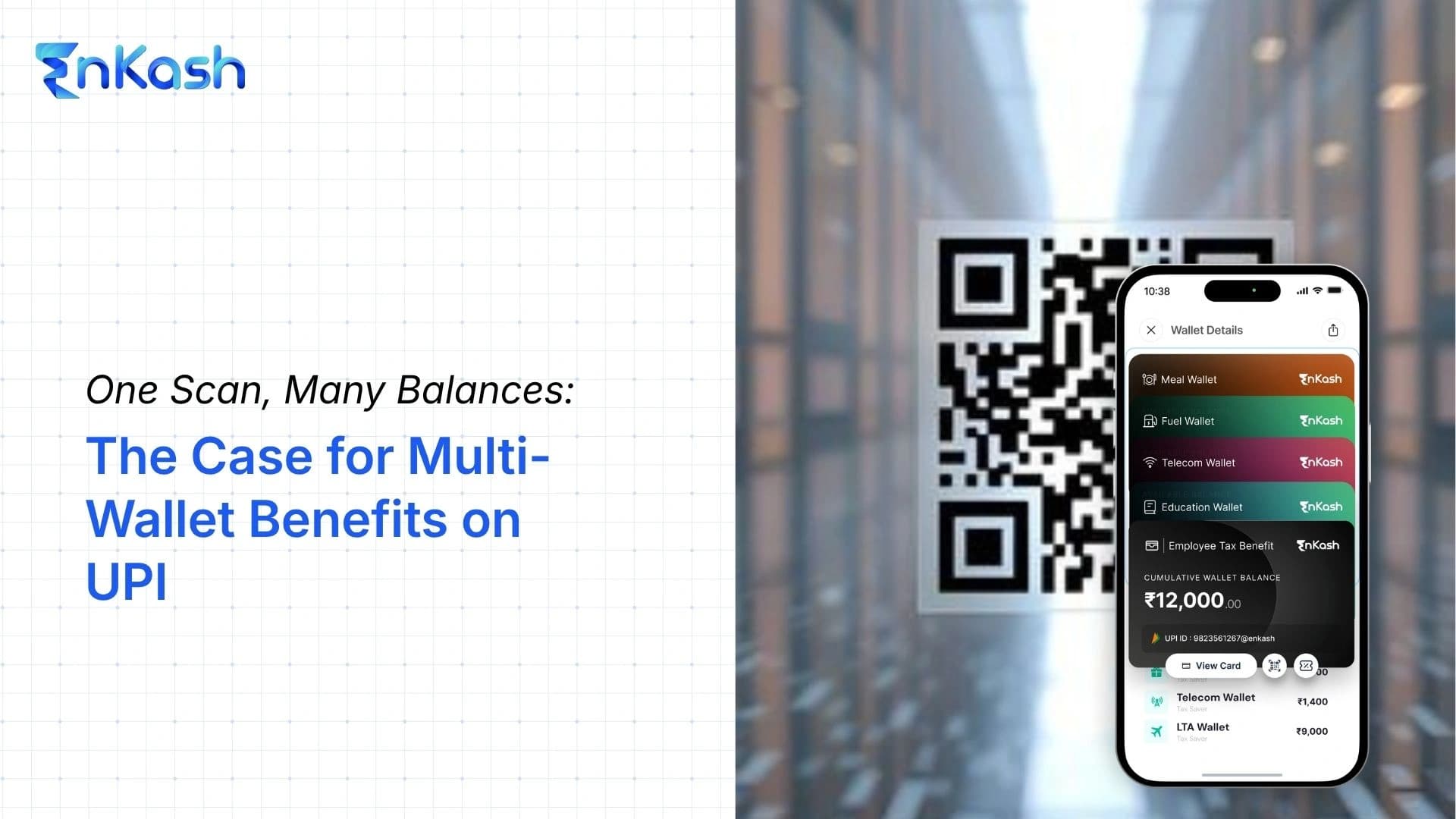
A multi-wallet structure addresses this by linking several purpose-specific balances to one payment instrument. An employer can load separate meal, fuel, gift, telecom or travel wallets. Each wallet can retain its own limits, permitted merchant categories and reporting requirements.
The employee sees one card or one payment interface. The organisation still sees separate ledgers.
This distinction matters. “Multi-wallet” describes how balances are organised within a product. It is not a separate regulatory category of prepaid payment instrument. The Reserve Bank of India’s PPI guidance classifies regulated PPIs primarily as small PPIs and full-KYC PPIs. A multi-wallet product must still operate within the applicable PPI, KYC and payment-system requirements.
UPI turns one instrument into an everyday payment experience
Putting several balances on one card solves only part of the problem. Employees increasingly expect to pay through UPI, particularly at merchants where a QR code is easier to find than a card terminal.
The regulatory foundation for linking prepaid balances with that behaviour became stronger in December 2024. The RBI enabled UPI payments from and to full-KYC PPIs through third-party UPI applications. The circular allows an eligible PPI to be discovered and linked on a third-party UPI app, with transactions authenticated using UPI credentials.
That decision has a larger meaning for employee benefits. UPI can serve as the common interface for money that has different purposes.
Consider an employee with four balances on one instrument:
- ₹4,000 for meals
- ₹3,000 for fuel
- ₹1,500 for telecom expenses
- ₹5,000 received as a festival gift
When the employee makes an eligible payment, the system can apply the relevant wallet based on configured rules and the merchant category. The visible action remains familiar: select the linked instrument, scan the QR and authorise the payment. Behind that action, the product checks which balance can fund the transaction.
UPI provides reach, while eligibility still depends on the wallet rules, merchant classification, available balance and product configuration. A meal wallet should not become spendable at an unrelated merchant merely because the merchant displays a UPI QR. The value lies in combining familiar payment behaviour with purpose-based controls.
Read more: Flexi-benefits for employees in India
Policy can move from the handbook into the payment
Most employee benefit policies live in documents. Employees are expected to remember the limit, eligible category, submission date, and evidence required. Finance checks the transaction after the money has already been spent.
A well-designed multi-wallet system moves part of that policy to the moment of payment. Merchant-category controls can restrict where a balance is used. Transaction limits can govern how much is spent. Separate wallet records can show which benefit funded a purchase. Employers can load, block, reload and review balances centrally.
This reduces the dependence on retrospective policing. Finance teams receive structured transaction data instead of trying to reconstruct the purpose of a payment from a receipt weeks later. HR can offer several benefits without creating a separate operational process for each one.
Employees gain something equally valuable: they do not have to fund an approved expense from their salary and wait for reimbursement. The benefit is available when the payment is made.
One payment interface does not create one tax rule
The convenience of a multi-wallet card can encourage a dangerous oversimplification: if the balances sit on one instrument, they must receive the same tax treatment. They do not.
Tax treatment follows the underlying benefit, its conditions, the employee’s circumstances, the applicable tax regime and the records maintained by the employer. The payment instrument alone does not make an allowance tax-free.
For example, the notified Income-tax Rules, 2026 provide prescribed treatment for eligible food and non-alcoholic beverages up to ₹200 per meal, subject to stated conditions. The same Rules separately address employer-provided gifts, vouchers or tokens, with the value treated as nil when it is below ₹15,000 in aggregate during the tax year. Fuel, telecom and travel expenses have their own tests around purpose, eligibility and supporting records.
Keeping these balances separate supports better administration because each wallet can follow the policy appropriate to that benefit. Employers should still obtain tax and legal advice for their specific compensation structure. Technology can enforce configured rules and maintain records; it cannot replace the law or professional judgment.
The real opportunity is purpose without inconvenience
There has long been a trade-off in employee benefits. Give an allowance as unrestricted cash and the employee enjoys flexibility, while the employer loses much of the usage control and category-level record. Preserve the purpose through separate prepaid cards, coupons and reimbursement systems, and the employee inherits the inconvenience.
Multi-wallet benefits on UPI offer a better middle ground. The organisation can keep meal money separate from fuel, gifts, telecom and travel. The employee can access those balances through an interface already used in daily life.
EnKash’s Employee Benefit Multi-Wallet follows this model by bringing meal, fuel, gift, telecom and travel balances onto one instrument with UPI and RuPay-based payment options. EnKash operates in this category, so our view is grounded in the practical questions employers ask: Can each balance retain its purpose? Can employees use the benefit easily? Can finance see what happened without chasing paperwork?
Conclusion: One payment experience, several accountable balances
Employee benefits become simpler when employees no longer manage the machinery behind each allowance. Multi-wallet architecture keeps meal, fuel, gift, telecom and travel balances distinct, while UPI gives them a familiar way to be used.
For employers, this means offering several benefits with category controls and cleaner records. For employees, it means using approved funds without carrying multiple cards or waiting for reimbursement.
The future is one scan in front and several accountable balances behind it. Each rupee keeps its purpose, while the employee experiences one connected benefit programme.