Key Takeaways
- Bulk electricity bill payments work best when every bill entering the run has a current amount, correct consumer number, due date, and approval status.
- Finance should separate bills that are ready from bills that need review before creating the batch.
- The batch itself needs a final check for duplicates, unusual amounts, payment limits, and last-minute changes.
- A failed or pending bill should remain traceable on its own even when the rest of the batch clears successfully.
- Reconciliation should connect every paid bill back to the right branch, transaction reference, and accounting entry.
A company with many operating locations can end up dealing with a large electricity-payment list every month. Each branch may have its own electricity distribution company (DISCOM), consumer number, billing date, and payable amount. Bills may reach finance at different points in the month—some well before the due date, others only shortly before payment is due, while a few may already require review.
Handling each account separately creates unnecessary repetition and makes the overall payment position harder to see.
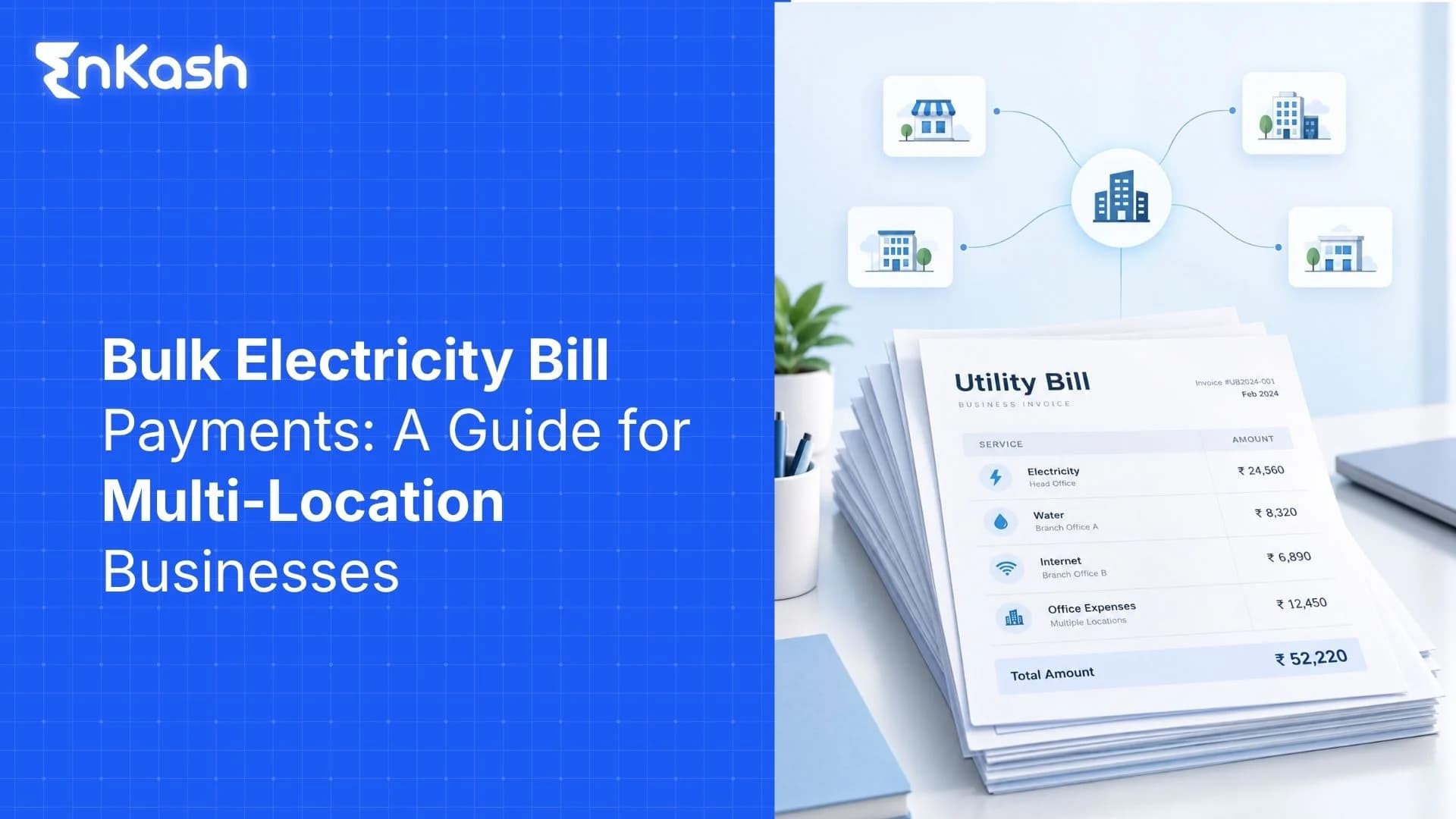
Bulk electricity bill payments bring several current bills into one controlled payment run. Finance first decides which bills are ready, then builds the batch, checks it, releases payment, and follows up on anything that does not close cleanly. The process below shows how multi-location businesses can structure bulk electricity bill payments while retaining bill-level control.
What Are Bulk Electricity Bill Payments?
Bulk electricity bill payment is a business process that allows multiple electricity bills to be selected, approved, and released for payment together while retaining bill-level records, transaction references, and payment statuses for each underlying account.
A bulk payment run groups several current electricity bills for payment within the same business process. The accounts may belong to stores, offices, warehouses, plants, clinics, or other company locations.
Grouping the payments does not merge the underlying accounts. Each bill keeps its own consumer number, amount, due date, and payment record. Finance can later trace an individual bill or branch payment without untangling the entire batch.
For businesses handling electricity bills across many sites, the batch becomes the processing unit, while each bill remains separately identifiable against its consumer account. This allows finance to process multiple bills together without losing bill-level traceability. This separation is important as it lets finance process many payments together and keep every connection identifiable after payment has been processed.
Which Bills Should Enter a Bulk Payment Run?
A bill should enter the batch only when finance has enough information to release it confidently. It is easier to remove a bill with an unresolved issue before the run than to resolve it after payment.
The following checks belong at bill level:
- Use the current bill: Confirm the bill belongs to the latest billing period and reflects the current payable amount.
- Match the consumer account: The consumer or service number must point to the intended branch, plant, office, or other location.
- Check whether it is unpaid: A bill settled through another team, bank account, or payment channel should stay out of the batch.
- Look at the due date: Include the bills that fall inside the company's chosen payment window.
- Clear bill-level approval: Complete any review needed before the bill is allowed into the payment run.
- Hold bills with unresolved issues: Keep a bill out of the batch if there is a billing dispute, branch closure, changed consumer number, or another unresolved account issue.
Once these checks are done, finance has a cleaner pool of bills from which the actual batch can be built.
How to Pay Multiple Electricity Bills Online
Once the bill-level checks are finished, the remaining work is to turn those approved items into a payment run. Each stage has a different job, from assembling the batch to recording what happened after submission.
1. Collect Current Bills
Move the bills that passed the earlier checks into the payment workspace. At this point, finance is gathering the approved items rather than repeating the earlier bill-level validation. For transactions routed through Bharat Connect (BBPS), the bill is fetched before payment initiation. A BBPS reference number is generated from the payment-initiation stage for transaction tracking.
2. Select Bills for Payment
Choose which of the eligible bills will move in the current batch. The business may run several batches during the month, so every approved bill does not have to move at once. Once selected, the list becomes the working batch for that payment run.
3. Get the Batch Approved
Send the prepared batch through the company's required authorization process. This is approval of the payment run itself. A bill returned by the approver comes out of the active batch until the issue has been resolved and the bill is approved again.
4. Process the Payment Batch
Once the batch is approved and the final release checks are complete, submit it through the supported payment channel. Although finance releases multiple bills through the same bulk action, each underlying bill payment should remain separately identifiable for status tracking and reconciliation.
5. Record Each Result
After submission, record the transaction reference and payment status against each bill or payment record. At this stage, finance records the outcome of each bill payment.. Any pending or failed bill moves to the separate exception process covered below.
What Should Finance Check Before Releasing the Batch?
Before the payment leaves the account, finance needs one last look at the batch as a whole. Individual bills may already be cleared, but changes can happen between approval and release.
Check the following before the transaction goes through:
- Count the bills again: The number in the batch should match the payment list finance approved.
- Look at the total amount: A mismatch can point to an added bill, a removed bill, or a value that changed after the batch was prepared.
- Scan for repeats: The same consumer account or billing period should not appear twice.
- Catch recent changes: A bill may have been paid separately, revised, cancelled, or placed on hold since the batch was created.
- Review unusually high amounts: An electricity bill that is well above its normal range deserves another check before money moves.
- Confirm the final approval: The batch should carry the authorization required under the company's payment process.
- Check the payment account and limit: Use the intended company account and make sure the value can be processed within the available banking limit.
- Keep excluded bills visible: Any bill excluded from the run should remain on a follow-up list with the reason recorded.
At this point, finance should know exactly what is being paid and what has been kept back.
What Happens When Some Bills Fail or Remain Pending?
A batch does not always finish with every bill in the same state. Ten bills may clear, one may remain pending, and another may fail. The completed bills can stay closed. The unresolved ones move into a separate follow-up list.
A pending payment should be verified before another payment attempt is initiated. In some cases, the bank debit and final bill-payment status may not update at the same time. Paying the same account again before the first transaction is settled can create a duplicate debit.
For BBPS transactions, the reference number generated at initiation can be used when tracing a disputed or failed transaction. The BBPS framework also provides a centralised dispute-resolution framework through which participating entities can raise and resolve transaction-related complaints using the BBPS reference number.
Finance should keep the unresolved bill out of the next normal batch until the first transaction reaches a final or otherwise actionable status. A later success, failure, reversal, or refund then determines what happens next. This keeps exception work separate from the routine payment cycle.
How Should Bulk Electricity Payments Be Reconciled?
Reconciliation starts with the bills that already have a usable payment result. At this stage, the focus shifts from payment follow-up to reconciliation and accounting.
A few records need to agree before the transaction is closed in the books.
Match Each Bill
Every business electricity bill payment should link back to the right consumer account, branch, billing period, paid amount, and transaction reference. The payment record can then be matched with the electricity bill it settled.
Match the Bank Debit
Match the successfully settled bill amounts with the corresponding debit or debits posted to the company's payment account. If the bulk run generates multiple bank entries, those entries should reconcile with the bills successfully settled in that run. If the payment run produced several bank entries, those entries should together explain the successfully settled bills.
Post the Accounting Entry
Record the electricity expense against the correct branch, legal entity, or cost centre. The ledger entry should carry enough reference information to trace it back to the underlying bill and payment if finance needs to check it later.
Keep Payment Records
Store the bill copy and payment evidence with the relevant bill or payment record and keep it mapped to the correct location. An older transaction can then be traced from the finance record without searching separately through branch emails, banking entries, and provider portals.
How EnKash Handles Electricity Payment Batches
EnKash brings electricity bills from multiple business locations into a centralized payment environment. EnKash brings bill fetching, location mapping, approvals, bulk payment, payment-status tracking, reconciliation, and ERP/accounting connectivity into one utility-payment workflow.
Two areas are particularly relevant for businesses running electricity-payment batches.
Control Payment Runs
EnKash supports single and bulk electricity transactions along with maker-checker workflows and role-based access.
Supported bills can include structured information such as the amount, billing cycle, and due date, while EnKash can map the bill to the relevant branch or business unit and route it through the configured approval workflow. Finance can use those fields while preparing and controlling payment activity across locations.
Connect Records and Exceptions
ERP and accounting APIs are available where bill and payment data need to move into existing finance systems. Transaction references and payment information can remain connected with the underlying bill record.
EnKash also introduced automated alerts in April 2026 for failed bill-copy retrieval, overdue bills, and bills stuck in processing a long list of electricity bills to process every month. Those alerts give finance a separate view of cases that need attention after normal payment activity has moved ahead.
Conclusion
Bulk electricity bill payments are useful when finance can process several bills together without losing sight of the accounts inside the batch. A reliable bulk-payment process depends on accurate bill selection, final batch validation, exception handling, and reconciliation. A clean exception process and proper reconciliation complete the cycle. For a multi-location business, that creates a more controlled monthly electricity-payment process without weakening bill-level control.
FAQs
Can electricity bills from different DISCOMs be included in one bulk payment?
Yes, where the payment setup covers the relevant DISCOMs and billers. A business should confirm support for the electricity accounts it actually uses before moving them into a common payment run.
Can bills with different due dates be included in the same batch?
Yes, if the payment setup permits it. A business may decide its own payment window and combine eligible bills that fall within that run.
Can bills from different legal entities be included in one payment run?
It depends on the payment structure. Separate entities may use different bank accounts, approval chains, and accounting records. Those arrangements can make separate batches easier to control.
Can another bill be added after the batch has already been approved?
Adding another bill changes the payment run that was approved. The revised batch should follow the company's required approval process before release.
Is there a maximum number of electricity bills that can be paid together?
There is no single batch limit that applies everywhere. Limits can vary with the platform, biller coverage, payment channel, bank arrangement, API or file setup, and the company's own controls.