Quick Takeaways
- Under Rule 7(2) of the Electricity (Rights of Consumers) Rules, 2020, electricity bills exceeding ₹1,000, or the amount specified by the State Electricity Regulatory Commission, must be paid online.
- Under Rule 6(6), distribution licensees must upload bills to their websites on the day they are generated and make the previous year's billing details available.
- Under the Electricity (Rights of Consumers) Amendment Rules, 2023, Time-of-Day tariffs for commercial and industrial consumers with maximum demand exceeding 10 kW were to take effect no later than 1 April 2024. Applicable time blocks and tariffs are specified by the State Electricity Regulatory Commission.
As of 12 March 2026, India had installed 5.97 crore smart meters across various schemes. Under the Revamped Distribution Sector Scheme (RDSS), smart-metering works covering 19.79 crore consumers had been sanctioned. For businesses with high electrical loads, an HT electricity bill belongs to a regulated billing environment that can differ by state and connection category. Unlike a typical household bill, an HT bill may include demand charges, Time-of-Day adjustments, and other tariff-specific components that require additional verification. A better HT bill payment process begins with understanding the document under the rules governing that connection. This article explains HT electricity bills, their charges, how they differ from LT bills, and how businesses can download, pay and verify them.
What Is an HT Electricity Bill
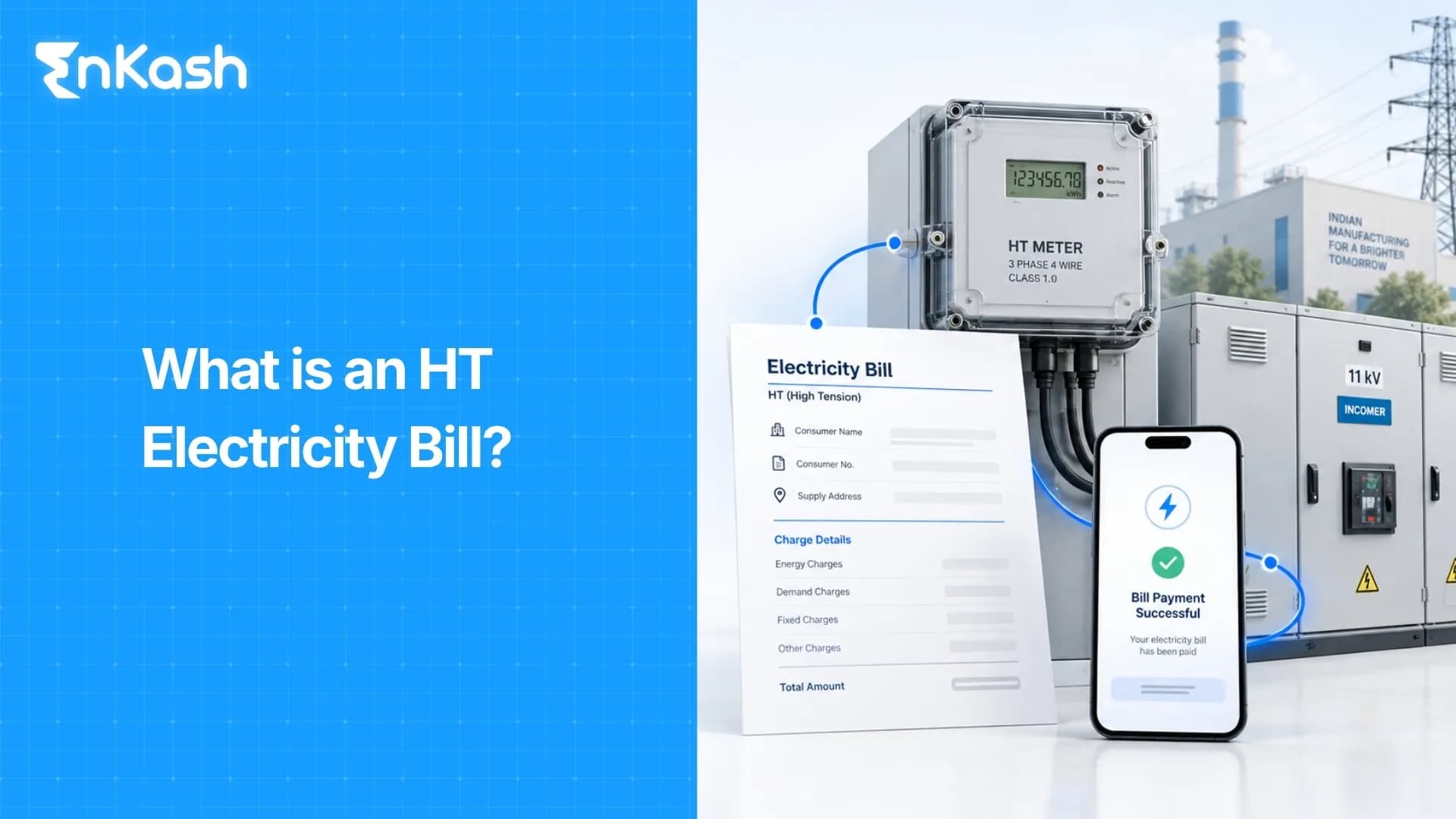
An HT electricity bill is the periodic bill issued for an electricity connection classified under a High Tension supply or tariff category. The applicable state framework decides which connection qualifies for HT treatment, using the voltage and demand conditions prescribed for that supply area.
It shows the amount payable for a billing period under the applicable tariff. HT status comes from the sanctioned connection and applicable tariff framework; the monthly bill does not create the classification. If a business changes its sanctioned load or supply arrangement, it should confirm whether its connection category and tariff have also changed. The current connection documents and tariff category should be checked before treating an account as HT. The bill itself is a periodic demand for payment; it is different from the supply agreement that establishes the sanctioned connection.
What Is LT and HT in an Electricity Bill
LT and HT in an electricity bill refer to the supply category under which a connection receives electricity. LT means Low Tension, and HT means High Tension. The applicable supply voltage and connection category depend on the relevant electricity supply regulations, utility requirements and approved tariff schedule.
Current tariff structures show this variation clearly. HT connection requirements vary by state and consumer category. For example, the Gujarat Electricity Regulatory Commission's FY 2026–27 tariff for Uttar Gujarat Vij Company Limited includes HT supply at 3.3 kV and above, with the relevant HT tariff category applying to contract demand of at least 100 kVA. Businesses should refer to their distribution utility's current tariff schedule and supply agreement to confirm the applicable voltage and demand requirements. These differences make the local tariff schedule more reliable than a single nationwide voltage rule. Contract demand can influence classification alongside voltage, and the approved load can affect the supply level assigned to a business connection.
| Comparison Area | LT Connection | HT Connection |
|---|
| Supply category | Lower-voltage electricity supply | Higher-voltage electricity supply |
| Electrical requirement | Lower or moderate load levels | Larger load requirements |
| Voltage threshold | Set by the local supply framework | Set by the local supply framework |
| Contract demand | May apply by tariff category | Common billing parameter |
| Receiving arrangement | Lower-voltage service infrastructure | Higher-voltage receiving equipment |
| Common use | Homes and smaller establishments | Larger commercial, institutional, and industrial premises |
How to Understand an HT Electricity Bill
An HT bill contains account, meter, load, and consumption fields that tell a business what was measured during the billing cycle. Each field has a separate role. Separating them prevents confusion between capacity, consumption, and peak demand.
| Bill Field | What it Means |
|---|
| Consumer or service number | Unique identifier assigned to the electricity connection. |
| Tariff or category code | Classification used for applying the relevant tariff schedule. |
| Supply voltage | Voltage level recorded for the approved connection. |
| Sanctioned or connected load | Approved or connected electrical load associated with the premises. |
| Contract demand | Demand in kW or kVA agreed under the connection arrangement. |
| Maximum demand | Highest average kW or kVA demand recorded during the specified measuring interval. Central consumer rules define it using a consecutive 30-minute period unless the Commission specifies another period. |
| kWh | Active electrical energy consumed during the billing period. |
| kVAh | Kilovolt-ampere-hours, a measure of apparent energy used for billing under certain tariff categories. |
| Power factor | Relationship between active power and apparent power for the electrical load. |
| Multiplying factor | Factor applied to meter values where the metering setup requires conversion. |
| TOD or TOU data | Consumption separated across time blocks defined under the tariff. |
| Billing period | Dates covered by the current bill. |
| Due date | Final payment date before applicable delayed-payment consequences can arise. |
What Charges Appear on an HT Electricity Bill
HT tariffs frequently use a multi-part billing structure. The final amount can combine capacity-related charges, energy consumption, time-based adjustments, statutory levies, previous dues, and tariff credits. A business should check the tariff order for its state, category, voltage, and connection arrangement.
| Charge | What Creates the Amount |
|---|
| Demand charge | Calculated from billing demand under the approved tariff. Billing demand can depend on recorded maximum demand, contract demand, or a tariff-specific formula. |
| Energy charge | Calculated using the billed energy units and the applicable tariff rate. Depending on the tariff, billing may be based on active energy (kWh) or apparent energy (kVAh). |
| TOD or TOU adjustment | Changes the energy cost for consumption during specified peak, normal, solar, or off-peak blocks. |
| Fuel or power-purchase adjustment | Recovers approved changes in fuel or purchased-power costs under the applicable regulatory mechanism. The name and calculation vary across states. |
| Wheeling or network charge | Applies where the tariff or supply arrangement includes a charge for use of the distribution network. |
| Electricity duty, tax, or cess | State-level statutory levy charged under the law applicable to the connection. |
| Excess-demand charge | Additional amount triggered when demand crosses the permitted level under the tariff or agreement. |
| Arrears and delayed-payment additions | Earlier unpaid dues, interest, or late-payment amounts carried into the current billing cycle. |
| Rebates or credits | Reductions permitted under the relevant tariff, such as eligible payment, power-factor, or other approved credits. |
An HT electricity bill typically combines demand charges and energy charges with applicable Time-of-Day adjustments, fuel or power-purchase adjustments, statutory levies, and previous dues. Rebates and other eligible credits are then deducted to arrive at the payable amount. The actual calculation depends on the approved tariff for the connection. The tariff order decides the actual calculation. Rates and billing conditions can vary by supply voltage, demand, consumer category and Time-of-Day period. A finance team should reconcile the billed line items against the tariff applicable to its own connection instead of relying on a generic rate. The tariff period also deserves attention because a revised order can change rates or billing conditions between financial years.
How Is an HT Electricity Bill Calculated?
An HT electricity bill is calculated using the applicable demand and energy charges, along with other adjustments specified in the distribution utility's tariff.
The calculation generally involves:
| Component | Calculation |
|---|
| Demand charges | Billing demand × applicable demand-charge rate |
| Energy charges | Billable energy units × applicable energy tariff |
| Time-of-Day adjustments | Additional charges or rebates for consumption during specified time periods |
| Other applicable charges | Fuel or power-purchase adjustments, statutory levies and other tariff-specific charges |
| Previous dues and credits | Outstanding amounts added and eligible rebates or credits deducted |
For example, consider a business with a billing demand of 100 kVA and monthly consumption of 20,000 kWh. If its applicable demand-charge rate is ₹150 per kVA and energy rate is ₹5 per kWh, these two components would contribute ₹15,000 and ₹1,00,000, respectively.
The amount before other charges and adjustments would therefore be ₹1,15,000.
This is only an illustrative calculation, not an actual tariff. The final payable amount may differ because of Time-of-Day charges, fuel adjustments, electricity duty, previous dues, rebates and the method used to determine billing demand.
Businesses should always use the current tariff approved for their specific connection when verifying an HT electricity bill.
HT Electricity Bill Download: How to Get a Copy Online
Download your HT electricity bill from your distribution utility's official website or designated HT consumer portal. The menu names may change between providers, but the HT electricity bill download itself follows a familiar pattern.
- Start at the official electricity-provider website or designated HT portal.
- Open the correct consumer account using the requested account or login information.
- Search the account menu for billing records or bill history.
- Select the required billing month and verify the consumer number and connection details.
- Download the bill and save it with the corresponding consumer account records.
Retain the original file you received from the portal. Check both the billing month and account reference before passing the document onward.
How to Pay HT Electricity Bill Online
For most businesses, an HT electricity bill first needs to be matched with the right location and account. A company with several offices, plants, or operating units may have several consumer numbers in use at the same time. Paying against the wrong one can create an unnecessary reconciliation issue later.
Before the payment is released, check the consumer number, billing month, due date, and amount payable. Any arrears or adjustment shown on the bill should also be looked at. The bill may then need to pass through the company’s normal approval process.
From there, the payment process is fairly easy:
- Open the utility’s approved payment channel or the company’s banking platform.
- Enter the consumer, service, contract, or account number shown on the bill.
- Fetch the bill and check the amount against the copy already received by the business.
- Select an available payment method. Depending on the amount, this may be internet banking, UPI, card payment, NEFT, RTGS, or another authorized channel.
- Complete any maker-checker or bank authorization required internally.
- Keep the transaction reference and payment acknowledgement with the bill record.
For a high-value HT bill payment, bank limits need a quick check before the transaction is started. Some businesses may prefer NEFT or RTGS for larger amounts, particularly where internal banking controls are already set up around such payments.
Transactions processed through the Bharat Bill Payment System (BBPS) fetch the bill before payment is initiated. The biller and payment options available can differ across participating channels.
One final check is worth doing after payment. A bank debit does not always mean the utility account has updated immediately. Use the transaction reference to check the payment status before trying again. A second payment against the same bill can leave the finance team with a duplicate debit to sort out later.
What Should Businesses Check Before and After HT Bill Payment
Large electricity payments deserve a control check separate from the payment steps. These checks help prevent duplicate payments, payments to the wrong account, missing approvals, and reconciliation errors.
| Control Point | Verification |
|---|
| Legal entity | Confirm the bill belongs to the business entity making payment. |
| Consumer account | Match the consumer or service number with internal records. |
| Billing month | Confirm the correct cycle is being settled. |
| Approval | Record the required internal authorization before payment. |
| Duplicate check | Search prior payment records for the same bill. |
| Amount | Match the payment amount with the approved payable figure. |
| Transaction reference | Capture the bank or digital transaction number. |
| Utility status | Confirm that the account reflects successful settlement. |
| Reconciliation | Match the bill, bank debit, and payment receipt. |
| Record retention | Store the bill and payment evidence together. |
Together, these checks help finance teams maintain a complete record of each bill and its payment.
Managing Electricity Bills Across Multiple Business Locations
For businesses operating factories, warehouses, offices, or other facilities, electricity bill management can become more complicated when each location has a separate consumer account, due date, and approval requirement.
EnKash's Utility Bill Payment platform helps businesses bring supported electricity bills into one dashboard. Finance teams can fetch bills from supported post-paid billers and pre-paid billers, map them to business locations, manage approvals, make single or bulk payments, and track payment status against the corresponding bill records.
Businesses can also maintain bill copies and payment information together for easier reconciliation.
The availability of a particular HT electricity biller and payment method should be confirmed before initiating payment.
Conclusion
Paying an HT electricity bill on time is important, but businesses also need to verify the charges and retain the payment records. Proper handling means checking the tariff, consumer details, metering information, and payment terms before approval. It also means keeping proof after the money has been transferred. Link the bill, tariff reference, transaction ID, and receipt within the same HT bill payment record.This gives finance teams the supporting records they need for reconciliation, audits and billing disputes.
FAQs
Can an HT electricity bill be paid partly?
Part-payment rules depend on the distribution utility, tariff conditions, and payment channel. India has no universal entitlement for every HT consumer to settle only part of the current bill. Check the account terms before entering a lower amount.
Is GST charged on electricity supplied to an HT consumer?
The supply of electrical energy is taxed at a nil GST rate under HSN code 2716 00 00, including supply to HT consumers. Separately supplied goods or services may have different GST treatment. Electricity duty and other statutory levies are governed by the applicable laws.
Can an HT consumer change contract demand?
An HT consumer can apply to increase or decrease contract demand under the applicable State Electricity Regulatory Commission's regulations and the distribution utility's procedures. Approval may depend on technical feasibility, network capacity, documentation, connection conditions and applicable charges. Approval can depend on technical feasibility, network capacity, documents, connection conditions, and applicable charges.
Where can a business raise an unresolved HT billing complaint?
Begin with the distribution utility’s billing grievance channel. An unresolved consumer grievance can move to the Consumer Grievance Redressal Forum and, where applicable, the Electricity Ombudsman. Keep the bill, complaint reference, payment records, and meter details available.