Introduction
An electricity bill is a document usually issued on a regular billing cycle (often monthly) to customers. It provides information about how much electricity was consumed and the amount payable for that usage. It is also referred to as an energy or power bill. The bill generally includes information such as your meter readings, total units consumed, tariff rates, and taxes. Correctly interpreting your electricity bill can help you monitor your energy usage, manage your monthly budget, and avoid overpayment. Digital tools and online payment methods now provide one of the fastest and easiest ways to settle your electricity bill. Since electricity prices in India vary across states and depend on consumption patterns, knowing how to read and understand your bill can make a real difference. In this blog, we explain what an electricity bill is, its key components, how it is calculated, and how you can manage and pay it smartly using simple digital options.
Pay Electicity Bills of Multiple LocationWhat Is an Electricity Bill?
An electricity bill (also known as a power bill) is a periodic statement issued by an electricity service provider that details the amount of electrical energy consumed over a specific billing cycle and the total amount payable. It reflects how much power has been used by a home or business and serves as the official record required for electricity bill payment.
For businesses, electricity bills are critical operational documents because uninterrupted power is essential for offices, warehouses, retail outlets, and manufacturing units. Managing electricity bills digitally helps organizations maintain service continuity, control costs, and improve financial visibility.
Pay Your Electricity BillKey Components of an Electricity Bill
An electricity bill has several elements that determine the total amount you pay. Understanding these components makes it easier to see how your charges are calculated.
Fixed Charge
The fixed charge is the minimum amount you pay for having an electricity supply and meter, and it is charged monthly. It is applicable even when you don’t consume much electricity. This fee is to make sure that the power supply network is always available and can be depended upon for your home or business.
Energy Charge
This is the most significant portion of your electricity bill. It is determined by the number of units (kWh) consumed during the billing period. For example, in many Indian states, residential tariffs increase with consumption slabs, so higher usage falls under higher per-unit rates. The higher your energy consumption, the higher your power bill will be.
Electricity Tax or Duty
Electricity tax, also known as duty, is a charge that the government levies on your energy bill and which varies from one state to the other. This tax, besides being a revenue source for the government, also supports local electricity infrastructure and welfare projects.
FAC (Fuel Adjustment Cost)
The Fuel Adjustment Cost (FAC) or Fuel Cost Adjustment is a measure of the fuel used in electricity production and hence its cost changes. When fuel prices rise, an additional charge may be added to your bill to account for higher generation costs and keep electricity pricing balanced.
Penalty or Late Fee
If you miss the payment due date for your current bill, the utility company may impose a small penalty or late fee. This amount is added to your next electricity bill and encourages timely payments.
Rebate
Some power companies offer rebates or small discounts to encourage early payment of electricity bills, especially when paid online or through electronic bill payment systems. It is a good way to save money while keeping a good payment record.
Interest, Incentives, and Arrears
Interest may be levied if you have outstanding dues. Some utilities may offer incentives for consistent payments or participation in specific energy-saving schemes. Arrears are the amounts that are not paid and thus referred to as old, unpaid amounts that are carried over to your next electricity bill.
Learning these key points makes it easier for you to keep track of your electricity expenses and thereby manage the payment of your monthly power bill effectively.
Utility Bill PaymentsSurcharge in Electricity Bill
A surcharge on the electricity bill is an additional fee that may be applied when a payment is made late or when consumption crosses certain thresholds defined by the utility or regulator. It acts as a financial encouragement to promote the behaviour of paying on time and consuming energy prudently. In case the electricity company does not get the current bill's payment by the due date, it will impose a small percentage of the total amount as a surcharge.
Customers who use more power during peak hours may have to pay additional charges under time-of-day or peak-load tariffs. The surcharge, while it might not appear to be significant, could lead to higher electricity prices for you, especially when your monthly bills are always delayed. Prompt payment of your energy bill means you avoid these additional fees and also get to keep a good payment record. Nowadays, for quicker processing, many people are opting for online payment methods that are secure. Services such as EnKash provide easy-to-use electricity bill payment that makes it hassle-free for you to pay on time, log the payments, and manage your electricity bill effectively. By paying on time consistently, you can avoid surcharges, save money, and support a more predictable billing process.
What Are Electricity Bill Copies?
Electricity bill copies are official digital or physical records of an electricity bill or a power bill issued by an authorized electricity provider. These copies contain verified billing details such as electricity usage, billing period, payable amount, and payment status, and serve as proof of consumption and electricity bill payment for businesses.
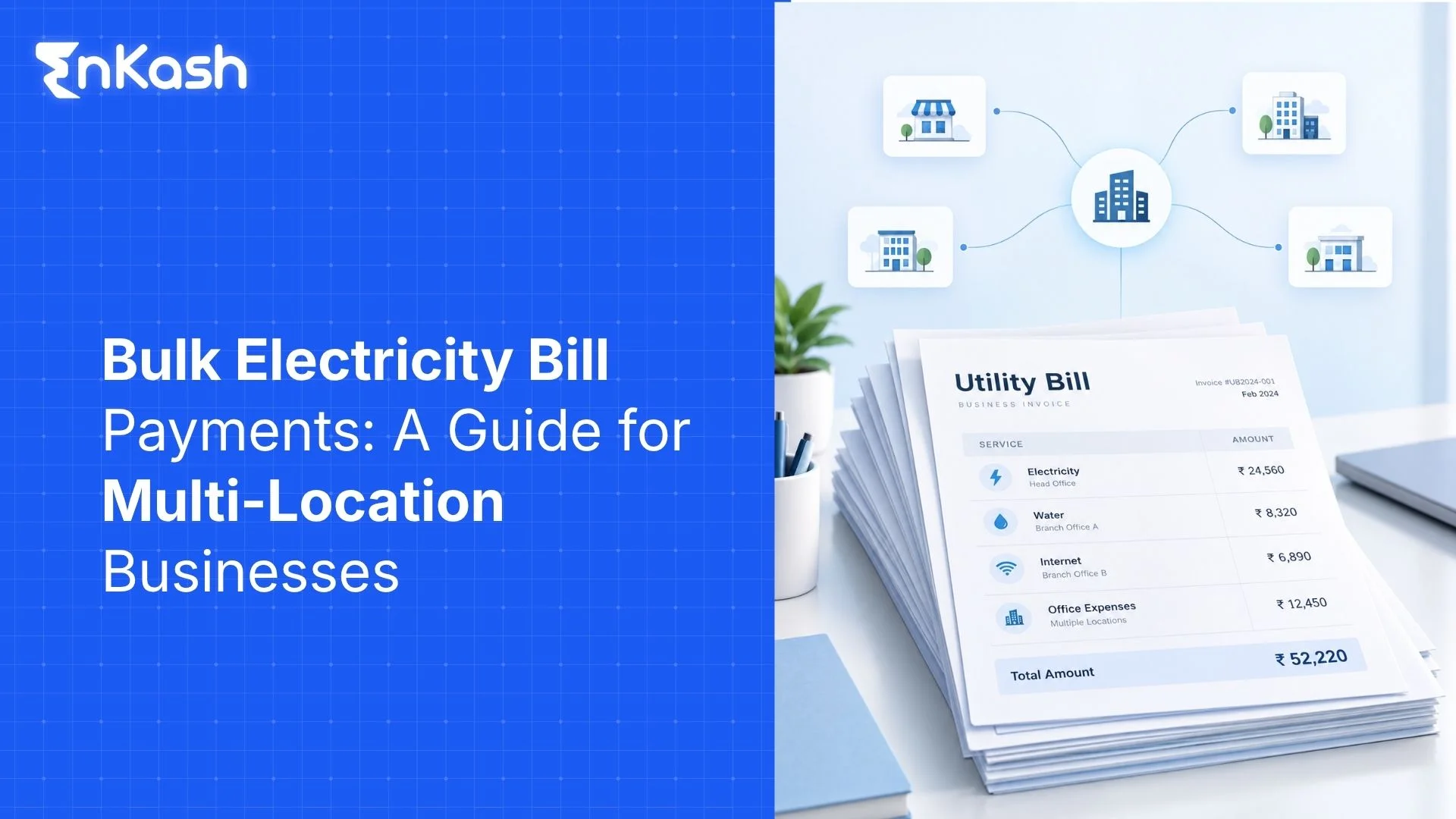
For organizations operating across multiple offices, warehouses, or retail locations, electricity bill copies are essential financial documents used for reconciliation, audits, compliance, and expense tracking.
Get Bill CopiesWhy Electricity Bill Copies Are Important for Businesses
Unlike individual consumers, businesses rely on electricity bill copies for more than just making payments. They play a critical role in financial governance and operational continuity.
Key reasons businesses must maintain electricity bill copies:- Audit & Compliance Requirements
Electricity bill copies are required during internal audits, statutory audits, and regulatory reviews to validate power-related expenses.
- Accurate Reconciliation
Finance teams use electricity bill copies to match invoices with actual electricity bill payments, ensuring there are no discrepancies or duplicate charges.
- Expense Verification & Cost Control
Reviewing historical power bill copies helps businesses analyze consumption patterns and optimize energy costs.
- Branch-Level Accountability
For multi-location businesses, electricity bill copies help attribute power expenses to the correct branch, department, or cost center.
Pay Business Electricity BillA standard electricity bill copy includes:- Consumer or service connection number
- Billing cycle and meter reading details
- Electricity units consumed (kWh)
- Tariff rates, taxes, and surcharges
- Total payable amount and due date
- Status of electricity bill payment (paid / unpaid)
These details make electricity bill copies a reliable source for financial reporting and operational analysis
What is the Electricity Bill Tariff? How Electricity Bill Tariff Works in India
The electricity bill tariff is the pricing structure that decides the amount you are going to pay for the electricity you consume. In a nutshell, it’s the unit rate that power suppliers charge you for every single unit of electricity that you use. The tariff not only sets the price of electricity in India but also defines how different customer categories, such as domestic, commercial, and industrial, are billed. Given that every state has its own power supply and regulatory authority, the electricity tariff in India depends on various factors like locality, type of connection, and total consumption.
Tariff Structure and Charges
The electricity tariff rates, most of the time, are set in slabs according to the level of consumption. This approach is adopted to encourage efficiency in energy use and prevent its wastage. For example, consumers who use 0–100 units are charged at the lowest rate, whereas those who fall between 101–300 units are charged at a moderate rate. Customers who exceed 300 units are charged at higher rates to promote responsible electricity consumption. Such slab-based schemes are created to ensure that households with low energy use get the electricity at reasonable rates, while at the same time, the bulk users pay more, but proportionately.
Most electricity tariffs include fixed charges, energy charges, and government duties as per your power distribution company’s policies. Rates are approved by the State Electricity Regulatory Commissions (SERCs) to balance utility costs and consumer protection.
The electronic bill format has made the management of electricity bills simpler, quicker, and more efficient for both individuals and businesses. Instead of receiving bills in paper format, consumers are now getting their electricity bills delivered to them instantly through email, SMS, or mobile applications, which makes it very easy to keep track of the bill and pay it from anywhere.
The digital power bill contains all the necessary information, i.e,. Meter readings, units consumed, energy charges, taxes, and the total amount due — all very clearly shown for better understanding. Behind this seamless process is an advanced energy billing system that automates data collection, bill generation, and payment reminders, ensuring accuracy and reducing manual errors.
Furthermore, the companies can incorporate providers such as EnKash to streamline the processing of multiple current bill payments through one dashboard that also gives real-time monitoring of the business's electricity expenses. Choosing electronic billing is economical and environmentally friendly, as it significantly reduces paper use.
Moreover, it assures that the users will never miss their payments, thus simplifying the entire procedure. In conclusion, a digital electricity bill is a modern, safe, and smart choice that simplifies payments, improves customer convenience, and supports environmental sustainability.
Electricity Bill Payment Modes
Paying your electricity bill has become simple, fast, and user-friendly. In India, the majority of the electricity boards offer their customers a variety of payment methods, both online and offline, giving customers the flexibility to choose the most suitable mode and time for bill payment.
The simplest way is to make the payment online through the official website or the mobile applications of the concerned electricity board. You just need to enter your consumer or connection number, verify the bill details, and select your preferred payment method — whether UPI, debit/credit card, or internet banking. Along with the successful payment, you are given an instant digital receipt for confirmation.
EnKash can reduce the effort by letting you manage all your power bill payments from one dashboard. Moreover, you can set reminders or even automate recurring current bill payments to avoid penalties or disconnections. For those who like to stick to the classic ways, there is the offline payment option — just go to the nearby electricity office or payment center to make the payment in cash, by cheque, or by demand draft. No matter what method you choose, online or offline, the process has been made a lot simpler and safer over the years.
Secure transactions, quicker confirmations, and multiple payment options are now making electricity bill payments no longer a stressful task but a smooth and efficient routine instead.
How to Pay the Electricity Bill
Today, paying your electricity bill is simpler and more convenient than ever. There is no more standing in long lines or rushing to the nearest office before the due date. Just go to the website or mobile app of your electricity provider, enter your customer or connection number, see your billing information, and choose a payment method: UPI, debit or credit card, or net banking.
The bill payment is done in just a couple of mouse clicks, and you get a notification or digital receipt for your records right away. For people who are managing several connections or business accounts, platforms like EnKash make things even easier by allowing you to manage all your electricity bill payments from one dashboard. It is not only about convenience; online payment saves you from late fees, helps you stay organized, and allows you to pay from anywhere at any time.
Additionally, your transactions remain secure thanks to strong, encrypted digital gateways. Whether you are at home, in the office, or out, online bill payment guarantees that you will never miss a due date again. It is a minor move toward smarter money management and a less stressful way to stay on top of monthly expenses.
Read More: What is BBPS?
How to Pay an Electricity Bill Offline
In case you wish to make your electricity bill payment more conventional, different offline payment methods still exist throughout India. You can go to the electricity board office that is nearest to you, the payment counter, or an authorized collection center to pay your power bill in person. A copy of your energy bill or your consumer number is the only thing you need to bring.
You can usually pay by cash, cheque, or demand draft, depending on what is convenient for you. In addition, there are several local banks and post offices that are allowed to collect payments for electricity bills for the power company, which makes it easier for people in both urban and rural areas to pay their bills.
After the payment is made, you will receive a printed receipt as proof of payment, and it should be kept carefully for future reference. While offline payments are safe and known to a lot of consumers, they may be prone to taking a longer time sometimes due to traveling and waiting in long queues. This is where digital payment methods have become more popular — they take less time and allow you to make payments instantly for your current bill.
Nonetheless, for those who prefer in-person transactions or live in areas with limited internet connectivity, offline electricity bill payment continues to be a dependable and trustworthy option.
Read More: About Utility Bill Payments
How Electricity Bill Is Calculated
The method used to calculate your electricity bill is straightforward. The total power consumed in the billing period is the basis of your billing and is measured in units or kilowatt-hours (kWh).
The electricity rate that is specifically assigned to the portion of electricity used is called a tariff, and it is not the same everywhere. The tariff not only depends on your area, but also on the type of connection (residential, commercial, or industrial) and the total amount of power consumed. The billing system uses consumption slabs. It imposes a lower rate for low usage and a higher rate for high usage. For example, if the per-unit tariff is ₹6 under a particular slab, then the basic energy cost for 200 units would be ₹1,200 before adding other charges. However, this amount is not the final one.
The base cost of a power supply may include fixed charges, taxes, electricity duty or tax, FAC (Fuel Adjustment Cost), and sometimes even rebates, penalties, or arrears. The total amount payable is the result of adding applicable charges and subtracting any rebates. Besides, some states allow discounts for paying on time and impose extra charges for late payments. Knowing the factors that together compose your electricity bill can help you become a smarter and thus more efficient user in terms of both the time and the quantity of electricity consumed.
Following your energy consumption every month could lead you to discover areas where you can save energy, which in turn would lower your overall energy cost.
Conclusion
By understanding your electricity bill, you will be able to monitor your energy consumption, manage your costs, and prevent any penalties. Whether you choose to pay online or offline, paying on time is essential for an uninterrupted electricity supply.
The recent advent of digital platforms like EnKash has made the management of several energy bills a walk in the park. Technology guarantees every customer a hassle-free and safe experience, from digital, paperless billing formats to versatile payment methods. Understanding tariffs, charges, and bill calculations helps customers save money and make more informed choices about their electricity usage.
FAQs
1. What is an electricity bill?An electricity bill is a statement from your electricity provider showing how much energy you used in a billing period, the total amount payable, and a breakdown of charges such as fixed charges, energy charges, taxes, and fuel adjustment.
2. What are the main components of an electricity bill?The main components include fixed charges, energy charges, electricity duty or tax, FAC, and any applicable rebates, penalties, interest, or arrears.
3. Is it safe to pay my electricity bill online?Yes. Well-known payment platforms such as EnKash, electricity board apps, and banking portals employ encryption and secure gateways to use encryption and secure gateways to help ensure that transactions are safe and hassle-free.
4. What will happen if I don't pay my electricity bill when it's due?In case you delay payment of your current bill, the next bill will be charged with a surcharge or late payment fee. In extreme cases, if you do not pay for a prolonged period, your electricity may be cut off.
5. Can my electricity bill be reduced?Yes. Many utilities offer rebates or discounts for early payments, digital or paperless payments, or participation in specific energy-saving schemes, depending on their policies.