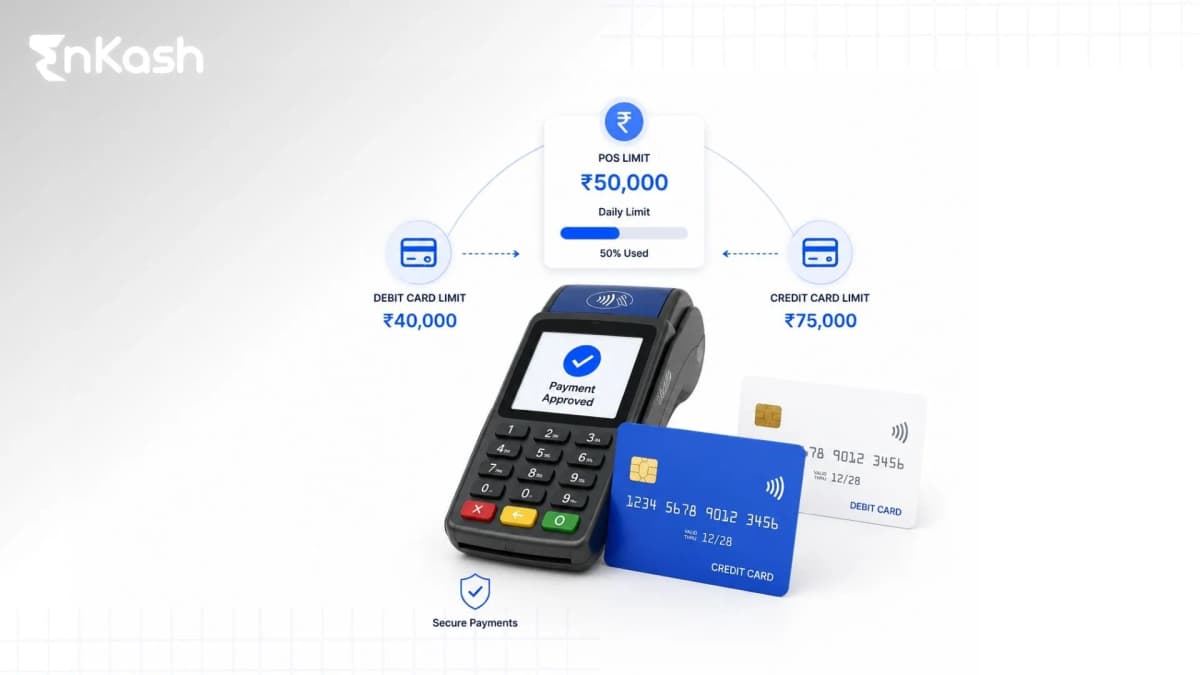
A card payment can get declined at a billing counter even when the linked account has enough money. The issue may come from the POS limit, which is one of the controls that determines the maximum amount a card can be used for at a point-of-sale terminal. This is the payment device found at stores, fuel stations, hospitals, restaurants, hotels, malls, travel counters, and similar merchant locations.
The confusion starts because banks place separate limits on the same card. A customer may have one cap for ATM cash withdrawal, another for merchant payments, another for online use, and a separate value for contactless transactions. Some cards also carry different domestic and international usage settings.
The ATM POS meaning can confuse users because both terms appear in banking apps, card settings, and transaction alerts. An ATM allows customers to withdraw cash from a bank machine.
A POS terminal allows card payments at merchant counters. Certain enabled POS terminals may also allow limited cash withdrawal through eligible debit cards and full-KYC prepaid cards, subject to RBI rules and issuer support.
The sections below cover POS meaning, debit card limits, credit card transactions, swipe controls, cash withdrawal rules, and the way card payments move through a merchant terminal.
POS limit is part of a card’s channel-level control system. Banks may set separate limits for ATM withdrawals, POS payments, online transactions, contactless payments, domestic usage, and international usage. These controls help issuers manage fraud risk, customer safety, transaction approval, and cardholder preferences.
What is the POS Limit
POS Limit means the maximum transaction value allowed when a card is used through a Point of Sale terminal. The cap may apply to a retail purchase, a restaurant bill, a hospital payment, a hotel charge, or a cash withdrawal through an eligible merchant terminal. The bank’s card settings decide the exact use case.
For merchant payments, this limit controls the amount a customer can pay through the terminal in a single transaction or during a defined usage period. A card may have sufficient funds, yet the terminal payment can still fail if the card’s permitted merchant limit is lower than the bill amount.
Banks decide these limits based on the card type, account category, card network, usage channel, customer controls, and internal risk checks. Cardholders may also reduce or modify card limits through mobile banking, net banking, ATM services, or branch support, depending on issuer options.
How POS Works Through Physical Card Use
A POS transaction happens when the card is used at a merchant payment device. The card may be inserted into a chip terminal, tapped through contactless mode, or swiped through a magnetic stripe reader. The customer may need to enter a PIN, depending on the amount, card type, terminal setup, and authentication rules.
The card swipe limit in POS is the spending cap linked with card use at a merchant terminal. Customers use the term “swipe” for many card-present payments, even though modern terminals may process transactions via chip or tap technology.
POS, ATM, and Online Limits Work Separately
Card channels do not always share the same limit. ATM usage relates to cash withdrawal from a bank machine. POS usage relates to payments made through a merchant terminal. Online usage applies when card details are entered on a website, app, or payment page.
Separate limits make card usage easier to manage. A customer may keep e-commerce spending restricted, leave a higher cap for store payments, and disable international transactions during regular domestic use.
What is the POS Limit on Debit Cards
A debit card withdraws funds from the bank account linked to it, but a merchant payment still requires issuer approval. The card can process only the amount allowed for that payment channel. A transaction may fail if the bill exceeds the permitted amount, even if the account has enough funds.
Approval depends on several checks working together. The account must have a usable balance, the card must remain active, the merchant payment channel must be enabled, and the transaction value must fall within the approved purchase limit. Location also affects approval when domestic and international controls are managed separately.
The same debit card POS cap may appear under different names across banking apps. Some banks place it under a shopping limit, while others use a purchase limit, merchant limit, daily transaction limit, or debit card POS limit. In every case, the card can process payments only within the value permitted for that channel.
Limits also differ by card type. A basic debit card linked to a regular savings account may have a lower purchase cap than a premium debit card linked to a priority account. Business debit cards may have separate controls for vendor payments, travel costs, and operating expenses. Salary cards may follow a different structure depending on the account program and issuing bank.
A terminal decline does not always point to a low balance. The bank may reject the payment because the merchant channel is switched off, the daily value has already been used, the PIN is incorrect, or the transaction appears unusual under issuer risk checks. Contactless payments may also fail when the amount crosses the permitted tap value.
Before a high-value purchase, customers should check the exact card channel rather than only the account balance. Mobile banking or net banking can help confirm the purchase cap, single transaction value, contactless setting, and overseas usage status before the card is used at the counter.
Types of POS Limits
Daily POS Transaction Limit
A daily POS transaction limit controls the total card value allowed through merchant terminals within a single banking day. This cap is useful because merchant payments can happen across many places, including supermarkets, pharmacies, fuel stations, clinics, hotels, and electronics stores. Once the daily limit is reached, the next merchant payment may fail even when the account has enough funds.
Daily limits vary by card issuer, card variant, account type, network, customer profile, and channel settings. Some cards are built for small household spending. Others allow higher merchant payments for travel, business, or premium account use. A customer cannot assume a universal figure because each issuer maintains its own card matrix.
Per Transaction POS Limit
A per-transaction limit controls the highest amount allowed in a single merchant payment. This value may equal the daily cap or be lower. For example, a card can allow a high daily purchase value but restrict a single large transaction for security reasons.
Customers commonly use the term ‘POS card swipe limit’ for this cap. The wording comes from older magnetic stripe payments, but the same idea applies when the card is inserted into a chip terminal or tapped on a contactless machine. A large jewellery purchase, hospital bill, hotel payment, or electronics purchase can fail if the single transaction exceeds the allowed cap.
POS Cash Withdrawal Limit
POS cash withdrawal is a separate facility from merchant purchase payments. It allows an eligible cardholder to withdraw cash at selected merchant terminals where the service is enabled. The customer may not need to buy goods for this facility, but the terminal, merchant, issuer, and acquiring arrangement must support cash withdrawal.
RBI rules allow cash withdrawals at POS terminals up to ₹2,000 per transaction, subject to an overall monthly cap of ₹10,000. Issuers or merchants may apply stricter controls depending on the card and arrangement. Charges, where applicable, should be checked with the issuer and merchant. RBI guidance has capped charges for cash withdrawal at POS at 1% of the transaction amount. This limit should never be confused with ATM withdrawal limits, as both services use different channels and rules.
Contactless card payments work through tap technology at NFC-enabled terminals. Small-value transactions can move faster because the customer may not need to enter a PIN within the permitted no-authentication value. Current RBI rules allow contactless card-present transactions up to ₹5,000 per transaction without an additional authentication factor, subject to card, terminal, and issuer settings.
Higher amounts may need PIN entry or another validation step. Banks can apply stricter security settings based on card type, customer preference, and transaction risk.
Domestic and International POS Limits
Domestic and international merchant limits may be managed separately. A card may work smoothly at local terminals but fail abroad when overseas usage is disabled. Many banks allow customers to activate international merchant payments for a limited duration or set a lower value for overseas travel.
This separation gives customers tighter control. A person without a travel plan can keep international merchant usage off and reduce the risk of misuse. A traveler can enable it before departure and adjust the permitted amount based on planned expenses.
Credit Card POS limit
Credit card merchant payments follow a different funding model. The amount is not withdrawn from a bank account at once. It reduces the card’s available credit and is included in the billing cycle. The approved credit limit, available balance, issuer controls, merchant category, and risk checks determine whether the payment proceeds.
Cash access on a credit card is subject to a separate cash advance arrangement under the issuer's terms. It should not be confused with cash withdrawal at merchant POS terminals.
What Type of Cards Can be Used for POS Withdrawals
For cash access at merchant terminals, debit card POS usage depends on card eligibility, issuer permission, and merchant terminal support. The POS transaction limit for withdrawal is separate from regular purchase payments, which is why customers should check the facility before expecting cash at a retail counter.
Debit Cards
Debit cards can be used for cash withdrawal at selected merchant POS terminals when the facility is available. The card must be active, the linked account must hold sufficient funds, and the merchant terminal must support cash withdrawal. The customer should expect to be authenticated using a PIN or another approved method before cash is handed over.
This facility is useful in areas where ATM access may be limited. A merchant terminal can act as a cash access point, provided the service is enabled through the acquiring arrangement. The customer should still check charges and confirm the transaction before leaving the counter.
Full-KYC prepaid cards can support POS cash withdrawal when the issuer and facility permit it. These cards hold preloaded values. They are different from small prepaid instruments with limited functionality.
KYC levels become important because cash withdrawals require stronger identification and controls. A full-KYC prepaid card has completed the required customer verification, which allows broader use than a restricted prepaid instrument.
Other Eligible Cash Access Routes
Some banking access routes may support cash withdrawal at enabled merchant points, but customers should verify eligibility with their bank. For clarity, RBI’s standard cash-at-POS facility is commonly explained for debit cards and full-KYC prepaid cards. This point is useful for customers who use basic banking services or digital payment options beyond regular debit cards.
These routes depend on the facility being enabled at the merchant point. A customer should not assume every shop or local counter can provide cash withdrawal through these methods.
Credit Cards
Credit cards can be used for merchant purchases at POS terminals, but they cannot be used for POS cash withdrawal under this facility. A cardholder may still have access to credit card cash advances through ATMs if the issuer allows it, but that is a separate service with its own fees, interest terms, and billing treatment.
The difference is important because merchant payment and cash access carry different risk and cost structures. Customers should review the issuer's terms before using any credit card cash feature.
How POS Works
Step 1: The Card is Used at the Merchant Terminal
A POS payment begins when the customer presents the card at a merchant payment device. The card can be inserted into a chip terminal, tapped on an NFC reader, or swiped through the magnetic stripe reader. The method depends on the card, terminal, merchant setup, and transaction value.
A terminal payment may be called a swipe in everyday banking language, although the card may be inserted, tapped, or swiped. The card swipe limit in POS still refers to the amount allowed at the merchant payment device, regardless of the card-present method used.
Step 2: Transaction Details Move for Approval
The terminal sends the payment request through the acquiring side and the card network toward the issuer. The request carries transaction details such as amount, merchant information, card data, and authentication signals. The customer does not see this routing, but these checks determine whether approval arrives within seconds.
The acquiring bank or payment service partner manages the merchant side. The issuing bank checks the customer's side. The card network connects the transaction path between both sides.
Step 3: Authentication Takes Place
Authentication protects the cardholder before funds are moved or credit is blocked. Debit card purchases commonly need PIN entry at the terminal. Contactless transactions within the permitted value may proceed without a PIN, while higher values may require validation. International terminal behavior can differ based on card network rules and issuer settings.
Authentication failure can stop a payment even when the account balance is adequate. An incorrect PIN, an expired card, an inactive chip, a blocked contactless channel, or a disabled international setting can interrupt the approval chain.
Step 4: The Bank Checks Balance, Card Status, and Limit
Before approval, the issuer checks the POS card swipe limit, card status, available balance or credit, channel permission, and risk signals linked with the transaction.
For debit cards, the linked account must have enough usable funds. For credit cards, the available credit must support the purchase. For prepaid cards, stored value must cover the payment. Any mismatch can lead to decline.
Step 5: Payment Confirmation Reaches the Counter
Once approval is received, the terminal prints a receipt or displays a confirmation. The customer may receive an SMS, app alert, or email based on bank notification settings. Debit card payments reduce the bank account balance. Credit card payments reduce available credit. Prepaid card payments reduce the loaded value.
Merchant settlement happens later through the acquiring arrangement. From the customer side, the payment is complete once confirmation is generated and the merchant accepts the transaction.
Failed POS Transactions and Reversal Timeline
A failed POS transaction requires a separate view when the customer’s account is debited, but the merchant terminal does not generate a confirmation. This can happen due to network failure, timeouts, or communication failures between systems.
For card-present POS transactions, including cash at POS, the reversal timeline is T+5 days from the date the account is debited, but the merchant location does not receive confirmation. Compensation of ₹100 per day applies if the reversal exceeds the prescribed timeline. Customers should keep the failed receipt, SMS alert, transaction reference, and merchant details until the reversal is completed.
What Debit Cards Have POS Limits
Customers asking what the POS limit is on a debit card should first check the card variant and bank settings. Every active card enabled for debit card POS payments has a merchant usage cap, which varies by issuer, account type, and card category.
All Active Debit Cards Used for Merchant Payments Carry Limits
Every debit card enabled for merchant payments carries a purchase cap in some form. The bank may place it under card controls, usage limits, channel settings, transaction management, or debit card services. The label can differ across banks, but the function remains tied to merchant payment control.
A customer should check the card’s active channels before making a large purchase. The ATM limit, merchant purchase cap, online payment settings, contactless value, and international permission may all appear in separate places.
Standard Debit Cards
Standard debit cards are built for regular household and personal spending. They are commonly used for groceries, medicines, fuel, dining, utility counters, small retail purchases, and local service payments. Their merchant limits are designed for everyday use rather than heavy business spending.
These cards can still handle many routine POS payments when the balance and channel settings are correct. The customer should verify the single transaction limit before large purchases, as standard cards may have lower purchase caps than premium variants.
Premium Debit Cards
Premium debit cards can carry higher merchant purchase limits because they are linked with higher account tiers or upgraded card programs. These may include platinum, select, wealth, priority, or signature-style debit cards, depending on the issuer.
Higher limits can help with travel bookings, medical bills, hotel payments, electronics purchases, and family expenses. They should still be managed with care. A high merchant cap can increase exposure if the card is lost, cloned, or misused. Customers should keep alerts active and reduce channels they do not use.
Business and Salary Debit Cards
Business debit cards may support higher or differently structured purchase limits because they are used for operational payments. A proprietor, professional, or small business owner may use such cards for fuel, travel, supplies, vendor counters, or office purchases.
Salary account debit cards may be subject to limits linked to the employer banking program or account package. Some may resemble standard cards, while others may provide higher merchant usage based on the salary relationship.
How Users Can Check or Change POS Limits
Most banks allow customers to manage debit card limits through mobile banking, net banking, ATM services, customer care, or branch support. The exact path differs by issuer, but the control area generally appears under debit card services or card management.
Before a large merchant payment, customers should check the domestic POS status, international POS status, daily purchase cap, single transaction cap, and contactless setting. A quick review can prevent a failed transaction at the counter and reduce exposure on unused channels.
Bottom Line
The POS limit is the card usage cap linked with payments at merchant terminals. It determines how much value can be processed through a physical payment device, based on issuer rules, card type, available balance or credit, channel settings, and security checks.
Debit cards use funds from the linked account. Credit cards use available credit. Prepaid cards use stored value. Cash withdrawals at merchant terminals are processed through a separate regulated facility with its own eligibility rules.
A failed POS payment does not always mean a lack of funds. The reason may be a disabled channel, an exhausted limit, an authentication issue, an international restriction, a contactless value mismatch, or a bank risk check. Checking card settings before a high-value payment remains the simplest way to avoid avoidable declines.
FAQs
What does POS Limit mean on a card?
POS limit means the maximum amount a card can process through a Point of Sale terminal. It applies to payments made at merchant counters, and the exact value depends on the card issuer, card variant, channel settings, and available balance or credit.
What is the POS limit on debit cards?
The POS limit on a debit card is the maximum value allowed for merchant payments through that card. The amount is taken from the linked bank account, but approval still depends on issuer-set purchase limits and active card channels.
Is the POS limit the same as the ATM limit?
POS limit and ATM limit apply to different card uses. ATM limit controls cash withdrawal from bank machines, while POS limit controls payments at merchant terminals. Banks may display both controls separately in mobile banking or net banking.
What is a POS cash withdrawal?
POS cash withdrawal allows eligible customers to withdraw cash at selected merchant terminals. RBI permits this facility for eligible debit cards and full-KYC prepaid cards, with a ₹2,000 per transaction cap and ₹10,000 monthly overall limit, subject to issuer and merchant support.
Can I withdraw cash from a POS using a credit card?
Credit cards cannot be used for cash withdrawals at POS under the RBI’s cash-at-POS facility. Credit card cash access, when available, works like an ATM cash advance and is subject to the issuer’s fees, interest rates, and billing terms.
Why did my debit card POS transaction fail?
A debit card POS transaction may fail due to insufficient usable balance, exhausted purchase limit, disabled merchant channel, incorrect PIN, contactless value restriction, inactive international usage, terminal error, network timeout, or issuer security checks.
What is the Card Swipe limit in POS?
Card swipe limit in POS refers to the maximum amount allowed when a card is used at a merchant terminal. The term “swipe” is common, but the same limit idea applies to chip insertion and contactless tap payments.
Can I change my POS card swipe limit?
Many card issuers allow customers to adjust POS limits through mobile banking, net banking, ATM services, customer care, or branch support. Any increase remains restricted by the maximum value assigned to the card variant and account category.
What is the contactless POS payment limit in India?
Contactless card-present transactions can be completed without an additional authentication factor up to ₹5,000 per transaction, subject to applicable card and terminal standards. Higher-value transactions may require PIN or another authentication step.
What happens if a POS payment is debited but fails?
When a card-present POS transaction debits the account but does not generate confirmation at the merchant location, auto-reversal must happen within T + 5 days. Delay beyond that timeline attracts a ₹100 per-day compensation.