Payment Successful is not just another notification or pop-up on the screen, it is the whole point for businesses. The moment when a customer’s buying intent converts into payment, that is when the revenue is generated. Until that moment, everything else is only potential. The buyer may have discovered your product, added items to their cart, completed a booking, or enrolled in a course. But they will become your customer until the payment goes through and your business has earned from it. This distinction in businesses matters more than most businesses realize.
Revenue is Dependent on Payment Completion
Whether you are a fast-growing D2C brand, a travel platform handling thousands of bookings, an edtech company, or a SaaS business, one thing remains constant: Your business will thrive and grow only when payments are collected successfully. Everything in business including customer acquisition, employee salaries, product development and business expansion is dependent on how well the business is doing which in turn questions the revenue. And, the revenue can never materialize without successful payments. So, it’s a loop.
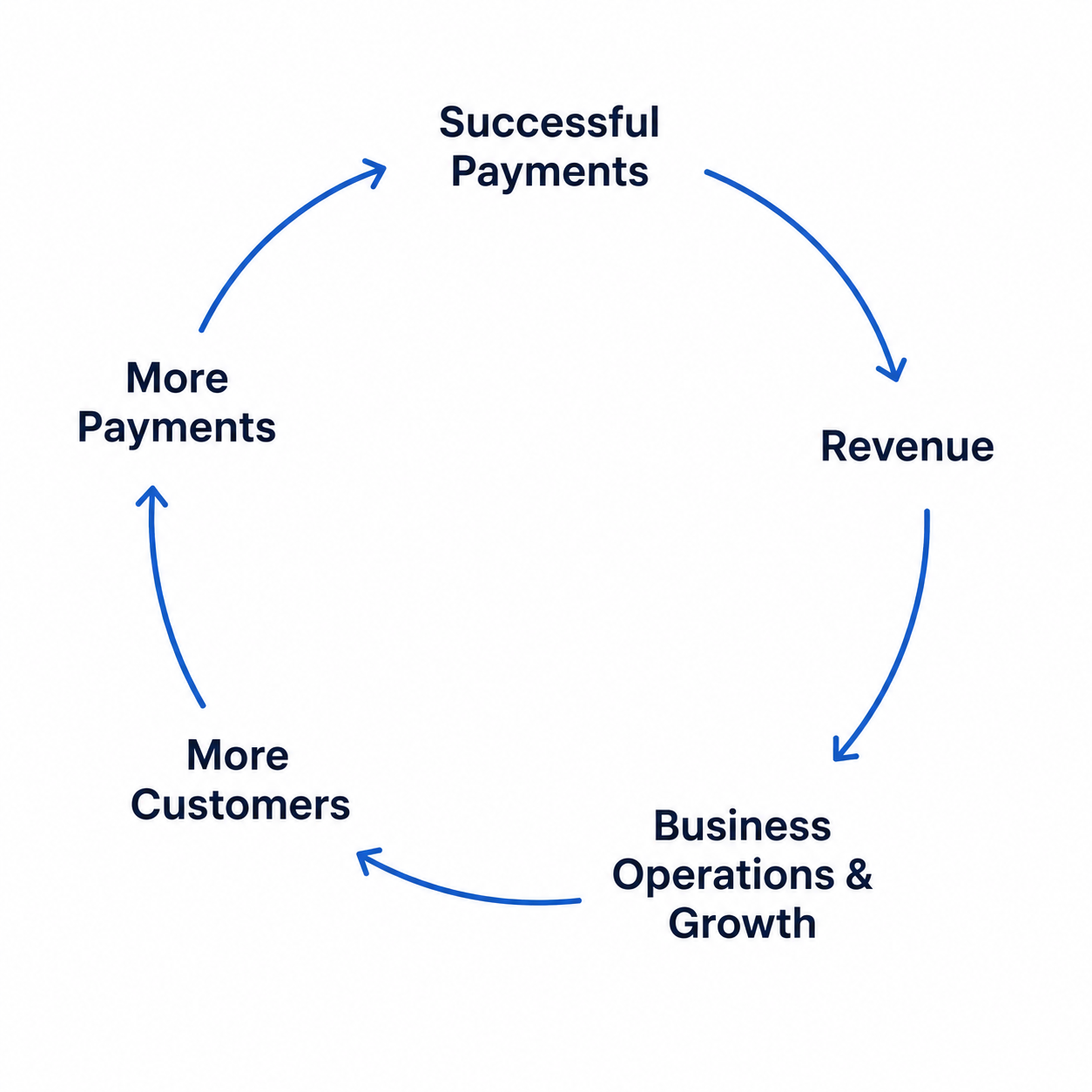 The Hard Truth About Business Growth
The founders pour their heart and sweat to design the best product, make marketing work in their favour, provide the best customer service, give a competitive pricing and facilitate distribution. BUT… If their customers cannot complete their payments, the value of each of these upstream investments is diminished. Every money spent on making this money is gone in that one defining moment.
Failed Payments Equals Revenue Loss
A failed payment is a business loss. Period. A slight increase in payment success rates can have a meaningful impact on revenue, especially for businesses processing large transaction volumes. Similarly, one failed payment may not affect the business as compared to thousands of failed payments. Whenever a payment fails, businesses not just lose revenue but also experience disruption in cash flow, higher cost for support, increased customer churn and reduced customer trust, wasted marketing spend and lower rates of conversion.
Different Industries, Same Story
D2C and E-commerce
Imagine you are a skincare brand or a healthy dessert brand and your latest product has gone viral. You see a lot of customers flocking to your website and adding the product to their carts. The moment they head towards checkout, the payment fails! What looked like a successful marketing campaign suddenly turns into a missed revenue opportunity. The customer may abandon the purchase, your conversion rate drops, and the money you invested in advertising delivers a lower return than expected. In many cases, that customer may never come back, reducing their lifetime value and increasing your customer acquisition cost. This is why checkout is one of the most important stages in your revenue journey. No matter how compelling your product is, how strong your brand story is, or how much you spend on marketing, profitability ultimately depends on your ability to convert purchase intent into completed payments. Checkout is where profitability is won or lost. A failed payment is not just a technical issue. It is a direct hit to revenue, cash flow, customer retention, and long-term business growth.
Travel and Hospitality
When a customer completes payment, it triggers a chain of critical business operations — airline tickets are issued, hotel rooms are reserved, itineraries are confirmed, and the revenue generated provides the working capital needed to manage day-to-day operations. A completed payment is more than just a transaction in the travel industry. It is the event that converts customer intent into confirmed revenue. If the payment fails, tickets are not issued, reservations are not secured, and the customer may abandon the purchase altogether. In this highly competitive industry, travelers quickly move to another platform, causing the business to lose revenue instantly. For travel companies, payment success rates directly affect the entire booking journey. Every successful payment confirms a booking and every failed payment implies the risk of losing both the customer and the revenue.
Education and EdTech
The education industry enables new learning experiences with very successful fee payment. The ecosystem in the education industry is dependent on each payment that is done to pay for any course subscription, coaching fee, university fee or offline admission. When a student successfully pays the fees, institutions and education platforms can invest in better technology and digital infrastructure, pay their faculty timely to keep them motivated, maintain classrooms and learning systems, expand their courses, and deliver academic experiences that support student’s growth. A payment is not just an administrative process. It allows institutions to continue delivering quality education at scale. Any delayed or failed fee can create significant operational challenges. In many cases, payment friction can even lead to incomplete enrollments or student drop-offs, affecting both revenue and retention.
Payments As A Strategic Infrastructure
Payments had been treated as a backend utility for the longest time. But today, they have become a core component of business strategy. Modern payments have an infrastructure that does more than transaction processing. When payment infrastructure performs well, revenue becomes scalable. 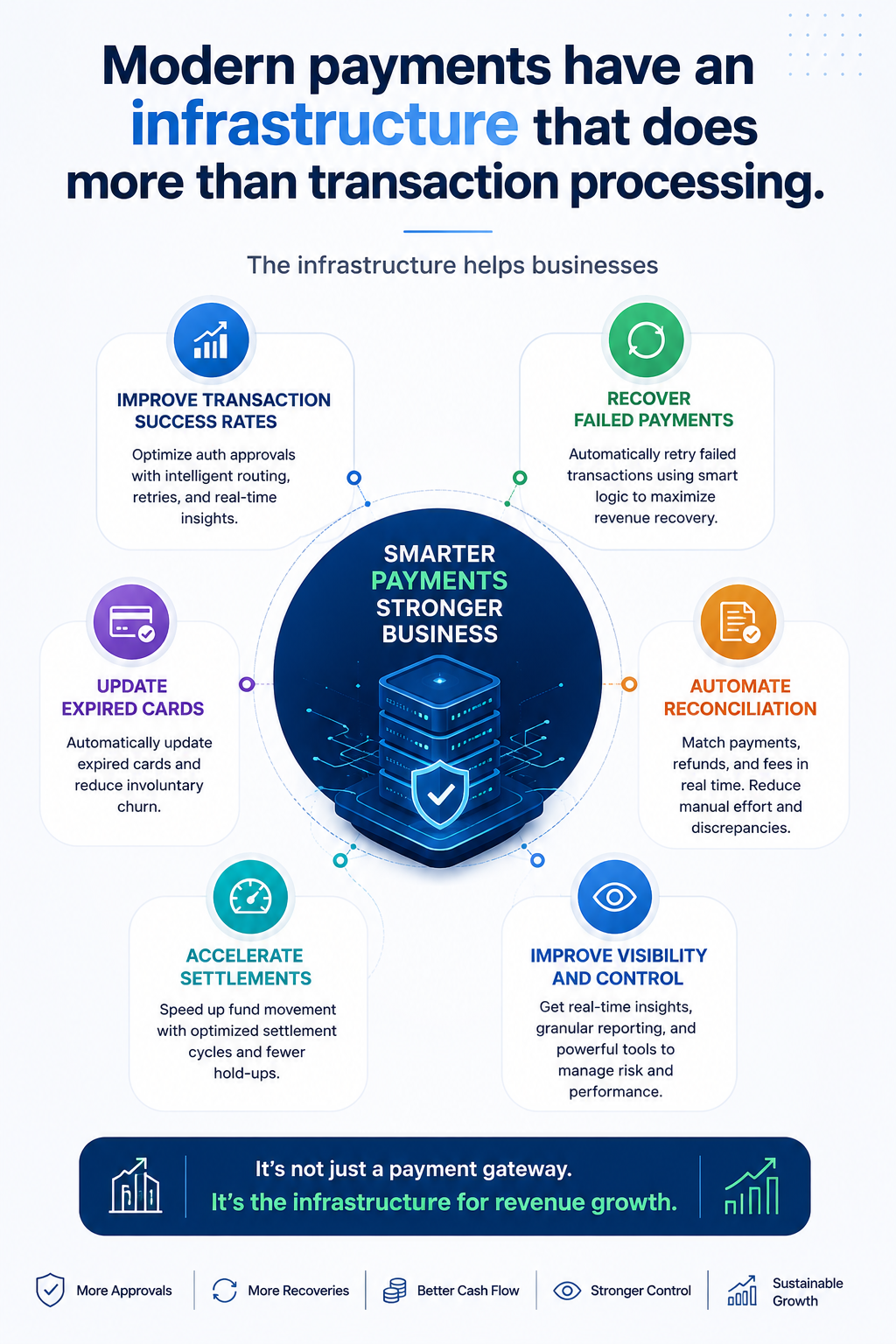
Why High-Growth Businesses Invest in Better Payments
Businesses who intend to scale understand that payments influence their conversion rates, cash flow, customer retention, working capital, operational efficiency and eventually profitability. It is vital for businesses to understand that a payment gateway is not simply a technical integration. It is in fact one of the most important revenue systems in the business. The Question Every Business Must Ask While evaluating a payment solution, businesses should not ask: “Can this gateway process payments?” Instead, they should ask: “How much revenue can this gateway help us protect and recover?” This shift in thinking changes everything for businesses.
Payments Are the Point Where Businesses Get Paid
No matter what you sell — products, experiences, subscriptions, software, or education; your growth is dependent on one critical outcome: Successful payments. Because payments are not utility or just another product feature. Payments are realised revenue, generated cash flow, growth enabler and business sustainer. No business runs on notifications, dashboards, or integrations. It runs on one message: Payment Successful.