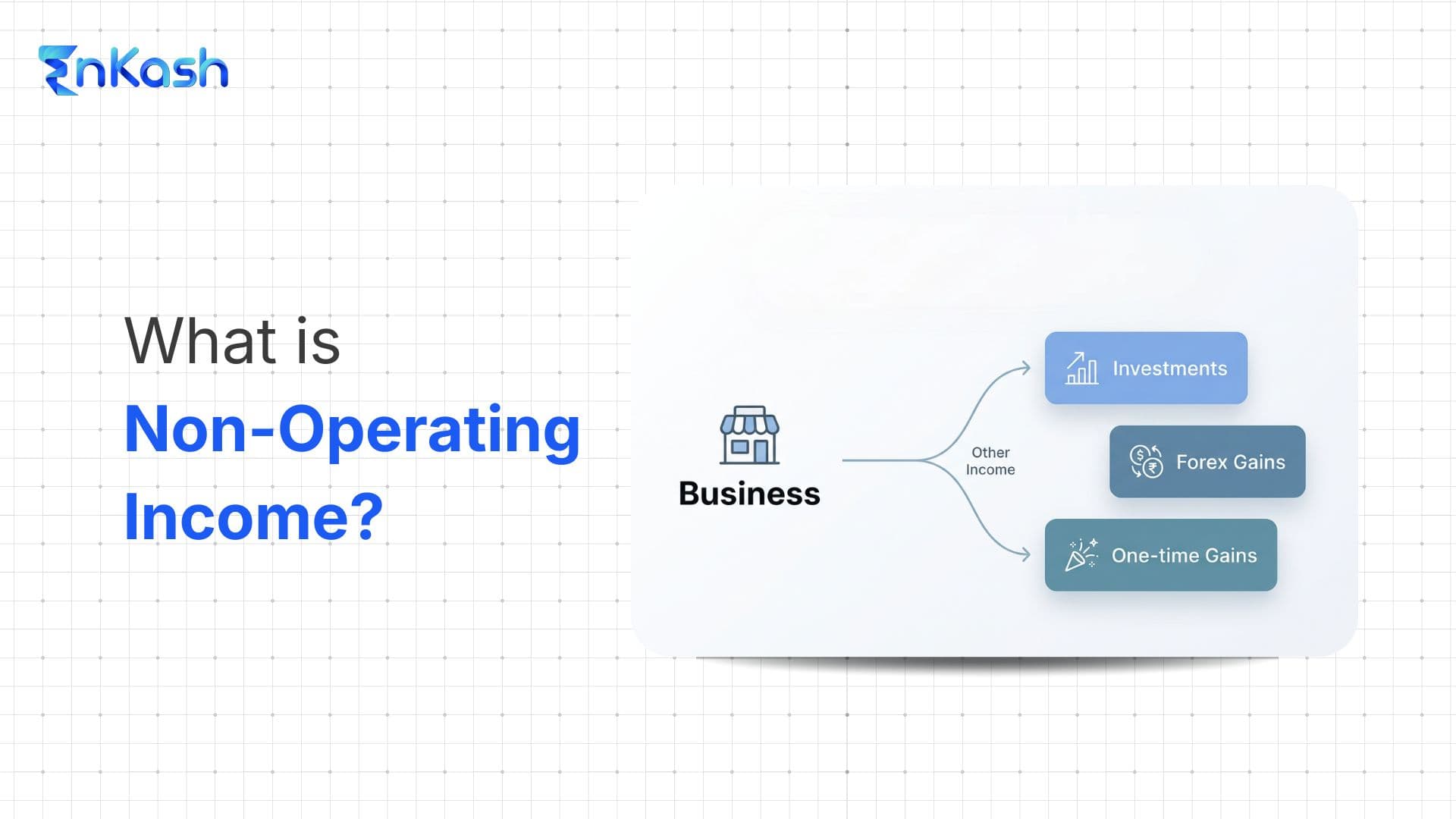
A company can report stronger profits even when its core business has not improved at the same pace. A quick reading of the profit and loss statement can miss that shift. Earnings may include inflows from sources outside the business activity that drives regular sales. Interest on surplus funds, rent from an unused asset, or a gain from selling old equipment can all raise profit without reflecting day-to-day operating output. This blog explains non-operating income, how it is identified, how it is calculated, where it differs from non-operating revenue, and why this distinction changes the way financial performance should be read. In financial statements prepared under the Indian presentation format, readers need to separate revenue from operations from other income before forming a view on profit quality, earnings durability, or the real strength of the operating engine.This guide is written from the perspective of Indian financial statement analysis and references Schedule III presentation requirements and Ind AS reporting principles commonly used in corporate financial reporting.
Key Takeaways
- Non-operating income comes from non-core business activities
- It is generally reported under “Other Income”
- It may include interest, dividends, rent, or asset sale gains
- It helps analysts assess earnings quality
- Non-operating income does not always reflect operational strength
What is Non-Operating Income
Non-operating income is income earned from activities outside a company’s core business operations. It may include interest income, dividend income, gains on asset sales, or rental income from non-core assets. For a product company, the main stream may be product sales. For a service company, the main stream may be service fees. Income earned outside that principal business stream is generally classified separately because it does not reflect core operating performance.
The distinction becomes clearer when profit is evaluated for earnings quality rather than headline growth. Reported profit can look healthy even when a portion of it comes from surplus-fund income, incidental receipts, or gains linked to asset disposals. These amounts are genuine and are included in the profit figure, though they do not reflect the company’s regular business performance through its primary commercial activity during the year.
In Indian financial statements prepared under Schedule III of the Companies Act, these inflows are generally reported under ‘Other Income’. Analysts often classify them as non-operating income because they arise outside the company’s principal business activities.
- Interest earned on deposits or short-term investments
- Dividend income from equity or mutual fund holdings
- Gains on the sale of financial investments
- Gains on disposal of fixed assets, such as machinery or equipment
- Incidental rent earned from assets that are not part of the main operating cycle
The term non-operating items covers a broader range than income alone. It can include expenses and gains that arise outside the company’s core line of business, though the discussion here is limited to income. The classification also depends on the enterprise's principal activity. Interest income, for example, may fall outside a manufacturer's core operations, yet it can form part of regular business income for a finance-driven company. Non-operating income, therefore, needs to be understood in relation to the business model, the revenue structure, and the activity the company exists to carry on.How to Calculate Non-Operating Income
Locate the Non-Core Income Section in the Profit and Loss StatementThe calculation starts with the statement of profit and loss and then moves into the notes that support it. Under the Indian presentation format, companies present revenue from operations separately from other income. This structure gives the reader a direct entry point into the analysis. Revenue from operations reflects income earned through the company’s principal business activity. Other income captures receipts that arise outside that main commercial stream. Schedule III of the Companies Act, 2013 requires companies to separately disclose material components of ‘Other Income’, including interest income, dividend income, and gains or losses on investments.
The headline number alone does not provide enough insight. The notes include a breakdown of what the total actually includes. A single other-income figure can combine treasury returns, gains on disposal, incidental rent, exchange-related gains, and smaller one-time receipts. Until those components are separated, the number does not tell the reader how much of the year’s profit came from activity outside the operating business.Pull out the Income Streams that do not come from the Main Business
Once the other-income note is available, the next step is classification. The reader has to identify the entries that do not arise from the company’s principal activity. For a manufacturing, trading, or services business, this often includes interest income, dividend income, gains on sale of investments, gains on disposal of fixed assets, and incidental rental receipts. A company with a large treasury balance may earn meaningful returns from deposits, debt instruments, or mutual fund holdings, and those amounts can push profit higher without saying anything about operating execution.This step depends on understanding what the business actually does. The same income line can be interpreted differently across industries. For a finance-led company, interest income may be included in operating revenue because lending activity drives the business. Schedule III captures this by including interest and financial service income within revenue from operations for such entities. Ignoring this context can distort the classification. The business model should guide the treatment at every stage.
Adjust for Directly Attributable Expenses Where Required
The receipt figure is not always the right figure for analysis. Schedule III refers to other non-operating income on a net basis after deducting expenses directly attributable to that income. This means the reader should not assume that every non-core inflow is included in the calculation at gross value. When a disposal, incidental receipt, or other non-core earning is accompanied by a directly linked expense, the cleaner analytical number is the net contribution. That gives a more accurate picture of what the non-operating activity added to profit during the year.
Non-operating income = non-core interest income + dividend income + gains on sale or fair valuation of investments + gains on disposal of fixed assets + incidental rent and other non-core receipts − directly attributable expenses.This formula helps with analysis by turning disclosed components into a readable working number. It shows how much of the year’s profit came from non-core income streams rather than from the main business activity. Once the income streams have been properly classified, the calculation itself is straightforward and easy to follow.
Numerical Example of Non-Operating Income
| Particulars | Amount |
|---|
| Interest Income | ₹5 lakh |
| Dividend Income | ₹2 lakh |
| Gain on Sale of Machinery | ₹8 lakh |
| Directly Attributable Expenses | ₹1 lakh |
| Non-Operating Income | ₹14 lakh |
Reconcile the Number with Disclosure Depth and Materiality
The closing step is a credibility check on the number rebuilt. It should make sense in light of the company’s disclosure pattern and the size of other income reported in the statement of profit and loss. When a non-core amount is large, the notes deserve closer attention because material income and expense items must be disclosed separately. Under Ind AS 1, companies are not permitted to classify any income or expense as an extraordinary item in the statement of profit and loss. This approach keeps the reading aligned with the reporting format used for that year and avoids relying on outdated presentation language.Example of Non-Operating Income
Interest Income from Surplus Funds
A company may hold temporary surplus cash in bank deposits, debt funds, or other interest-bearing instruments until the money is required for working capital, capital expenditure, or debt service. The return earned on that parked money increases profit for the year, though it does not arise from the company’s main business activity. A manufacturer did not generate that income by selling products. A services firm did not earn it through client work. This makes it a clear non-operating income example because the inflow is real, measurable, and separate from the normal operating cycle.Gain on Sale of an Old Machine
Consider a company that sells a machine that is no longer required and records a gain on disposal. The gain improves the year's reported profit, yet it does not come from routine business activity. It arises from exiting an asset rather than from carrying on the core business. Such gains may appear in one reporting period and disappear in the next. For that reason, it deserves separate analytical attention because it affects profit without revealing anything about recurring commercial performance.
Rent from an Incidental Asset
A business may earn rent from a spare building, employee housing recovery, or another asset that does not form part of its principal operation. In that case, the income can be reported as other income rather than operating revenue. This point is of real significance in Indian financial reporting because classification depends on the company's actual activities. An incidental rental receipt can increase profit, yet it still does not describe how the business performed through its core line of work.
Treasury and Investment Income in a Large Listed Company
Annual reports of large listed companies make this easier to spot in practice. Reports indicated interest income, dividend income, net gains from investment disposal or fair valuation, net gain on disposal of property, plant, and equipment, net foreign exchange gain, rent income, and other income within its other-income note for the year ended March 31, 2025 (Source: TCS Annual Report 2024–25). This offers a clear working example of how several non-core earnings can be grouped under a single reported figure. It also shows why readers need to examine the note line by line rather than rely solely on the total.
When Non-Recurring Income Enters the Picture
Some non-core receipts appear repeatedly across reporting periods, while others arise once and then disappear. Interest on surplus balances can recur whenever excess funds remain deployed in interest-bearing instruments. A gain on sale of a large fixed asset may arise only once.
This is where non-recurring income becomes relevant. Ind AS 1 does not permit companies to label items as extraordinary, which makes note reading and materiality review even more important when the reader is trying to isolate one-off non-core gains.Non-Operating Revenue vs Non-Operating Income
| Basis | Non Operating Revenue | Non Operating Income |
|---|
| Meaning | A non-core inflow described in revenue terms | A broader category covering income earned outside principal business operations |
| Scope | Narrower in analytical use | Wider in analytical use |
| Reporting relevance | Descriptive phrase only in many cases | Closer to how readers interpret non-core inflows within financial statements |
| Formal presentation anchor | Not the standard face-of-statement label | Read through the other income section and its supporting notes |
| Coverage of interest income | May be included when it arises outside the main business | Commonly included for non-finance businesses |
| Coverage of dividend income | Can be included, though the term is less precise | Included where it arises outside core operations |
| Coverage of gains on sale of investments | Can be described under this phrase informally | Included as part of non-core income analysis |
| Coverage of gains on disposal of fixed assets | Less naturally captured by the word revenue | Readily included because the term income is wider |
| Link with recurring business performance | Weaker analytical value | Stronger analytical value because it helps separate core and non-core earnings |
| Use in company analysis | Less precise for reading annual reports | Better suited for evaluating earnings quality |
| Risk in interpretation | Can blur the difference between business receipts and broader non-core gains | Gives a more complete view of non-core profit contributors |
| Best way to use the term | Use with caution in explanatory writing | Use when analyzing non-core earnings in context of financial statements |
Why Non-Operating Income Matters to Investors and Analysts
A company’s reported profit does not always reflect the actual strength of its core business. Part of that profit may come from non-operating income sources such as interest earned on surplus cash, gains on investment sales, or disposal of fixed assets. These receipts are legitimate, though they do not necessarily indicate stronger operational performance.
This distinction becomes important during financial analysis because operating income and non-operating income behave differently over time. Operating earnings are generally linked to the company’s primary business activity and are more useful for assessing long-term business performance. Non-operating income, on the other hand, may arise from incidental, temporary, or one-time events that may not recur in future reporting periods.
Investors and analysts therefore separate non-operating income from operating profit to evaluate earnings quality more accurately. A company may report higher net profit in a particular year because of a large investment gain or asset sale, even when its actual business operations remained flat. Without this separation, headline profit figures can create a misleading impression of business growth.
Reviewing non-operating income also helps in:
- Assessing whether profit growth is sustainable
- Understanding how much profit comes from core operations
- Identifying one-time gains that may not repeat
- Evaluating the consistency of operating margins
- Building more reliable valuation and forecasting models
This analysis becomes especially relevant in industries where companies hold large treasury balances or regularly generate income from investments and non-core assets. In such cases, the statement of profit and loss should be read together with the notes to accounts to understand the true drivers of profitability.
Final Takeaway
A profit figure becomes easier to interpret when operating earnings are separated from non-core receipts. Non-operating income adds depth to the annual profit picture, though it does not confirm stronger business performance by itself. A reliable reading comes from reviewing revenue from operations, other income, and the supporting notes together. A large non-core contribution deserves closer scrutiny because it can improve reported profit without reflecting the same strength in the underlying business.
FAQs
1. What is non-operating income in accounting?Non-operating income refers to income earned from activities outside a company’s main business operations. It can include interest income, dividend income, gains on asset sales, rent from incidental assets, and other receipts that do not arise from the core operating cycle.
2. Where does non-operating income appear in financial statements?In the statement of profit and loss, non-operating income generally appears within other income rather than within revenue from operations. Readers should also check the notes to accounts because the detailed components are often disclosed there.
3. How do you calculate non-operating income?To calculate non-operating income, add all non-core income streams such as interest, dividends, gains on investment sales, gains on disposal of fixed assets, and incidental rent, then reduce any directly attributable expenses linked to those receipts.
4. What is a non-operating income example?A clear non-operating income example is interest earned on surplus cash placed in bank deposits or debt instruments. The company records real income, though the amount does not come from its principal business activity or normal sales cycle.
5. What are non-operating items in a company’s accounts?Non-operating items include gains, income, losses, or expenses connected to activities outside the company’s main operations. On the income side, this can include treasury income, dividend receipts, investment gains, and profit from asset disposals.
6. What is the difference between non-operating revenue and non-operating income?Non-operating revenue is a narrower descriptive phrase, while non-operating income is broader and covers multiple non-core earnings. In practical financial analysis, non-operating income gives a fuller view of receipts that arise outside the main business line.
7. Is interest income always non-operating income?Interest income depends on the nature of the business. For a manufacturing or services company, it may form part of non-operating income. For a finance-led company, interest may arise from the principal activity and belong within operating revenue.
8. Is the gain on sale of fixed assets non-operating income?Gain on sale of fixed assets is commonly viewed as non-operating income because it comes from disposing of an asset rather than from the company’s regular business activity. It can increase profit for the year without reflecting core operating performance.
9. Is non-operating income the same as non-recurring income?The two terms do not mean the same thing. Non-operating income refers to income outside the core business, while non-recurring income refers to receipts that arise once or infrequently. A non-core income stream can recur across multiple years.
10. Why should investors separate non-operating income from operating income?Separating non-operating income from operating income helps readers assess earnings quality more accurately. A company’s headline profit can rise because of non-core receipts, even when the main business has not improved at the same pace.