Online payments can become difficult to manage as a business adds more payment methods, providers, customer segments, and transaction types. A UPI payment may remain pending, a card transaction may fail at the issuer level, or a provider may slow down during peak checkout traffic.
Indian businesses often manage payments across UPI, cards, net banking, wallets, EMI, payment links, subscriptions, refunds and settlement cycles. A transaction may be successful at the customer’s bank but pending at the merchant’s system. A UPI collect request may expire. A card payment may fail due to issuer-side decline. A refund may be initiated by the provider but not yet visible to the customer.
For high-volume businesses, these are not only checkout issues. They affect order confirmation, support tickets, reconciliation, cash flow visibility and customer trust.
This blog explains:
- How payment orchestration works.
- Where it operates in the checkout journey.
- When a payment orchestration system becomes relevant for a business.
What is Payment Orchestration
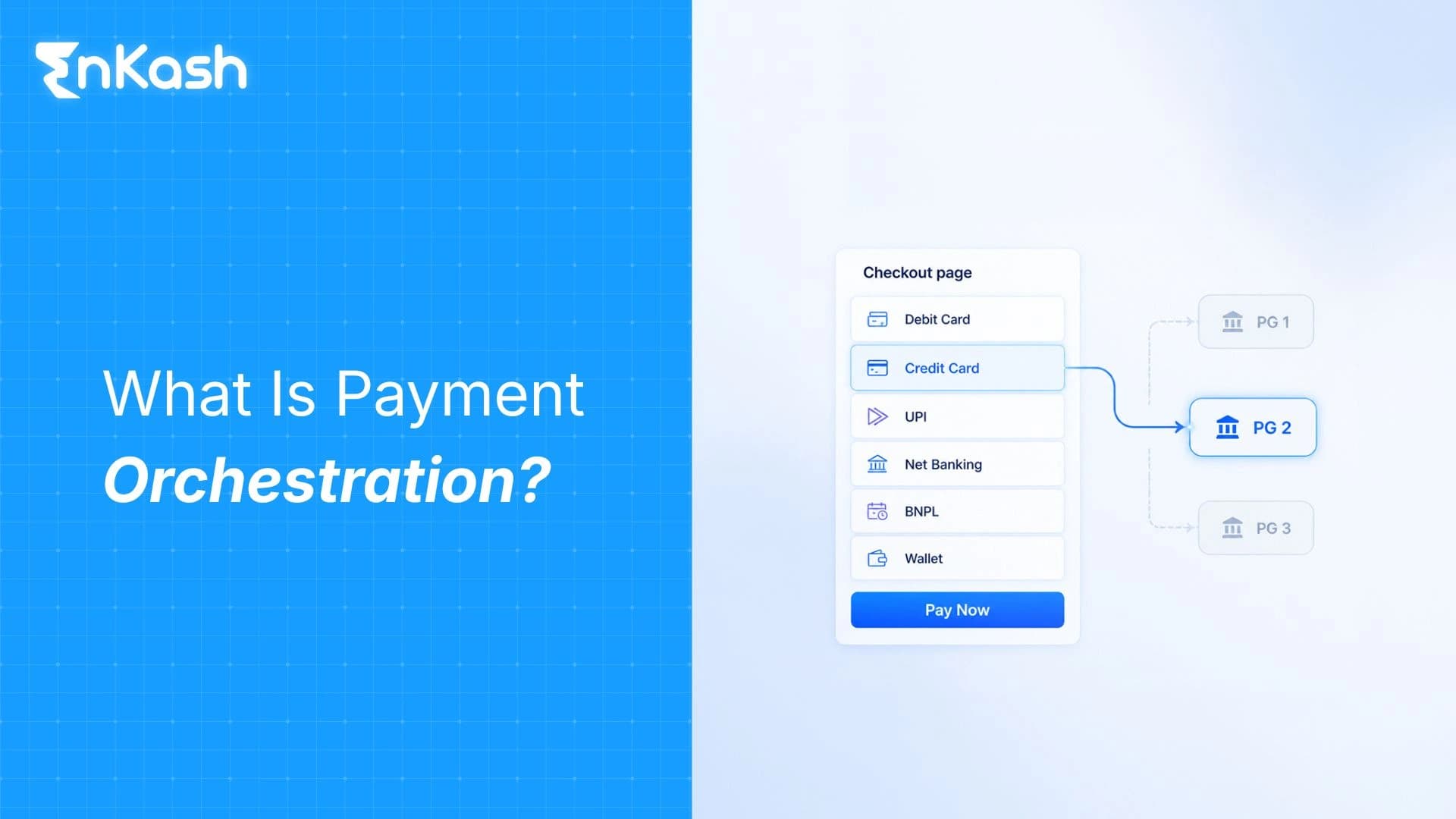
Payment orchestration is a software layer that helps businesses manage multiple payment providers, payment methods, routing rules, retries, refunds, settlements and reporting from one central system. It sits between the checkout and payment providers, deciding how each transaction should be processed based on predefined rules of business.
The payment orchestration layer operates between the checkout and the provider responsible for processing the transaction. It does not necessarily replace payment gateways, banks, acquirers, or other payment services. Instead, it helps the business coordinate how these connections are used.
A standard payment setup generally contains three stages:
- Customer checkout: The checkout captures the order value, chosen payment method, customer reference, currency, and other transaction details.
- Payment orchestration system: The system evaluates the request against configured rules and selects the approved provider or payment connection for that transaction.
- Payment provider: The selected gateway, bank, acquirer, or payment service processes the request and returns the transaction response.
This setup separates payment decision-making from payment processing. The orchestration system selects the appropriate payment path, while the chosen payment gateway provider authorises, declines, or updates the transaction.
How Does Payment Orchestration Work
A payment orchestration system handles each payment request through a defined sequence of checks, provider selection, transaction responses, and record updates. The process begins when the customer submits payment details and continues until the business receives a confirmed, failed, or pending status.
1. The Checkout Creates the Payment Request
The checkout creates a payment request using transaction details such as:
- Order value.
- Selected payment method.
- Customer reference.
- Order number.
- Currency.
- Billing location.
- Merchant account information.
These details create the initial transaction record that the system uses during processing.
2. The System Evaluates the Request
The payment orchestration layer checks the request against the business rules configured for that transaction type. These rules may consider the payment method, transaction value, customer category, billing geography, provider availability, or risk conditions. The system then identifies the approved provider connection that matches those conditions.
3. The Request Reaches the Selected Provider
The system sends the payment request to the selected gateway, acquiring partner, bank connection, or other approved provider. The provider processes the request using its own authorization and verification procedures. The orchestration system does not complete the payment itself. It coordinates the handoff to the provider chosen for that transaction.
4. The Provider Returns a Response
The provider returns a transaction response, such as:
- Successful.
- Declined.
- Failed.
- Pending.
- Timed out.
The payment orchestration system reads this response and applies the next configured action.
5. The System Handles Unsuccessful or Unclear Responses
When a provider times out or returns an eligible failure response, the system may send the transaction through another approved connection. This action depends on the business rules, provider sequence, retry limits, and transaction conditions configured beforehand. Each recovery attempt should have a clear trigger and limit to prevent duplicate transactions or unnecessary repeated attempts.
6. The Business Receives the Final Transaction Status
The merchant’s order system receives the resulting payment status and updates the customer journey accordingly.
- A successful payment allows the order to proceed.
- A failed payment can display another payment option.
- A pending payment can remain open until the provider sends final confirmation.
The system also records the order ID, payment ID, provider response, transaction status, and timestamps. These records support later payment tracking without repeating the refund, settlement, or reconciliation functions explained in subsequent sections.
Core Components of a Payment Orchestration System
A payment orchestration system combines provider integrations, transaction rules, payment-data controls, financial tracking, and operational monitoring within a single infrastructure. Each component performs a separate function and supports a different stage of payment management.
Provider Connector Hub
This component connects the business to various gateways, banks, acquirers, and payment providers. It reduces the need to build and maintain every provider connection separately. For example, an e-commerce brand can manage card, UPI, wallet, and net banking providers with a single setup.
Business Rule Engine
The rule engine decides how payments should be handled under defined conditions. A business can set rules for transaction size, payment mode, customer segment, geography, provider performance, or risk level. This gives the payment orchestration layer a clear decision framework.
Failover and Retry Logic
This part manages what happens when a provider declines, times out, or returns an unclear response. It can trigger another approved payment path when the business allows it. Recovery works best when each retry has a defined trigger, limit, and payment path.
Payment Data and Token Management
Payment orchestration software can reduce repeated handling of sensitive payment data when token-based and compliant flows are configured correctly. Token-based flows can also support repeat payments, saved payment methods, and subscription journeys when configured correctly.
Refund and Settlement Tracking
Refunds and settlements need separate visibility because they do not always move at the same speed as payment collection. This component helps teams track refund requests, settlement references, provider status, and unresolved payment cases.
Reconciliation and Reporting Layer
This component gives finance teams a clearer view of orders, collections, provider responses, refunds, and settlement data. It helps teams compare payment records with internal order data instead of checking each provider's dashboard separately.
Monitoring and Alerts
Monitoring helps payment teams spot unusual failure spikes, provider downtime, delayed settlements, or refund delays. This matters during sales campaigns, subscription billing cycles, and high-volume checkout periods.
Why Businesses Need Payment Orchestration
A business may need payment orchestration when its existing payment setup starts creating repeated technical, operational, or financial problems. The following signs indicate that a single-provider or manually managed setup may no longer offer sufficient control.
When Payment Teams Depend Too Much on Developers
A business should not need developer effort for every payment change. If teams need code changes for provider rules, checkout experiments, payment method changes, or merchant account updates, the payment setup can slow growth.
When Different Customer Segments Need Different Payment Logic
A SaaS company may treat monthly renewals differently from annual enterprise payments. A marketplace may need separate handling for buyer collections and seller-side money movement. A D2C brand may need different payment handling for prepaid orders, high-value carts, and repeat customers.
When Payment Costs Need Closer Review
Payment costs can vary by method, provider, card type, transaction size, and commercial agreement. A payment orchestration system helps businesses review these payment choices with greater control, rather than treating every transaction the same way.
When Expansion Adds Payment Complexity
A business adding new cities, product lines, currencies, banks, or customer groups may need a stronger payment structure. The payment orchestration layer helps teams manage this growth without having to rebuild the payment stack each time.
When Finance Needs Cleaner Accountability
Payment operations affect revenue reporting, bank settlement checks, dispute handling, and month-end closure. One of the key advantages of payment orchestration is that teams can assign clearer ownership for payment decisions, records, and follow-up actions.
When Leadership Needs Better Payment Visibility
Founders, finance heads, and operations leaders need to know where payment friction affects business performance. Payments orchestration software can help teams see payment behavior across providers, methods, and customer journeys before small issues become recurring revenue leaks.
Payment Orchestration vs Payment Gateway
A payment gateway processes a payment transaction. A payment orchestration system decides how that transaction should be routed, retried, tracked and reported across one or more payment providers. A gateway is a processing connection, while orchestration is the control layer above multiple payment connections.
| Comparison Point | Payment Gateway | Payment Orchestration |
|---|
| Main role | Processes payment requests | Manages payment decision flow |
| Provider scope | Usually works as a provider connection | Can work across multiple providers |
| Business control | Limited to gateway-level settings | Allows broader transaction rules |
| Best fit | Smaller or simpler payment setups | Growing or multi-provider payment operations |
| Refund visibility | Usually limited to that gateway | Can bring refund records into one view |
| Reporting | Provider-specific dashboard | Consolidated payment view across providers |
| Technical effort | Simpler to start | Better for complex payment operations |
How Should Businesses Choose Between a Payment Gateway and Payment Orchestration
A payment gateway works when the business has a simple payment setup. Payment orchestration makes more sense when payment operations need wider control across providers, customer journeys, refunds, and reporting.
A payment gateway may be enough when the business has:
- One checkout flow.
- Limited payment methods.
- Low transaction volume.
- Simple refund handling.
- One provider dashboard.
- Minimal finance reporting needs.
A payment orchestration system becomes useful when the business manages:
- Multiple payment providers.
- Different payment methods.
- Recurring or high-value transactions.
- Customer segments with different payment behavior.
- Refund and settlement tracking across providers.
- Finance reports that need cleaner payment data.
The main difference is control. A gateway processes the payment. A payment orchestration layer manages the payment choice before processing.
Advantages of Payment Orchestration
The advantages of payment orchestration are strongest when a business wants payment control without locking itself into one provider, one checkout setup, or one operational method. It gives teams more room to adapt payment strategy without rebuilding the payment stack each time.
Reduces Provider Lock-In
A business should not depend on one provider for every payment outcome. Payment orchestration allows teams to work with different providers for different needs, so a pricing change, product limitation, or service issue does not require a full payment rebuild.
Payment teams can review how different providers perform across payment modes, transaction types, and customer groups. For example, an e-commerce brand can compare card performance for high-value orders without assuming every provider performs the same way.
Supports Better Commercial Negotiation
A business with a single provider has limited leverage. A payment orchestration system gives finance and payment teams stronger data before discussing pricing, settlement terms, or service commitments with providers.
Keeps Checkout Changes More Controlled
Payment changes can quickly affect the customer experience. A payment orchestration layer helps teams update payment logic in a more controlled way instead of changing the full checkout code for every provider or method update.
Improves Governance Over Payment Decisions
Growing teams need clear ownership for payment changes. Payments orchestration software can help define who can update payment rules, review provider performance, approve changes, and track payment decisions.
Supports Market and Product Expansion
A business launching a new product, subscription plan, region, or customer segment may need a different payment approach. Payment orchestration gives teams greater flexibility to support that expansion without treating each new use case as a new technical project.
Conclusion
Payment orchestration becomes valuable when payment operations need structure, flexibility, and clearer control. Businesses should review their checkout paths, provider mix, refund workload, reporting gaps, and future growth plans before choosing a setup. A basic gateway can support early payment needs, but expanding teams need a stronger system when payment decisions start affecting revenue flow, customer experience, and finance closure. The right payment orchestration system should help teams manage provider choices, track payment movement, reduce operational confusion, and prepare the business for higher transaction complexity.
FAQs
Can payment orchestration be added to an existing checkout?
Yes, payment orchestration can be added to an existing checkout if the current setup supports integration changes. Businesses should review checkout code, payment provider contracts, API readiness, and testing requirements before migration.
Can existing gateway contracts and merchant accounts be retained?
Existing gateway contracts and merchant accounts can often remain in place when they are technically compatible with the payment orchestration system. Businesses should confirm API access, token portability, settlement arrangements, commercial terms, and provider permissions before planning the integration.
How can businesses migrate without interrupting live payments?
A safe migration starts with a complete transaction-flow map, sandbox validation, limited live traffic, and predefined rollback conditions. Businesses should move providers or payment methods in stages, monitor results closely, and avoid switching every transaction path at once.
What prevents duplicate charges during payment retries?
Duplicate charges are prevented through idempotency keys, unique transaction references, retry limits, status verification, and provider-response checks. The payment orchestration layer should confirm whether an earlier attempt succeeded or remains pending before starting another eligible payment attempt.
What is a payment orchestration API?
A payment orchestration API helps the business connect its checkout or payment system with the orchestration setup. It carries transaction details, receives payment responses, and helps the system communicate with selected payment providers.
How should businesses test payment orchestration before launch?
Businesses should test small-value payments, high-value payments, refunds, failed transactions, pending cases, duplicate attempts, and provider downtime scenarios. Testing should happen before full rollout to avoid live checkout issues.
Can payment orchestration support international payments?
Yes, payment orchestration can support international payments when the connected providers, currencies, compliance checks, FX handling, tax treatment, and settlement rules allow it. Businesses should verify country coverage, foreign exchange handling, and local payment regulations first.
What happens if the payment orchestration platform becomes unavailable?
Businesses should review how payments continue if the payment orchestration platform becomes unavailable. Resilience measures may include redundant infrastructure, queueing, provider fallback procedures, manual controls, incident alerts, recovery objectives, and tested continuity plans for critical checkout periods.
How is payment orchestration pricing structured?
Payment orchestration pricing may be based on transaction volume, provider connections, platform access, implementation work, support levels, or additional modules. Businesses should compare total operating cost rather than only the headline fee, including migration, maintenance, and usage-based charges.
How often should payment orchestration rules be reviewed?
Payment rules should be reviewed after provider changes, pricing updates, checkout issues, product launches, campaign spikes, and finance-reporting gaps. Regular review keeps the setup aligned with business and customer behavior.
What should businesses ask before buying payments orchestration software?
Businesses should ask about integration effort, supported providers, rule controls, refund handling, reporting depth, security practices, compliance support, support response time, pricing model, and migration risks before selecting payments orchestration software.