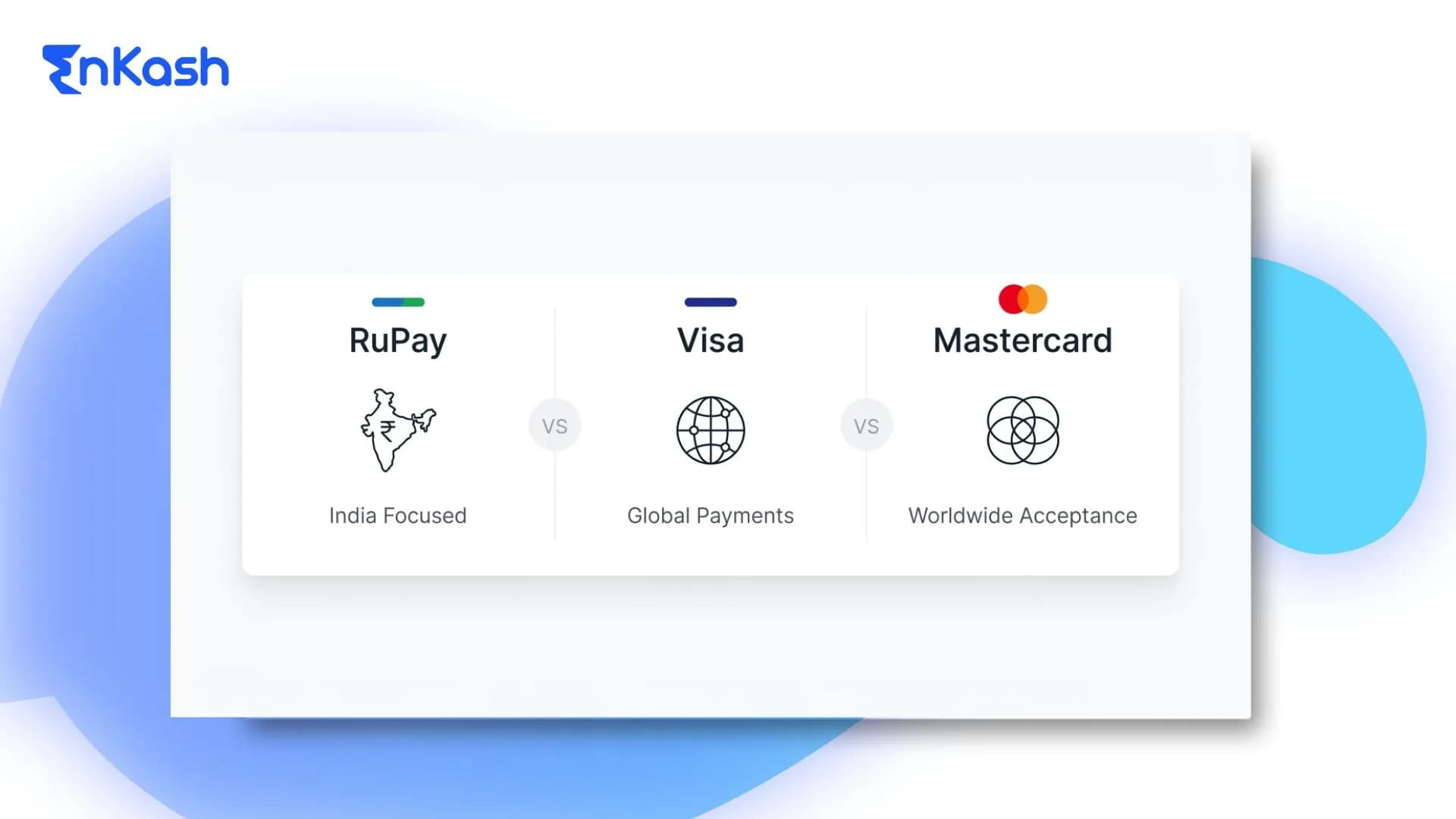
Indian cardholders now have wider payment choices, but card networks can still feel confusing. Two cards may come from the same bank and look almost identical. Both may support online payments, ATM use, and store purchases. The difference begins with the network printed on the card.
This is where the RuPay vs Visa vs Mastercard comparison becomes important. RuPay, Visa, and Mastercard are payment networks. They are not the bank that issues your card. Your bank manages your account, card limit, fees, statements, approvals, and customer support. The network helps move the payment safely between the merchant, the merchant’s bank, and your card-issuing bank.
For domestic payments, RuPay has gained significant relevance because it is built for India’s payment system. Eligible RuPay credit cards issued by participating banks can be linked to supported UPI apps and used for payments at eligible merchant QR codes. Visa and Mastercard remain strong choices for international travel, foreign websites, hotel bookings, global subscriptions, and cross-border card use.
The right network depends on how the card will be used. Someone who pays for local store purchases via UPI has different needs from someone who travels overseas regularly. A customer looking for cashback may judge the card differently from someone looking for airport lounge access or lower forex charges.
This guide explains what Visa and Mastercard are, how RuPay works, the difference between RuPay and Visa and Mastercard, and how to decide which option suits your payment habits.
Understanding RuPay, Visa, and Mastercard
Every card payment moves through a chain of parties. The customer uses the card. The merchant accepts the payment. The merchant’s bank processes the payment request. The customer’s bank approves or declines the transaction. The card network connects these parties and helps the transaction move through authorization, routing, clearing, and settlement.
The card type and the card network are different things. Debit, credit, and prepaid cards explain how payments are funded. RuPay, Visa, and Mastercard explain which network carries the transaction. This difference is useful because two cards from the same bank may work differently when used for UPI, foreign payments, rewards, or travel benefits.
RuPay
RuPay is the domestic card payment network operated by the National Payments Corporation of India. It supports several card types, including debit, credit, prepaid, contactless, and international variants. It was developed to support local digital payments and has become a familiar network across banks, ATMs, point-of-sale machines, and online merchants.
RuPay works well for users whose spending is mainly domestic. A RuPay card can support everyday transactions such as shopping, bill payments, ATM withdrawals, online purchases, and contactless payments where the merchant setup allows it. Banks issue RuPay cards across basic, standard, and premium categories, depending on the customer segment and product design.
The clearest current advantage is the eligibility of the RuPay credit card linkage with UPI. This allows users to pay eligible merchants through supported UPI apps using a linked RuPay credit card. It is useful for people who want to use credit cards while paying via QR codes at shops, service counters, and other local businesses.
RuPay Global extends RuPay beyond domestic use through partner networks, but not every RuPay card is automatically enabled for international use. Acceptance depends on card variant, issuer activation, partner network, destination, and merchant setup. Its acceptance outside the country depends on the card variant, issuing bank, destination, and merchant payment setup. Users should check international support before relying on it abroad.
Visa
Visa is a global payment network used by banks, merchants, payment processors, and financial institutions. The bank issues the card, while Visa provides the network that enables payments to move between parties. This network role enables a Visa card to work across many merchants, platforms, and countries, subject to card activation, bank rules, and merchant acceptance.
For anyone asking what Visa and Mastercard are, Visa is a global card payment network. It supports debit, credit, prepaid, and commercial cards, as well as contactless payments, for cards issued by banks and financial institutions. Its strength lies in broad acceptance across domestic and international payment environments.
A Visa card is useful for customers who need a card for both local and global spending. It can support purchases at stores, online shopping, international websites, hotel bookings, foreign travel payments, and subscriptions billed by overseas merchants. Many banks issue Visa cards across a range of categories, from entry-level debit cards to premium credit cards.
The value of a Visa card depends on the exact product issued by the bank. A basic Visa debit card may offer simple payment access. A premium Visa credit card may include cashback, reward points, lounge access, insurance benefits, travel privileges, or merchant offers. The network helps enable acceptance, but the bank decides on most customer-facing benefits.
Mastercard
Mastercard is a global payment technology network used for card payments across consumer, business, travel, and commercial categories. It connects cardholders, merchants, issuing banks, acquiring banks, and payment processors. The bank issues the card to the customer, while Mastercard provides the network layer that completes the transaction.
Mastercard is widely used across debit, credit, travel, co-branded, business, and premium lifestyle cards. Banks may use Mastercard for products linked to shopping, dining, travel, corporate payments, category-based rewards, or higher-value card benefits. This makes it relevant to customers who compare cards beyond basic payment access.
For everyday cardholders, Mastercard can support store payments, online purchases, contactless transactions, and international usage where the card and merchant are enabled. Premium Mastercard variants may carry additional benefits, but those features depend on the issuing bank, card tier, annual fee, eligibility rules, and benefit structure.
A Mastercard card should be judged as a complete product. The network supports payment acceptance, but the issuing bank decides reward value, charges, fee waivers, lounge access rules, foreign currency markup, and spend-based benefits. This is why two Mastercard cards can offer very different values even when both carry the same network logo.
What is the Difference Between RuPay, Visa, and Mastercard
The difference between RuPay, Visa card, and Mastercard begins with the network behind the card. A card network provides the payment rail for approving, routing, clearing, and settling transactions between banks and merchants. The bank issues the card, but the network determines where the card can operate and which payment features it can support.
RuPay is the domestic card network operated by NPCI. Visa and Mastercard are global payment networks used across multiple countries, merchant systems, and banking partners. This distinction affects cross-border acceptance, UPI credit card support, payment routing, and card product design.
| Factor | RuPay | Visa | Mastercard |
|---|
| Network base | Domestic card network operated by NPCI in India. | Global payment network | Global payment network |
| Main payment strength | Domestic transactions and eligible UPI credit card payments | International acceptance and global merchant access | International acceptance with strong premium card positioning |
| UPI credit card use | Supported on eligible RuPay credit cards through approved UPI apps | Not available in the same standard RuPay credit card format | Not available in the same standard RuPay credit card format |
| International usage | Available through RuPay Global, where supported | Strong across foreign merchants and platforms | Strong across foreign merchants and platforms |
| Benefit control | The issuing bank controls rewards, fees, and usage rules | The issuing bank controls rewards, fees, and usage rules | The issuing bank controls rewards, fees, and usage rules |
| Best comparison point | UPI access and domestic utility | Travel, subscriptions, and foreign websites | Premium cards, travel, lifestyle, and business use |
Network Structure
RuPay gives banks a domestic card network option across debit, credit, prepaid, and contactless card products. Its structure is closely linked with local banking and payment rails.
Visa and Mastercard operate through global network systems. Their broader value becomes apparent when the card is used with foreign merchants, overseas payment gateways, travel platforms, hotels, and global subscription services.
This makes the network base the first major difference. RuPay is stronger as a local payment network. Visa and Mastercard are stronger when wider international acceptance is needed.
UPI Credit Card Capability
UPI creates the sharpest functional split in the Visa vs Mastercard vs RuPay comparison. Eligible RuPay credit cards can be linked to supported UPI apps and used to pay at eligible merchant QR codes.
This feature depends on four checks: the card must be eligible, the issuing bank must support it, the UPI app must allow linkage, and the merchant must accept credit card payments through UPI.
At present, the standard credit-card-on-UPI model in India is available through eligible RuPay credit cards, not through the same standard Visa or Mastercard credit card linkage. This gives RuPay a clear edge for users who want credit card access across QR-based merchant payments.
Cross-Border Usage
Visa and Mastercard have stronger foreign merchant acceptance. They are more practical for international travel, hotel bookings, overseas shopping websites, airport transactions, and foreign subscription platforms.
RuPay Global gives RuPay an international reach through partner networks. Its acceptance must still be checked before travel because support can vary by destination, card variant, issuing bank, and merchant setup.
This is the key international difference. Visa and Mastercard work better as default global payment options. RuPay Global can be used abroad, but it requires verification before relying on it.
Card Benefits and Charges
The network logo does not determine the full value of a card. The issuing bank controls the reward rate, redemption value, annual fee, renewal waiver, fuel surcharge waiver, forex markup, lounge access, EMI charges, and spend exclusions.
This means a premium RuPay card can beat a basic Visa card for domestic spending. A premium Visa or Mastercard can beat a basic RuPay card for travel or lifestyle use.
Cardholder Choice
Card network choice has become more relevant after the RBI directed card issuers to give eligible customers the option to choose from available card networks at issuance, with existing cardholders getting the option at renewal, subject to applicable conditions.
This gives users more control at the selection stage. The better choice should be based on payment needs, acceptance requirements, UPI usage, foreign spending, charges, and reward value.
How to Choose Between RuPay, Visa, and Mastercard
The right card network depends on the user’s payment pattern. A useful decision starts with where the card will be used, how frequently, and which benefits can be recovered through real spending.
A person who pays many local merchants through QR codes may need a different card from someone who books overseas hotels or pays foreign subscription platforms. A customer focused on rewards may need a different card from someone who wants low charges and simple acceptance. The answer to which is better, RuPay or Visa, changes with the use case.
For Everyday QR-Based Merchant Payments
RuPay can be a stronger option when UPI merchant payments make up a large part of the user’s routine. Eligible RuPay credit cards can help cardholders use credit through supported UPI apps at eligible merchant QR codes.
This works well for local shops, clinics, service providers, tuition centers, utility counters, and smaller merchants that accept UPI payments. The user should check whether the card earns rewards on UPI payments, because reward rules may differ by bank.
A RuPay credit card makes sense when the user wants daily payment convenience across QR-based merchant transactions. The card becomes stronger when the issuing bank offers useful rewards, fair fees, and broad UPI app support.
For Overseas Travel and Foreign Websites
Visa or Mastercard can be a better choice for users who make frequent foreign payments. This includes international travel, hotel bookings, airline purchases, shopping on overseas websites, airport transactions, global app subscriptions, and foreign currency spending.
The decision should include forex markup, international transaction charges, card activation rules, reward value on foreign spends, travel insurance, and dispute support. A card with wide acceptance can still become expensive when charges are high.
Visa can be a better option for frequent foreign use. RuPay can remain useful for domestic payment habits. The right answer depends on the payment location and spending category.
For Premium Lifestyle and Travel Benefits
Mastercard and Visa are strong candidates when the user wants premium card benefits tied to travel, dining, shopping, or lifestyle categories. The final choice should be based on the exact card variant rather than the network label.
A premium Mastercard may offer strong value for dining, hotel privileges, concierge access, airport lounge visits, or co-branded benefits. A premium Visa may offer similar value through a different issuer program. A premium RuPay card may deliver stronger domestic rewards if its categories match the user’s spending.
This decision needs a benefit recovery check. The user should compare the annual fee against rewards, milestone vouchers, lounge visits, travel perks, and real redemption value. A premium card is valuable only when its benefits match actual spending.
For Low-Fee and Simple Domestic Card Use
Users who want a simple card for regular domestic payments should focus on charges and acceptance within their own usage pattern. RuPay is suitable when the user wants local card access, UPI credit card functionality, and a lower-friction domestic payment setup.
The better card is the one with clear charges, easy redemption, accessible customer support, and fewer spend exclusions. A card with a lower annual fee can deliver better value than a premium card if the user does not use travel or lifestyle benefits.
This use case is important for salary account holders, first-time credit card users, small business owners, and customers who want reliable card access without complex reward rules.
For Business Payments and Recurring Expenses
Business users should compare card networks through acceptance, controls, statement clarity, expense categories, and international payment needs. A company card used for software subscriptions, travel bookings, vendor payments, and digital tools may need Visa or Mastercard acceptance.
A business that mainly pays domestic vendors, office expenses, and local merchants may consider RuPay if the card product offers useful reporting, UPI linkage, and suitable bank support. The network decision should match the expense trail and reconciliation process.
Business cardholders should also check billing cycles, credit period, GST documentation needs, expense categorization, limits, user controls, and integration with accounting workflows.
For Users Who Want a Two-Card Setup
Many users may benefit from keeping two networks rather than searching for a single perfect card. A RuPay credit card can handle eligible UPI merchant payments and domestic spending. A Visa or Mastercard can handle foreign travel, global websites, and international subscriptions.
This setup reduces payment failure risk. It also keeps spending categories cleaner. Domestic QR payments can be routed through RuPay, while foreign and travel payments can be placed on a global network card.
The two-card approach works best when both cards have clear purposes. The user should avoid holding multiple cards with overlapping fees, weak rewards, or unused benefits. Each card should solve a separate payment need.
How Card Network Choice Affects Failed Transactions
Merchant Acceptance Can Block the Payment
A card may fail when the merchant’s payment setup does not support the card network used for that transaction. This can happen at a POS machine, an online checkout page, a payment gateway, or an international merchant platform. The issue may not be with the card balance or credit limit. The merchant’s acquiring bank, payment processor, or gateway must support the network for the payment to move ahead.
Card Settings Can Restrict Usage
Many failed transactions happen because a card setting is switched off. Domestic online payments, international payments, contactless payments, ATM withdrawals, and card-not-present transactions may have separate controls in the banking app. A Visa, Mastercard, or RuPay card can fail when the required usage type is disabled, even when the card itself is active.
UPI Credit Card Payments Need Eligibility Checks
A RuPay credit card linked to UPI can still fail if the payment does not meet the eligibility criteria. The card must be supported by the bank and the UPI app. The merchant must also be eligible to accept credit card payments through UPI. Some categories, apps, or transaction types may have limits. This makes eligibility more important than the network name alone.
International Transactions Depend on Multiple Controls
Foreign payments can fail when international usage is disabled, the merchant does not support the network, the bank flags the transaction, or the card variant lacks proper foreign acceptance. RuPay Global, Visa, and Mastercard may all need bank-level activation for overseas use. Travelers should check international limits and card settings before making foreign payments.
Authentication Errors Can Stop Online Payments
Online card payments may fail during OTP, tokenization, 3D Secure, or bank authentication steps. The card network helps route the payment, but the issuing bank and merchant gateway also control parts of the approval flow. A timeout, incorrect OTP, expired token, unsupported saved card, or gateway issue can stop the transaction before completion.
Bank Risk Checks Can Decline Valid-Looking Transactions
Banks may decline a payment if the transaction looks unusual based on the amount, merchant type, location, frequency, or previous usage behavior. This can happen even when the network is accepted. Large first-time payments, repeated attempts, foreign websites, and high-risk merchant categories may trigger extra checks or automatic declines.
Final Thoughts
The comparison between RuPay, Visa, and Mastercard becomes simple when usage is the primary factor. RuPay supports everyday domestic payments and adds a useful layer when eligible credit cards are used with UPI merchant QR codes. Visa is better suited for users who need reliable acceptance from foreign merchants, travel portals, hotel platforms, and global subscription services. Mastercard can be useful when the card offers strong premium benefits, business features, or lifestyle rewards. The actual value still comes from the issuing bank’s card terms. Fees, reward conversion, forex markup, lounge rules, waivers, and exclusions all need review. The best setup may combine RuPay for local use with Visa or Mastercard for wider reach.
FAQs
1. What is the main difference between RuPay, Visa, and Mastercard?
RuPay is a domestic card network operated by NPCI, while Visa and Mastercard are global payment networks. RuPay is stronger for local payments, while Visa and Mastercard offer wider acceptance among foreign merchants and platforms.
2. Which card network is better for UPI credit card payments?
RuPay is the better option for UPI credit card payments because eligible RuPay credit cards can be linked to supported UPI apps. This allows users to pay eligible merchants through UPI QR codes.
3. RuPay or Visa, which is better for Indian users?
RuPay works better for users focused on domestic payments and UPI-linked credit card use. Visa is better for users who travel abroad, shop on foreign websites, or pay for global subscription platforms.
4. What are Visa and Mastercard in simple words?
Visa and Mastercard are payment networks that help process card transactions between customers, merchants, and banks. Banks issue the cards, while these networks support payment acceptance, transaction routing, and settlement.
5. What is the difference between RuPay and a Visa card?
The difference between RuPay and Visa cards lies in payment reach and use case. RuPay is stronger for domestic usage and UPI credit card linkage, while Visa has wider international acceptance.
6. Can RuPay cards be used internationally?
RuPay cards can be used internationally when they are enabled under RuPay Global and accepted through partner networks. Acceptance depends on the issuing bank, card variant, destination, and merchant payment setup.
7. Is Mastercard better than Visa for everyday payments?
Mastercard and Visa are similar for many everyday card payments. The better choice depends on the issuing bank’s fees, rewards, foreign exchange markup, lounge access rules, and merchant offers attached to the card.
8. Which card network is better for international travel?
Visa and Mastercard are stronger choices for international travel because they are more widely accepted by merchants, hotels, airlines, travel platforms, and subscription services worldwide. RuPay Global should be checked before travel.
9. Do card rewards depend on RuPay, Visa, or Mastercard?
Card rewards depend mainly on the issuing bank and card variant. The network supports acceptance, while the bank decides reward rates, redemption value, annual fees, waiver rules, and spend exclusions.
10. Should users keep both RuPay and Visa or Mastercard cards?
Many users can benefit from keeping both. RuPay can handle domestic spending and eligible UPI credit card payments, while Visa or Mastercard can support foreign travel, global websites, and international subscriptions.