Key Takeaways
- A petty cash voucher creates an internal record for an approved small business expense paid from a petty cash fund.
- The record normally shows the date, recipient, amount, purpose, expense category, and approval details.
- A voucher records the company’s cash movement, while a receipt or invoice supports the underlying purchase.
- A petty cash book brings several individual cash transactions into one running record.
- Completed vouchers give accounting teams a clear trail for posting expenses and checking the cash balance.
- Each business should set its own petty cash rules, spending limits, and approval boundaries.
- Indian income-tax rules for cash expenditure operate separately from the company’s internal petty cash policy.
- GST credit depends on the prescribed tax documentation and applicable statutory conditions.
A ₹220 courier payment or a ₹350 local travel expense can look insignificant during a busy workday. The problem appears later, when somebody has to explain why cash left the office fund and where the supporting document went. A petty cash voucher gives that small payment a proper accounting trail before the details disappear into memory. For Indian businesses, the record becomes useful when expenses are posted, cash is reconciled, supporting papers are reviewed, or an old transaction needs to be traced. This blog stays focused on that record, from its format and everyday use to accounting, controls, tax treatment, and digital recordkeeping.
What is a Petty Cash Voucher?
A petty cash voucher is an internal business document used to authorise and record a specific payment from the petty cash fund. It normally identifies the amount, recipient, business purpose, expense category, supporting reference, and approval connected with the transaction.
Small office spending often moves faster than the formal procurement process. Courier charges, local conveyance, emergency stationery, minor repairs, and similar expenses may need immediate payment. The voucher gives each payment an internal identity, so the business can later see why the money was released and who received it.
Each company can decide which expenses qualify for petty cash. Indian law does not prescribe one universal rupee amount that automatically classifies an expense as petty cash.
Voucher vs Receipt, Invoice and Petty Cash Book
The same expense may create several records. A voucher, receipt, invoice, and petty cash book can all appear around one payment, although each document carries a different job.
The comparison below keeps those roles separate:
| Document | Main Job | Created By | Scope |
|---|
| Petty cash voucher | Records an internal cash disbursement | The business | One petty cash transaction |
| Receipt | Acknowledges payment received or provides evidence of the completed purchase | Seller or service provider | Evidence for the transaction |
| Supplier invoice | Records the details and value of the supplier's sale or supply | The supplier | Commercial or tax documentation, as applicable |
| Petty cash book | Tracks repeated petty cash movements | The business | Running petty cash record |
The petty cash voucher records why company cash was authorised and used. The supplier's receipt or invoice provides external evidence of the underlying purchase or payment. Keeping the voucher and supporting invoice or receipt together creates a clear audit trail from payment approval to accounting.
A useful petty cash voucher format should be simple enough for everyday use and detailed enough for accounting review. Excess fields slow the process, while missing information creates questions later.
The form normally needs the following information:
| Voucher Field | What It Records |
|---|
| Business name | The entity using the petty cash fund |
| Voucher number | A consistent numbering sequence makes it easier to trace the voucher from the petty cash register or accounting system back to its supporting documents. |
| Date | The voucher or cash-release date, with the actual expense date recorded separately where required |
| Paid to | The person or supplier receiving cash |
| Amount | The amount paid from petty cash |
| Purpose | The business reason for spending |
| Expense head | The accounting category used |
| Cost center | The internal allocation where needed |
| Supporting reference | The related bill, receipt, invoice or other evidence, preferably with its document number where available |
| Prepared by | The person creating the record |
| Approved by | The person authorizing the payment |
| Cash released by | The custodian releasing the money |
| Received by | Confirmation that cash was received |
Some businesses also record the branch, project, location, or amount in words. Those additions make sense only when they serve an actual reporting need.
PETTY CASH PAYMENT VOUCHER
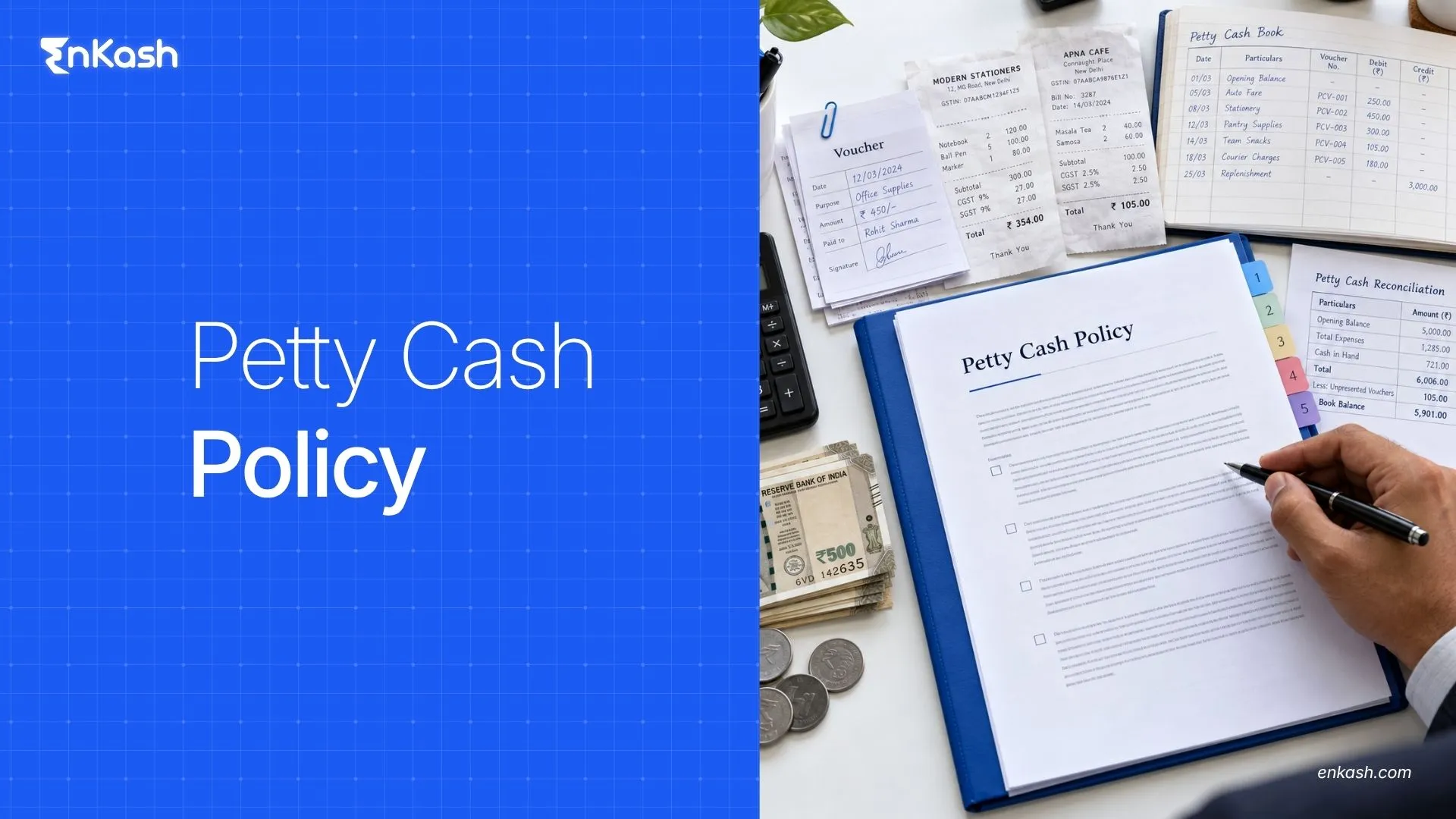
A petty cash payment voucher records the amount paid, the recipient, the business purpose, and the person authorising the expense. Businesses can use a printed form, Excel spreadsheet, or digital record. Each voucher should have a unique reference number and be linked to its supporting bill or receipt where available.
Instead of managing petty cash receipts manually, you can use the EnKash petty cash management tool for better petty cash management and reconciliation. With EnKash, you can manage petty cash expenses with UPI.
How Do You Fill a Petty Cash Voucher?
A petty cash voucher can support different workflows. In some businesses, cash is approved and released before the expense is incurred. In others, an employee first makes an eligible small payment and is reimbursed after submitting the required evidence. The exact sequence depends on company policy.
For an advance-based petty cash payment, the process may look like this:
- Start with the business reason: The requester records what the money is needed for and the expected amount.
- Enter the transaction details: Record the date, recipient, amount, expense category, business purpose, and any available supporting-document reference.
- Get the required approval: The authorized person checks whether the expense falls within company policy.
- Release the approved cash: The petty cash custodian hands over the amount and records the release.
- Complete the business purchase: The employee or recipient spends the money for the approved purpose.
- Submit the supporting evidence: Attach the bill, receipt, ticket, or other supporting document required under company policy.
- Confirm the final spending: Record the actual amount spent and return any unused advance to the petty cash fund. Any difference should be documented and resolved according to company policy.
- Close the transaction record: The completed voucher moves into filing and accounting.
When an Employee Is Reimbursed From Petty Cash
For a reimbursement, the employee first incurs an eligible small business expense, submits the receipt or available supporting evidence, records the purpose and expense category, obtains the required approval, and then receives reimbursement from the petty cash fund.
Petty Cash Voucher Examples
Examples become clearer when they look like expenses that actually appear in an office. The basic document remains familiar, although the supporting record and expense category change with each situation.
The following cases show how the same form works across different kinds of spending.
Local Courier Expense
An employee pays ₹280 for a courier used to send signed documents to a client and later claims reimbursement from petty cash. The voucher records the date, recipient, amount, courier expense category, business purpose, and approval. The courier receipt remains with the record because it supports the payment made outside the company.
Emergency Stationery Purchase
Printer paper runs out during the working day, and an employee receives ₹450 for an immediate purchase. The petty cash payment voucher records office supplies as the expense category and identifies who received the cash. The supplier bill is attached after the employee returns. A clear description such as printer paper and pens is far more useful than a vague entry such as miscellaneous office expense.
Local Auto Fare
An employee pays ₹180 for an auto ride to a business meeting. The record shows the traveler, date, amount, journey purpose, and local conveyance category. Where a formal receipt is unavailable, the employee should follow the company's missing-document or self-declaration process rather than creating or substituting unsupported evidence.
Minor Office Repair
A small repair needs immediate payment and costs ₹1,250. The voucher identifies the repair expense, person paid, business reason, amount, and approval. Any supplier bill or service record remains linked with the transaction.
How is a Petty Cash Voucher Recorded in Accounting?
Once the payment is complete, the voucher becomes the source record for bookkeeping. A complete voucher gives accounting the information needed to classify, post, and trace the expense.
The accounting trail moves through three clear stages:
The Transaction Enters the Petty Cash Record
The completed voucher is entered into the petty cash book, register, or accounting system. Its reference number gives the accounting entry a path back to the supporting paperwork.
The Expense Receives Its Account
The nature of the spending determines the expense account. Courier charges may enter courier or postage expense, while stationery belongs under office supplies. Local travel and minor repairs receive their own relevant classifications.
The Expense Entry Is Posted
The accounting entry depends on how the business maintains its petty cash system. Where individual payments are posted directly, the relevant expense account may be debited and petty cash credited. Under an imprest system, the expenses may instead be recognised when the spent amount is replenished, with the relevant expense accounts debited and bank or cash credited. The accounting policy should be applied consistently.
How Are Petty Cash Vouchers Used for Reconciliation?
A cash box may look fine until the physical money is compared with the records. Reconciliation performs that check by bringing the remaining cash and documented spending back to the expected fund balance.
Consider an imprest fund of ₹10,000. Suppose the physical cash remaining is ₹6,850, while completed supported vouchers total ₹3,150. Together, those amounts return to the original ₹10,000 fund.
A shortfall or excess means something needs investigation. A missing voucher, unreturned advance, recording error, or incorrect cash count may explain the difference. Reconciliation gives the business a chance to find that problem before the fund moves into another period.
What Controls Should a Business Set?
Petty cash becomes difficult to manage when every employee follows a different informal rule. A small policy makes expectations clear before money leaves the fund.
Useful controls can include the following measures:
- Eligible expenses should be defined clearly: Employees should know which categories may be paid through petty cash.
- An internal ceiling should be documented: The business should decide the amount it considers appropriate for petty cash use.
- Fund access should remain restricted: Designated custodians or authorised users should control access to the petty cash fund or digital petty cash system.
- Approval duties should remain separated where possible: The requester, approver, and custodian should not automatically become the same person.
- Missing-document cases need an exception rule: The policy should explain who can approve the expense and what explanation must be recorded.
- Unused advances should return promptly: The closing process should account for both the spending and any balance returned.
- Periodic review should have an owner: Someone should be responsible for checking records and unresolved differences.
- Retention periods should be documented: Petty cash vouchers and supporting records should be retained for the period required by applicable accounting, tax, audit, and company policies. Internal retention rules should not be shorter than any statutory requirement that applies.
What Income-Tax Rules Matter for Petty Cash Payments in India?
Company petty cash policy and income-tax rules operate on different levels. An internal ceiling decides what the business wants employees to pay from petty cash. Tax law determines how certain cash expenditure is treated for deduction purposes.
Under Section 36(4) of the Income-tax Act, 2025, deduction is generally restricted where a payment or aggregate of payments to a person in a day exceeds ₹10,000 and is made outside the specified banking or online modes, subject to prescribed exceptions.
For a payment made for plying, hiring or leasing goods carriages, Section 36(6) applies ₹35,000 in place of the ₹10,000 threshold, subject to the prescribed conditions and exceptions.
A petty cash voucher records why the business spent the money. The document cannot override the statutory rule governing the payment mode. The ₹10,000 income-tax cash-payment threshold is not a statutory petty cash limit. A company's petty cash ceiling remains an internal control decision.
A company voucher alone does not establish entitlement to GST input tax credit. A petty cash voucher is an internal accounting document and is not, by itself, a GST tax invoice. Input tax credit depends on the business satisfying the applicable GST conditions and holding the prescribed supporting document, such as a valid tax invoice, debit note or other permitted tax document where applicable.
For accounting purposes, three separate pieces should remain clear:
- Internal voucher: Records the business purpose and movement of petty cash.
- Supplier document: Provides the external commercial or tax evidence for the underlying transaction.
- GST eligibility review: Determines whether the applicable documentation and statutory conditions for input tax credit have been satisfied.
Adding tax fields to an internal company voucher does not convert that document into a supplier tax invoice.
Can Petty Cash Vouchers Be Maintained Digitally?
A business does not need to depend entirely on paper slips. Petty cash records can be maintained digitally where the system preserves the transaction details, supporting evidence, approvals and references needed for accounting, audit, tax and internal-control purposes.
Digital records can keep receipt images, expense categories, approval history, and payment details together. Older transactions also become easier to retrieve when accounts, management, or audit teams need them. Whether the record is paper-based or digital, it should still preserve the business purpose, approval trail and supporting evidence needed to account for the transaction
From Petty Cash Vouchers to Digital Petty Cash Management
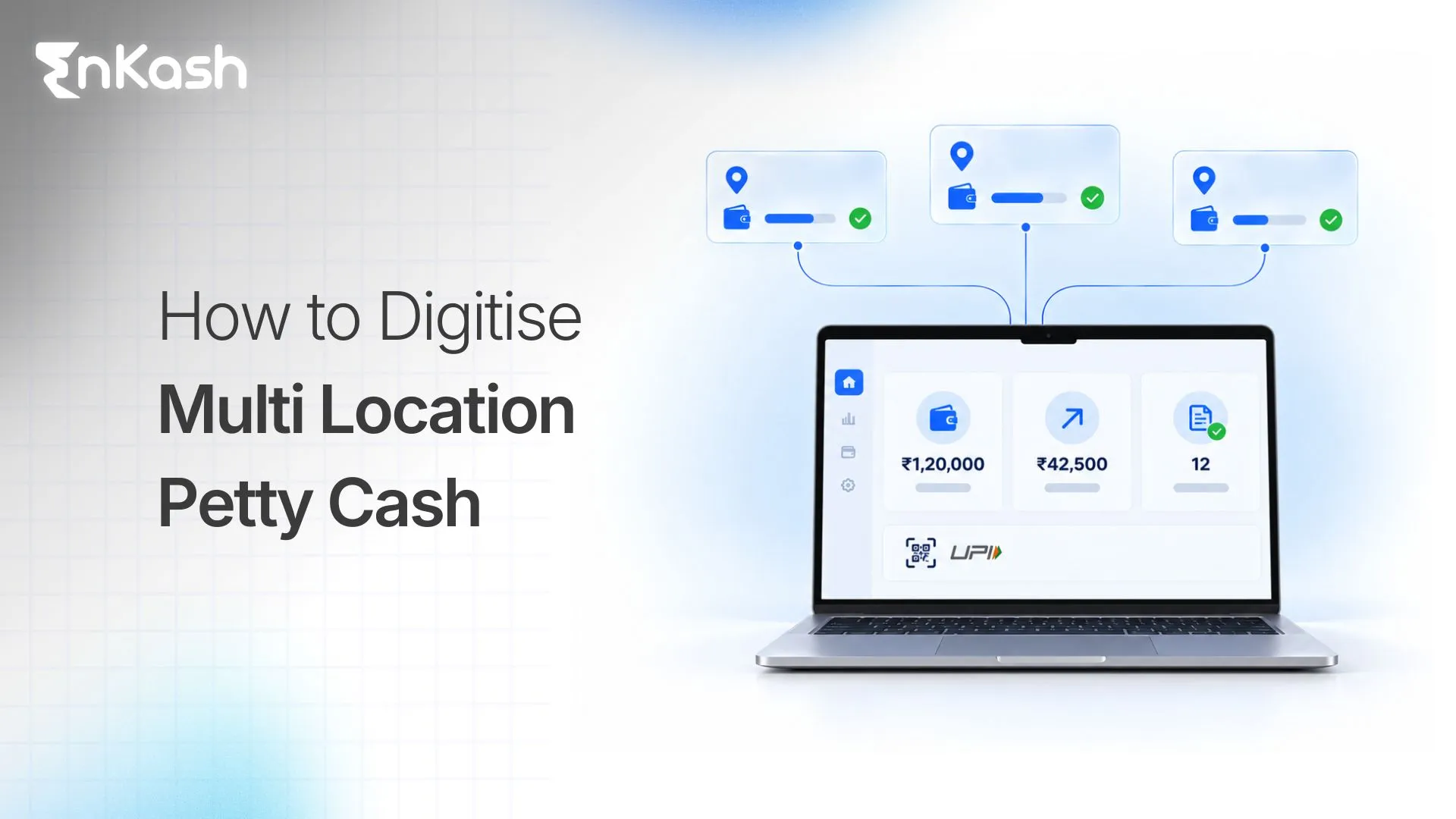
For businesses managing petty cash across branches, stores or teams, digitising only the voucher may solve the recordkeeping problem but not the wider operational effort. A digital petty cash system can bring fund allocation, payments, controls and reconciliation into the same workflow.
With EnKash Petty Cash Management, businesses can allocate funds to employees or locations, enable UPI-based payments, set spending limits and controls, capture receipts, route expenses for approval, and maintain transaction-level visibility for reconciliation and audit.
The objective is to reduce dependence on physical cash and manual follow-ups while giving finance teams a clearer record of where petty cash was allocated, how it was spent and whether each transaction was properly supported..
Why Small Cash Spending Still Needs a Proper Record
Small payments scarcely feel significant when they happen individually. Across weeks and months, however, those transactions become part of the same accounting trail as every other business expense.
A petty cash voucher turns a small cash payment into a traceable business record. When the voucher is linked with the appropriate supporting document, accounting entry and reconciliation process, finance teams can see why money was spent and whether the petty cash fund remains accounted for. The company's internal petty cash rules should still be kept separate from the income-tax and GST requirements that may apply to the underlying payment or purchase.
FAQs
Is a Petty Cash Voucher the Same as a Receipt?
A petty cash voucher is an internal business record of cash spending. A receipt normally comes from the seller or service provider and supports the underlying purchase.
Who Should Sign a Petty Cash Voucher?
The required signatures depend on company policy. Businesses commonly record the person preparing the voucher, the approver, the cash custodian, and the recipient where acknowledgment is required.
Can a Petty Cash Voucher Be Used Without a Receipt?
A petty cash voucher can document the internal expense when a receipt is unavailable, but it does not automatically replace external evidence. The business should follow its documented missing-document process, record the reason, collect any alternative evidence available, and obtain the required exception approval.
Is There a Legal Petty Cash Limit in India?
Indian law does not prescribe one universal petty cash ceiling for businesses. Companies can set internal limits, while separate income-tax rules can restrict deductions for certain cash payments above specified thresholds.
Can Petty Cash Be Used Without a Voucher?
A business can physically make a petty cash payment without a paper voucher, but the transaction should still have an internal record showing the amount, recipient, business purpose, approval and supporting evidence. That record may be paper-based or digital, depending on the company's process.
What Should a Petty Cash Voucher Contain?
A petty cash voucher should normally include the voucher number, date, recipient, amount, business purpose, expense category, supporting-document reference and required approval details. Businesses may also include cost centre, branch, project, cash custodian and recipient acknowledgement fields where needed.