The Purchase Price is Only the Beginning
An employee needs ₹2,000 to purchase supplies for an urgent client meeting.
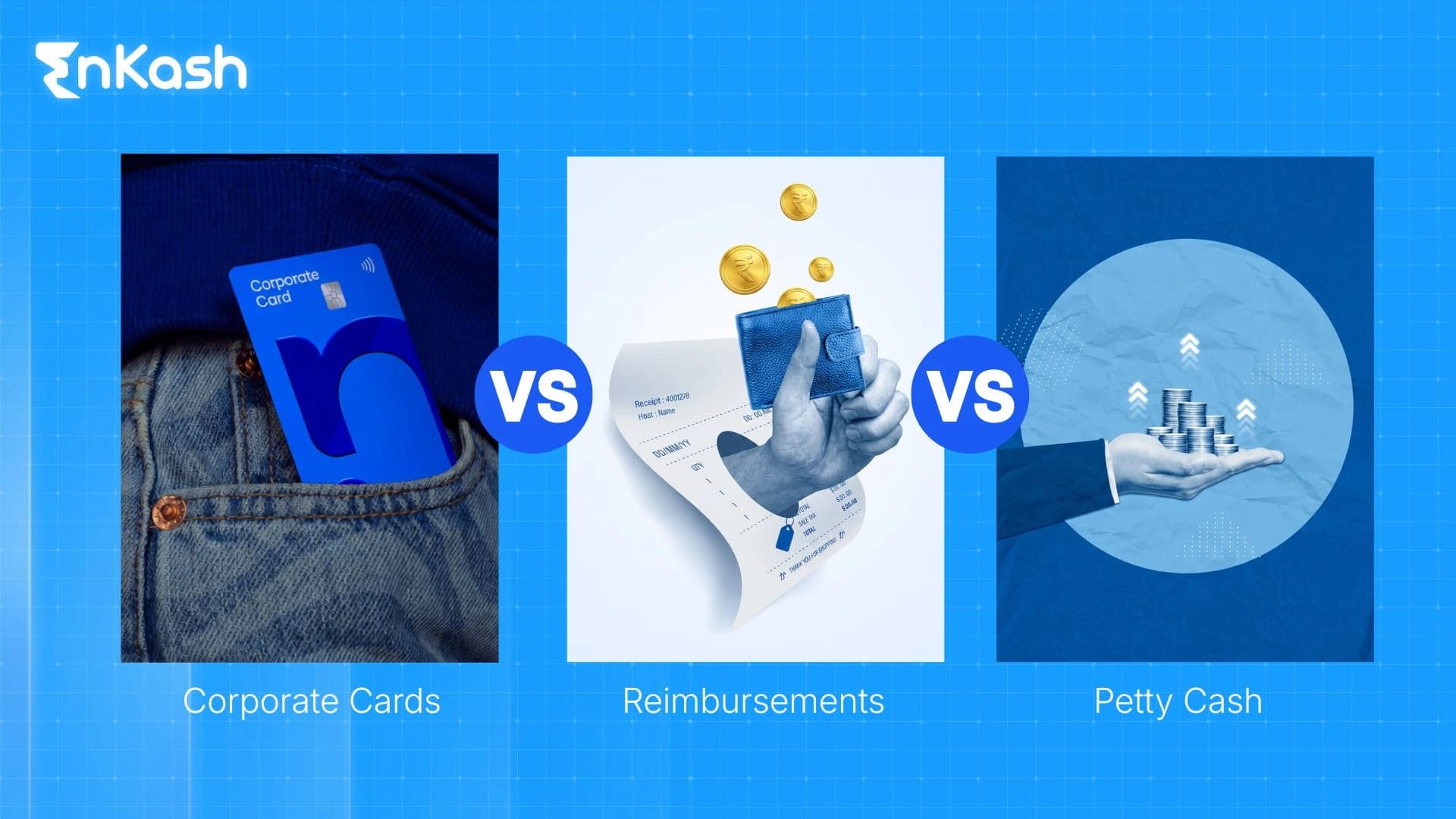
They could take the money from petty cash, pay personally and submit a reimbursement claim, or use a corporate card. The vendor receives the same ₹2,000 regardless of the payment method. For the business, however, the cost can be very different.
The cheapest expense method is not the one with the lowest fee. It is the one that creates the least friction across approval, funding, documentation, reconciliation, and audit.
Petty cash requires someone to maintain the cash balance, collect receipts, record transactions, and investigate discrepancies. Reimbursements require employees to use personal funds, prepare claims, secure approvals, and wait for repayment. Corporate cards may involve issuance or platform fees, but they can give finance teams greater control and visibility over spending.
The true cost of a business expense therefore extends beyond the amount paid to the vendor. It also includes the cost of employee time, approval effort, reconciliation work, compliance risk, and financial uncertainty created before and after the transaction.
Understanding these hidden costs helps businesses decide which payment method truly costs less and where each option belongs in their expense process.
How to Calculate the True Cost of a Business Expense
The true cost of an expense includes every resource the business uses to complete, verify, and record it. This means a ₹2,000 purchase may cost considerably more once the time spent seeking approval, arranging payment, collecting receipts, correcting errors, and reconciling accounts is considered.
Approval delays add another layer of cost after a purchase has been completed. Capture Expense analysed more than 371,000 claims processed through its platform across 460 UK organisations between January 2024 and June 2025. In that dataset, only 2.6% were approved immediately, while nearly 27% were approved after more than 30 days. While this is a UK platform dataset, it shows how approval delays can create hidden expense-management costs.
Businesses can evaluate each method using a broader calculation:
True expense cost = Purchase value + employee time cost + finance processing cost + payment-method cost + exception-resolution cost + risk exposure
The calculation should consider the complete expense lifecycle:
- Before payment: How is the expense requested, approved, and funded?
- At payment: Who pays, and what spending controls apply?
- After payment: How are receipts collected, transactions reviewed, and records created?
- During reconciliation: How easily can finance teams identify and correct discrepancies?
- During an audit: Can the business produce complete transaction records and supporting documents?
Petty cash, reimbursements, and corporate cards create costs at different stages of this lifecycle. Comparing only withdrawal charges, card fees, or reimbursement amounts can therefore make the least efficient method appear to be the cheapest.
Petty Cash: Convenient to Use, Expensive to Control
Petty cash remains useful when an employee must make an urgent, low-value purchase from a vendor that only accepts cash. The transaction itself appears simple: withdraw money from the cash box, make the purchase, submit the receipt, and record the remaining balance.
However, keeping petty cash available creates continuous administrative work. Someone must withdraw and safeguard the funds, issue cash to employees, maintain a register, collect supporting bills, count the remaining balance, and investigate every discrepancy. These tasks continue even when the business makes only a few cash purchases.
The method also provides limited control before payment. Once cash is issued, finance teams cannot restrict where it is spent or verify the transaction until the employee returns with a receipt. Missing bills, unrecorded purchases, duplicate claims, and incorrect balances can therefore remain unnoticed until reconciliation.
The larger risk with petty cash comes from limited traceability. Unlike a digital payment, a cash transaction does not automatically record who made the payment, where the money was spent, or what was purchased. Finance teams must depend on receipts, registers, and manual verification to create that record.
When documentation is missing or balances do not match, identifying whether the cause was an error, an unsupported purchase, or misuse can require significant investigation. The risk increases when separate cash funds are maintained across multiple branches or field teams.
Petty cash becomes increasingly expensive as a business adds more offices, departments, or field teams. Each location may require its own cash balance, custodian, register, and reconciliation process. Finance teams then spend more time consolidating records without gaining real-time visibility into where the money is being used.
Petty cash is best reserved for genuine cash-only expenses and emergencies. Using it as the default method for routine business spending can make small purchases disproportionately expensive to manage.
Reimbursements: When Employees Fund Business Expenses
Reimbursements can appear to be an easy way to manage employee expenses. The business does not need to issue cash or provide a dedicated payment method. Employees pay using their personal funds and claim the amount later.
However, the simplicity exists mainly at the point of purchase. Employees must preserve receipts, prepare claims, explain the business purpose, select expense categories, and wait for approvals. Managers and finance teams must then review each claim, verify supporting documents, check policy compliance, resolve errors, and arrange repayment.
Until this process is complete, the employee carries the financial burden of a business purchase. This can be particularly difficult for employees who travel frequently, purchase supplies regularly, or incur high-value expenses. Delayed repayments may also affect their ability or willingness to make future business purchases.
A Europe-focused SAP Concur study reported that 58% of surveyed employees were concerned about delayed reimbursements affecting their personal finances. Another 46%, said the reimbursement process was difficult enough that they avoided claiming smaller expenses. Another 8% were concerned about losing money because of missing receipts or forgotten claims.
Reimbursements also give finance teams limited control before a purchase occurs. They can reject a non-compliant claim, but the money has already been spent. The resulting disputes, corrections, and approval delays create further work while potentially damaging the employee experience.
Reimbursements remain practical for occasional or exceptional expenses where a company-funded payment method is unavailable. When used for routine spending, they create delayed spend visibility, recurring administrative work, and an unfair dependence on employees’ personal finances.
Corporate Cards: A Visible Cost With Greater Control
Corporate cards require a business to invest in a formal payment system. Depending on the provider and card type, the business may pay issuance, platform, transaction, or annual fees. Cards must also be assigned carefully, funded or linked to suitable limits, monitored regularly, and blocked promptly when an employee leaves.
These costs are easier to notice because they usually appear directly on an invoice or statement. However, corporate cards can reduce many of the less visible costs created by petty cash and reimbursements.
Employees can make approved business purchases without using personal funds or collecting cash from the finance team. Every card transaction automatically creates a digital record containing the amount, merchant, date, and cardholder details. When cards are integrated with an expense management system, employees can attach receipts to transactions, while finance teams can review spending without waiting until the end of the month.
Businesses can also decide how money should be spent before it leaves the account. Limits can be set for individual employees, teams, transactions, or defined periods. Depending on the card programme, businesses may also restrict merchant categories, disable certain transaction types, or issue cards for specific purposes such as travel, procurement, subscriptions, or imprest expenses.
PwC notes that corporate credit cards and prepaid cards are commonly used for reimbursable expenses and can be integrated with expense management systems. Yet access often remains limited to senior employees or selected departments, leaving other employees to pay personally and wait for reimbursement. Extending controlled access to employees who regularly incur business expenses can help reduce that dependence.
Corporate cards do not remove the need for expense policies or oversight. Employees may still submit receipts late, use cards incorrectly, or spend outside the intended business purpose. Poorly managed cards can also remain active or carry unnecessarily high limits.
Their value therefore depends on the controls and expense processes around them. When configured well, corporate cards move expense management closer to the point of purchase, giving employees a company-funded payment method while allowing finance teams to monitor and control spending as it occurs.
Corporate Cards vs. Petty Cash vs. Reimbursements: A Cost Comparison
The three payment methods can fund the same purchase, but they distribute the work and financial burden differently. Petty cash requires the business to manage physical money. Reimbursements place the initial cost on employees. Corporate cards require a formal card programme but provide greater control over routine spending.
| Cost factor | Petty cash | Reimbursements | Corporate cards |
|---|
| Who funds the purchase? | Business provides cash in advance | Employee pays until reimbursed | Business funds the expense |
| Visible cost | Cash withdrawal and handling costs | Amount reimbursed to employees | Card issuance, platform, or programme fees |
| Employee effort | Collect cash, retain receipt, and return the balance | Pay personally, retain receipts, prepare claims, and follow up | Make the payment and submit supporting documents |
| Finance effort | Issue cash, maintain registers, count balances, and reconcile receipts | Review claims, verify receipts, secure approvals, and arrange repayments | Monitor transactions, review exceptions, and reconcile card records |
| Control before spending | Limited once cash is issued | Limited because review usually happens after payment | Limits and usage controls can be applied before payment |
| Spend visibility | Available after records are manually updated | Available after the employee submits a claim | Available soon after the transaction |
| Transaction trail | Depends on receipts and manual records | Depends on receipts and claim details | Digital transaction data is automatically recorded |
| Employee financial burden | Low | High, particularly for frequent or large expenses | Low |
| Risk exposure | Missing cash, incomplete records, and unsupported purchases | Duplicate claims, policy violations, and missing receipts | Misuse, excessive limits, and inactive cards if poorly managed |
| Scalability | Difficult across multiple teams and locations | Creates growing approval and processing workloads | Easier to manage across teams when supported by suitable controls |
| Best suited for | Genuine cash-only and emergency purchases | Occasional expenses where company-funded payment options are unavailable | Planned, recurring, and frequent business expenses |
No method is entirely free of administrative work or financial risk. The more relevant question is whether the effort required to manage a payment method is reasonable for the expenses processed through it. A ₹500 emergency cash purchase may not justify creating a separate card workflow, while regularly reimbursing employees for travel, subscriptions, or supplies can create far more work than providing controlled corporate cards.
How to Choose the Right Payment Method for Business Expenses
Replacing every petty cash payment and reimbursement with a corporate card may create unnecessary complexity. Continuing to use all three methods without clear rules, however, can leave employees uncertain about how they should pay and make expense oversight difficult for finance teams.
Businesses should assign each payment method according to the nature and frequency of the expense.
Use corporate cards for frequent and predictable expenses
Corporate cards are better suited to spending that occurs regularly or requires stronger controls. Common examples include:
- Business travel and accommodation
- Software subscriptions and digital advertising
- Office supplies and recurring vendor payments
- Departmental and field-team expenses
- Fuel, logistics, and procurement-related purchases
Keep petty cash for genuine cash-only requirements
Petty cash may remain necessary for emergencies, low-value purchases, or vendors that do not accept digital payments. Businesses should maintain a defined cash limit, assign responsibility to a custodian, and reconcile balances frequently.
Reserve reimbursements for exceptions
Reimbursements work best when an employee unexpectedly incurs a legitimate business expense and cannot access a company-funded payment method. They should remain an exception rather than the standard way employees fund routine business activities.
| Question to consider | Suitable payment method |
|---|
| Is the expense frequent, planned, or recurring? | Corporate card |
| Does the business need controls before payment? | Corporate card |
| Does the vendor accept only cash? | Petty cash |
| Is the expense unexpected and unlikely to repeat? | Reimbursement |
| Does the employee regularly make business purchases? | Corporate card or another company-funded method |
| Is the expense difficult to trace or reconcile? | Corporate card, prepaid card, UPI-led petty cash flow, or another digital payment method connected to expense management |
What Businesses Often Discover When They Digitise Expenses
Moving routine expenses from petty cash and reimbursements to company-funded digital payment methods can reduce this workload. However, simply issuing corporate cards does not solve every expense management problem.
At EnKash, we see this pattern often: the payment method is rarely the only problem. The real cost sits in the gaps between approval, payment, receipt capture, reconciliation, and accounting. Businesses that digitise only the payment step still end up chasing receipts and correcting records later
An effective expense process requires five connected elements:
- A defined payment method for each expense category
- Spending limits and controls applied before payment
- Easy access to company-funded payment methods
- Timely receipt capture and approval workflows
- Direct integration between payments, expense records, and accounting systems
When these elements work together, finance teams no longer need to reconstruct expenses after they occur. They can monitor spending earlier, reduce manual reconciliation, and give employees a practical way to make approved business purchases.
The Lowest Visible Cost is Not Always the Lowest True Cost
For finance teams, the decision is no longer cash versus card versus reimbursement. The real decision is whether business spending should be controlled before it happens or repaired after it happens.
Petty cash, reimbursements, and corporate cards can fund the same purchase, but they create different costs before and after payment. Petty cash requires physical handling and manual reconciliation. Reimbursements place the initial financial burden on employees. Corporate cards involve visible programme costs but can provide stronger controls and earlier spend visibility.
The most cost-effective approach is usually a defined mix: corporate cards for regular spending, limited petty cash for cash-only requirements, and reimbursements for genuine exceptions. Businesses should evaluate each method based on the complete work required to approve, fund, document, reconcile, and audit the expense.