As businesses handle a growing share of transactions digitally, managing payments becomes more demanding. Payments today move across multiple methods, networks, and settlement cycles. This makes it harder for teams to track transaction status, settlement progress, and cash inflows with certainty.
Across many Indian businesses, payments are collected through UPI, cards, net banking, and bank transfers, often resulting in fragmented data and delayed reconciliation. Finance teams face challenges in tracking settlements accurately, identifying failed transactions, and maintaining consistent payment visibility, while customers expect quick confirmations and reliable checkout experiences.
As payment volumes increase across sales, subscriptions, and operational collections, payment processing plays a direct role in revenue realisation and cash flow control.
By the end of this blog, you will understand how payment processing works, the systems involved, and how to evaluate payment processing solution that supports secure, efficient, and scalable digital collections.
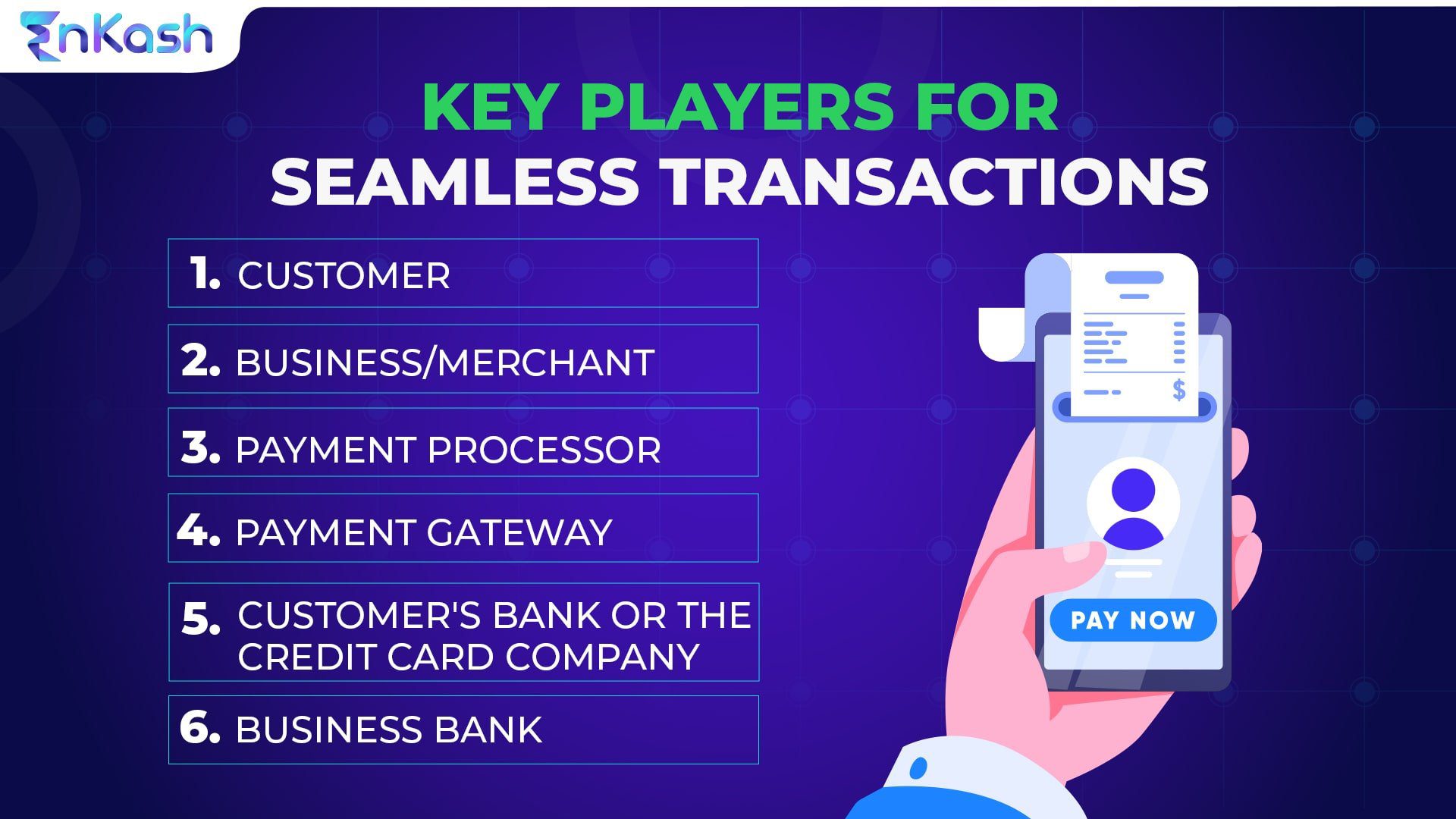
Key players for seamless transactions
What is Payment Processing
Payment processing refers to the set of actions that take place once a customer initiates a digital payment, covering transaction validation, authorisation, routing, and settlement with the business. It includes transaction validation, authorisation, security checks, routing through financial networks, and settlement into the merchant’s account.
Every digital transaction, whether completed through UPI, cards, net banking, or Digital wallets, passes through multiple systems to confirm payment authenticity, availability of funds, and compliance requirements. These checks ensure that payments are completed accurately, securely, and within defined timelines.
For businesses, payment processing acts as the operational backbone of collections. It supports online and offline transactions, enables near real-time transaction visibility, and ensures that customer payments move through regulated and traceable channels with minimal manual intervention.
How Does Payment Processing Work
Payment processing follows a structured sequence that moves a transaction from initiation to settlement. While authorisation happens within seconds, multiple systems work together in the background to validate, route, and complete the payment securely.
Step-by-Step Payment Processing Flow
Payment initiation The customer selects a payment method and authorises the transaction on the checkout page, app, or payment interface.
Payment data transmission The payment request is encrypted and sent to the payment gateway or processing system for verification.
Authorisation request The processor routes the transaction to the issuing bank or payment network to check account validity, balance, and security parameters.
Authorisation response The issuing bank approves or declines the transaction and sends the response back through the same channel.
Transaction confirmation The customer and the business receive confirmation of the transaction status in real time.
Settlement and fund transfer Approved transactions are batched and settled, and funds are transferred to the merchant’s account within the defined settlement cycle.
This payment processing procedure ensures that payments are authenticated, protected against fraud, and recorded accurately. The same core flow applies across electronic payment processing methods, with slight variations based on the payment instrument and network involved.
Types of Payment Methods in Payment Processing
Payment processing supports multiple payment methods to match how customers prefer to pay and how businesses collect funds. Each method follows the same core processing flow, with variations in authorisation, settlement timelines, and intermediaries involved.
Card payments
Debit and credit cards remain a widely used payment method for online and offline transactions. Card payment processing involves authorisation from the issuing bank, routing through card networks, and settlement to the merchant account. It supports one-time payments, subscriptions, and recurring billing.
UPI payments
UPI enables near real-time, account-to-account transfers through mobile applications. Payments are authorised using PIN-based authentication and processed in near real time. UPI payment processing is commonly used for e-commerce checkouts, in-store QR payments, and peer-to-business collections.
Net banking
Net banking allows customers to make payments directly from their bank accounts by logging into their banking portal. The payment is authorised by the customer’s bank and settled through banking networks. This method is often used for high-value or corporate transactions.
Wallet payments
Digital wallets store prepaid balances or link to bank accounts and cards. Payment processing for wallets includes balance validation or account authorisation before completing the transaction. Digital Wallets are typically used for quick checkouts and repeat payments.
Bank transfers (NEFT, RTGS, IMPS)
Bank transfer methods are commonly used for business payments and high-value transactions. Processing timelines vary based on the transfer type, with some methods offering near real-time settlement and others following batch-based cycles.
Offering multiple payment methods through a single payment processing system helps businesses improve payment success rates, reduce drop-offs, and meet diverse customer payment preferences.
A payment processing system is built on multiple components that work together to authorise, route, and settle transactions. Each component plays a specific role in ensuring payments are completed securely and efficiently.
Payment gateway
The payment gateway captures payment details from the customer and transmits them securely for processing. Payment gateway acts as the entry point for digital transactions and handles encryption, authentication, and communication between systems.
Payment processor
The payment processor manages the transaction flow between the payment gateway, banks, and payment networks. It is responsible for routing authorisation requests, handling approvals or declines, and coordinating settlement.
Issuing bank
The issuing bank is the customer’s bank that issued the card or holds the account being used for payment. It verifies account details, checks available balance, and approves or declines the transaction.
Acquiring bank
The acquiring bank holds the merchant’s account and receives the funds once the transaction is settled. It works with the processor to ensure funds are credited as per the settlement cycle.
Payment networks
Payment networks connect issuing and acquiring banks or institutions and define transaction rules, security standards, and routing protocols for different payment methods. They define transaction rules, security standards, and routing protocols that enable payments to move across financial institutions.
Settlement and reconciliation systems
Settlement systems transfer approved funds to the merchant account, while reconciliation systems match transactions with payouts. These components help businesses track payments, identify discrepancies, and maintain accurate financial records.
Together, these components form the backbone of a payment processing system. Their coordination ensures that processing payments remains secure, traceable, and compliant across different payment methods.
Why Payment Processing is Important for Businesses
Payment processing directly affects how efficiently a business collects revenue, manages cash flow, and delivers a reliable customer experience. Delays, failures, or lack of visibility in the payment process can disrupt operations and impact growth.
Enables faster and reliable collections
A structured payment processing system ensures that customer payments are authorised and settled within defined timelines. This reduces dependency on manual follow-ups and shortens the time between sale and fund availability.
Improves customer payment experience
Customers expect payments to be quick, secure, and seamless. Reliable payment processing minimises transaction failures and provides instant confirmation, which builds trust and reduces checkout abandonment.
Supports multiple payment methods
Modern businesses need to accept payments across cards, UPI, net banking, and bank transfers. Effective payment processing enables all these methods through a single, consistent flow, without operational complexity.
Enhances transaction visibility and control
Payment processing systems provide real-time insights into transaction status, settlements, and failures. This visibility helps finance teams track incoming payments, identify issues early, and reconcile accounts accurately.
Strengthens security and compliance
Processing payments through regulated systems helps protect sensitive payment data and reduces exposure to fraud. Built-in checks, encryption, and network-level controls ensure transactions meet security and compliance standards.
Scales with business growth
As transaction volumes increase, manual payment handling becomes unsustainable. Automated payment processing supports higher volumes without compromising speed or accuracy, enabling businesses to scale efficiently.
How to Choose the Best Payment Processing Solution
Selecting the right payment processing solution requires more than comparing transaction fees. The choice affects payment success rates, settlement timelines, operational efficiency, and customer experience.
Supported payment methods
The solution should support all relevant payment methods, including cards, UPI, net banking, and bank transfers. This ensures customers can pay using their preferred option without friction.
Payment success rates and reliability
High success rates indicate stable integrations with banks and payment networks. Consistent performance reduces failed transactions, retries, and customer drop-offs.
Settlement timelines and payout visibility
Clear settlement cycles and transparent payout reporting are critical for cash flow planning. Businesses should be able to track when funds are credited and reconcile payments without manual effort.
Integration and scalability
The payment processing system should integrate easily with websites, apps, and backend systems. As transaction volumes grow, the infrastructure must scale without impacting performance.
Security and compliance standards
Strong encryption, tokenisation, and adherence to regulatory and security standards help protect payment data. This reduces fraud risk and ensures long-term compliance.
Reporting, reconciliation, and support
Access to detailed transaction reports and responsive support simplifies issue resolution. Reliable support becomes especially important during high-volume periods or payment disruptions. Choosing a payment processing solution that aligns with business size, transaction volume, and operational needs helps ensure stable collections and long-term scalability.
India’s digital payments ecosystem includes several payment processing solution providers that cater to different business sizes, industries, and transaction needs. While the core payment processing flow remains the same, providers vary in terms of payment method coverage, settlement speed, reporting depth, and support.
Payment Gateway Providers
Payment gateway providers enable businesses to accept online payments through cards, UPI, net banking, and wallets. They are commonly used by ecommerce platforms, SaaS businesses, and service providers that collect payments digitally.
Examples include providers that focus on quick onboarding, wide bank coverage, and high transaction success rates, along with APIs for website and app integrations.
Bank-Backed Payment Processors
Some banks offer in-house payment processing solutions or partner-led platforms. These solutions are often preferred by large enterprises that prioritise direct bank relationships, predictable settlement cycles, and compliance-led setups.
Full-Stack Payment Platforms
Full-stack providers combine payment gateways, processing, settlement, reporting, and reconciliation within a single platform. These solutions are designed for businesses that want better visibility and control over payment operations, beyond basic collections.
Such platforms typically support multiple payment methods, real-time transaction tracking, and finance-friendly dashboards that reduce manual reconciliation work.
Industry-Specific Payment Solutions
Certain providers focus on specific use cases such as subscriptions, marketplaces, education, or high-volume B2B payments. These solutions optimise payment processing for recurring billing, split settlements, or large transaction volumes.
When evaluating payment processing solution providers, businesses should consider their transaction profile, preferred settlement timelines, reporting needs, and long-term scalability rather than selecting solely based on pricing.
Conclusion
So far in this blog, you have learned how payment processing works, the flow followed during a transaction, the payment methods involved, and the systems that support secure and timely settlements. The guide also covered why payment processing is important for businesses and how to evaluate the right solution based on operational needs.
Having clarity on payment processing helps businesses handle collections with better control, reduce payment-related issues, and maintain consistent cash flow. As digital payments continue to expand across channels and use cases, understanding the payment process becomes a practical requirement rather than a technical detail.
For more such guides on payments, business operations, and financial workflows, explore additional resources that break down complex topics into clear, actionable insights.
FAQs
1. How long does payment processing usually take? Payment processing typically happens within seconds for authorisation. Settlement to the business account depends on the payment method and provider and can range from near real-time to one or two business days based on the settlement cycle.
2. What happens if a payment fails during processing? If a payment fails during processing, the transaction is marked as failed, and the amount is either not debited or automatically reversed to the customer’s account within a defined timeframe. Businesses can track failed transactions through their payment dashboard and retry or reconcile them if required.
3. Is payment processing the same as settlement? No. Payment processing covers authorisation, validation, and transaction confirmation, while settlement refers to the actual transfer of funds to the merchant’s bank account after the transaction is approved.
4. Can a payment be cancelled while it is processing in Google Pay? No, payments cannot usually be cancelled once processing starts. Payments marked as processing usually cannot be cancelled manually. If the transaction fails, the amount is reversed automatically. For delays, users should contact Google Pay support or the linked bank.
5. What does payment processing mean in Google Pay? It refers to the steps that occur after payment authorisation, including bank verification, routing, and transaction confirmation.
6. What is credit card payment processing? It is the process through which a card transaction is authorised by the issuing bank and settled to the merchant via payment networks.
7. How long does the NEFT payment process take? NEFT payments are processed in half-hourly batches and are available 24×7. Funds are typically credited the same day, depending on cut-off timings and bank processing.