Key Takeaways
- Expense reimbursement pays an employee back for an approved business cost first paid from personal funds.
- Reimbursement, allowance, advance, and company-paid spending follow different money flows, even when they cover similar work costs.
- Income-tax treatment, employer deduction, and GST input tax credit are separate checks. Approval of a claim does not settle all three.
- From Tax Year 2026-27, businesses need to assess reimbursement treatment under the Income-tax Act, 2025 and the Income-tax Rules, 2026.
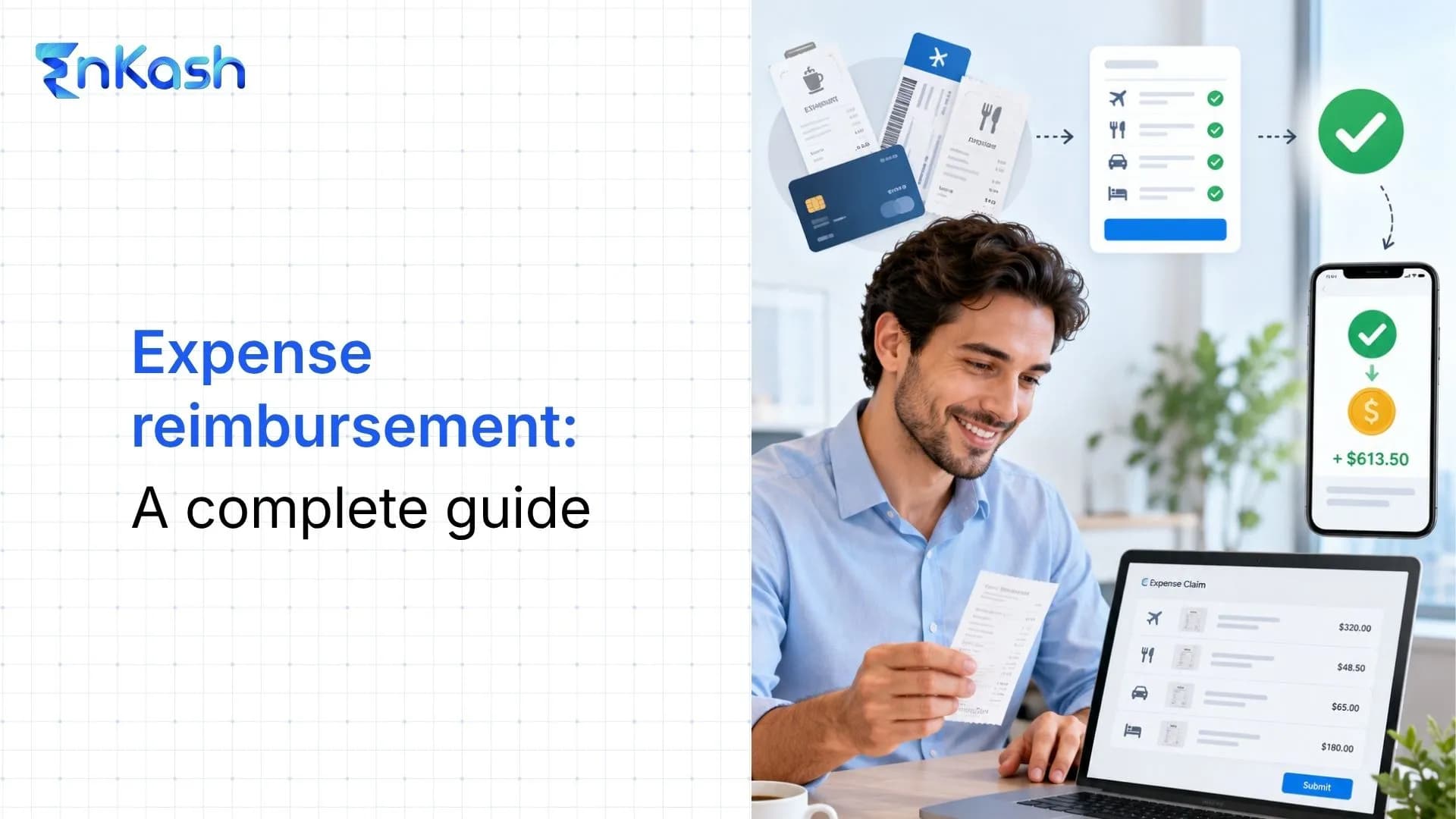
An employee travels to a client meeting and pays for the cab using a personal UPI account. On another trip, the company card is unavailable, so the hotel goes on the employee’s own card instead. Different situations, same basic issue. Personal money has covered a business expense.
Employee expense reimbursement begins from that point. Once submitted, a reimbursement claim goes through approval, payment, accounting and recordkeeping. Where applicable, finance also reviews its income-tax and GST treatment. Understanding this process helps employees submit accurate claims and businesses manage approvals, payments, and compliance.
What is Expense Reimbursement?
Expense reimbursement is the repayment of an approved business cost that an employee first paid personally. The employee pays for a work-related expense, retains the supporting documents, and submits a claim for reimbursement. The company checks the purpose and amount before repayment.
The original payment came from the employee. Reimbursement returns that business spend after review. The employee is asking the company to settle a cost incurred on its behalf. Unlike salary or an expense allowance, reimbursement is linked to an eligible expense incurred on the employer's behalf.
Expense Reimbursement Example
An employee spends ₹2,500 on a cab while travelling to an approved client meeting. The payment is made through the employee's personal UPI account.
The employee submits the cab invoice, payment details and business purpose through the company's reimbursement process.
The manager verifies the expense, and finance checks the amount against the company's travel policy. Once approved, the company reimburses ₹2,500 to the employee through its designated payment method.
The company records the eligible travel expense and corresponding reimbursement in its accounting system. Any applicable tax treatment is assessed separately.
How Is Reimbursement Different From an Allowance, Advance, and Company-Funded Expense?
The same business expense can be funded through reimbursement, an allowance, an advance or a company-paid arrangement.
| Expense Model | Who Pays First? | How the Amount Is Set | Typical Use |
|---|
| Expense Reimbursement | Employee | Actual eligible expense, subject to company policy and approved limits | Employee-funded business purchase |
| Company-Funded Expense | Employer | Actual cost paid directly | Corporate card, vendor bill, centralized purchase |
| Expense Allowance | Employer | Predetermined amount or rate based on company policy | Defined expense support |
| Cash or Travel Advance | Employer | Estimated upcoming cost | Planned business travel or activity |
Reimbursement repays an eligible expense after the employee pays for it. Allowances provide an amount under a defined policy, while advances provide funds before spending and must generally be accounted for later. Company-funded expenses are settled through a business payment arrangement
Which Employee Expenses Can Be Reimbursed in India?
Most reimbursement claims begin with a work expense that an employee has paid personally. The reimbursable amount depends on company policy, the business purpose, and the applicable approval limits. Common reimbursement categories include business travel, accommodation, local conveyance, work-related purchases, and approved communication expenses.
Business Travel
Official travel can include approved flights, rail tickets, taxis, and booking charges paid by the employee.
Accommodation
Employees may claim approved hotel or accommodation expenses incurred during business travel.
Local Conveyance and Mileage
Employees may claim approved local travel expenses, including cabs, public transport, parking, and eligible mileage. Mileage may also be available for approved personal vehicle use.
Business Meals and Client Expenses
Meals incurred during approved business travel or client meetings may be reimbursed in accordance with company policy.
Office and Work Supplies
Office stationery, printing, courier charges and other approved business supplies may be reimbursed when employees pay personally.
Work-From-Home and Communication Costs
Companies may reimburse eligible internet, mobile phone and work-from-home expenses based on their policies and applicable tax requirements.
Training and Professional Development
Courses, certification fees, and conferences may be reimbursed when the company has approved them for professional use.
How Does the Expense Reimbursement Process Work?
An expense claim typically moves from employee submission to policy validation, approval, payment and accounting. The employee first records the business expense, the manager confirms why it was needed, and finance checks whether the claim meets company and accounting requirements. A defined expense reimbursement process keeps those responsibilities clear and gives the company a record of how the payment was approved.
The employee expense reimbursement process typically includes the following steps:
- Pay the Business Expense
The employee uses personal money for an approved or permitted work-related cost. - Collect the Supporting Proof
The receipt, invoice, ticket, booking confirmation, or another relevant record is kept with the expense. - Submit the Expense Claim
The employee records the amount, expense category, business reason, and supporting documents through the company’s claim process. - Manager Approval
The assigned manager checks whether the expense relates to legitimate business activity and falls within the permitted spending rules. - Complete the Finance Check
Finance reviews the approved claim for required records, correct classification, and applicable accounting or compliance requirements. - Pay the Approved Claim
Once the checks are complete, the company pays the approved amount through its designated reimbursement process, which may involve payroll or a separate payment workflow. - Record and Reconcile the Expense
The claim, approvals, payment details, and supporting documents remain in the finance records for accounting and audit purposes.
What Should an Expense Reimbursement Policy Include?
A reimbursement policy defines eligible expenses, spending limits, required documents, approval responsibilities, and payment timelines. A good policy also gives employees a clear answer before they spend their own money.
Scope and Policy Ownership
State who is covered, who owns the policy, and who can update or interpret it.
Spending Limits and Pre-Approval
Set limits by category or role and identify costs that need permission before spending.
Claim Submission Window
Set an internal period for claim submission and explain how late requests are handled. India does not set one universal central reimbursement deadline for every private employer.
Approval Authority
The policy should show who approves standard and higher-value claims.
Exception Handling
Define how claims with missing receipts, policy deviations, or unusual circumstances will be reviewed and approved.
Reimbursement Timeline and Method
Specify when approved claims will be paid, whether payments are processed through payroll or separately, and how employees can track their status.
What Documents Should Support an Expense Reimbursement Claim
Finance needs enough information to identify the spend, business reason, and approval. A receipt establishes the purchase details but may not explain its business purpose.
Expense Details
Date, vendor, amount, and category identify the transaction.
Receipt or Invoice
An invoice or receipt records the purchase. Where required, employees should also provide proof of payment, such as a card statement or UPI transaction record
Business Purpose
A short note should connect the expense with a client, project, trip, or other work activity.
Travel or Usage Evidence
Travel claims may need itinerary or booking details. Vehicle claims can also need journey or mileage records where the applicable tax rules require proof of official use.
Approval Record
Pre-approval, final authorization, and approved exceptions should remain with the claim.
A basic reimbursement claim should capture the following information:
| Field | Example |
|---|
| Employee name | Aarav Sharma |
| Employee ID | EMP-1042 |
| Department | Sales |
| Expense date | 12 October 2026 |
| Expense category | Local Conveyance |
| Business purpose | Travel to an approved client meeting |
| Merchant / vendor | ABC Cabs |
| Expense amount | ₹2,500 |
| Payment method | Personal UPI |
| Supporting documents | Cab invoice and UPI payment record |
| Claim submission date | 13 October 2026 |
| Approval status | Approved |
| Approved amount | ₹2,500 |
| Reimbursement status | Paid |
Illustrative claim details, not an actual employee or transaction.
Is Employee Expense Reimbursement Taxable in India?
Expense reimbursement is not automatically taxable or tax-free. Its treatment depends on the purpose of the expense, who benefits from it, the supporting documentation, and the applicable income-tax provisions.
From April 1, 2026, the Income-tax Act, 2025 and Income-tax Rules, 2026 govern the relevant treatment for Tax Year 2026–27.
1. Reimbursement of Official Business Expenses
When an employee incurs an expense wholly for official duties and the employer reimburses the eligible amount, it may not result in taxable salary or a taxable perquisite, provided the applicable conditions are satisfied.
For example, reimbursement of documented business travel or other expenses incurred on the employer's behalf may qualify for such treatment.
The employer should maintain the supporting documents and other records required for the particular expense.
2. Reimbursement of Personal Expenses
If an employer pays for an employee's personal expenditure, the payment may be treated as a taxable salary component or perquisite, depending on the nature of the benefit and applicable provisions.
Calling a payment a reimbursement does not automatically make it tax-free.
3. Reimbursement of Mixed-Use Expenses
Some expenses, such as vehicle running costs or communication bills, may involve both personal and business use.
The employer should identify the official-use portion and apply the relevant valuation or tax rules. Where prescribed, supporting records such as journey details, mileage logs and employer certification may be required.
4. Tax Deduction for the Employer
The employer's tax deduction is assessed separately from the employee's tax treatment.
Under Section 34 of the Income-tax Act, 2025, qualifying business expenditure incurred wholly and exclusively for business or professional purposes may be deductible, subject to the Act's conditions and exclusions.
Important: A company's approval of a reimbursement does not automatically establish that the expense is tax-free for the employee or deductible for the employer.
A business may be able to claim GST input tax credit (ITC) on an expense initially paid by an employee, provided the underlying purchase and supporting documents satisfy the conditions prescribed under GST law.
The fact that the employee paid personally does not automatically disqualify the expense. However, reimbursing the employee does not itself create ITC eligibility.
Finance teams should verify the following:
| GST Check | What Finance Should Verify |
|---|
| Business purpose | The goods or services were used or intended to be used for business, subject to the applicable restrictions. |
| Tax invoice | A valid GST invoice or other permitted document supports the registered business as the recipient and contains the required particulars. |
| Supplier reporting | The supplier has reported the relevant invoice details and the information has been communicated to the recipient as required under Section 16. |
| Receipt of supply | The applicable condition concerning receipt of goods or services has been met. |
| ITC restrictions | The expense is not covered by blocked-credit restrictions under Section 17(5), unless a relevant exception applies. |
| Other conditions | Applicable tax-payment, return-filing, time-limit and other statutory requirements have been satisfied. |
Example: Employee-Paid Business Purchase
Suppose an employee purchases approved office supplies for the company and pays through a personal UPI account.
If the supplier issues a valid tax invoice to the registered business, the purchase is eligible for ITC, and all other GST conditions are fulfilled, the company may be able to claim the input tax credit even though the employee made the initial payment.
However, a UPI payment screenshot or an invoice addressed only to the employee does not, by itself, establish the company's ITC eligibility.
Similarly, an approved reimbursement for a client meal does not automatically qualify for GST ITC because food and beverage expenses may fall under blocked-credit restrictions.
Companies should therefore evaluate reimbursement eligibility and GST ITC eligibility separately.
What Controls Reduce Reimbursement Errors and Misuse
Duplicate Claims
Compare invoice numbers, dates, vendors, amounts, and earlier payments to spot repeat claims.
Personal Spend
A weak business reason may signal personal expenditure.
Amount and Policy Manipulation
Changed values, altered records, or several smaller claims around an approval limit can signal an attempt to bypass policy. Looking at the claim in isolation may miss that pattern.
Segregation of Duties
Separating the claimant, approver, finance reviewer, and payment authority reduces the chance that one person controls the whole decision.
Keep the reason, approver, decision, and later changes on record for unusual claims.
How Can Businesses Automate Expense Reimbursements
Expense reimbursement software helps businesses automate receipt capture, policy checks, approval routing, payments, and reconciliation.
Digital Receipt Capture
Employees can upload receipts from a phone. Optical character recognition (OCR) can extract details such as the vendor name, invoice date, amount, and GST information for employee or finance review.
Automated Policy Validation
Software can check limits, required fields, and spending rules before review.
Approval Routing
The system can send a claim to the correct approver based on role, amount, or exception status.
Reimbursement Processing
Approved claims can move into payroll or a separate payment workflow.
Accounting Integration
Approved expense data can be synced with accounting or ERP systems using the appropriate ledger codes and cost centres.
Employee Status Visibility
Employees can see whether a claim is submitted, under review, approved, rejected, or paid. Real-time claim status helps employees track reimbursements without repeatedly contacting finance.
How EnKash Helps Businesses Manage Employee Reimbursements
EnKash Expense Management brings expense submission, policy checks, approvals, and reimbursement tracking into one workflow.
Employees can submit receipts through supported channels such as WhatsApp, email, or the app. AI-powered OCR extracts expense details, while configurable policies help flag missing information, duplicate claims, and spending-limit violations.
Finance teams can manage approval workflows, monitor reimbursement status, and sync expense records with supported accounting or ERP systems.
By connecting expense capture, approvals, and financial records, businesses can reduce manual follow-ups and improve visibility into employee spending.
Explore EnKash Expense Management
Which Expense Reimbursement Metrics Should Finance Teams Track
Finance teams should measure reimbursement delays, exception rates, and manual intervention to identify process bottlenecks. Claims may wait in queues, bounce back to employees, need exception approval, or stay with finance for manual handling. The metrics should make those differences visible.
Measure the full wait from valid submission to completed repayment.
First-Pass Approval Rate
Measure the percentage of claims approved during their first review without requiring correction or resubmission.
Policy Exception Rate
Track the claims that cannot move under the standard policy and need separate judgment.
Claim Aging
Review what is still open after the internal target date has passed.
Manual Touch Rate
Measure the percentage of claims that require manual correction, additional verification, or intervention outside the standard automated workflow.
Employee Out-of-Pocket Exposure
Keep a current figure for business costs employees have already paid and are still waiting to recover.
Conclusion
An effective reimbursement process helps employees recover approved business expenses on time while giving finance teams greater control over spending. Employees who spend personal money for valid company work need a defined path to claim it back. A clear reimbursement policy, complete supporting documents and accurate tax classification reduce delays, disputes and compliance risks. Once those pieces work together, automation can remove routine effort and measurement can show where the process is slowing down.
FAQs
Is Expense Reimbursement Taxable for Employees in India?
The word reimbursement does not settle the tax issue. A genuine business expense supported by proper records is looked at differently from a payment that is really an employee benefit or additional compensation.
Can an Employee Claim Expense Reimbursement Without a Receipt?
Yes, if the employer's policy allows an exception and alternative evidence sufficiently supports the claim. A bank or UPI record may help establish payment, but it does not automatically replace a tax invoice for GST ITC purposes. A card statement, reservation proof, transaction message, or written declaration may be enough if the company’s policy permits it.
Can a Company Reject an Employee Expense Reimbursement Claim?
Yes. A company may reject or return a claim if it is unrelated to work, exceeds permitted limits, lacks necessary supporting documents, or was incurred without required pre-approval. The decision should follow the applicable policy and employment terms.
Is There a Legal Time Limit for Expense Reimbursement in India?
One central deadline does not cover every private-sector employer. The time available for filing a claim can differ from company to company and may also depend on contractual or industry-specific requirements.
Yes, GST input tax credit may be available on an employee-reimbursed expense if the underlying purchase and supporting documents satisfy GST requirements. Reimbursement approval alone does not establish ITC eligibility. The business needs the right tax documents and must satisfy the normal eligibility rules.
Is Expense Reimbursement Part of an Employee's Salary?
Expense reimbursement is generally different from salary because it repays an eligible cost incurred for business purposes. However, a payment described as reimbursement may be taxable if it provides a personal benefit or does not satisfy the relevant tax conditions.
How Long Does Employee Expense Reimbursement Take?
There is no single processing time followed by all employers. The timeline depends on the company's reimbursement policy, document verification, approval workflow and payment schedule. Employers should communicate their reimbursement service-level targets clearly and allow employees to track claim status.