In July 2026, UPI processed 23.66 billion transactions worth ₹29.88 lakh crore, according to NPCI data. Digital payments are now a routine part of how people in India pay. So the question for schools and colleges isn't really “Should we accept digital payments?”
It's “Why should fee collection be manual?”
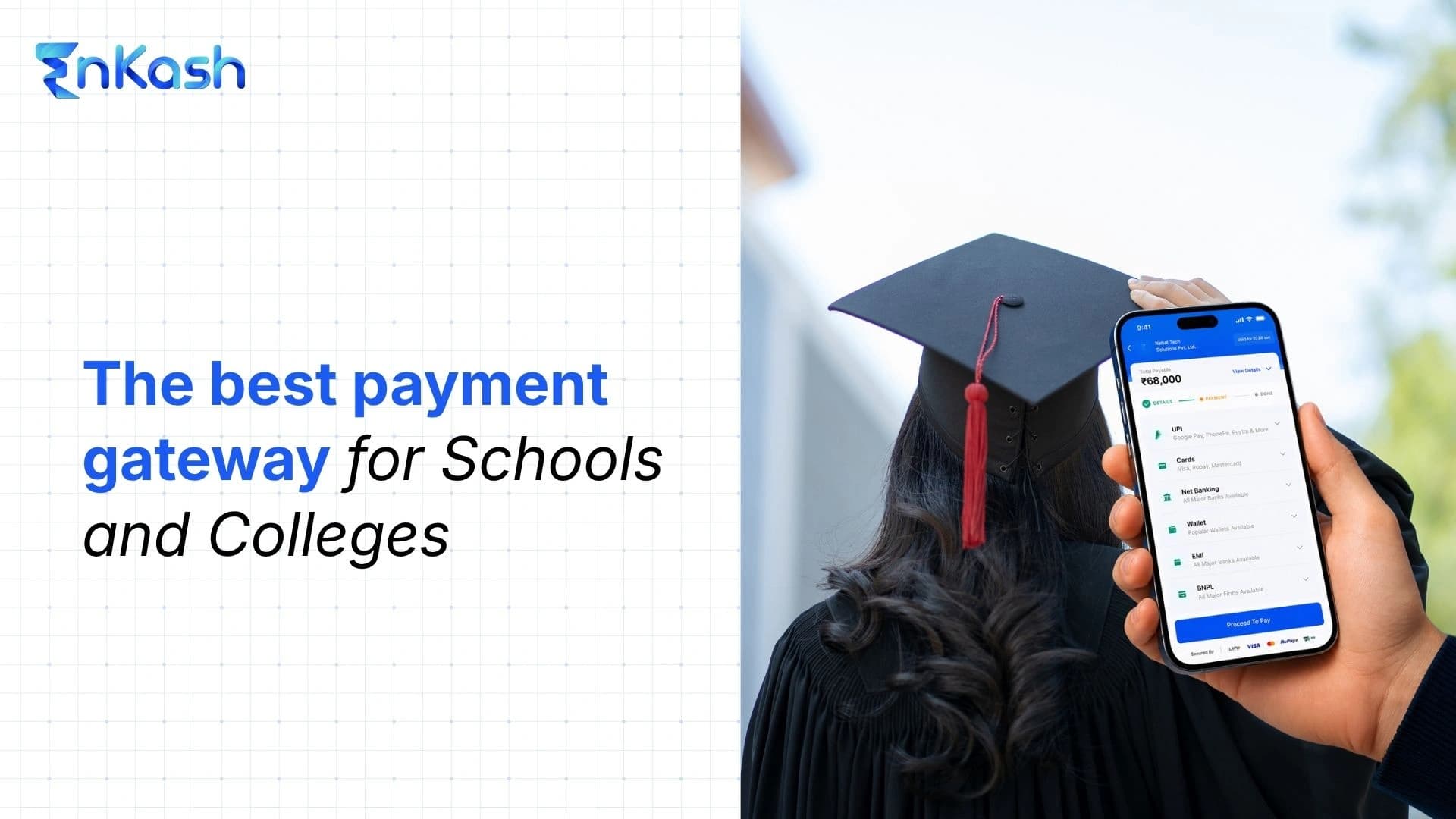
For many institutions, fee collection has moved beyond cash counters and cheques. Parents can now pay tuition, admission, examination and other fees digitally, without visiting the campus.
Today, parents can pay tuition fees, admission fees and other institutional charges from their phones in just a few clicks.
But making fee collection digital is only half the job.
The bigger challenge for educational institutions is everything that happens after the payment: mapping it to the right student, tracking different fee heads, generating receipts, updating records, following up on pending dues and reconciling transactions.
That's where the right
payment gateway for schools and colleges can make a difference.
With so many payment gateways available, how do educational institutions decide which one actually fits their fee collection needs?
In this guide, we'll explain what schools and colleges should look for in a payment gateway, compare leading providers and examine how the right payment setup can simplify fee collection and reconciliation.
What is a Payment Gateway for Educational Institutions?
A
payment gateway for schools, and colleges enables educational institutions to accept fees digitally through payment methods such as UPI, debit and credit cards, net banking, wallets and, where available, EMI options.
When integrated with an ERP, SIS or fee-management system, a payment gateway can support collections across fee categories such as tuition, admission, examination, semester, transport and hostel fees while helping institutions map each payment to the relevant student and fee head.
Payment Gateway vs Fee Management System: What's the Difference?
A payment gateway and a fee management system perform different roles in the fee collection process. The payment gateway processes the payment, while the fee management system or ERP maintains the student's fee records and related information.
Understanding this difference is important because a payment gateway does not replace the institution's ERP or student management system. Instead, the two can work together to automate the movement of payment information and reduce manual reconciliation.
| Payment Gateway | ERP / Fee Management System |
|---|
| Processes digital payments | Maintains student fee records |
| Supports payment methods such as UPI, cards and net banking | Defines fee heads, due dates and outstanding amounts |
| Returns payment success, failure or pending status | Updates the student's payment record |
| Provides transaction, refund and settlement data | Maps payments to the relevant student and fee head |
| Provides APIs and webhooks for payment updates | Uses payment data to update student records and reports |
| Supports payment collection through checkout, links, pages or other available modes | Manages institution-specific fee schedules and student-level information |
For example, when a parent pays an examination fee through the payment gateway, the gateway processes the transaction and returns its status. Through an ERP or student management system integration, that payment can then be mapped to the correct student and examination fee head, the payment record can be updated and a receipt can be generated.
For schools and colleges, the more useful setup is therefore one where the payment gateway integrates with the existing ERP, SIS or fee management system. This connects payment collection with student records, fee tracking and reconciliation without requiring administrative teams to update the same information manually across multiple systems.
6 Features of Payment Gateways For Schools and Colleges
Payment gateways for schools and colleges have been designed to meet their requirements. The payment gateway must have the following features:
ERP Integration: The payment gateway should integrate with the institution's ERP or student information system so payments can be mapped to the correct student record, fee receipts can be generated, and payment status can be updated automatically.
Multiple Payment Modes: A
payment gateway that provides multiple payment modes like UPI, debit/credit cards, wallets, and net banking must be preferred, as it allows parents to make payments via their choice of payment method.
Installment Payment: Parents must get the option to break the fees into easy monthly installments or EMIs, making it easy for them to submit fees.
Recurring Payments: If the institution offers scheduled fee collection, check whether the provider supports recurring mandates through options such as UPI AutoPay, eNACH, or cards, subject to applicable limits and rules.
Receipts & Reminders: The payment setup should support automated payment confirmations, digital receipts, and due-date reminders, either natively or through integration with the institution's ERP or fee-management system.
Security: The provider should comply with PCI DSS requirements for card-data security and use appropriate encryption and tokenisation controls for sensitive payment information.
How does a Payment Gateway work for Educational Institutions?
From clicking on “Pay Now” to payment recorded in the institution’s system, there is a whole process that runs in the background. Here is a step-by-step working of a payment gateway for schools and colleges:
Step 1: Payment Gateway Set Up
It starts with integrating the payment gateway with the institution’s official website, app, student portal or ERP. This helps create a seamless payment channel for parents and students.
Step 2: Fees Collection
As soon as the parent or student clicks on “Pay Now” on the website or app, they are redirected to the payment gateway where they get payment options to pay the fee.
Step 3: Payment Verification
Once the payment is initiated, the transaction is securely routed through the relevant payment network and banking infrastructure for authentication and authorisation. The transaction is verified to ensure that the payment can be processed successfully.
Step 4: Payment Processing & Settlement
After the transaction is approved, the payment is processed and the fees are settled in the educational institution’s bank account, as per the settlement cycle.
Step 5: Instant Notification
The payment confirmation message pops up immediately on the screen after the payment is successful. The payment details can then be shared with the institution's system for tracking and reconciliation.
Why do Schools and Colleges need a Payment Gateway?
Payment requirements in education differ from those of a typical retail or e-commerce checkout. Fee collection at school and college is more than receiving a payment. It includes tracking multiple fee categories, following up on fees due, generating receipts while updating a student’s records, and reconciling the transactions.
An education sector-centric payment gateway upgrades the traditional fee deposit process into a streamlined digital setup.
When connected with the institution's fee-management or ERP system, the payment infrastructure can support multiple fee schedules, partial payments, recurring collections, reminders, receipts, and student-level payment tracking.
Benefits of Payment Gateway for Educational Institutions
Educational institutions integrating their website with payment gateways can change the way fees are collected, tracked and reconciled.
Easy Fee Collection: An efficient payment gateway helps educational institutes collect student fees easily by reducing the administrative effort and manual processes. It enables parents to pay fees digitally with their choice of payment method.
Generate Receipts & Financial Reports: After the
payment is successful, digital receipts are generated, which can be shared with the fee payer digitally. Schools and colleges can access fee receipts and payment records whenever required for accounting purposes.
Improve Collection Visibility: A digital payment system gives institutions better visibility into their fee collections. Administrative teams can track collected fees, outstanding dues, failed transactions, and collections by fee type. This makes it easier to identify pending payments and take timely action.
Convenient Payment Experience: Parents don't have to plan a visit to the school just to pay a fee. They can pay digitally from their phone, choose an available payment method, and receive confirmation once the transaction is completed. Automated reminders can also help parents stay on top of upcoming or overdue payments.
Support Multiple Fee Heads: A suitable payment setup should support the institution's different fee heads, such as tuition, transport, examination, hostel, and admission fees. Mapping these payments to the relevant student record can make tracking and reporting significantly easier.
Automate Repetitive Tasks: The biggest advantage of digital fee collection is what happens after the payment. With the right integrations, a successful payment can trigger a workflow such as:
Payment → Confirmation → Receipt → Student Record Update → Reconciliation
This reduces repetitive data entry and frees administrative teams to focus on more important tasks.
Integrate With Existing ERP or Student Management Systems: Schools and colleges don't need another disconnected system. A payment gateway can be integrated with the institution's existing ERP, LMS, student management system, website or mobile application, allowing payment information to flow into the systems already being used.
Improve Transparency and Trust: Digital payments create a clear transaction trail for both the institution and the payer.Parents get payment confirmations and receipts, while finance teams have access to transaction records for tracking and reconciliation.
A Comparison of Best Payment Gateways for Schools and Colleges
Schools and colleges should compare payment gateways based on how well they support fee collection, integrations, reconciliation, and the payment experience for parents and students.
How we compared: We reviewed publicly available product pages and documentation from each provider and compared capabilities relevant to schools and colleges, including payment methods, payment links and pages, recurring payments, ERP integration, fee tracking, reconciliation, and support. Feature availability may vary depending on the integration type, institution requirements, merchant eligibility, and commercial agreement.
| Features | EnKash | Razorpay | PayU | Cashfree |
|---|
| UPI, Cards & Net Banking | ✅ | ✅ | ✅ | ✅ |
|---|
| Payment Links | ✅ | ✅ | ✅ | ✅ |
|---|
| Payment Pages | ✅ | ✅ | ✅ | ✅ |
|---|
| QR Payments | ✅ | ✅ | ✅ | ✅ |
|---|
| EMI / Pay Later Options | ✅ | ✅ | ✅ | ✅ |
|---|
| ERP/LMS Integration | API/ERP integration | API/partner integrations | API/custom integration | API/ERP partner integrations |
|---|
| Fee Collection & Tracking | ✅ | ✅ | ✅ | ✅ |
|---|
| Multiple Fee Heads | ✅ | ⚠️ Depends on integration | ⚠️ Depends on integration | ⚠️ Depends on integration |
|---|
| Automated Reconciliation | ✅ | ✅ | ✅ | ✅ |
|---|
| Recurring Payments | ✅ | ✅ | ✅ | ✅ |
|---|
| WhatsApp/SMS Payment Collection | ✅ | ✅ | ✅ | ✅ |
|---|
| Custom Payment Experience | ✅ | ✅ | ✅ | ✅ |
|---|
| Dedicated Support | ✅ | Available on select plans | Enterprise-focused | Available |
|---|
| Best Suited For | Schools, colleges & education businesses | General businesses & EdTech | Enterprises & high-volume businesses | Businesses needing fast settlements |
|---|
Why Choose EnKash Payment Gateway for Educational Payments?
Collecting student fees is only one part of the process for an educational institution. The larger operational task is tracking, reconciling, and managing those payments after they are received.
For education and EdTech use cases, EnKash supports automated instalment collection, bulk fee collection, and student payment tracking, alongside payment and reconciliation capabilities.
Here’s why the EnKash payment gateway can simplify fee collection for educational institutions:
1. Give Parents 100+ Ways to Pay
Not all parents use the same method to make payments. EnKash supports 100+ payment options through a single integration, including UPI, debit and credit cards, net banking, wallets, and EMI options. This includes major card networks like Mastercard, Visa, RuPay and Amex.
This gives parents greater flexibility at checkout while allowing institutions to manage collections through one payment setup.
2. Make Fee Collection Easier to Manage
Educational institutions have tuition fees, course fees, examination fees, admission fees, transport fees, and other miscellaneous fees across different time schedules in a year.
EnKash helps with automated and bulk fee collection, allowing institutions to track student fees.
These capabilities can reduce manual follow-ups and help institutions manage high-volume fee-collection periods more efficiently.
3. Reduce Reconciliation Work
EnKash has a user-friendly and intuitive analytics dashboard that allows merchants to track fee collection in high-volume periods, payment success rates, timelines for
payment settlement, and other transaction details. This data can be used for accounting and reconciliation purposes.
4. Choose the Right Payment Experience for Every Collection
EnKash has a payment collection suite inclusive of payment gateway, payment page, payment link,
payment button, QR codes, auto collect and
bulk collect. Institutions can choose the collection method that best fits each payment use case.
For example, an institution can integrate the payment gateway into its website or app, use
payment links for individual or bulk fee requests, and create hosted payment pages for dedicated collection flows.
5. Integrate With Your Existing Systems
EnKash provides APIs, mobile SDKs, and
plugins, enabling payment integration across websites, mobile applications, and existing technology ecosystems. It also supports integrations with ERP and other business systems.
6. Give Finance Teams One View of Payments
EnKash brings payment operations and analytics into a single dashboard. Finance teams can view, manage, and monitor transactions, refunds, settlement status, payment analytics, invoices, API keys, webhooks, and reconciliation data from the same dashboard.
7. Build on Security and Compliance
EnKash is an RBI-authorised online Payment Aggregator. Its payment gateway lists PCI DSS Level 1 certification, 256-bit SSL encryption, tokenisation and continuous security monitoring among its security controls.
8. Get Support Beyond the Integration
EnKash provides support for integration, testing, production troubleshooting, transactions, refunds, settlements and reconciliation, along with structured escalation for critical issues. EnKash offers 24/7 human support and 24-hour onboarding, subject to merchant eligibility and completion of the required onboarding checks.
Conclusion
The best payment gateway for a school or college should offer more than multiple payment methods. It should also fit into the institution's broader fee-collection and finance workflows. Instead, it is the one that fits seamlessly into the institution’s entire payment lifecycle. Everything from fee collection to reminders, student details mapped to fees receipt, confirmation to reconciliation must be a part of the payment gateway ecosystem to facilitate the fee collection and submission process smoothly for both parents and students.
FAQs
1. What is a payment gateway for schools?
A payment gateway enables schools to collect student fees digitally through payment methods such as UPI, net banking, and cards. It also helps track transactions, confirm payment status, and send automated reminders to parents.
2. Can schools collect fees without a website?
Yes, schools can collect fees without a website. They can do so by using payment links and hosted payment pages. This allows a parent to open the payment page directly without navigating through the institution's website.
3. Can a payment gateway handle multiple fee types?
A payment gateway can support multiple fee types when the required fee head and student information is passed through the institution's ERP, SIS, or payment integration. Schools should confirm whether tuition, hostel, examination, transport, and other fee categories can be mapped to the correct student record.
4. Can parents pay school fees through UPI?
Yes, parents can pay school fees using
UPI with the EnKash payment gateway as it supports different UPI checkout flows.
5. Can schools automate recurring fee collection?
Yes, if the provider supports recurring payment mandates such as UPI AutoPay, eNACH or eligible card-based mandates. The exact options depend on the provider, payment method and applicable mandate rules.
6. Can a payment gateway integrate with an ERP?
Yes. Payment gateways can integrate with ERPs, student information systems, and other institutional platforms through APIs, SDKs, webhooks, or provider-specific integrations. EnKash supports ERP and business-system integrations through its payment infrastructure.
7. What is the biggest benefit of a payment gateway for schools?
The biggest benefit is reducing manual work across fee collection, payment tracking and reconciliation. When connected with the institution's ERP or fee-management system, digital payments can also improve payment visibility and reduce repetitive administrative tasks.
8. Which is the best payment gateway for schools and colleges?
The right payment gateway for schools and colleges depends on the institution's fee structure, size, ERP integration, payment volume, and automation requirements.