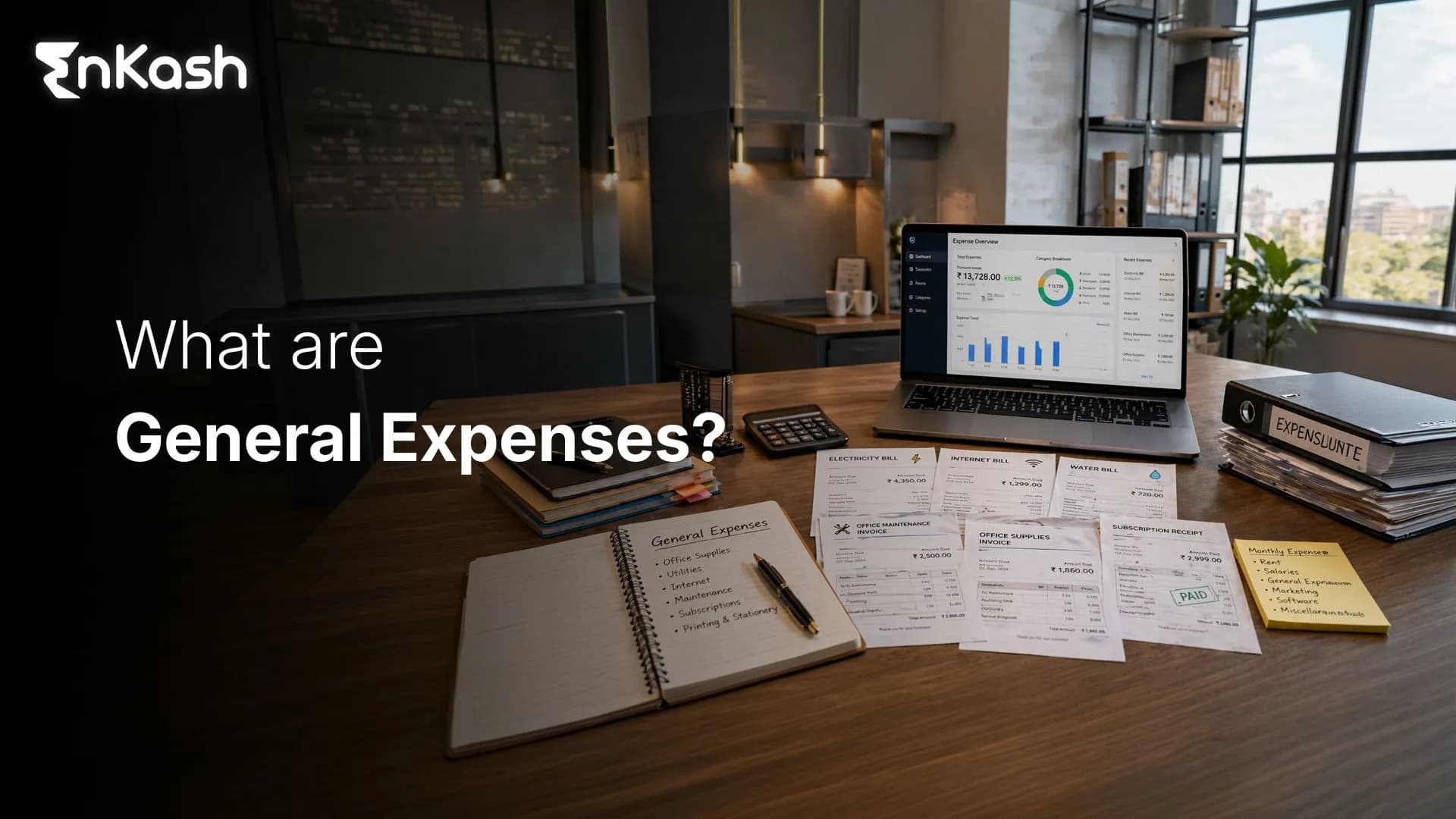
General expenses can weaken financial control long before the issue becomes visible in reporting. Delayed coding, missing support documents, scattered approvals, and vague classifications reduce clarity and slow the monthly review. A stronger structure improves visibility from the point of entry. This blog explains the category, identifies what belongs within it, compares related concepts, and outlines the recording discipline required for cleaner reporting and tighter expense control.
General expenses are typically recognized in the accounting period in which they are incurred, subject to accrual principles. Depending on the nature of the item, they may appear under rent, utilities, professional fees, employee benefits, software subscriptions, or other operating expense heads in financial statements. Businesses should apply consistent classification policies across reporting periods.
What Are General Expenses?
General expenses are a practical bookkeeping term often used for indirect administrative and overhead costs. In formal reporting, these costs are usually classified under employee benefits, other expenses, rent, legal fees, utilities, and similar heads.
In everyday accounting use, general expenses are indirect operating costs incurred to keep the business functioning without linking directly to production output or a single sale. They support administration, office operations, governance, and shared business activity. These costs are recorded in expense ledgers during the accounting cycle and are traditionally treated as nominal expense accounts and closed to the profit and loss account at period end.They exist below the direct cost layer, which is why they matter so much in profitability review. A business may control material consumption or sales effort well and still lose clarity because routine overhead has been poorly grouped. Good accounting treatment keeps these costs visible without confusing them with manufacturing overhead, marketing overhead, or finance cost. This distinction is important in both financial reporting and cost analysis.
Importance of General Expense Tracking
Profit Visibility and Cost Control
Indirect spending can grow quietly when it moves through cards, reimbursements, vendor bills, shared services, and petty cash without a review structure. Strong tracking reveals the true overhead burden and shows where administrative costs are pushing down operating performance. Finance teams get a clearer picture of what the business spends simply to stay organized and functional.Better Budgeting and Forecast Accuracy
Planning improves when recurring overhead is organized into stable categories rather than broad buckets that change every month. This is where general cost control becomes useful. A cleaner structure makes the budget-versus-actual review more meaningful, highlights overspending patterns earlier, and improves forecasting quality because the baseline itself becomes more reliable.
Cleaner Audit and Compliance Readiness
Tracked expenses are easier to support. Bills, tax data, vendor details, and approval history stay attached to the transaction, which reduces end-period cleanup and strengthens the logic behind classification. Better documentation also makes audit reviews less disruptive because the finance team does not have to rebuild the expense management story after the fact.Stronger Approval Discipline and Spend Governance
A business can manage general expenses more effectively when approvals, policy checks, and limit controls are close to the point of spending. That approach catches exceptions earlier, reduces duplicate claims, and makes policy enforcement practical rather than cosmetic. Governance works best when it is attached to a live transaction flow instead of a delayed monthly review.Example of General Expenses
Office and Administrative Overheads
A practical general expense list starts with the routine costs of keeping the office and support environment running. Office rent for administrative premises, communication charges, internet, printing, stationery, office supplies, and insurance linked to administration usually sit in this group. These costs do not create inventory or produce sales directly, but the business cannot function smoothly without them.Professional and Statutory Support Costs
An administrative expenses list also includes the professional services that support governance and financial discipline. Audit fees, legal fees, accounting support, compliance assistance, secretarial work, and similar back-office services belong here. These costs are indirect, yet essential because they protect process quality, reporting discipline, and statutory readiness.Shared Systems and Business Support Costs
Administrative software, common cloud tools used for back-office work, outsourced support services, and common management salaries can also fall into this area when they relate to general administration instead of manufacturing or front-line selling. Their role is organizational support, which is why they belong in overhead review rather than in direct product costing.
Items that do not Belong Here
Direct material, direct labor, production overhead, sales commissions, promotional spend, finance cost, and abnormal losses should not be pushed into the general bucket simply because they are inconvenient to classify. Costing discipline improves when each cost sits where it actually belongs.
General Expenses vs Direct Expenses
| Basis | General Expenses | Direct Expenses |
|---|
| Nature | Indirect | Directly attributable |
| Example | Rent, audit fee | Raw material, freight inward |
| Impact | Overhead | Cost of goods/services |
G&A vs. SG&A Expenses?
Management teams often separate these categories for internal review because the insight they offer is different. G&A captures the administrative side of overhead, and SG&A captures a broader operating-cost picture.
| Basis | G&A expenses | SG&A expenses | Practical use |
| Scope | General management and administration | Selling plus administration | SG&A is wider |
| Typical contents | Admin salaries, legal, audit, office rent, admin systems | G&A items plus sales payroll, commissions, promotion, and selling support | Each bucket answers a different review question |
| Exclusions | Direct production, direct material, direct labor, finance cost | Direct production and cost of goods sold | Neither replaces cost of sales |
| Best use | Overhead control and administrative review | Broader operating-expense analysis | Finance teams use them for different decisions |
| Statutory presentation | Internal analysis label | Internal analysis label | Schedule III does not require either as a fixed face-line |
Semi-Variable vs. Fixed General Expenses
Cost behavior changes the way finance teams budget and review support spending. Some overhead remains broadly stable within a normal operating range. Another layer combines a fixed base with a usage-linked element, which means control requires closer monitoring of consumption patterns.
| Basis | Fixed General Expenses | Semi-variable General Expenses | Why Finance Separates Them |
|---|
| Cost movement | Broadly stable over short periods | Part fixed and part usage-linked | Budget review becomes more precise |
| Common examples | Office rent, admin salaries, annual licenses, insurance | Electricity, telecom, cloud usage, repairs, courier, printing | Usage-led leakage becomes easier to detect |
| Budgeting impact | Easier to estimate monthly | Needs thresholds and usage review | Planning quality improves |
| Control method | Contract review, renewal checks, headcount discipline | Alerts, caps, vendor review, consumption analysis | Different behavior needs different controls |
How to Record and Track General expenses
Set Up Clear Ledgers and Categories
Good recording discipline starts at the ledger level. Repeated administration costs need their own heads, which keeps unrelated spending out of vague miscellaneous accounts. Separate ledgers for office rent, legal charges, audit fees, communication, software, and office supplies make the monthly review sharper and improve the quality of management reporting.
Capture Documents and Classify at Source
Every expense should be entered into the system with its bill, tax details, user note, and approval context attached. Source-level classification reduces later guesswork and helps finance teams code the cost correctly at first entry. Clean capture also improves vendor review, GST support, and department-level analysis because the transaction already carries the evidence needed for review.Post Accurately and Review Monthly
Posting discipline matters because prepaids, accruals, and shared-cost allocations can distort results when they are handled casually. The month-end review should test category trends, unusual spikes, and old unmatched balances before the books move into reporting. A disciplined process supports accurate movement into financial statements and cost records without forcing major repairs at close.
Review by Cost Center, Department, and Vendor
A single ledger balance does not answer operational questions. Finance teams need visibility into support spending by department, branch, user, vendor, and cost center to understand where it is rising and why. This level of review helps identify weak policy discipline, concentration risk with vendors, and recurring overspend in specific units.
Reconcile Balances and Close Cleanly
Expense ledgers should reconcile with bills, advances, reimbursements, and payment records before closure is finalized. Cost-sheet use cases add another layer because administrative overhead must be assigned using rational principles such as traceability, cause and effect, or benefits received. Clean reconciliation protects both financial accuracy and internal cost analysis.General Expenses Journal Entry Example
If the office rent of ₹50,000 is paid:
Office Rent A/c Dr ₹50,000 To Bank A/c ₹50,000This records an administrative expense paid through the bank.
How EnKash Helps in Tracking General expenses
Centralized Capture Across Payment Modes
EnKash consolidates scattered transactions into a single review structure across prepaid cards, reimbursements, petty cash, app submissions, WhatsApp capture, and email-based workflows. This reduces blind spots created by mixed payment channels and shortens the path from expense occurrence to finance visibility. Card activity can automatically create draft entries, reducing manual delay.
Approval Workflows and Spend Controls
Custom policies, multi-level approvals, role-based permissions, budget checks, and overrun alerts help finance teams control routine overhead before posting. Policy violations can be flagged at the submission stage, which strengthens preventive controls and reduces rework after reimbursement or accounting entry.
Accounting Sync and Reporting Support
The platform supports GL mapping, automated journal support, and integrations with Tally, Zoho Books, QuickBooks, ERPs, and APIs. This reduces duplicate data entry, improves ledger quality, and speeds up financial reporting by connecting expense capture directly with accounting workflows.Real-time Visibility for Finance Teams
Real-time dashboards, custom reports, audit trails, duplicate-claim checks, and GST-linked expense support give finance teams quicker visibility into overhead patterns. Review improves because the data arrives in a structured form rather than through delayed spreadsheet consolidation across departments and branches.
Challenges in Recording General Expenses
Misclassification and Vague Grouping
The first problem is vague coding. When unrelated costs are pushed into broad headings such as miscellaneous expenses, reporting loses precision. The books may balance perfectly, yet the information becomes far less useful for planning, control, and management review.
Missing Documents and a Weak Audit Trail
Documentation gaps create another risk. Missing bills, incomplete narration, late uploads, and weak approval evidence make overhead harder to defend during tax work, audit review, and internal checks. Small gaps repeated across many entries can erode confidence in the records quickly.
Shared-Cost Allocation Problems
Shared subscriptions, office services, support teams, and head-office functions often benefit multiple departments. Without a rational basis for allocation, one unit absorbs too much cost while another absorbs too little. This weakens both control review and internal profitability analysis.
Timing Errors in Accruals and Prepaids
Annual licenses, insurance, retained professionals, and service contracts may cover more than one reporting period. When accruals and prepaids are ignored, one month carries an inflated burden and another month carries too little. Trend analysis then becomes less reliable.
Low Visibility Across Teams and Branches
Fragmented visibility remains a persistent weakness when branch spending, reimbursements, petty cash, card use, and digital payments are spread across separate systems. By the time a pattern becomes visible, the window for early correction has narrowed considerably.
In Summary
Routine overhead deserves careful attention because small coding issues can undermine reporting across the business. The query general expenses comes under which account points to the first step, though reliable control requires far more than ledger placement. General expenses in the trial balance help finance teams review the quality of posting before close. General expenses in the final accounts determine how useful that information becomes for management and compliance. A cleaner process turns scattered overhead into visible, reviewable data that supports better planning and stronger financial discipline.Accounting treatment may vary based on the business structure, reporting framework, audit policy, and applicable tax laws. Companies should consult qualified accountants or auditors for final classification decisions.
FAQs
What are general expenses in accounting?General expenses are indirect operating costs incurred for general management, office administration, and shared business support rather than direct production or direct selling. In company reporting, these costs are grouped under nature-based expense heads instead of a compulsory standalone caption called general expenses.
Which type of account covers general expenses?General expenses come under nominal expense accounts in bookkeeping. They are recorded in expense ledgers during the accounting period and then transferred through period-end closing into profit and loss as part of indirect expense treatment.Are general expenses direct or indirect?General expenses are usually indirect expenses because they support overall operations rather than one product or one sale.
Are general expenses debit or credit in the trial balance?
General expenses appear on the debit side of the trial balance because they are expense balances. Users often search “general expenses in trial balance.” General expenses normally appear on the debit side as expense balances.
How are general expenses shown in final accounts?In traditional final accounts, general expenses are presented with indirect expenses on the debit side of the profit and loss account. In company-format statements, the same costs are classified under broader heads such as employee benefits expense or other expenses, depending on their nature.
Do general expenses appear in a cost sheet?General expenses enter the cost analysis under administrative overheads rather than under a loose, informal heading. Cost accounting standards define administrative overheads as the cost of activities relating to general management and administration, and they exclude production overheads, marketing overheads, and finance costs.What is included in a general expense list?A general expense list commonly includes office rent for administrative premises, communication charges, stationery, office supplies, audit fees, legal fees, accounting support, insurance, and administrative software. Direct material, direct labor, selling commissions, and finance costs belong outside this category.
What is the difference between general expenses and administrative expenses?General expenses are a practical bookkeeping label for routine indirect overhead. Administrative overhead is the technical costing term for costs associated with general management and administration, giving it a sharper role in cost sheets and internal overhead analysis.
How can businesses manage general expenses better?Businesses manage general expenses better when they use clear categories, source-document capture, approval workflows, periodic reconciliation, and reporting by department, vendor, and cost center. Digital systems strengthen this process through policy checks, category tagging, GL mapping, and live spend visibility.
Can general expenses be claimed as business expenses for tax purposes?General expenses can be claimed as business expenses when they are incurred wholly and exclusively for business purposes and are supported by proper records. Personal spending, capital items, and unsupported claims do not qualify under normal business tax treatment.
Why do businesses put general expenses under miscellaneous expenses?Businesses use miscellaneous expense heads when the chart of accounts is weak or the team is unsure about classification. This creates poor visibility, weaker analysis, and harder audits. Repeated admin costs should move into clear ledgers with proper naming.