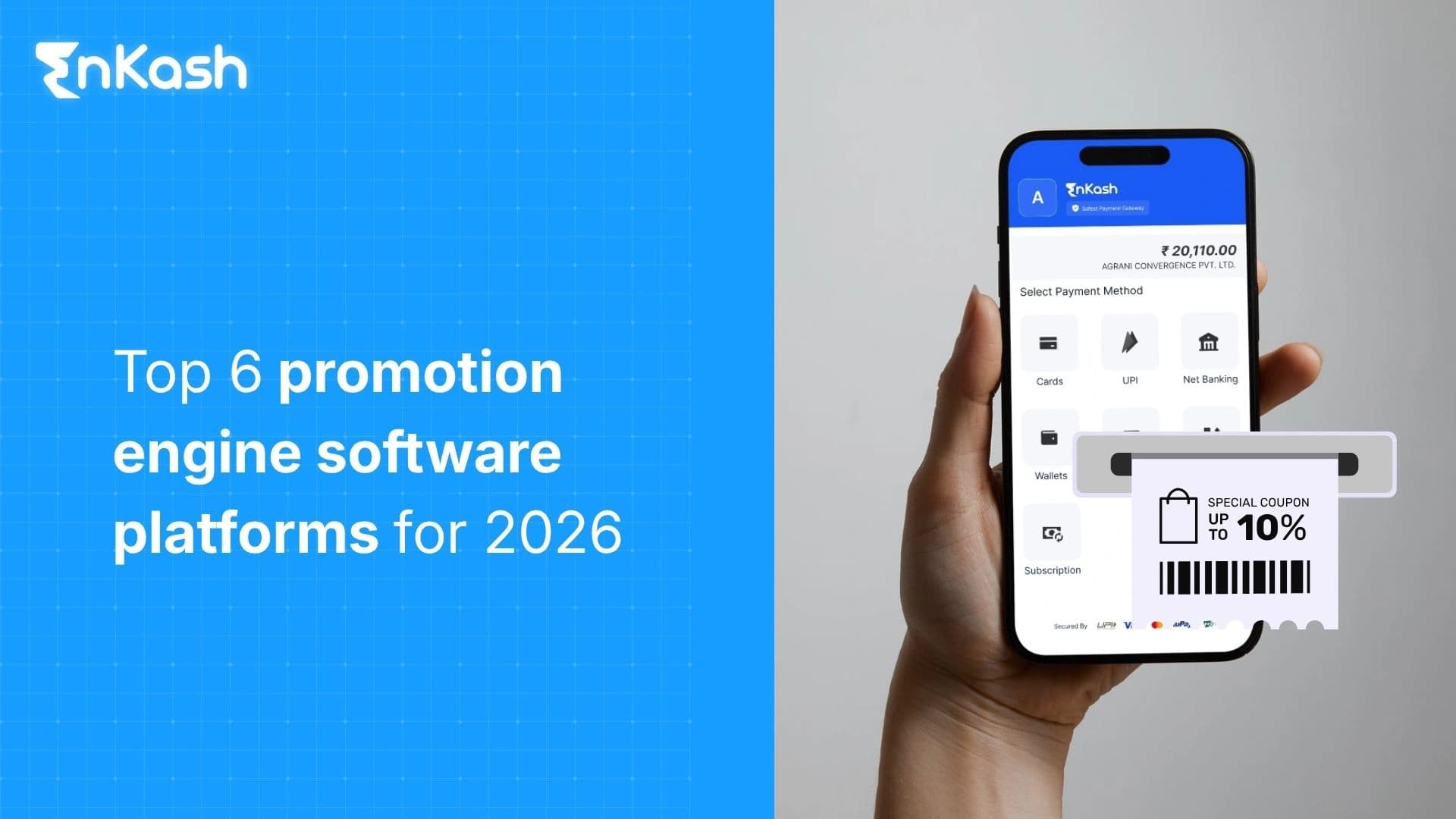
The best promotions no longer look like static discount codes. In 2026, the strongest promotion engine software helps brands decide who gets what offer, when, and under which rules, all in real time. For Indian businesses managing e-commerce, retail, loyalty, and omnichannel campaigns, that shift can mean better control, cleaner execution, and fewer costly mistakes.
Promotion engine software is a decision layer that exists between customer data and the commerce platform. It checks who the customer is, what is in the cart, and which business rules apply, then applies the right incentive in real time.
It helps a business run discounts, loyalty rewards, referral bonuses, bundles, and personalized offers from one place. This helps because native e-commerce discount tools often work for simple percentage-offs, but they struggle when campaigns need stacking rules, eligibility checks, regional logic, or cross-channel control.
For an Indian brand, this is useful when one offer has to behave differently across web, app, store, or partner channel. It also becomes important when marketing wants speed, finance wants control, and engineering wants fewer incentive-related tickets.
The biggest reason promotion engines hold key now is that discounting has become more sophisticated, and plain coupon logic is no longer enough for many teams. Promotion engines are now being treated less as discount tools and more as operational systems for governing offers, applying rules, and tracking results.
This shift is prominently visible in India, where brands are moving toward instant rewards, phygital campaigns, and more personalized promotions. Indian market trends show growing interest in experiential rewards, loyalty integration, and customer data-driven promotions.
That means a retailer or D2C brand needs more than a coupon code box. It needs a system that can target the right audience, prevent offer conflicts, and show whether a promotion actually drove incremental value.
1. Talon.One
Talon.One is a real-time incentives platform built around promotions, loyalty, referrals, bundles, and pricing logic. Its core value is that it centralizes promotion rules in one engine, which makes it easier for marketing to act quickly while preserving governance and control.
It is positioned as a fit for enterprises that want a dedicated decision layer rather than basic commerce discounting. The company emphasizes API-first architecture, code-free rule building, and low-latency decisioning, which matters when promotions must be evaluated during checkout without slowing the customer experience.
Best for: Large e-commerce and omnichannel businesses that need a unified incentive engine.
Why it stands out: It combines rules, targeting, stacking, and analytics in one place, which reduces the risk of conflicting offers.
2. Voucherify
Voucherify is an API-first promotion and coupon platform used by teams that want programmable incentive logic. The strongest part of its positioning is flexibility, especially for coupon codes, cart discounts, referrals, bundles, and loyalty-related flows.
It is generally a good match for teams that are comfortable with integration work and want control through APIs rather than only through a marketer-facing interface. This approach suits businesses where product and engineering teams want to build the promotion layer alongside the commerce stack.
Best for: Mid-market brands and developer-led teams.
Why it stands out: It offers a clean way to build programmable promotions without relying entirely on native e-commerce discount tools.
3. Antavo
Antavo is better known as a loyalty platform, but its 2026 positioning also includes promotions. This makes it relevant for businesses that already run loyalty and want to expand into discounts, bundles, or other incentive formats without introducing a completely separate ecosystem.
The main advantage is continuity. If a brand already uses loyalty as a retention lever, adding promotions from the same vendor can reduce operational fragmentation. The trade-off is that loyalty and promotions may still remain separate modules, so buyers should evaluate how unified their actual workflow will be.
Best for: Loyalty-led consumer brands.
Why it stands out: It works well when promotions are an extension of an existing loyalty strategy.
4. Eagle Eye
Eagle Eye is strongly associated with omnichannel retail, especially grocery and store-led businesses. Its AIR platform focuses on loyalty, promotions, gifting, and personalized offers with a strong connection to in-store and POS environments. This makes it useful for businesses where the promotion must work across physical and digital touchpoints. The limitation is that this architecture is usually more relevant for retail networks than for purely digital-first D2C brands.
Best for: Large retail and grocery chains.
Why it stands out: It is built for high-volume omnichannel execution, not just online checkout logic.
5. Salesforce Commerce Cloud
Salesforce Commerce Cloud includes native promotion capabilities inside the commerce layer. Salesforce confirms its trade promotion tools help teams plan, manage, execute, and analyze trade activities, with support for approvals, budgeting, and promotion optimization.
This is a strong fit for businesses already standardized on Salesforce. The main benefit is tight integration with the broader Salesforce stack, which can simplify data flow and reporting. The main limitation is that commerce-native promotion logic may not be enough if a brand wants one incentive brain across multiple systems and channels.
Best for: Enterprises already invested in Salesforce.
Why it stands out: It keeps promotions close to the commerce and CRM layers.
6. Adobe Commerce
Adobe Commerce offers built-in promotion controls through cart price rules, coupon logic, and customer-segment conditions. For brands that already run on Adobe Commerce, this can cover many common promotion needs without adding another platform too early.
Its strength is convenience inside the existing commerce environment. Its weakness is that promotions remain scoped to the Adobe Commerce ecosystem, so cross-channel orchestration may still require another layer if the business grows more complex.
Best for: Businesses already using Adobe Commerce.
Why it stands out: It is practical for cart-centric promotions and standard e-commerce use cases.
India-Specific Buying Factors
Omnichannel Execution
Indian businesses should prioritize platforms that can run the same promotion across app, web, store, and partner channels without breaking the customer journey. It has real impact because promotions in India are increasingly designed to move with the buyer, not stay trapped in one channel.
Phygital and Instant-Reward Fit
India’s promotion environment is moving toward phygital engagement, instant rewards, and more loyalty-linked experiences. A platform should support those behaviors instead of relying only on basic coupon redemption or one-time discount logic.
Operational Simplicity
Many Indian brands operate with lean marketing and operations teams, so ease of use becomes a serious buying factor. A tool that reduces manual effort and engineering dependency often creates more value than a feature-heavy platform that is difficult to manage day to day.
Stack Fit and Scalability
The best choice usually depends on whether the business needs one controlled engine for all offers or just a better discount module. That decision should also reflect the company’s current systems, growth plans, and how much promotion complexity it expects in the next 12 to 24 months.
Start by checking whether the platform can handle the actual promotion rules you need, without workarounds. The best systems support stacking, eligibility checks, budgets, approvals, and reporting in a way that both marketing and finance can understand.
Test Integrations Early
A promotion engine should connect cleanly with your e-commerce stack, CRM, CDP, and POS systems. If it does not, implementation becomes slower, harder to scale, and more expensive than expected.
Look at Measurement Quality
A strong platform should show not only what was sold, but also what the promotion changed. That includes visibility into redemptions, campaign performance, and the business impact of the offer itself.
Check Operational Ownership
The right platform should fit the team that will actually run it. If marketing, finance, or operations cannot use it comfortably, the tool may look powerful on paper but remain underused in practice.
Final Takeaway
The best promotion engine software for 2026 depends on where your promotions live and how complex your incentive logic is. If your promotions move across channels, require layered rules, and need to be managed with precision, a dedicated platform is the better long-term option.
FAQs
What does promotion engine software do?
Every promotion needs a decision somewhere behind it. Promotion engine software makes that decision by reading the customer, the purchase, and the rules the business has already defined.
Who needs promotion engine software?
The need usually appears once promotional activity becomes difficult to coordinate by hand. e-commerce brands, retailers, loyalty programs, and businesses running overlapping campaigns can use it to keep offer management practical.
How can a promotion engine help reduce customer service issues?
Promotion complaints often begin with a simple question about why an offer failed. When the underlying rules are consistent and visible, support teams have a much easier time finding and explaining the answer.
Is a promotion engine different from coupon software?
Coupon software mainly creates codes and records their redemption. A promotion engine controls the decisions surrounding those codes, including customer eligibility, timing, qualifying conditions, and the offer eventually applied.
How do contextual offers differ from standard discounts?
A standard discount generally behaves the same way for everyone who meets its basic rules. Contextual offers can change according to the purchase itself, including timing, basket contents, behavior, channel, and customer information.
How does a promotion engine support lean teams?
Small teams cannot afford to send every promotion adjustment through a development queue. A central promotion system lets them manage routine rules directly while keeping campaign logic organized and easier to control.