Travel payments do not always end at checkout.
A customer may reserve a hotel room today and change the dates tomorrow. A guest may check in with a room deposit, but the final bill may include room service, laundry, or late check-out charges. An OTA may accept a booking request, but the final confirmation may still depend on fare, inventory, or supplier availability.
In a regular payment flow, the business charges the customer first and handles changes later through refunds, payment links, manual adjustments, or support follow-ups. That creates friction for everyone.
Customers worry about delayed refunds. Businesses deal with payment failure, cancellation risk, and revenue leakage. Finance teams struggle to match the original booking amount, captured amount, refunded amount, and final settlement.
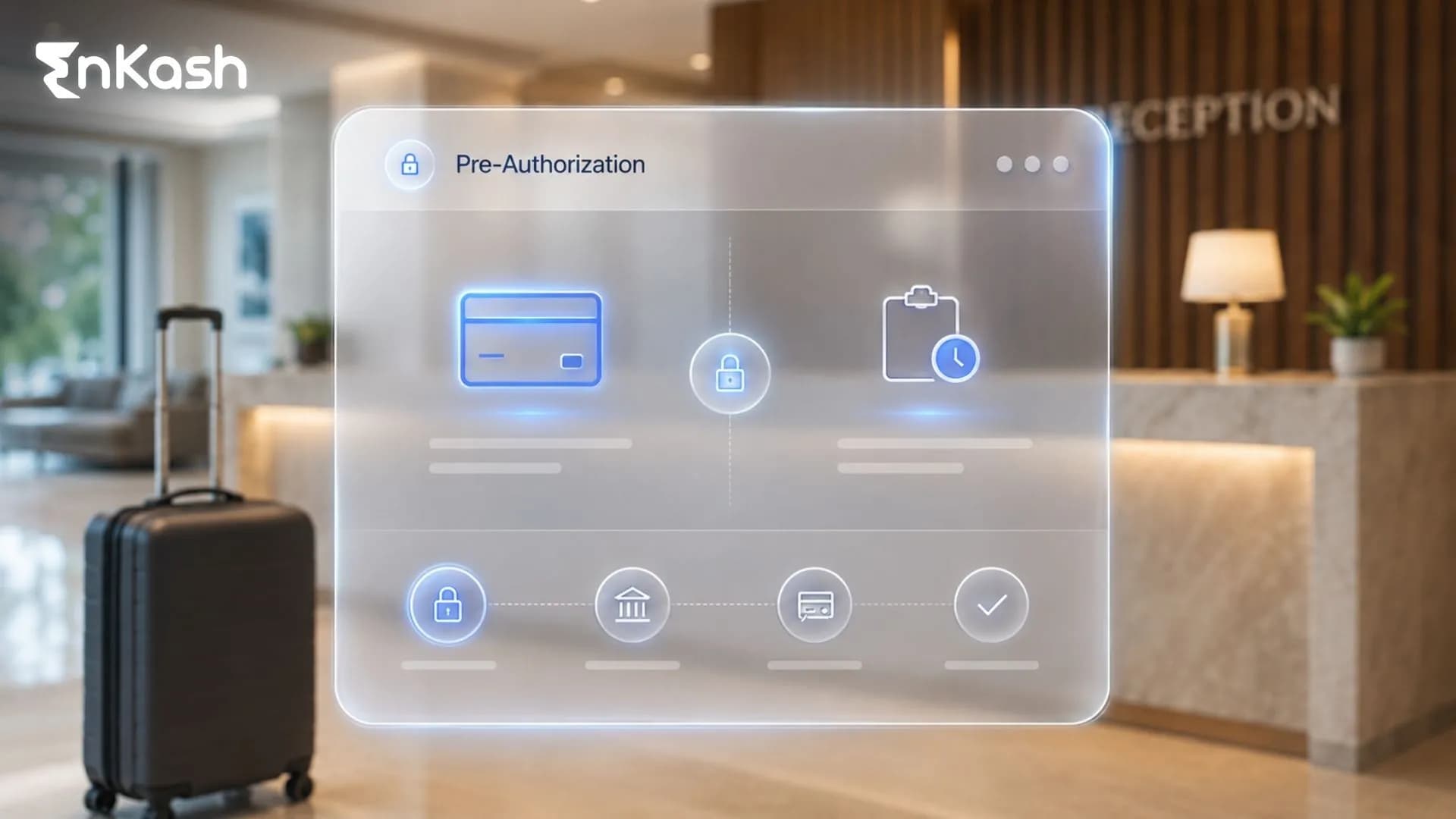
Pre-auth helps travel businesses manage this middle ground. It allows them to temporarily block an amount, confirm the service or final payable value, and capture the required amount later.
What is Pre-Auth in Payments?
Pre-auth, or pre-authorization, is a payment process where a business temporarily blocks a certain amount on the customer’s card or supported payment method without charging it immediately. In pre-authorization, the payee gets permission to take money from the customer’s bank card or account at a set time.
The blocked amount confirms that the customer has enough available balance or credit limit. Based on the final transaction value, the business can then capture the full amount, capture a partial amount, or void the authorization if the payment is no longer needed.
For example, a hotel blocks ₹10,000 on a guest’s card at check-in. At check-out, the final bill is ₹7,500. The hotel captures ₹7,500, and the remaining ₹2,500 is released.
The important point is that authorization and capture are not the same. Authorization only blocks the amount. Capture is when the business actually charges the customer and moves the transaction toward settlement.
Authorization vs Capture
| Stage | Authorization | Capture |
|---|
| Funds blocked | Yes | No |
| Settlement completed | No | Yes |
| Customer charged | Not yet | Yes |
| Can be voided | Yes | No |
How Pre-Authorization Fits Into Card Payment Infrastructure
Pre-authorization is a standard card-payment capability supported across major card networks. During authorization, the issuer verifies available funds or credit and places a temporary hold without completing settlement. Settlement happens only after capture. This distinction allows industries such as hospitality, travel, rentals, and ticketing to handle situations where the final payable amount may change after the initial booking.
Pre-Auth on Debit Cards vs Credit Cards: Why customers Get Confused
One of the biggest reasons customers misunderstand pre-auth is because the blocked amount does not appear the same across debit cards and credit cards.
On a credit card, pre-auth usually reduces the customer’s available credit limit. The customer has not been billed yet, but a portion of the credit limit is reserved until the merchant captures, voids, or releases the authorization.
For example, if a hotel blocks ₹10,000 on a credit card and later captures ₹7,500, the remaining ₹2,500 is released back to the available limit.
On a debit card, the experience can feel more direct because the card is linked to the customer’s bank account. Blocked amount typically reduces the available balance, although the exact customer experience may vary across banks and card issuers.
This is why it becomes confusing for customers. A customer may see a booking fail, but the amount may still appear blocked. A hotel guest may check out, but the released deposit may not reflect immediately.
From the customer’s side, this feels like a payment problem. From the business side, it may simply be an authorization hold awaiting release through issuer or card network processes.
How Pre-Auth Works in a Travel Payment Flow
Pre-auth separates a travel payment into two steps: authorization and capture.
Authorization happens when the customer’s bank or card issuer approves the transaction and blocks the requested amount. At this stage, the merchant has not received the money.
Capture happens later, when the travel business confirms the final payable amount and charges the customer.
A typical pre-auth flow in travel looks like this:
- The customer enters payment details while booking, checking in, or renting a vehicle.
- The travel business requests authorization for a specific amount.
- The bank or issuer approves the request and blocks the amount.
- The booking, stay, rental, or service is completed or confirmed.
- The business captures the full or partial amount based on the final bill.
- Any unused amount is released, or the authorization is voided if no charge is needed.
For example, an OTA may block the booking amount while checking hotel availability. If the room is confirmed, it captures the payment. If not, the authorization can be voided.
This gives travel businesses more control than charging the customer immediately, but it also adds more payment states to track.
Why Travel Businesses Need Pre-Auth
Travel payments are often dynamic, with the final amount becoming clear only after a booking is fulfilled.
A hotel booking may start with a room tariff, but the final amount can change after check-in. A car rental may begin with a fixed booking amount, but fuel usage, tolls, traffic penalties, extra kilometres, or delayed return can change the final bill. An OTA may accept a payment request, but the booking may still depend on fare availability, room inventory, or supplier confirmation.
In such cases, collecting the full amount upfront can create refund pressure. Asking the customer to pay later can create collection risk.
Pre-auth gives travel businesses a safer middle path. It confirms that funds are available before the service is delivered, while allowing the actual charge to happen later once the final payable value is known.
This makes it useful for deposits, variable charges, cancellations, supplier confirmations, and post-service billing.
Use case 1: Hotels and security deposits
Hotels often use pre-auth at check-in to block a security deposit without charging the guest immediately. This deposit can cover room service, minibar usage, laundry, late check-out, unpaid bills, or property damage.
Instead of collecting a deposit upfront and refunding the balance later, the hotel can block a reasonable amount and capture only what is finally due.
For example, if ₹10,000 is blocked and the guest’s incidental bill is ₹3,500, the hotel can capture ₹3,500 and release the remaining amount.
The key challenge is tracking. The hotel needs to map the room booking, deposit hold, final capture, release, and settlement to the correct guest folio.
Use case 2: Car rentals and refundable deposits
Car rental companies use pre-auth to manage risk before handing over the vehicle. The final payable value can change after return because of fuel difference, late return, damage, tolls, penalties, or extra kilometres.
Instead of collecting a large refundable deposit upfront, the rental company can block a deposit and capture only the amount finally due.
For example, if ₹15,000 is blocked and the customer has ₹2,000 in fuel and late return charges, the company can capture ₹2,000 and release the remaining amount.
The challenge is timing. If inspection happens after the authorization expires, the business may need to raise a fresh payment request.
Use case 3: OTAs and booking confirmation
For OTAs, a customer may complete the payment step while the final booking still depends on fare availability, room inventory, or supplier confirmation.
Pre-auth helps OTAs block the amount first and capture it only when the booking is confirmed. If the supplier cannot confirm the booking, the authorization can be voided instead of moving the customer through a refund process. This is useful for dynamic fares, last-room availability, high-demand routes, and package bookings where inventory can change quickly.
The challenge is customer communication. If a booking fails but the amount still appears blocked, the OTA needs clear status updates for authorized, captured, voided, and released amounts.
Use case 4: Travel packages with multiple suppliers
A travel package may include flights, hotels, transfers, meals, insurance, and activities. The customer sees one package price, but the travel company has to manage multiple supplier confirmations at the backend.
Pre-auth can help the platform block the package amount while confirmations are being processed. If the full package is confirmed, the business can capture the required amount. If part of the package is unavailable, it may need to capture a lower amount or release the authorization.
The main issue is reconciliation. Finance teams need to connect the authorized amount, confirmed services, captured amount, released amount, supplier payout, and customer invoice to the same booking record.
Differentiating Between Pre-Authorization and Refund
Many businesses confuse pre-authorization with a refund, but they solve different payment problems.
A pre-authorization only blocks funds temporarily. The money is not settled to the merchant unless capture takes place.
A refund happens after a payment has already been captured and settled. The merchant must initiate a return transaction to send the money back to the customer.
For travel businesses, voiding an unused authorization is usually cleaner than capturing the amount first and processing a refund later. This reduces refund timelines, support tickets, and reconciliation efforts.
The Hidden Complexity of Pre-Auth in Travel
Pre-auth may seem simple: block the amount first and charge it later. In travel, the real work begins after the amount has been blocked.
Authorization validity can affect revenue collection
Every authorization comes with a validity period, although the exact duration can vary based on card network rules, issuer policies, merchant category, and payment provider implementation. The merchant has to capture or void it within the allowed window. If no action is taken, the hold may expire, and the amount may be released.
This matters because the final payable value is often known later, such as after check-out, vehicle inspection, or supplier confirmation.
Partial capture needs to work without manual fixes
Travel businesses often need to capture less than the amount blocked at the start.
If the payment gateway does not support partial capture cleanly, teams may depend on refunds, manual adjustments, or fresh payment requests. This makes the process slower for customers and harder for finance teams to track.
Voids and refunds must be treated differently
A void cancels the authorization before the money is captured. A refund happens after the amount has already been charged.
This difference matters because not every failed or changed booking should become a refund case. If a booking fails before confirmation or a deposit is no longer needed, voiding the authorization is usually cleaner.
Release timelines can create customer confusion
Even after a merchant voids an authorization or releases the unused amount, the customer may not see it reflected immediately.
This is sensitive in travel because hotel deposits and car rental holds are often larger than regular online payments. From the customer’s side, the delay can look like a failed refund or an incorrect charge.
Capture failure can create risk after service delivery
A successful authorization does not mean the money has been collected. The merchant still has to capture the amount.
If capture fails, expires, or is missed by the operations team, the customer may have already consumed the service while the payment remains incomplete.
Reconciliation becomes more layered
Pre-auth adds more payment states to a single booking. The same booking can move through authorization, partial capture, void, expiry, release, refund, and settlement.
These events need to be matched with booking IDs, customer records, invoices, supplier payouts, and settlement reports. Without clear reporting, pre-auth can improve customer experience on one side and create payment operations gaps on the other.
How EnKash Payment Gateway supports pre-auth-led travel payments
EnKash Payment Gateway supports preauthorization, capabilities that can be configured for eligible payment flows where funds need to be reserved and captured later.. For travel businesses, this is useful in payment flows where the amount is not final at the time of booking.
A hotel can reserve a deposit at check-in and charge the final amount after check-out. A car rental company can reserve an amount before handing over the vehicle and adjust the final charge after return. An OTA can reserve the amount while the booking confirmation is pending and release it if the booking cannot be completed.
The payment action also needs to connect with the systems that travel teams already use. EnKash provides payment gateway APIs for orders, payments, refunds, and settlements, which can help businesses connect payment status with booking engines, websites, apps, PMS, ERP tools, or internal dashboards.
This helps teams avoid treating authorization, capture, refund, and settlement as disconnected events. A booking can be tracked from the first reserved amount to the final captured or released amount, with payment records available for support, operations, and finance teams.
Conclusion
Pre-auth helps travel businesses manage payments when the final amount is not fixed at checkout. It gives hotels, car rentals, OTAs, and travel platforms a way to reserve funds first and charge later based on the actual booking outcome.
But its value depends on what happens after authorization. Businesses need clear control over capture, release, refunds, settlement, and reconciliation.
For travel businesses, pre-auth should not be treated as a small payment feature. It should be seen as part of the full booking and payment lifecycle.