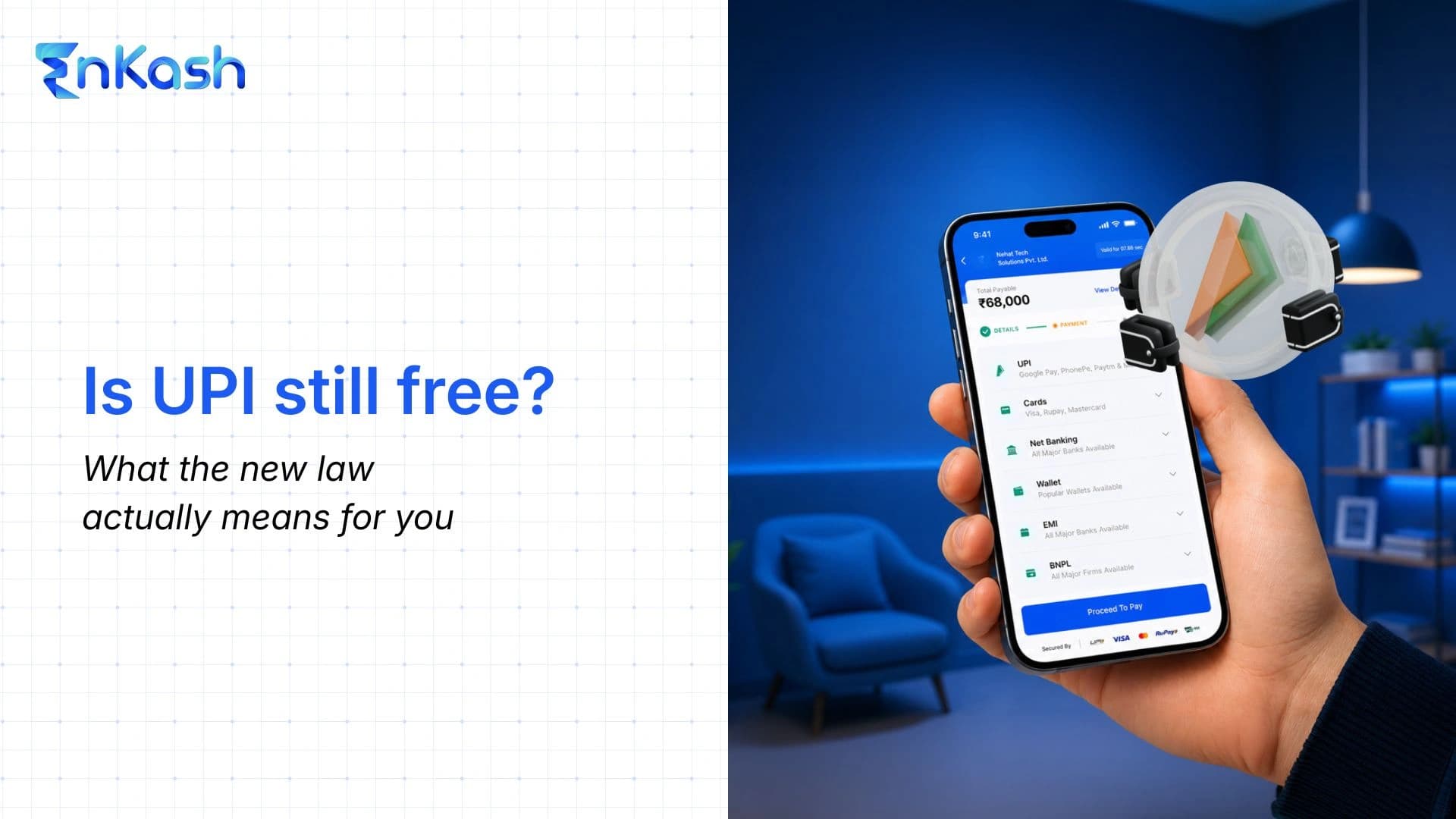
If you pay by UPI: nothing changes. You will not be charged. Every payment you make — to a friend, a shopkeeper, anyone — stays free.
If you accept UPI as a business: nothing changes today either. In the future, a small merchant fee (MDR) could apply, but only to larger merchants above a set turnover, at a rate the government has said will be nominal and lower than card fees. Small merchants and everyday payments are meant to stay free.
The panic came from a real event — Parliament passing a law — attached to a wrong conclusion. Here's the clear version, split by who you are.
If you use UPI to pay for things
The one thing to take away: there is no charge on you, and there is no plan for one.
The new law does not touch consumers. It does not add a fee to your UPI payments, your bank transfers, or the money you send to friends and family. Person-to-person (P2P) transfers stay free — that's been stated plainly and repeatedly by the government, and reaffirmed by the Finance Minister in Parliament.
MDR, the fee at the centre of this whole debate, is a charge on the merchant's side of a transaction — the fee a shop pays its bank for accepting a digital payment. It has never been a charge on the person paying, and this law does not change that.
There's one honest nuance worth knowing, and it's not a reason to worry. If a merchant fee is eventually introduced for large businesses, some of those businesses could, in theory, build the cost into their prices — the same way card-acceptance costs sometimes sit inside what you pay. That's an indirect, downstream possibility affecting a narrow slice of high-value payments, not a fee on your UPI app. For the payments you actually make day to day, the answer is simple: free, as before.
So if you saw a forward claiming "UPI is now chargeable," you can stop worrying and stop forwarding it.
If you accept UPI to get paid
This is where it matters, so let's be precise. The impact depends entirely on your size.
Small and mid-sized merchants: you're the ones the design protects
If you're a kirana store, a café, a salon, a small D2C brand, or a growing business, the framework the government has described is built to keep you out of any fees.
Officials have said any future MDR would be threshold-based — applying only to merchants above a specified turnover and to higher-value transactions — not a blanket fee on everyone. They've put a number on how broad the protection is: over 90% of transactions, including everyday retail like groceries and vegetables, are expected to stay free.
The reason a threshold protects most businesses is in the data. In FY26, UPI processed more than 24,000 crore transactions worth about ₹314 lakh crore. Only around 4% of person-to-merchant transactions were above ₹2,000 — but those few accounted for close to two-thirds of the total value (figures as reported from official data). That's why any fee, if it comes, is expected to target the high-value merchant slice and leave the small-ticket majority alone.
Practical read: keep accepting UPI exactly as you do. There's nothing to plan for and nothing to change.
Large merchants: you may eventually pay a small fee, so model it now
If you're a high-turnover business, this is the part to pay attention to.
No rate is fixed yet — anything specific is an industry estimate, not law. With that caveat, payments-industry executives expect a tiered, small fee rather than a flat one. A widely cited estimate from Zeta's Mehul Mistry puts a likely UPI MDR at roughly 0.05–0.07% for large merchants, with RuPay debit-card MDR a bit higher at around 0.15–0.20%, applicable only to merchants above roughly ₹1–1.5 crore in annual turnover.
Here's what that actually costs, so it stops being abstract. At an estimated 0.06%, every ₹1,00,000 of qualifying UPI collections would carry about ₹60 in MDR. Scale that to your volume, and you have your worst-case line item. For comparison, credit card MDR typically runs 1–2%, so the same ₹1,00,000 on a credit card can cost ₹1,000–2,000. Even at the top of the estimate, a UPI fee would be a fraction of what you already pay to accept cards.
What to do now, in order of usefulness:
- Know your real payment cost today across UPI, cards, net banking, and digital wallets. Most businesses don't, and this is a good reason to fix that.
- Model the worst case using the numbers above, so if a nominal UPI MDR is notified, it's a line you've already planned for, not a surprise.
- Don't over-rotate on the fee alone. A few basis points on high-value transactions is manageable. What actually moves your revenue is whether payments succeed, settle fast, and reconcile cleanly.
That last point is the real lesson here. "UPI is free" was never the reason a payment stack earned its keep. Success rates, instant settlements, clean reconciliation, refund control, and the analytics to see where money leaks — that's the value, and it holds no matter what happens with MDR. A capable payment gateway that supports UPI, cards, net banking, wallets, EMI, and pay-later in one flow — with real-time monitoring and collection tooling built for businesses — is what keeps those numbers strong. If your UPI collections run through EnKash, you'll hear from us clearly and early the moment anything concrete is notified.
What the law actually changed
The event underneath all this is straightforward.
On 6 August 2026, the Lok Sabha passed the Taxation and Other Laws (Amendment) Bill, 2026. On 10 August 2026, the Rajya Sabha cleared it. Because it's a Money Bill, the Rajya Sabha could only recommend changes and send it back — it can't block it. Both houses of Parliament have now approved it, and it awaits Presidential assent to become law. You can track the status on the PRS Legislative Research bill page.
The relevant change is a small edit to Section 10A of the Payment and Settlement Systems Act, 2007. Until now, that section blocked banks and payment providers from charging MDR on the payment modes covered under Section 269SU of the Income Tax Act — a big reason UPI has stayed free for merchants and users since MDR was waived in January 2020. The amendment removes that blanket ban and instead lets the central government notify which modes may carry a charge and which stay protected.
Two things this does not do, both worth stating clearly:
It does not impose any charge. It's an enabling provision — it gives the government the option, nothing more. The Finance Minister confirmed in Parliament that it adds no tax and no transaction charges on UPI users.
It does not set any rate or date. Before anything changes for anyone, the NPCI-led UPI and Services Steering Committee has to decide whether MDR is needed, for whom, and at what level — and the government has to formally notify it. Until that happens, nothing is charged.
Quick definition — what is MDR? The Merchant Discount Rate is the fee a merchant pays its bank or payment provider to accept a digital payment, shown as a percentage of the transaction. Merchants already accept it on credit and debit cards. UPI has been the exception. (RTGS and NEFT, by contrast, have carried service charges for years.)
Why is the government doing this at all
UPI is free to use. It is not free to run — and that gap is the whole story.
Every payment triggers real work: authorisation, routing, settlement between banks, reconciliation, fraud checks, dispute handling, cloud infrastructure, customer support, and compliance. That runs continuously, and someone funds it.
The numbers that frame the debate:
- Running UPI and RuPay debit-card infrastructure reportedly costs as much as ₹20,000 crore a year, per figures cited by The Indian Express.
- A March 2026 report of the Parliamentary Standing Committee on Finance found that government incentives from 2021-22 to 2024-25 covered only about 11% of the industry's cost — the Centre paid ₹8,730 crore over four years, and the industry absorbed the rest.
RBI Governor Sanjay Malhotra put the economics simply after the August MPC meeting: the cost of the network has to be borne somewhere — either by the public through taxes that fund subsidies, or by users through a fee. He also noted consumers are, in some indirect way, already paying for it, and called it premature to discuss any exact MDR structure.
There's a genuine counter-view, and it deserves airtime. Zero MDR is a big reason UPI reached hundreds of millions of people and millions of small merchants so fast, and any friction risks slowing that. A LocalCircles survey found only 12% of respondents would keep using UPI if a fee were charged on payments above ₹3,000 at large merchants — dropping to 2% if merchants passed the fee to customers. That's exactly why the government has framed any future MDR as narrow, threshold-based, and nominal, rather than broad.
Myths worth killing
"UPI is now chargeable for everyone."
No. The law enables a possible future merchant fee. It charges no one today, and consumers aren't in scope at all.
"The government has imposed MDR on UPI."
No. Nothing has been notified. An NPCI-led committee decides first.
"My payments to friends and family will cost money."
No. P2P transfers stay free.
"Every shop will charge me extra for paying by UPI."
No. Any fee is on the merchant, not you, and only for larger merchants above a threshold. The government expects 90%+ of transactions to stay free.
"This is a stealth tax."
No. MDR is a service fee between a merchant and their payment provider, not a government levy. The Finance Ministry has confirmed there's no tax on UPI here.
Frequently Asked Questions (FAQs)
Will I be charged for using UPI now?
No. There's no charge to consumers. The law doesn't impose any fee on users.
Are person-to-person UPI transfers free?
Yes. Sending money to friends, family, or between your own accounts stays free.
I run a small shop. Will I have to pay to accept UPI?
The framework as described is built to keep small merchants out of any fees. The government expects over 90% of transactions to remain free, with any charge limited to larger merchants above a turnover threshold.
I run a large business. How much might I pay?
No rate is fixed. Industry estimates suggest roughly 0.05–0.07% on qualifying UPI transactions for large merchants — about ₹60 per ₹1,00,000 — which is a fraction of typical card MDR. Treat all numbers as estimates until officially notified.
Does this charge merchants immediately?
No. It only removes the legal ban on charging MDR on UPI. Whether it applies, to whom, and at what rate is a separate decision an NPCI-led committee must make, and the government must notify.
Why is the government doing this?
To make UPI financially sustainable. Running it reportedly costs up to ₹20,000 crore a year, and subsidies have covered only a small share of the industry's costs. The goal is a revenue model that funds security, reliability, and future investment.
When does any of this take effect?
No date for any charge has been announced. Nothing is charged until the NPCI-led committee acts and the government notifies it.