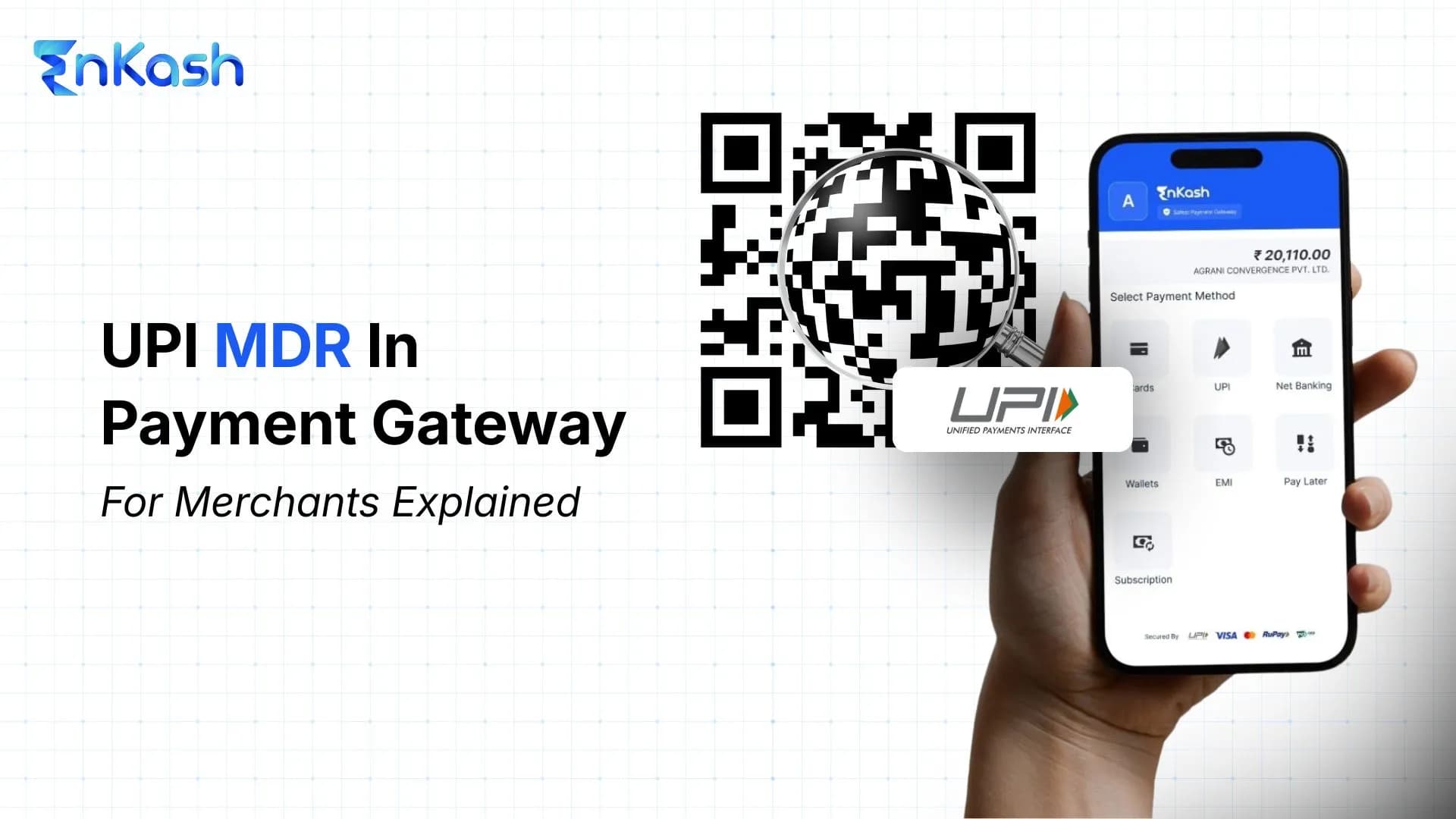
A UPI payment may take only a few seconds for the customer, but the pricing behind merchant acceptance is less straightforward. Since its launch in 2016, the Unified Payments Interface has changed how individuals and businesses make and receive digital payments in India. According to PIB, India processed approximately 66 crore UPI transactions per day on average during the referenced financial year, demonstrating the system’s enormous transaction scale.
Its speed and widespread availability have made UPI a common payment option for consumers and merchants.
A UPI transaction involves several participants, which may include the payer’s bank, the payee’s bank, payment service providers, the National Payments Corporation of India, or NPCI, in some merchant arrangements, a payment gateway or aggregator. UPI provides near-instant transaction confirmation between participating accounts.
However, merchants using a payment gateway may receive settlement according to the provider’s agreed cycle, such as real-time, same-day or a later settlement schedule. Operating this infrastructure involves costs. However, the rules governing who may charge merchants differ by payment method, and prescribed UPI transactions currently attract zero MDR.
Customers are generally not charged for making ordinary UPI payments. For merchants, bank-account-funded domestic UPI transactions currently attract zero MDR. However, transactions funded through linked credit cards or other eligible instruments may follow different pricing rules. Many merchants are unaware of whether UPI attracts MDR, how and when it is applied, who pays it, and how it impacts their payment costs.
We have a guide here for merchants to know everything about UPI MDR, how it functions and what things merchants should follow while choosing a payment gateway that facilitates their business growth.
What is UPI?
UPI is an instant bank-to-bank payment system developed by NPCI that enables users to send and receive money through participating applications. It has evolved to become the country’s most popular way to pay, owing to its efficiency, security, and speed. Merchants of all sizes depend on UPI to collect online payments and offer their customers a smooth checkout experience.
What is Merchant Discount Rate?
Merchant Discount Rate, or MDR, is a charge that a merchant may pay for accepting certain electronic payment methods. It is generally calculated as a percentage of the transaction value, although the applicable rate and fee structure depend on the payment instrument, network rules and merchant agreement.
Where MDR applies, the charge may support different participants involved in processing the payment, such as the acquiring bank, issuing bank, card network or payment service provider. Not every digital payment attracts MDR. Bank-account-funded domestic UPI merchant payments currently attract zero MDR under the prescribed framework.
When does MDR apply to UPI?
MDR does not apply uniformly to every payment made through UPI. The charge depends primarily on the source used to fund the payment and the commercial arrangement between the merchant and the payment provider.
Bank-account-funded domestic UPI merchant payments currently attract zero MDR under the prescribed government framework. This means that when a customer pays a merchant directly from a bank account using UPI, the merchant is not charged MDR on that transaction.
However, not every payment initiated through a UPI interface follows the same pricing model. Transactions funded through an eligible linked credit card or another supported payment instrument may attract merchant charges under the applicable network rules and provider agreement.
UPI payment type | Does MDR apply? | Who pays the charge? | What merchants should know |
UPI payment funded directly from a bank account | No MDR under the current prescribed framework | No MDR is charged to the merchant | To collect these digital payments via payment gateways, merchants pay a Merchant Discount Rate |
UPI payment funded through an eligible linked credit card | Merchant charges may apply | Generally the merchant | Pricing may depend on the card network, merchant category, transaction type and commercial agreement |
UPI payment funded through an eligible prepaid instrument or wallet | Depends on the instrument and applicable rules | Depends on the commercial arrangement | Merchants should confirm the funding source, issuer rules and applicable pricing |
Bank-account UPI payment with optional gateway services | The underlying transaction may still have zero MDR | The merchant may pay for optional services | Separate charges may apply for services such as instant settlement, subscriptions, reporting or reconciliation tools |
Who pays MDR on UPI Transactions?
Where MDR applies, it is generally borne by the merchant rather than added to the amount paid by the customer. The fee may be deducted before the settlement amount is credited or billed separately, depending on the provider agreement.
For standard bank-account-funded UPI merchant payments, the current MDR is zero. The customer pays the transaction amount, and the merchant receives the payment without an MDR deduction.
Is every UPI Payment free for merchants?
No. Zero MDR does not necessarily mean that accepting UPI has no cost in every situation.
A payment gateway or payment provider may charge separately for services such as:
Platform or subscription fees
Setup and integration charges
Faster or instant-settlement services
Refund or dispute-related processing
Advanced reporting and reconciliation tools
Other value-added services
GST on applicable service fees
These charges are different from MDR and should be disclosed separately in the merchant agreement.
Merchants should therefore ask the provider for a complete payment-method-wise rate card covering MDR, platform fees, settlement charges, refund costs, GST and any other applicable fees.
Understanding the MDR position is only one part of evaluating payment costs. Merchants should also understand what a payment gateway does and which separate processing or service fees may apply.
What is a Payment Gateway?
A payment gateway is the technology layer that securely transmits payment information between the merchant’s checkout and the relevant payment-processing participants. Depending on the provider’s regulatory model, a payment aggregator may also collect customer funds and settle them with the merchant. A payment gateway enables merchants to collect payments via different modes of payment like credit card, debit card, net banking, and UPI.
Depending on the payment method and merchant agreement, merchants may pay MDR or separate gateway fees for payment processing, settlement and other services. Bank-account-funded domestic UPI merchant payments currently attract zero MDR. UPI differs from cards because prescribed bank-account-funded UPI merchant payments currently attract zero MDR.
As per the existing government policy, UPI transactions made directly from a customer's bank account have zero MDR, which means merchants don't pay a transaction fee on these transactions. If merchants are not paying MDR on these transactions, how are the costs of operating the UPI ecosystem supported?
Understanding when MDR applies and when it doesn't is essential for merchants to make informed business decisions.
Different MDR rates for different Payment Modes
Payment method | General merchant-pricing position | What the merchant should verify |
Bank-account-funded UPI | Zero MDR under the current prescribed framework | Separate gateway, settlement or value-added service fees |
RuPay debit card | Zero MDR under the prescribed framework | Any separate provider charges |
Other debit cards | MDR may apply subject to applicable rules and caps | Merchant category, turnover, transaction channel and rate cap |
Credit cards | MDR generally applies | Card network, card type, merchant category and negotiated rate |
Supported credit card on UPI | Merchant charges may apply | Network rules, merchant category and provider agreement |
Net banking | Commercial processing charges may apply | Bank and gateway pricing |
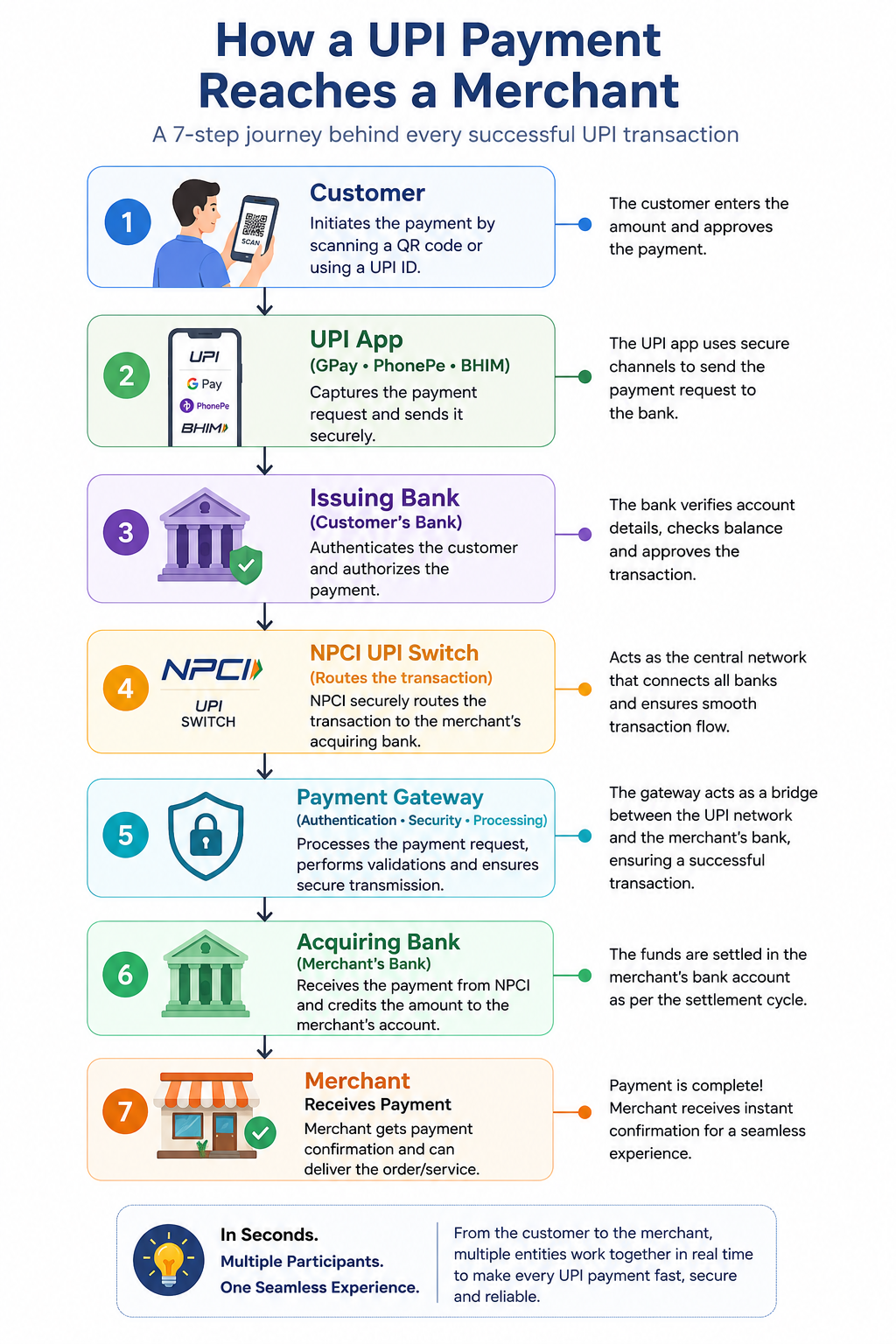
How UPI payment reaches a Merchant?
When a customer initiates a UPI payment, the payment request moves through the customer’s UPI application, the participating payment service providers, NPCI and the relevant banks. The customer’s bank authenticates the transaction and transfers the funds to the receiving side.
The customer and merchant generally receive the transaction status within seconds. However, where a payment gateway or aggregator is involved, the merchant’s final settlement and reconciliation may follow the provider’s agreed settlement cycle.
Transaction confirmation and merchant settlement are therefore not always the same event. Merchants should check how quickly a provider confirms payments, updates transaction status and settles the collected funds.
Why should merchants care?
Merchants need to understand that zero MDR doesn’t mean zero payment costs.
MDR is only one part of the cost of accepting digital payments. Merchants should also consider failed payments, settlement delays, checkout abandonment, reconciliation effort, refunds and support.
A slow or unreliable checkout can lead to abandoned purchases, making payment success and customer experience important alongside transaction pricing.
Merchants should therefore compare total payment-acceptance cost rather than selecting a provider only on the headline MDR. A payment partner with transparent pricing and payment methods can help merchants estimate their payment processing costs and optimize overall payment strategy.
What to Consider When Choosing a Payment Gateway
A payment gateway is an important part of online payment acceptance for merchants. They must consider these factors before deciding on one.
Transparent pricing
A provider should clearly disclose its pricing structure, including MDR, platform fees, setup charges, annual maintenance fees, and any additional costs.
Quick settlements
Faster and predictable settlement cycles can help merchants manage working capital more effectively.
Payment success rates
A payment gateway with a high success rate, reliable uptime, and smart routing can help improve the proportion of payment attempts completed successfully.
Reliable security
The payment gateway should maintain applicable PCI DSS compliance and offer controls such as encryption, tokenisation, fraud detection and risk monitoring.
Payment options
A good payment gateway supports multiple payment methods like UPI, credit card, debit card, net banking, wallet, EMI, and BNPL, giving flexibility to customers.
Customer support
Always choose a payment gateway with efficient and proactive customer support that helps resolve issues at the earliest.
Read more: How to Choose the Best Payment Gateway
Why EnKash is Built for Modern Merchants
EnKash Payment Gateway is designed while keeping merchant priorities in mind.
Here's what makes EnKash a merchant-friendly payment gateway:
What Merchants Need | How EnKash Delivers |
Transparent Pricing | Clear and straightforward pricing with no hidden charges |
High Payment Success Rates | 95% success rate with advanced payment routing |
Faster Settlements | 99.9% uptime for quick and reliable settlements |
100+ Payment Methods | Accept payments via UPI, credit cards, debit cards, net banking, wallets, EMI, BNPL, payment links, QR codes |
Robust Security | PCI DSS-compliant infrastructure, end-to-end encryption, advanced fraud detection |
Easy Integration | APIs, SDKs, and plug-and-play integrations |
Dedicated Human Support | Timely assistance from payment experts whenever needed |
Conclusion
While UPI customers enjoy free payments, merchants need to understand the payment ecosystem when it comes to Merchant Discount Rate. Understanding when MDR is applicable can help businesses calculate their payment costs, refine their financial planning, and pick the right payment acceptance strategy.
FAQs
1.Do QR code payments also attract UPI MDR?
The MDR treatment depends on the payment method and funding source used through the QR code. If the QR code is linked to UPI, then there would be zero MDR. If the QR code is used to make a payment via a credit card linked to UPI, MDR will be applicable based on the card network, issuing bank and agreement with the merchant.
2. Can payment gateways decide MDR?
No. MDR is governed by regulatory guidelines, payment networks, issuing and acquiring banks, and commercial agreements.
Payment gateways facilitate payment processing and disclose the applicable pricing to the merchants, but they have no say in government regulations.
3.Does MDR include GST?
No. MDR is not included in GST.
GST is charged in addition to the MDR.
For instance, if a merchant pays an MDR of 2%, the applicable GST is calculated on the MDR amount and not on the transaction value.