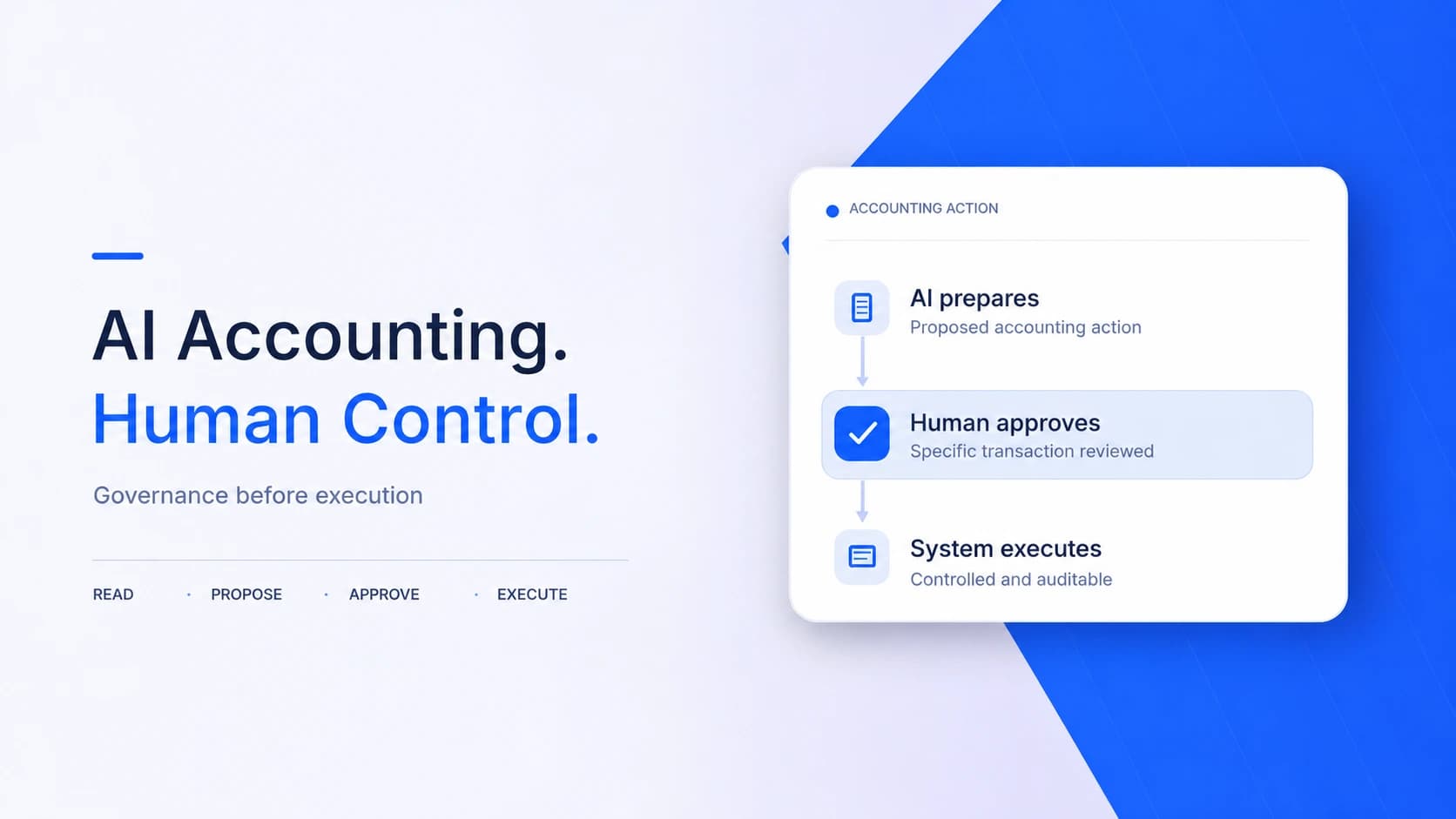
Before an AI assistant can change accounting records, the finance team needs enforceable rules for access, approval, accountability, and recovery. A useful starting principle is simple: the assistant may prepare a proposed action, but the business decides who can authorize it and which system can execute it.
That distinction matters because an accurate-looking explanation is not proof of an authorized transaction. An entry can balance while using the wrong account, entity, date, or accounting treatment. Controls therefore need to govern both the action and the evidence behind it.
Key Takeaways
- Separate the ability to read information, prepare a proposal, approve it, and execute a change.
- Apply permissions in the systems carrying out the action, not only in an AI prompt.
- Bind human approval to the specific transaction or batch being reviewed.
- Keep an auditable record of proposals, approvals, outcomes, and corrections.
- Treat uncertain outcomes and failed requests as exceptions to investigate, not automatic reasons to retry.
1. Define an Action Policy Before Granting Access
“Help with accounting” is not a permission policy. Finance leaders should first list the specific jobs an assistant may perform and distinguish their consequences.
A read-only variance explanation, a draft expense classification, a posted adjustment, and a payment instruction should not share one approval rule. Even actions that leave the general ledger unchanged may matter: emailing a report can disclose confidential information, while updating a vendor record can affect later payments.
A practical policy separates four stages:
Read: Retrieve only the information necessary for an assigned task.
Propose: Prepare a change with supporting evidence, without committing it.
Approve: Have an authorized person review the specific proposal.
Execute: Apply the approved change through a controlled system.
Not every action must pass through a manual queue forever. However, any later automation should be limited to a clearly defined class of work, with documented eligibility rules, exclusions, and monitoring.
For an India-based business, the policy should separately identify whether a task touches GST treatment, statutory records, payroll, vendor banking information, or payment release. These are questions for the responsible finance, legal, and compliance owners, not choices to delegate to a general-purpose model. A bookkeeping connection should not be assumed to support Indian tax requirements or regulated payment activity.
2. Enforce Minimum Permissions at the Point of Action
The instruction “ask before posting” is helpful guidance, but it is not a security boundary. If the credentials permit unrestricted changes, a model error or manipulated input may still produce an unauthorized request.
OWASP’s excessive-agency guidance recommends minimizing functionality and permissions, requiring approval for high-impact actions, and enforcing authorization in downstream systems rather than relying on the model’s judgment.
Finance and technical teams should translate that into concrete checks: which tools are enabled, which credentials they use, which businesses they can reach, and whether prohibited actions are actually rejected.
An accounting-specific example is LedgerMCP’s accounting MCP server, whose documentation describes read-only credentials alongside write-capable tools operating on its own ledger. Teams evaluating that approach should still confirm the current credential scope, account-level access, and where their required approval controls would be implemented. A product’s available tools do not establish the organization’s approval policy.
Use separate restricted credentials for analysis where possible. Avoid sharing a privileged human login among several automated workflows, and define who can create, revoke, or replace credentials. If the system cannot restrict access to one entity, document that limitation before using it across multiple businesses.
A confirmation button is useful only if the reviewer can understand what is being authorized. “Approve this batch” is inadequate when the screen hides changed accounts, missing documents, or newly added items.
The approval record should identify the business, transaction or batch, effective date, proposed accounting treatment, amounts and currency, supporting documents, and any exceptions. For a batch, show both a readable summary and access to individual items.
Consider a hypothetical assistant that recommends reclassifying twelve recurring software charges. A reviewer should be able to see the original accounts, proposed accounts, total value, and source transactions. If one item lacks a supporting invoice, it should be separated for investigation rather than silently included.
Approval should attach to that reviewed version. If the amount, recipient, account, or batch membership changes materially, the earlier approval should not authorize the revised action. The execution layer should validate that the approved details still match before proceeding.
For higher-risk work, separate the preparer from the approver where staffing allows. A small team that cannot fully separate duties should document compensating review, such as an independent owner checking a report of changes. Neither model confidence nor a balanced entry replaces that review.
4. Record the Decision Trail Without Creating a New Data Leak
Finance teams need more than a transcript saying the assistant completed a task. The record should let a reviewer reconstruct what was proposed, who approved it, what the system attempted, and what actually happened.
Useful fields include the initiating user or workflow, source-record identifiers, proposal version, approver, timestamps, execution result, and the identifier of any resulting accounting entry. If a correction follows, preserve its relationship to the original event.
The approval record and the accounting audit trail serve related but different purposes. The first explains the authorization; the second shows the effect on the books. Linking them avoids a gap in which a legitimate-looking posting cannot be traced to a legitimate decision.
Do not indiscriminately log entire prompts, invoices, credentials, or bank details. Logs need access restrictions, retention rules, and a review process. Record the evidence necessary for accountability while limiting unnecessary duplication of sensitive information.
Monitoring should also have an owner. Useful exception signals include attempted changes outside the permitted entity, repeated failures, unexpected write volume, and actions after a workflow was disabled. A log nobody reviews is a recordkeeping feature, not an effective response process.
5. Design the Failure and Correction Path Before Production
An assistant can lose its connection after a downstream system accepts a request but before the confirmation reaches the user. From the assistant’s perspective, the outcome is unknown. Repeating the instruction immediately can create a duplicate if the receiving system does not prevent it.
The implementation should use stable operation identifiers and duplicate-prevention mechanisms where supported. After an uncertain response, it should check the destination for the original result before deciding whether a retry is appropriate.
The finance team should also define who investigates partial batches, how rejected items are handled, and what evidence closes an exception. A batch with some successful entries is not equivalent to a batch that never ran.
Correction needs the same discipline. Depending on the accounting system and applicable rules, the appropriate response may be a linked reversal or adjustment rather than deletion. Reversing a ledger entry does not necessarily retract an invoice already sent or recover money already paid. Recovery must account for those external effects.
Before enabling live changes, test denied permissions, expired approval, changed proposal details, duplicate requests, and interruption during a batch. Confirm that disabling the workflow or revoking its credentials actually prevents subsequent access. These tests should be performed in a controlled environment using suitable test data.
Begin With a Narrow Release
The first production use should have a named finance owner, a limited scope, and a documented fallback. Read-only analysis followed by human-reviewed proposals is often a more informative starting point than immediate autonomous posting.
Expansion should depend on observed exception rates, review quality, and successful recovery tests. The objective is not simply fewer clicks. It is a process in which the business can explain and defend every consequential change to its records.
Frequently Asked Questions
Does using MCP automatically provide human approval?
No. MCP exposes tools to an application, but the existence of a tool does not prove that a business-specific approval process is enforced. The team must establish where confirmation occurs, which actions require it, and how the execution system checks authorization.
Should every accounting action require manual approval?
Not necessarily. Organizations can define narrow, lower-risk automation after testing and review. Actions affecting sensitive records, unusual accounting treatment, external communications, or payments need separate consideration. Thresholds should reflect the business’s risk policy, not a universal amount suggested by a model.
Does a balanced entry prove that an AI-generated posting is correct?
No. Equal debits and credits establish one structural requirement. They do not establish that the entry belongs to the right entity or period, uses the right accounts, has adequate support, or reflects the correct tax treatment. Those questions still require appropriate review.
Further Reading
Disclaimer: This article is a guest contribution. The opinions and views expressed are solely those of the author and do not necessarily reflect the views, policies, or position of
EnKash.