Customers rarely remember your interest rate. They remember how long they waited when something went wrong.
In financial services, that wait decides whether trust grows or quietly breaks. AI voice and conversational technology are reshaping that moment, and Indian fintech teams are moving quickly on it.
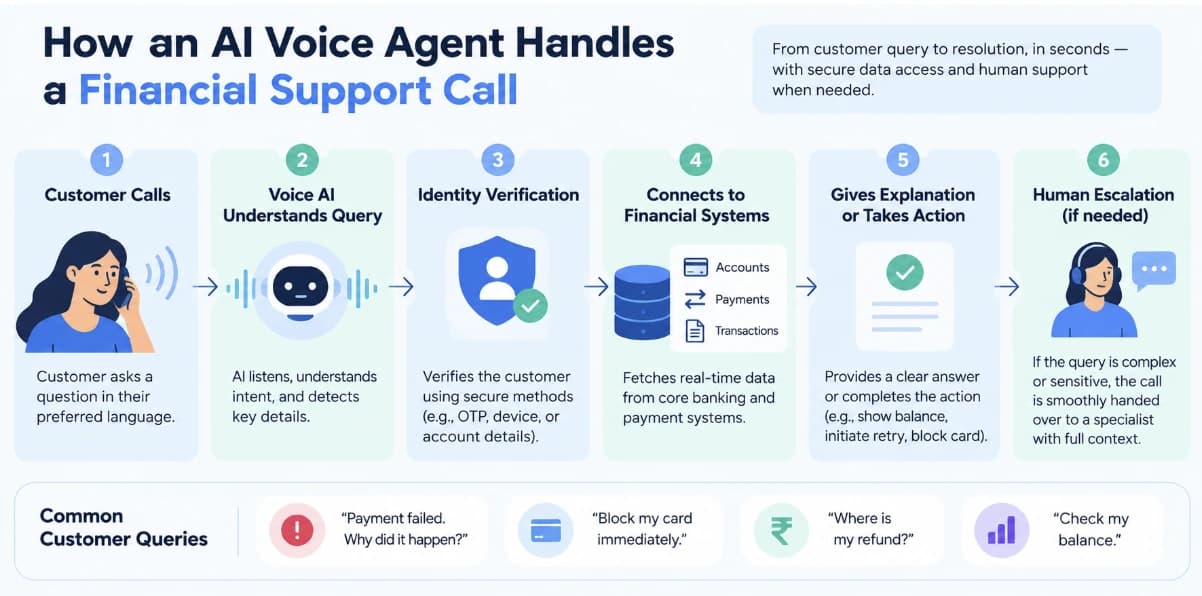
This shift is not about adding another chatbot to a website. It is about building financial conversations that verify a customer, pull the right data, explain an outcome, and act on it.
Why Financial Conversations Are Changing
Lately, payment volumes have outgrown the support models built around them. UPI recorded a daily average of 757 million transactions in June 2026, the highest since its launch, according to NPCI data.
Each of those payments can raise a query: a failed debit, a pending refund, or a duplicate charge.
Industry leaders read the same signal. Reeju Datta, Co-Founder of Cashfree Payments, noted that UPI is now the default way India pays for small-value purchases.
When paying becomes effortless, customers expect support to match that speed. That expectation is pushing businesses to rethink the service layer, not only the checkout, as digital payments grow across India.
What Does AI Voice Solve First in Fintech Support?
1. Round-the-Clock Account Support
Balance checks, statement requests, and limit queries arrive at every hour. A voice agent resolves them instantly and frees your team for cases that genuinely need judgement.
2. Failed and Disputed Payments
A customer whose payment fails at checkout wants a reason, not a ticket number. An agent connected to your systems can explain the failure and suggest a retry, which matters when you understand how a payment gateway works end to end.
3. Card Blocking and Fraud Reporting
A fast response can make all the difference during a fraud incident. Instant blocking cuts exposure, and structured incident capture feeds cleaner data into investigation teams that prevent fraud before detection.
Where AI Voice Fits Inside Regulated Financial Workflows
Many financial institutions have already settled the question of whether to deploy voice agents. The harder question is where to deploy them.
Most teams now start with high-volume, low-risk intents such as balance checks and card status, then widen the scope once accuracy holds. Loan journeys, KYC guidance, and repayment support follow later, because each one carries heavier regulatory weight.
This is where conversational AI in finance can add practical value within tightly governed workflows. A well-built agent verifies customers, retrieves their data, delivers mandated disclosures word for word, and hands off to a specialist the moment a query moves beyond what it can safely resolve. The handoff carries full context, so the customer never repeats the story twice.
Grounding matters just as much. An incorrect answer about a fee or a balance is a compliance issue. Answers should be pulled from your own knowledge base and core systems rather than general model training.
Every interaction should also leave a complete log, transcript, and consent record, which turns audit readiness into a by-product of normal operations.
Practical Tips Before You Build an AI Voice Agent
1. Start Narrow
Pick two or three intents with high volume and low risk. Prove containment there before expanding.
2. Design the Handoff First
Set a proper set of rules by intent, sentiment, urgency, or account tier. Proper rules protect the experience more than a clever script does.
3. Measure the Right Things.
Track containment rate, time to first response, authentication success, and post-call satisfaction. Raw call deflection alone hides poor outcomes.
4. Plan for Language Mixing
Indian customers often switch between two languages mid-sentence. Your agent should follow that switch naturally instead of resetting the conversation.
5. Review Transcripts Weekly
Patterns in drop-offs and repeated escalations tell you exactly which flows to retrain next.
The Business Case for Conversational AI in Fintech
Better conversations produce better data. Every interaction reveals where customers struggle, which products confuse them, and where internal processes slow down.
Finance teams can use those signals the same way they use real-time spend visibility to act during a month rather than after it closes.
There is a commercial upside too. An agent that understands context can surface a relevant product at the right moment, such as an investment option for an idle balance. Done with proper consent and disclosure, that is service rather than selling.
Put AI Voice to Work in Fintech
AI voice is not a replacement for your people. It is a way to give customers immediate answers on routine matters and give your specialists the context to handle the rest well.
Start with a narrow use case, ground every answer in real data, and build the escalation path before the script.
If you are planning a voice-led rollout, explore EnKash and see how payments, cards, and expenses connect into one system behind those conversations.