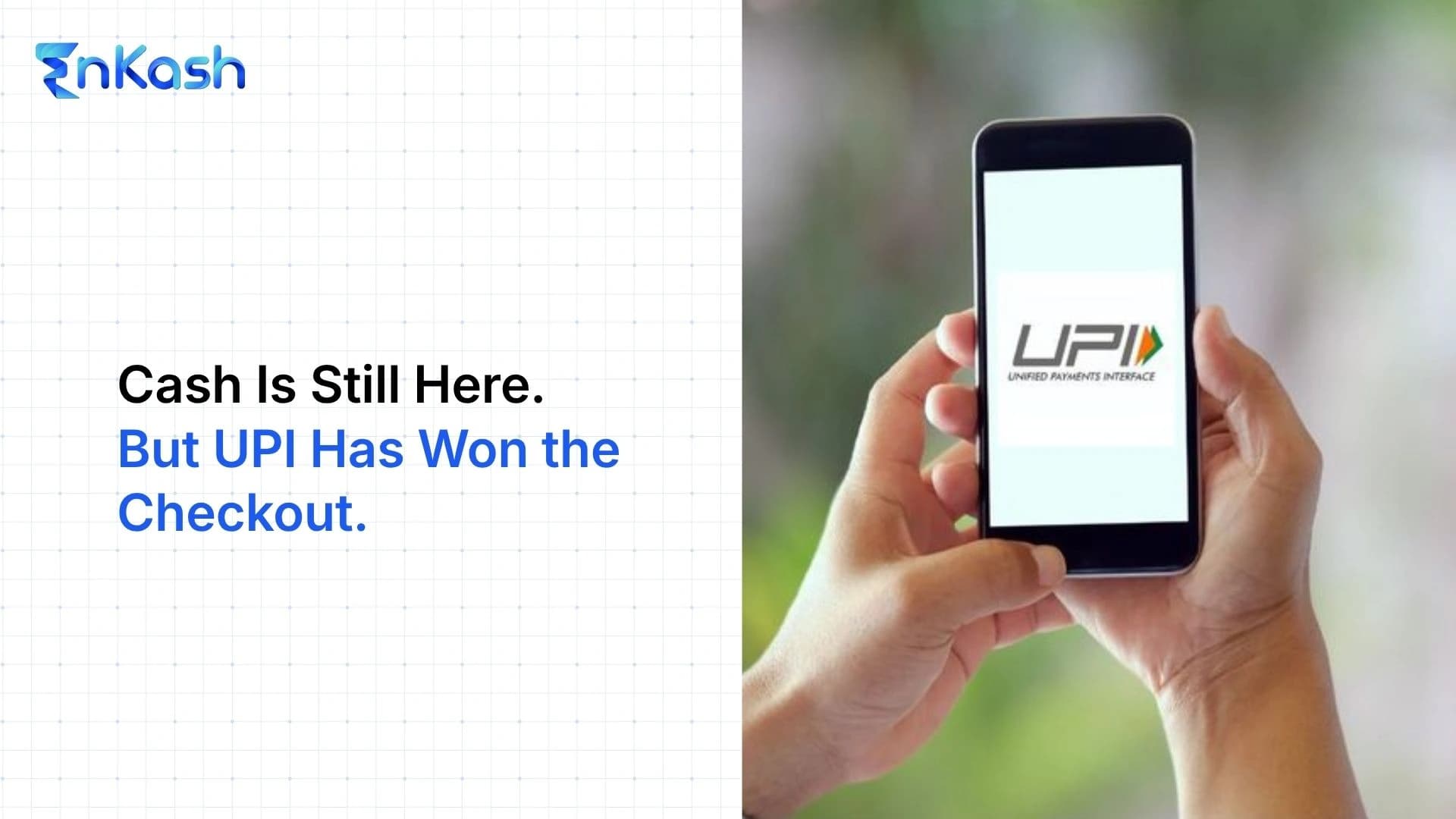
At a café, office canteen, or neighbourhood store, the payment routine has become remarkably predictable. The cashier points to a square printed near the counter. The customer opens an app, scans, enters a PIN, and waits for the familiar confirmation sound. A wallet may still be in the customer’s pocket, but the phone is usually what comes out first.
That habit is now visible on a national scale. In July 2026, the Unified Payments Interface processed 23.66 billion transactions worth ₹29.88 lakh crore, according to the National Payments Corporation of India. That works out to roughly 763 million transactions a day, or nearly 9,000 every second.
The size of those numbers matters, but the more interesting story is behavioural. UPI has made scanning feel like the normal way to pay for ordinary purchases. People use it for a cup of tea, a grocery run, a cab ride, and lunch. The act requires little thought because the customer already knows what to look for and what to do next.
Cash Has Not Vanished
It is tempting to treat the rise of UPI as proof that cash is disappearing. The evidence is more nuanced.
RBI data showed that the number of reported UPI QR codes reached 792.6 million in June 2026, up 16.9% over the previous year. ATM withdrawals fell 11% by volume over the same period, while debit-card cash withdrawals declined 8.6%.
Yet cash remains an important part of the economy. RBI monetary data showed that currency with the public stood at about ₹40.68 lakh crore at the end of March 2026, an 11.4% increase over the previous year.
These figures can coexist. People may continue to hold cash for emergencies, household budgets, informal transactions, or places with unreliable connectivity while choosing UPI more often at a checkout counter. Cash withdrawals are also an imperfect proxy for total cash usage because a banknote can pass through many hands after it leaves an ATM.
The more defensible conclusion is that the scan has become India’s default payment reflex across a growing share of daily retail transactions. Cash is still present, but it no longer defines the checkout experience in the way it once did.
Why the QR Code Won the Counter
UPI reduced the work required from both sides of a payment. A merchant could begin accepting digital payments with a printed code instead of a conventional card terminal. A customer could use a familiar app without carrying the right amount of cash or checking whether a particular wallet was accepted.
Interoperability strengthened that habit. The same visible action can initiate a payment from different participating accounts and instruments. RBI’s guidance on prepaid payment instruments, for example, requires full KYC wallet interoperability through UPI and covers QR-based acceptance. The RBI’s PPI FAQs describe how authorised prepaid payment instruments can work across payment systems rather than remain trapped inside a closed network.
This changes how payment products should be designed. The scan is becoming the interface, while the funding source can sit behind it. Depending on the product and the transaction, that source may be a bank account, an eligible credit instrument or a prepaid balance.
Employee Benefits need to fit the same habit
Meal benefits have traditionally required employees to follow a separate payment routine. They may need to carry a dedicated card, remember where it is accepted, or use a payment method they rarely choose for anything else. A benefit can be generous on paper and still feel inconvenient at the exact moment it is meant to help.
India’s revised Income-tax Rules make that usability question more important. Effective 1 April 2026, food and non-alcoholic beverages provided during working hours at the office or business premises, or through eligible paid vouchers usable at eating joints, can receive prescribed perquisite treatment up to ₹200 per meal. The conditions are set out in the official Income-tax Rules, 2026. Using an assumption of two eligible meals across 22 working days, the benefit can amount to ₹8,800 a month or ₹1,05,600 a year, subject to the applicable rules and employee circumstances.
The value of that benefit depends on whether employees can use it comfortably. If they already scan to pay for lunch, the meal programme should work with that behaviour.
EnKash introduced UPI payments on Meal Card with this principle in mind. Employees can pay from their meal balance by scanning eligible UPI QR codes at food and grocery merchants, while employers retain merchant-category controls and centralised management. The launch announcement explains the product structure and the controls available to employers.
The Next Phase of UPI is About What Sits Behind the Scan
UPI’s first achievement was making digital payment acceptance widely recognisable. Its next phase will be defined by the variety of regulated, purpose-specific payment experiences that can use that familiar interface.
For businesses, the design lesson is simple. A product is easier to adopt when it fits an action people already perform. Controls, eligibility rules, and reporting can operate behind the payment, while the employee sees the same QR code and uses the same scan-and-pay habit.
India may continue to carry cash for years. The stronger signal is what happens when a bill arrives. More often, people reach for a camera before they reach for currency. When lunch is already paid for with a scan, a modern meal benefit should be ready at that moment.