The digitisation of businesses showed us that everything runs on clicks.
From searching for a product, scrolling through, selecting and paying for it. This is how a transaction moved. Every action was driven by intent and this execution was undertaken by humans.
This, yes, exactly this is now changing as it is no longer user-driven.
Agents are becoming our driving force.
Welcome to the world of agentic AI.
Businesses have used softwares to support their product, operations and working.
- There are dashboards to give us insights
- Automation seamlessly reduces manual efforts
- APIs help connect systems
Besides all this, humans still do the most important part, to decide and act.
Agentic AI has introduced a new layer to this.
It has evolved from tools assisting to building systems that can:
- Observe workflows
- Make decisions while following rules
- Take actions without waiting for instructions
From support to execution, the shift is real.
The most interesting part of agentic AI is that it is not a single system; it is a set of agents functioning like a team, owning their individual roles.
Take an example of a finance team where a set of agentic AI is working:
- As a receivables agent following up on payments
- As a payouts agent who is executing transactions
- As an insights agent flagging risks and anomalies
This is a whole new interface where you don’t click through dashboards anymore. You define your intent.
When AI Starts Moving Money
Agents move beyond recommendations in this upgrade of AI.
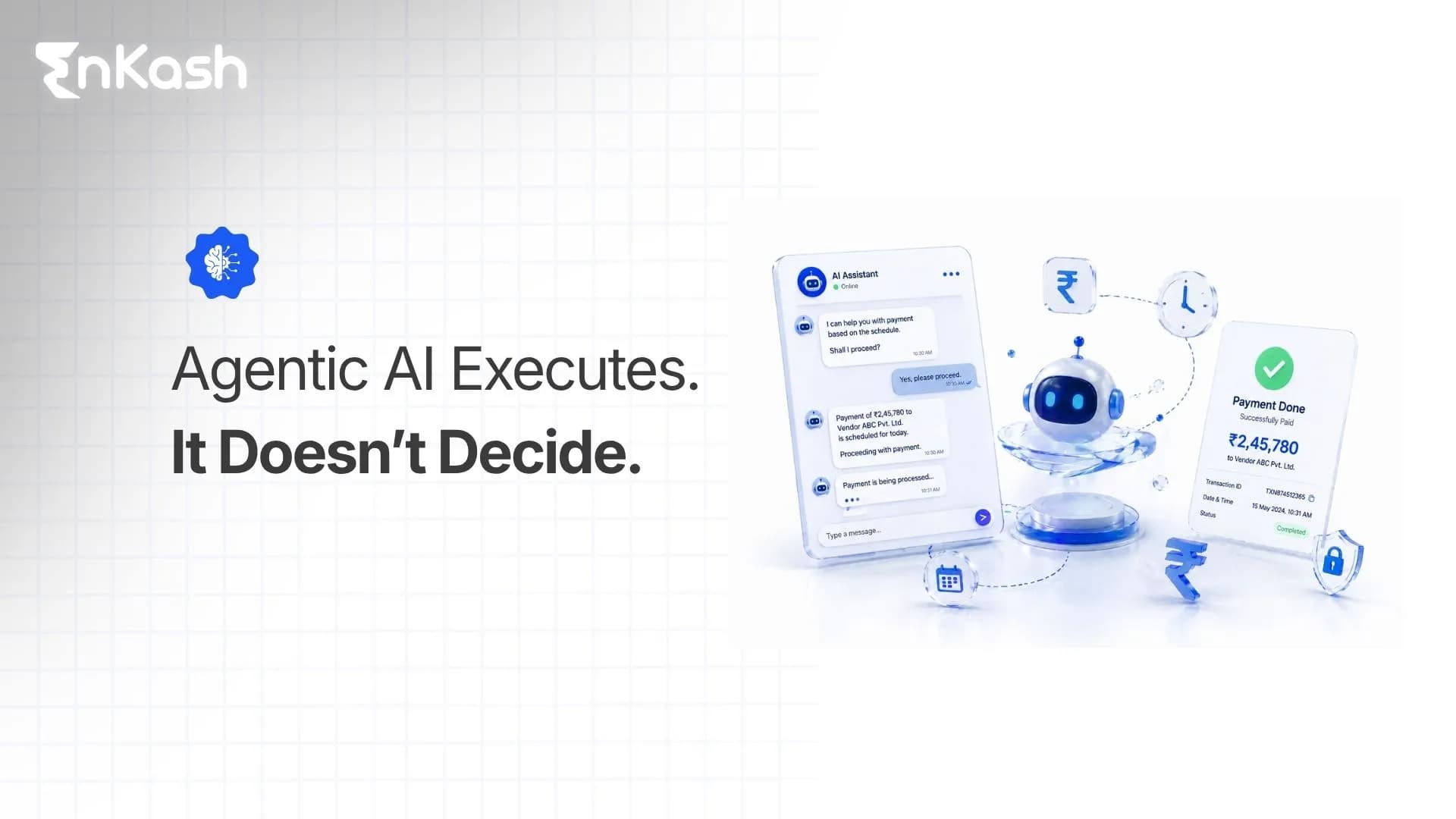
AI doesn’t suggest actions anymore. It executes them, including payments.
Just look at this flow:
- A system finds a due payment
- Defines priority on the basis of cash flow
- Initiates the transaction
- Makes the payment within the predefined limits
All of this and no human intervention.
Agentic payments are capable of making this decision with an unmatched speed.
Time For A Reality Check
Agentic AI is powerful and there are no two thoughts about it.
But…
Let’s think it through that execution is not intelligence.
A system can act but that doesn’t imply it understands.
- It optimises within the limitations of its learnings
- It decides but defined boundaries
- It acts but there is no accountability
What looks like intelligence on the outward is still pattern recognition at scale.
Where AI Stops…
Agentic AI is exceptional at
- Speed
- Scale
- Repetition
- Optimisation
But it can’t decide without:
- Context beyond data
- Situations with no past reference
- Decisions that need judgment
Moreover, AI works within a defined system and it can't question it.
It can follow rules and optimise outcomes, but it can’t step back and rethink the rules. That’s where human judgment comes in.
Why Humans Still Own the System
There is one core principle that moves the most advanced agentic systems and that is human-defined boundaries.
- Spending limits
- Approval layers
- Compliance checks
- Risk frameworks
AI can act but humans decide how far it can go.
This is by design. This is necessary.
Where Humans Still Win
Human intelligence becomes more critical with AI getting better at execution.
Humans have:
- Context to understand why something matters
- Judgment to know when to act and when to stop
- Ethics to decide what shouldn’t be done
- Accountability to own the outcome of their actions
AI can choose the path that is fastest but humans choose the one that is right.
The Real Role of Agentic AI
The biggest misconception that businesses have right now is:
- AI will replace everything
- Or AI is just another tool
However, the truth is completely different.
Agentic AI is:
- An execution engine
- A decision accelerator
- A layer of operational leverage
It amplifies human intelligence when used rightly. This is where agentic problem solving becomes useful: AI can break a goal into smaller steps, use tools, follow rules, and execute across a workflow, while humans still define the goal, boundaries, and acceptable risk.
The operational transition
We’re moving from:
- Tools to Systems
- Insights to Actions
- Workflows to Autonomous execution
The human role is evolving with this transition as they can oversee how systems execute and can allocate the operational tasks to AI.
The relationship between humans and AI
Who holds the accountability?
The real question is whom to question when it comes to accountability and responsibility.
When systems can act autonomously:
- Who is accountable for mistakes?
- How to define acceptable risk?
- Who intervenes when something goes wrong?
The biggest risk here is when humans put too much of their trust in systems because they don’t understand the consequences.
What This Means for Businesses
It is important to redesign how decisions and actions happen and for that some clear ground rules can be defined.
A few clear principles:
- Use AI only when decisions are repetitive and data-driven
- Keep humans involved where stakes are high and context matters
- Design systems where AI acts but within human-defined guardrails
When in practice:
- AI triggers actions
- Humans define intent
- Systems enforce boundaries
The Future Isn’t AI Vs Humans
It’s businesses that understand where AI should act and where humans must lead.
In a world where machines can execute, intelligence is no longer about doing more; it’s about deciding better.