Indian SaaS and D2C brands are increasingly selling beyond the domestic market. The scale of the shift is significant: India's SaaS ecosystem is projected to represent a US$50–70 billion revenue opportunity by 2030, according to IBEF, with Indian SaaS companies increasingly building businesses for global markets. SaaS companies are targeting customers across North America, Europe, and Southeast Asia, while D2C brands build international demand through marketplaces, social commerce, and their own websites.
But getting international customers to the checkout is only half the job. The other half is successfully getting the payment through.
A customer in the US may have a valid card but see the transaction declined. A shopper in the UAE may reach checkout only to discover that their preferred payment method isn't available. A subscription customer may have funds available but lose access to a service because an automated renewal failed.
These aren't necessarily signs of weak demand. They're often signs that the payment infrastructure wasn't built for cross-border payment transactions and for Indian businesses expanding abroad, which quietly becomes a constraint on growth.
What is a cross-border payment failure?
A cross-border payment failure occurs when an international transaction that could otherwise have completed does not reach payment completion. It can happen for several reasons:
The issuing bank declines the transaction.
A fraud system incorrectly flags a legitimate customer as risky.
The customer's preferred payment method isn't supported.
Currency or pricing friction prevents the customer from completing checkout.
Authentication fails.
A recurring payment cannot be processed.
The important point is that not every failed payment is fraud or insufficient funds. Some failures affect legitimate customers whose transactions are declined, while other customers abandon checkout because the available payment experience does not match local expectations. That makes payment optimisation a revenue issue, not just a technical one.
Why cross-border transactions are harder
A domestic transaction usually operates within a familiar environment. The merchant, customer, issuing bank, payment methods, currency, and regulatory framework are all relatively predictable.
International transactions add variables. A single payment might involve a merchant in India, a customer in the US, a card issued in a third country, a processor spanning several markets, and fraud systems evaluating unfamiliar patterns. Each variable is another opportunity for friction.
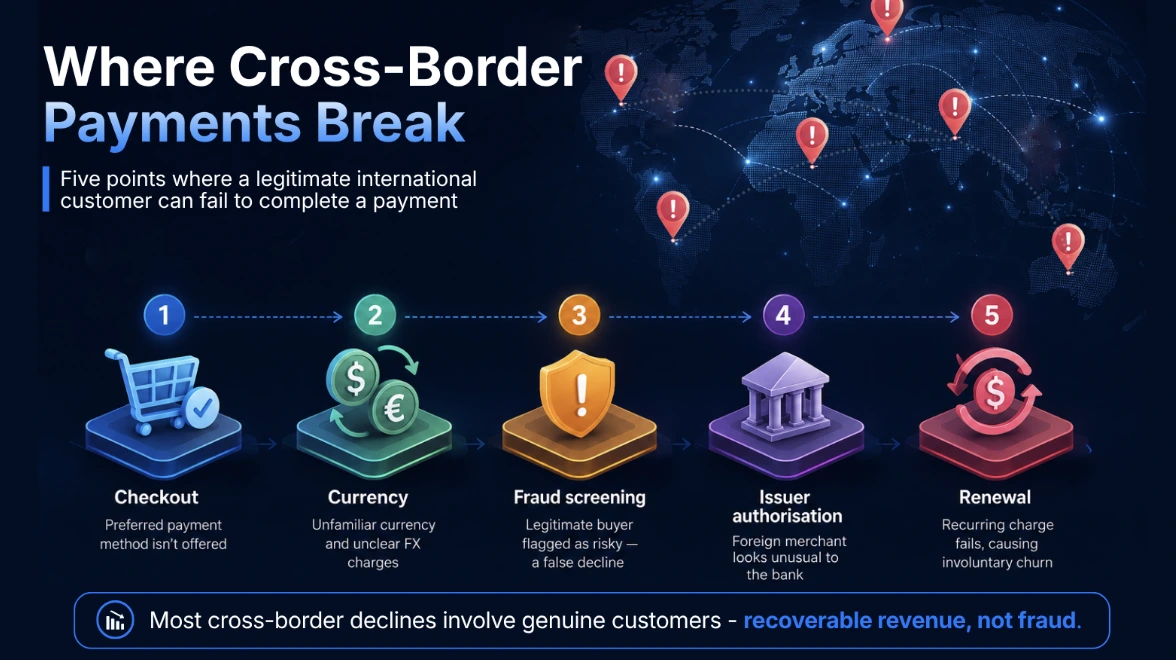
1. Foreign transactions can look unfamiliar to issuers
Banks lean on transaction history and behavioural signals to judge whether a payment looks legitimate. A customer who normally buys from US merchants may suddenly transact with an Indian one – completely genuine, yet unusual to an automated risk system. The same happens when customers travel, switch devices or networks, or ship to an address that doesn't match their billing details. The result can be a false decline.
2. Customers expect local payment experiences
Payment preferences aren't universal. Cards may dominate one market while bank transfers, wallets or local networks are more common elsewhere. A US customer may expect cards and digital wallets; a European customer may prefer bank-based methods; an Indian customer may expect UPI. Offering only the merchant's preferred method introduces avoidable friction. Localisation isn't just translating the checkout page – it's understanding how each market actually pays.
3. Currency adds another layer of friction
Customers are more comfortable when prices and charges appear in a familiar currency. An unexpected currency makes the final amount less predictable, especially when the buyer doesn't know what foreign-exchange charge their bank will apply. For D2C brands, this affects purchase completion. For SaaS companies, currency choice also affects recurring billing, making clear and predictable pricing important beyond the first purchase.
4. Fraud prevention can create false declines
Fraud controls are essential, but overly aggressive rules create their own problem: legitimate customers get treated like fraudulent ones. The scale is easy to underestimate – PYMNTS Intelligence reports that nearly half of merchants believe up to 5% of legitimate orders are wrongly declined as fraudulent, an estimated $50 billion in lost revenue across the industry.
This hits cross-border businesses harder because international transactions naturally carry signals that look unusual – a purchase from another country, a new device, a higher-value order.
The goal isn't to block every potentially risky transaction. It's to separate genuine risk from legitimate cross-border behaviour, which takes better transaction data, market-specific risk rules, and ongoing monitoring of approval and decline patterns.
5. Subscription businesses face a second problem: failed renewals
For SaaS businesses, failure often doesn't happen at first checkout. It happens months or years later. A card expires. A bank declines a recurring charge. Authentication requirements change. A temporary issuer problem interrupts a renewal.
If the system simply marks the payment as failed and cancels the subscription, the business loses a customer who never intended to leave. This is involuntary churn. Smart retry logic, account-updater capabilities, and effective dunning can recover many of these payments before they become cancellations, and keeping an existing customer usually costs far less than acquiring a new one.
The real cost of a failed payment
The cost of payment failure isn't limited to the transaction value.
Picture a D2C company that spends on ads to acquire a customer. They click the ad, browse the site, pick a product, reach checkout, and the payment fails. The business loses the sale and part of the marketing spend used to get them there. For SaaS companies, the loss can be larger, because a failed renewal can wipe out months or years of future recurring revenue.
This is why brands expanding internationally should watch transaction success rate alongside marketing metrics. Traffic and conversion tell only part of the story – authorisation rate, decline reasons, checkout completion, payment-method performance and involuntary churn reveal where revenue leaks at the final stage of the funnel.
How Indian businesses can reduce cross-border payment failures
There's no single fix, because failures have multiple causes. But several changes make a measurable difference.
Offer locally relevant payment methods. Don't assume methods that work in India perform everywhere. Review preferences by geography and surface the most relevant options at checkout.
Improve authorisation performance. Track declines by country, issuer, method, transaction type, and customer segment to see whether they cluster in a particular market or flow.
Use intelligent retry strategies. For subscriptions, don't treat every failed renewal as a lost customer. Match retry schedules and recovery workflows to the reason for failure.
Review fraud rules regularly. If legitimate international customers are repeatedly blocked, the answer usually isn't more fraud prevention. It's better risk calibration.
Localise the checkout experience. Go beyond language to currency, payment methods, billing fields, tax display, and authentication, so international customers feel they're buying from a business that understands their market.
Where a Merchant of Record can help
As the number of markets grows, payment complexity increasingly overlaps with tax, compliance and legal responsibility. This is where a Merchant of Record (MoR) model becomes relevant.
Instead of setting up and running every part of the selling infrastructure independently in each market, an MoR can act as the legal seller for transactions and take on payment processing, tax handling, compliance, and settlement, depending on the service model. For an Indian SaaS or D2C company entering several markets, this reduces the operational burden of managing international payments.
It also changes the question worth asking. Rather than "Can we accept payments from this country?", the better question becomes "Can we reliably acquire, authorise, collect, settle, and stay compliant when selling here?" Those are very different questions.
For Indian SaaS and D2C brands expanding globally, Transact Bridge provides payment infrastructure designed to simplify selling across India, the US, and global markets. From local payment methods and cross-border collections to compliance, tax, and settlement support, Transact Bridge helps businesses reduce payment friction and turn international demand into reliable revenue – without having to build the entire payment infrastructure market by market.
Global expansion needs payment infrastructure, not just marketing
Indian businesses have become good at finding customers outside India. The harder challenge is converting them consistently. A localised website brings visitors, a strong product creates demand, competitive pricing generates interest – but if the payment fails at checkout, none of it matters. For SaaS companies, the same applies after acquisition: a customer can be happy with the product and still churn because a renewal wasn't recovered.
Cross-border payment performance is best treated as part of the growth strategy, not a back-office function. Brands that approach it that way are better positioned to turn global demand into predictable revenue.
Frequently asked questions
1. What causes cross-border payment failures?
Common causes include issuer declines, fraud filters, unsupported payment methods, currency friction, authentication problems, and failed recurring payments.
2. How can Indian SaaS companies reduce failed international payments?
By improving payment-method coverage, optimising authorisation, using intelligent retry strategies, reviewing fraud rules, and localising the checkout experience for each target market.
3. Why are payment methods important for international customers?
Payment preferences vary by country. Offering only the methods familiar to the merchant creates friction for customers who expect different local options.
4. What is a Merchant of Record?
A Merchant of Record is a business or service provider that acts as the legal seller for transactions and can take responsibility for functions such as payment processing, tax, and compliance, depending on its operating model.
5. Can failed subscription payments cause customer churn?
Yes. Failed renewals can cause involuntary churn when a legitimate customer loses access because a payment wasn't successfully processed or recovered.
Disclaimer: The views and opinions expressed in this article are those of the guest author and do not necessarily reflect the views, opinions, policies, or positions of EnKash. The information provided is for general informational purposes only.