Every founder remembers the day they fell in love.
It wasn't with a person.
It was with an idea.
Maybe it was the first sketch on a notepad. The first prototype. The first Shopify order. The first customer review. The notification confirmed that someone, somewhere, believed in what you had created.
That moment changes you.
Your business stops being "a business." It becomes part of your identity.
You think about it over dinner. You dream about it. You worry about it. You celebrate every milestone as though you've watched a child take its first steps.
And that's exactly where the challenge begins.
Because while you remain deeply in love with your product, your customers haven't even met it yet.
They're not emotionally invested in your story.
They're trying to answer a much simpler question:
"Why should I trust you with my money?"
That's the conversation too many brands forget to have.
The AI Revolution Changed How We Build. It Didn't Change Why People Buy.
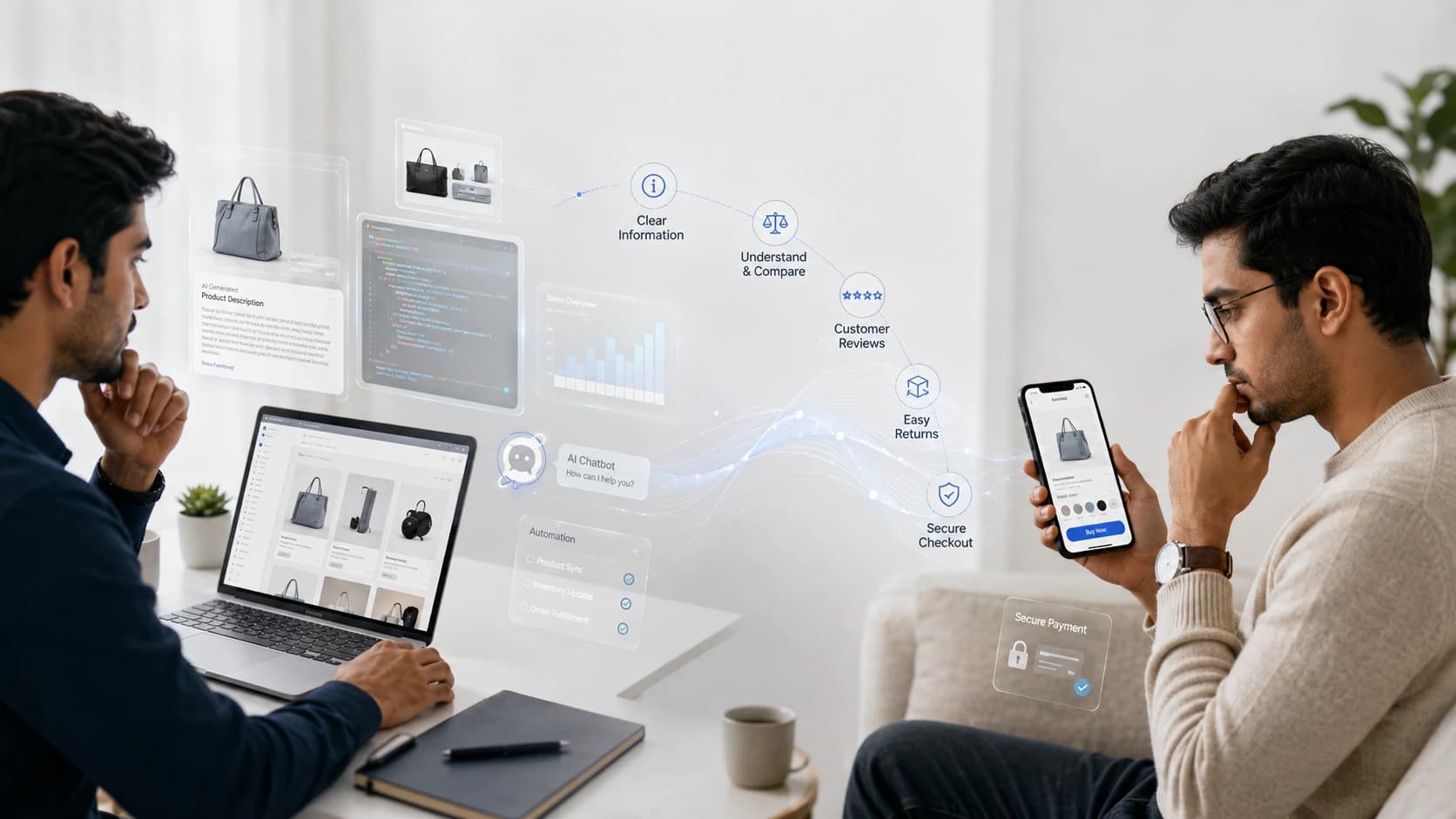
Over the last two years, AI has transformed how eCommerce businesses operate.
A Shopify store that once took months can now be launched in days.
Product descriptions can be generated in seconds.
Marketing campaigns can be drafted before your morning coffee.
Customer support can be automated.
Emails can be personalised.
Images can be created without a photographer.
On paper, this should have created an explosion in sales.
But for many businesses, it hasn't.
What AI has done brilliantly is reduce the time it takes to produce digital assets.
What it hasn't done is reduce the time it takes to earn trust.
And trust—not speed—is still what drives buying decisions.
The Problem Was Never Traffic
One of the most common conversations I have with founders starts like this:
"We need more traffic."
Sometimes that's true.
More often, it isn't.
I've worked with businesses that had healthy visitor numbers but disappointing sales.
They blamed advertising.
They blamed SEO.
They blamed pricing.
They blamed their payment gateway.
Some even rebuilt their websites entirely.
Yet nothing fundamentally changed.
The real problem wasn't attracting visitors.
It helped visitors make a confident decision.
Traffic doesn't create revenue.
Confidence does.
Founders See Features. Customers Feel Friction.
Founders naturally see their products through the lens of effort.
You remember every design revision.
Every manufacturing challenge.
Every late night.
Every feature you painstakingly added.
Customers don't.
They experience your business through moments.
Can I understand what you're selling within a few seconds?
Does this solve my problem?
Can I trust this brand?
Is your return policy clear?
Will this fit my needs?
What happens if something goes wrong?
Is this worth the price?
These questions are rarely answered by adding another app, another AI tool or another automation.
They're answered by understanding human behaviour.
The Hidden Cost of Falling in Love With Your Own Product
Every founder should be proud of what they've built.
But there's a danger in becoming too close to your own creation.
Psychologists call it the curse of knowledge—once you know something deeply, it becomes difficult to imagine what it feels like not to know it.
Your navigation makes perfect sense to you.
Your product descriptions feel obvious.
Your terminology sounds natural.
Your checkout flow appears simple.
To a first-time visitor, none of those assumptions may be true.
Customers don't abandon stores because founders don't care.
They leave because founders unknowingly communicate from familiarity instead of empathy.
The Intent-Led Growth Framework
At Refresh Ideas, we've found that sustainable eCommerce growth doesn't begin with more traffic.
It begins with understanding the customer's intent.
That's why I think about growth as a journey rather than a funnel.
The Intent-Led Growth Framework
Attention
Someone discovers your brand.
↓
Curiosity
Something encourages them to explore further.
↓
Understanding
They quickly understand what you offer and why it matters.
↓
Confidence
Your content, design, reviews, policies and messaging reduce uncertainty.
↓
Decision
They feel ready to buy.
↓
Checkout
Technology enables a smooth, trustworthy transaction.
↓
Experience
Your promise matches reality.
↓
Advocacy
Satisfied customers become repeat buyers and recommend your brand.
Notice something important.
Checkout is only one stage.
If confidence never existed, no checkout experience can create it.
What Research Continues to Tell Us
This isn't simply intuition.
Behavioural science has consistently shown that people don't make purchasing decisions purely through logic.
Daniel Kahneman's work on System 1 and System 2 thinking demonstrated that many everyday decisions are shaped by fast, intuitive judgement before rational analysis follows.
Barry Schwartz's research on the Paradox of Choice reminds us that too many options can increase hesitation rather than confidence.
The Baymard Institute, through years of checkout usability research, has repeatedly identified reasons shoppers abandon purchases that have little to do with technology itself. Unexpected costs, forced account creation, lack of trust, confusing checkout flows and insufficient information continue to influence abandonment far more than most businesses realise.
The common thread?
People buy when uncertainty decreases.
AI Makes Average Easier
Here's something we don't discuss enough.
AI has dramatically improved the quality of average work.
Average product descriptions are now good.
Average landing pages are now good.
Average advertisements are now good.
Average email campaigns are now good.
That's wonderful for productivity.
But it creates a new challenge.
When everyone produces competent digital experiences, competence stops becoming a competitive advantage.
Differentiation shifts somewhere else.
It shifts towards empathy.
Judgement.
Positioning.
Understanding.
Human insight.
Ironically, AI is making human thinking more valuable—not less.
Before Changing Technology, Ask Better Questions
Before replacing your Shopify theme...
Ask why customers hesitate.
Before changing your payment gateway...
Ask whether customers ever developed enough confidence to reach checkout.
Before investing in another marketing campaign...
Ask whether your current visitors truly understand your value.
Before adding another AI tool...
Ask whether you're solving a strategic problem or simply accelerating existing confusion.
Sometimes the biggest breakthrough comes from asking a better question—not finding a faster answer.
Where Payments Fit In
A seamless payment experience absolutely matters.
Reliable platforms such as EnKash help businesses provide secure, dependable payment experiences that reduce friction during the final stage of a customer's journey.
But payments don't create trust.
They reinforce it.
If a customer has already decided they don't understand your offer, don't trust your brand, or don't believe your product is right for them, even the best payment infrastructure cannot reverse that decision.
Technology completes confidence.
It doesn't replace it.
What I Believe the Next Generation of Shopify Brands Will Do Differently
The most successful eCommerce businesses won't necessarily have the biggest AI budgets.
They'll have the deepest understanding of people.
They'll invest in customer interviews before new software.
They'll simplify before they automate.
They'll test assumptions instead of copying competitors.
They'll use AI as an accelerator—not as a substitute for thinking.
And they'll recognise that growth isn't about convincing more people to visit.
It's about helping the right people make the right decision with confidence.
A Final Thought
Founders often tell me they want higher conversions.
I understand.
But conversions are an outcome.
The real objective is something much more human.
Help someone feel understood.
Help them trust you.
Help them believe they're making the right decision.
Everything else follows.
Because in the end, customers don't fall in love with products.
They fall in love with what those products make possible in their lives.
That's the story worth designing for.
About the Author
Gaurav Dhingra is the Founder of Refresh Ideas, a strategy-first digital consultancy helping growth-focused businesses and impact organisations turn digital investments into measurable outcomes. With over two decades of experience across eCommerce, UX, digital strategy and product thinking, he believes that AI is transforming execution—but human judgement still determines direction.
"AI gives answers. Experts give direction."