Under India’s GST framework, exports are classified as zero-rated supplies. This means exporters are not required to bear the final tax burden, but they must still follow prescribed compliance routes to avail this benefit. One such route is the use of LUT, which allows eligible exporters to supply goods or services without paying integrated tax at the time of export.
From a compliance standpoint, LUT in GST is not a relaxation of the law but a formal undertaking given to the tax authorities. By filing it, an exporter commits to meeting specific conditions, such as completing exports within the prescribed timelines and realising foreign currency proceeds in the case of services. When these conditions are met, GST does not need to be paid upfront, eliminating the need to claim refunds later. For exporters handling regular overseas transactions, the proper use of an LUT certificate plays a direct role in managing cash flow, reducing reliance on refunds, and maintaining clean GST records. The sections ahead clarify how LUT is applied in GST exports, identify the scenarios in which it is permitted, and detail the obligations that continue after filing.
What is LUT in GST?
LUT stands for Letter of Undertaking. Under GST, it is a prescribed declaration submitted by a registered exporter under Rule 96A of the CGST Rules. Through this declaration, the exporter formally assures the tax department that exports will be carried out in accordance with the GST, without payment of integrated tax at the time of supply. Legally, LUT in GST is recognised as a binding undertaking. It is not an approval, exemption, or licence. Once filed and accepted electronically, it becomes the basis for the exporter to make zero-rated supplies without payment of tax. LUT's in GST is rooted in enforcement rather than facilitation. By filing an LUT, the exporter accepts responsibility for completing exports within the stipulated period and for fulfilling post-export conditions defined under GST. If these conditions are breached, the law allows the tax authorities to recover the applicable tax along with interest. In effect, LUT shifts the point of tax enforcement. Instead of collecting tax upfront, GST relies on the exporter’s undertaking and monitors compliance after the supply has been made.
Why is LUT So Important for Exporters?
Reduces Dependence on the Refund Route
Under GST, exports are zero-rated, but the law still offers two distinct compliance paths. An exporter can either pay IGST at the time of export and later apply for a refund, or export without paying tax by using LUT. The refund route is procedural by nature. It involves system validations, document matching, and processing timelines that are not always predictable. During this period, the tax amount remains blocked. By exporting under LUT in GST, this blockage is avoided entirely. Since no IGST is paid upfront, there is no refund to wait for. For exporters with frequent shipments or recurring service invoices, this directly improves cash availability and reduces reconciliation workload.
Improves Cash Flow Predictability
Export businesses typically operate on tight working capital cycles. Funds are required for procurement, logistics, compliance, and vendor payments well before export proceeds are realised. When IGST is paid upfront, even temporarily, it disturbs this cycle. Using an LUT certificate keeps export transactions tax-neutral at the execution stage. This allows exporters to plan cash flows more accurately, without factoring in refund delays or follow-ups. From a finance and accounting standpoint, this also simplifies month-end closing and aligning GST returns.
Simplifies Ongoing GST Compliance
Exporting with LUT brings consistency to GST filings. Since tax is not paid on export invoices, there is no need to track refund claims, reconcile sanctioned amounts, or manage refund rejections. Returns such as GSTR-1 and GSTR-3B reflect exports as zero-rated supplies without tax outflow, making compliance cleaner and easier to audit. For service exporters in particular, the LUT for export creates a clear compliance path, provided payment is received within the permitted timeframe. As long as conditions are met, there is no downstream tax adjustment.
Provides Regulatory Clarity and Control
LUT also sets clear expectations. The exporter knows the conditions that must be fulfilled and the timelines that apply. This reduces ambiguity and limits exposure to unexpected tax demands. Instead of reactive compliance through refunds, exporters operate within a defined framework that is easier to monitor and control.
What are the uses of LUT?
LUT in GST is an important document submitted by taxpayers to get exemption from paying GST on exported goods and services. Better Liquidity: Businesses can maintain their working capital for better liquidity by avoiding the tax payment upfront. No Tax Payment for Export: Goods and services can be exported without paying IGST in the presence of LUT. No Administrative Work: LUT helps eliminate the need to file a GST refund for each shipment. Pricing: Exporters offer competitor prices in international markets. LUT: A LUT is valid for one financial year helping compliance simplification.
When Can LUT Not Be Used?
Cases Involving Serious GST Violations
The use of LUT is restricted where an exporter has been involved in serious GST offences. If prosecution has been initiated for tax evasion beyond the monetary threshold prescribed under GST law, the option to export under LUT under GST is not available. In such situations, the tax authorities do not accept an undertaking as sufficient assurance of compliance. This restriction is not discretionary. It is system-driven and applies automatically based on the exporter’s compliance history recorded under GST.
Failure to Meet Export Timelines
Another situation where LUT cannot be used arises when exports are not completed within the time limits specified under GST. If goods are not exported within the prescribed period after issuing the invoice, the exporter becomes liable to pay the applicable tax along with interest. Repeated failures of this nature can lead to withdrawal of the LUT facility. Once withdrawn, future exports cannot be made under LUT until the conditions are regularised.
Non-Realisation of Export Proceeds for Services
For service exporters, eligibility to use LUT depends on receiving payment in convertible foreign exchange within the permitted timeframe. If export proceeds are not realised within this period, the conditions of LUT are considered breached. This can result in tax liability and suspension of the LUT route for subsequent exports.
Mandatory Shift to Bond in Restricted Cases
When LUT is disallowed, exporters do not have the flexibility to continue using it. GST rules require exports to be made either by paying IGST upfront or by furnishing a Bond with applicable security. This ensures that tax exposure is adequately safeguarded in higher-risk cases. Read More: Types of GST in India.
How to File an LUT Online?
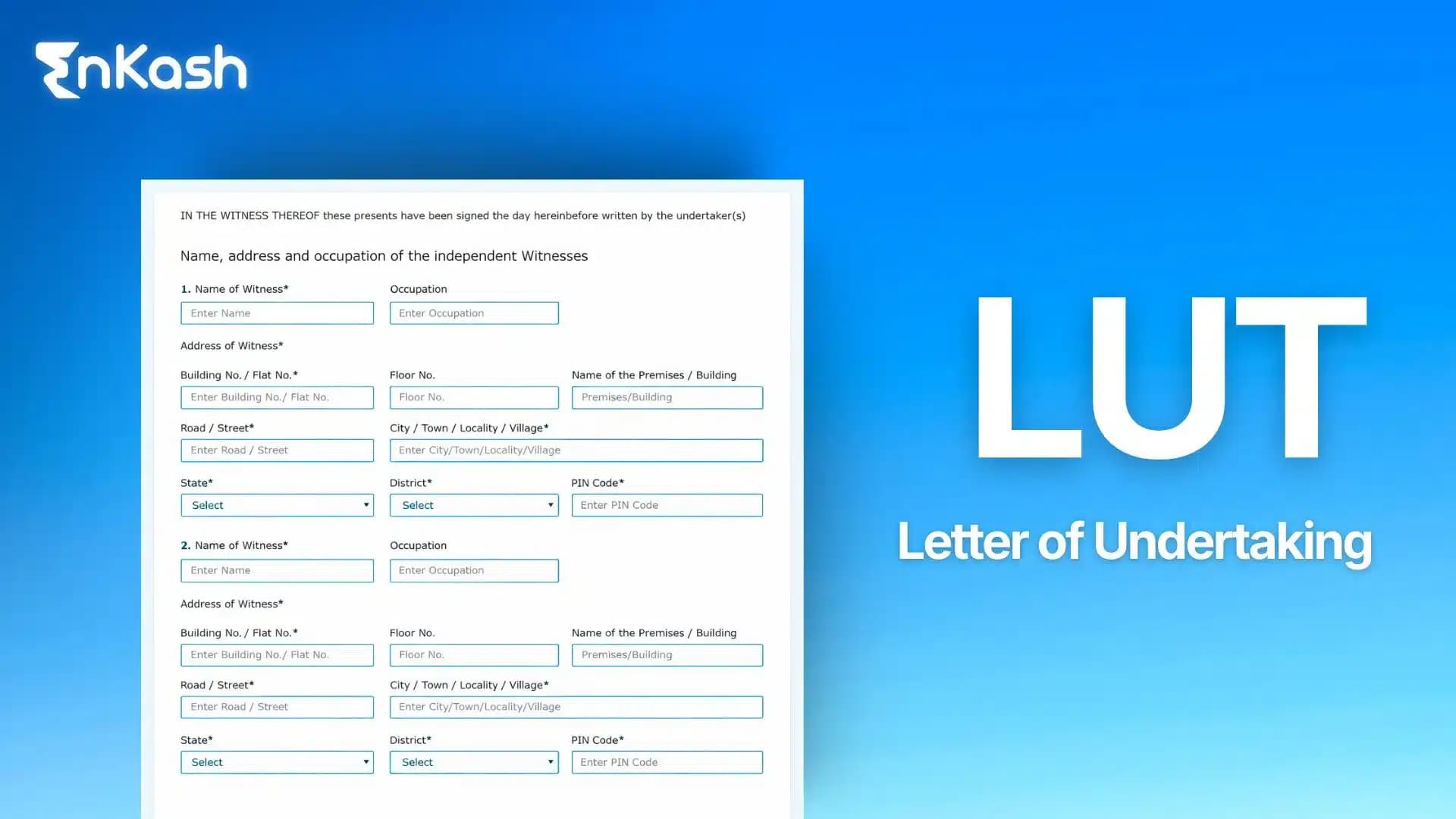
Filing LUT under GST is a fully digital process and does not involve any physical submission. The filing is done once for each financial year and applies to all eligible exports made during that period. Here is a step-by-step process to file LUT online.
Step 1: Login to the GST portal with valid credentials.
Step 2: Navigate to the Services section, User Services section and find LUT.
Step 3: Choose the financial year applying for.
Step 4: Enter the details required like name, address and witness’s occupations.
Step 5: Agree to the declarations required.
Step 6: Sign with your digital signatures or electronic verification code.
Step 7: A unique Application Reference Number (ARN) will be generated after completing the process.
Documents Required to File an LUT
Unlike many GST processes, filing LUT does not involve uploading a set of supporting documents. The system is designed to rely on declarations and digital authentication rather than paperwork.
No Physical Documents Required
When filing LUT under GST, exporters are not required to attach invoices, contracts, shipping bills, or bank certificates. The undertaking is accepted based on the exporter’s GST registration details and compliance history already available in the system. This makes the process faster and reduces documentation burden, especially for exporters with frequent or recurring transactions.
Digital Authentication Requirement
Although documents are not uploaded, the LUT filing must be authenticated digitally. Depending on the type of taxpayer, this is done using a Digital Signature Certificate or electronic verification. This step confirms that the undertaking is legally binding.
Before filing LUT in GST, exporters should ensure that core registration details such as legal name, authorised signatory, and contact information are updated on the GST portal. Any mismatch here can cause filing or verification issues later.
Validity of an LUT
An LUT filed under GST is not an open-ended permission. Its validity is clearly time-bound and linked to the financial year for which it is submitted.
Financial Year–Based Validity
LUT is valid only for the specific financial year selected at the time of filing. Once filed, it applies to all eligible exports made during that year, starting from 1 April and ending on 31 March. It does not automatically extend into the next year, even if the exporter’s business details remain unchanged. This makes LUT a periodic compliance requirement rather than a one-time filing.
When LUT Expires
The LUT expires automatically at the end of the financial year. No separate cancellation or closure is issued by the GST system. From the first day of the new financial year, exports cannot be made under the old LUT. If exports continue without filing a fresh LUT for the new year, the exporter may be required to pay IGST on such supplies or face compliance queries later.
Renewal Requirement
To continue exporting without upfront tax payment, exporters must file a new LUT at the beginning of each financial year. Most businesses do this before issuing their first export invoice of the year to avoid gaps in compliance.
LUT Vs Bond
| Basis | LUT (Letter of Undertaking) | Bond |
|---|
| Purpose | Allows exporters to export without paying IGST upfront based on a declaration | Allows exporters to export without paying IGST upfront through a security-backed commitment |
| Nature | Declaration-based undertaking relying on the exporter's compliance history | Security-backed instrument requiring a formal bond |
| Financial Security | No financial security or bank guarantee required | Usually requires a bank guarantee or other financial security |
| Validity | Applicable to all eligible exports during the financial year once filed | Remains valid as per bond conditions and value limits |
| Eligibility | Available to exporters meeting GST compliance requirements | Mandatory for exporters who are not eligible to furnish LUT |
| When Used | Default and preferred option for compliant exporters | Used when GST rules do not permit filing an LUT |
| Compliance Requirement | Simple filing with minimal documentation | Requires bond execution, supporting documents, and security arrangements |
| Operational Complexity | Low; no need to track guarantees or bond values | Higher; requires monitoring bond utilization and maintaining security coverage |
| Cost Implication | Minimal compliance cost | Additional costs due to bank guarantees and administrative requirements |
| Best Suited For | Most compliant exporters with a satisfactory GST record | Exporters with compliance restrictions or those ineligible for LUT |
Also read: What Is the GST Bill Format in India? Types and Templates
Common Mistakes While Using LUT
Filing LUT for the Wrong Financial Year
A frequent mistake exporters make is filing LUT under the incorrect financial year. Since LUT is strictly year-specific, selecting the wrong year renders it ineffective for current exports. This usually happens when the filing is done close to the year-end or at the start of a new financial year without checking the selected period.
Assuming LUT Auto-Renews
Many exporters assume that once filed, LUT under GST continues indefinitely. This is incorrect. LUT expires automatically at the end of each financial year and must be refiled. Continuing exports without renewing LUT can expose the exporter to IGST liability on those transactions.
Issuing Export Invoices Before Filing LUT
Another common error is raising export invoices before filing LUT for the year. Even if LUT is filed later, exports already invoiced may be treated as non-compliant. The LUT must be active on the date the export invoice is issued.
Ignoring Payment Timelines for Service Exports
For service exporters, delayed receipt of foreign currency is a critical compliance risk. If payment is not realised within the permitted timeframe, the conditions of LUT in GST are breached, leading to tax and interest exposure.
Incorrect Invoice Endorsement
Export invoices must clearly mention that the supply is made under LUT without payment of IGST. Missing or incorrect endorsement can create issues during audits or assessments.
Conclusion
For exporters, compliance under GST works best when the rules are understood and applied with precision. LUT is not a shortcut or concession. It is a structured undertaking that allows exports to move without upfront tax, provided conditions are followed strictly. When used correctly, it aligns export operations with regulatory expectations and reduces avoidable friction in tax reporting. What matters is timing, accuracy, and consistency across invoices, filings, and payment realisation. A clear understanding of LUT in GST helps exporters stay compliant, predictable, and audit-ready, without relying on corrective actions later.
FAQs
1. Can LUT be filed after exports have already started?
LUT is expected to be in place before export invoices are issued. If exports are made first and LUT is filed later, those transactions may not qualify for zero-rated treatment without tax payment. In such cases, authorities may treat the exports as taxable and ask for IGST along with interest, depending on facts and timelines.
2. Is LUT required for every export invoice separately?
LUT is not filed per invoice or per shipment. It is a single undertaking filed for an entire financial year. Once active, it covers all eligible export invoices issued during that year, as long as the conditions attached to exports of goods or services are followed consistently.
3. Can a newly registered GST exporter file LUT immediately?
A new GST registrant can file LUT as soon as the registration is active and credentials are available. There is no mandatory waiting period. However, eligibility still depends on compliance history and the absence of disqualifying factors such as prior prosecution under GST or earlier tax laws.
4. Does LUT apply to exports made through e-commerce platforms?
Exports made through e-commerce platforms can be covered under LUT, provided the supply qualifies as an export under GST and the exporter is the one raising the invoice. The method of order placement does not change LUT applicability. Compliance depends on documentation, export completion, and payment realisation.
5. What happens if export proceeds are received after the allowed time?
If payment for exported services is received beyond the permitted timeframe, the export may lose zero-rated treatment. In such cases, tax liability can arise along with applicable interest. Exporters may also face restrictions on using LUT for future transactions until compliance gaps are addressed.
6. Is LUT applicable to partial exports or advance payments?
LUT applies to export supplies, not to advances by themselves. For goods, the focus is on the actual export of goods. For services, advance receipts do not automatically complete export conditions. The relevant factor is whether the service is supplied and payment is realised within the permitted period.
7. Can LUT be cancelled voluntarily by the exporter?
There is no separate voluntary cancellation process for LUT. If an exporter chooses not to use it, they can export by paying IGST and claiming refunds instead. However, once filed, LUT remains valid for the year unless withdrawn by the authorities due to non-compliance.
8. Does LUT need to be mentioned in GST returns?
LUT itself is not reported as a separate entry in GST returns. Its effect is reflected through zero-rated export entries in GST returns like GSTR-1 and GSTR-3B. Authorities verify LUT compliance indirectly through export declarations, timelines, and payment records.
9. Can LUT be used for supplies to foreign branches or related entities?
Supplies to foreign branches or related entities can qualify under LUT only if they meet the definition of export under GST. This includes conditions related to the place of supply, recipient location, and foreign currency payment. Relationship alone does not disqualify the use of LUT.
10. How do authorities verify compliance after LUT is filed?
Post-filing verification is done through return data, shipping bills, bank realisation details, and timelines. Authorities do not approve each export in advance. Instead, compliance is checked during audits or assessments, where failures can result in tax recovery and restriction on future use.