A trade discount is a price reduction granted by sellers for bulk or wholesale purchases, whereas a cash discount is a reduction in the invoice provided to encourage faster payment. Trade and cash discounts are meant to achieve different goals and follow separate procedures. The difference between trade discounts and cash discounts is important for companies to manage financial strategies, customer retention, and cash flow in a better way.
What is a Trade Discount
A trade discount is a reduction in the listed price of goods a seller offers to a buyer, typically for bulk purchases or long-term business relationships. Unlike promotional discounts aimed at consumers, trade discounts are primarily used in business-to-business (B2B) transactions, where companies buy goods in large quantities or on a regular basis.
Purpose of Trade Discounts
One key reason for providing a trade discount is to motivate customers to buy in bulk, boosting sales. Manufacturers and wholesalers find trade discounts useful for maintaining consistent demand, building lasting connections with buyers, and speeding up the sale of large quantities of products. Customers enjoy the perk of lower prices per unit when purchasing goods in large amounts.
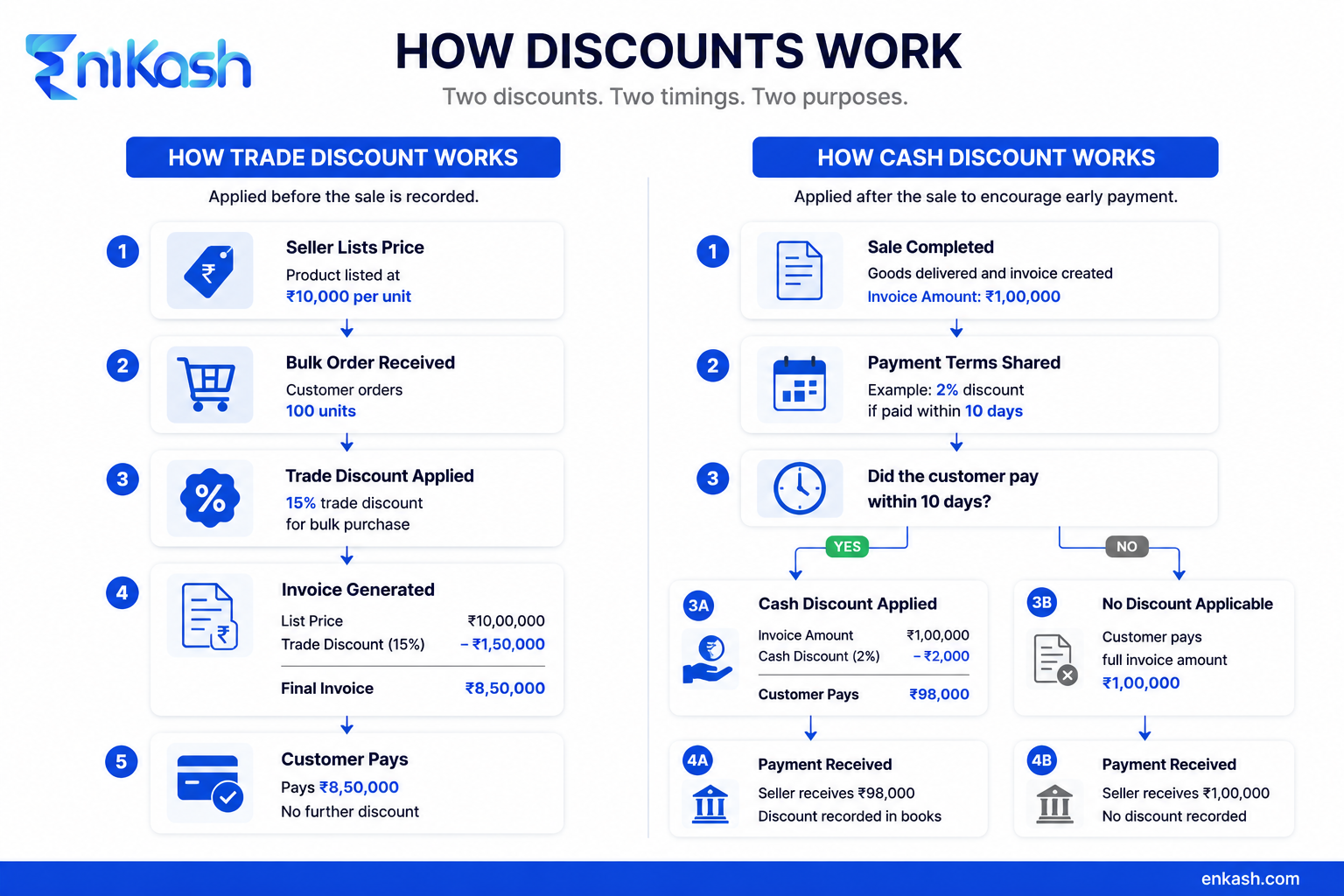
How Trade and Cash Discount Works
Characteristics of Trade Discounts
Trade discounts in accounting don’t appear in the account books and are usually paid at the time of sale. This type of discount is a regular feature in sectors like retail, manufacturing, and distribution. Here are the major charismatics of trade discounts:
- Not Recorded in Financial Accounts: A trade discount is usually an amount you get off your trade, but it doesn’t appear in the books. So, if you’re a trader, you buy something and get a discount, but it doesn’t appear in the books.
- Applied at the Time of Sale: You receive the trade discounts at the time you are ordering, so it will be reflected in the price you pay. The invoice you receive, therefore, will just show this lower price without any detail about the price before the discount or the discount itself.
- No Impact on Payment Terms: If you receive a trade discount, that doesn’t change the way you make the payment. You still have to pay according to the terms that you agreed to.
Examples of Trade Discounts
Suppose you get a trade discount. A wholesaler offers you a discount of 10 per cent on purchases of 100 units or more, and you buy 200 units of a product that costs ₹500 each. You would normally pay ₹1,00,000 (₹500 × 200), but with the 10 per cent discount, you pay only ₹90,000. Trade discounts help strengthen business relationships between a buyer and a seller. Buying in bulk becomes rewarding when you are given a trade discount. If a seller is willing to slice his or her prices by 30% on an order of 25 items, then that’s 30% more business and 30% more profit for the seller, with 30% more money in the buyer’s pocket.
What is a Cash Discount?
A cash discount is a price reduction offered by the seller to encourage the buyer to make an early payment or settle their invoice within a specified period. This discount is aimed at improving cash flow by providing an incentive for buyers to pay promptly. Unlike trade discounts, which are linked to the volume of purchases, cash discounts are tied to the timing of the payment.
Purpose of Cash Discounts
The main function of a cash discount is to encourage customers to pay early, thereby improving the seller’s liquidity and reducing the period that sales go unpaid. For example, they are often used in industries where accounts receivable management is critical to economic activity (such as financial services) by enabling a quick conversion of sales into cash.
Key Characteristics of Cash Discounts
The cash discounts allow the buyer to pay less than what is stated on the invoice. The buyer gets a cheaper product, and the seller saves on price when the buyer pays early. This shared benefit leads to closer and more collaborative financial relationships between the seller and the buyer. Learn about the key characteristics here-
- Time-Sensitive: Buyers can enjoy discounts by paying invoices promptly, like in the term “2/10, net 30” offering a 2% discount within 10 days but full payment is due by day 30.
- Reflected in Financial Accounts: Cash discounts, unlike trade discounts, appear in the books of the company that offers them. As the cash discount reduces the total amount to be paid at the end, the seller records the discount as an expense, and the buyer records it as income.
- Impact on Payment Terms: Cash discounts impact how fast buyers can make payments. When a buyer applies for a cash discount, they have to pay before the early payment date to qualify for a discount; otherwise, they must pay the full amount as listed on the invoice.
Examples of Cash Discounts
Let’s say you receive an invoice for ₹50,000 with the terms ‘2/10, net 30’. That means you can pay ₹49,000 if you pay the bill within 10 days. If you take 10 days or less to pay, you will receive a 2 per cent discount. But if you do not pay in 10 days, you must pay the full ₹50,000, even if you pay before 30 days pass. Another example of this is, suppose a supplier might be willing to give you a 2 per cent discount on a ₹1,00,000 invoice if you’re prepared to pay within 15 days. This would benefit the seller by increasing cash flow and you as a buyer by giving you a genuine discount. A cash discount is a powerful tool for businesses to encourage prompt payments, reduce outstanding account receivables, and improve liquidity. For buyers, it offers the benefit of reducing costs by making early payments.
Differences Between Trade Discount and Cash Discount
| Basis of Comparison | Trade Discount | Cash Discount |
|---|
| Definition | A reduction in the listed price of goods offered by the seller, usually to encourage bulk purchases or maintain trade relationships. | A reduction in the invoice amount offered to customers for making payments within a specified time period. |
| Primary Purpose | To increase sales volume, encourage bulk buying, and strengthen relationships with distributors, wholesalers, and retailers. | To encourage early payments, improve cash flow, and reduce the risk of delayed or bad debts. |
| Who Receives It? | Manufacturers, wholesalers, retailers, or business buyers purchasing goods. | Customers who pay their invoices within the discount period. |
| When Is It Applied? | At the time of purchase, before the invoice is issued. | After the sale, when payment is made within the agreed payment period. |
| Impact on Pricing | Reduces the listed selling price before the transaction is recorded. | Reduces the amount payable on the invoice after the sale has been recorded. |
| Invoice Value | Only the discounted price appears on the invoice. | The original invoice amount is recorded, and the discount is applied only if the customer pays on time. |
| Accounting Treatment | Not recorded separately in the books of accounts; only the net sale value is recorded. | Recorded separately in accounting. For the seller, it is a Discount Allowed (Expense); for the buyer, it is a Discount Received (Income). |
| Effect on Cash Flow | Does not directly impact cash flow as it only influences the selling price. | Improves the seller's cash flow by encouraging quicker payments. |
| Business Objective | Increase sales and market competitiveness. | Improve liquidity and reduce outstanding receivables. |
| Example | A wholesaler offers a 15% trade discount on orders above ₹1,00,000. | A supplier offers 2% off if payment is made within 10 days of the invoice date. |
Although trade discounts and cash discounts are both pricing strategies that offer financial incentives, they serve distinct purposes and are applied differently. Understanding the difference between trade discounts and cash discounts is crucial for businesses in managing pricing, cash flow, and customer relationships.
Advantages of Trade Discounts
A trade discount is an essential pricing structure in business-to-business transactions, offering significant benefits to both sellers and buyers. By providing a discount on the listed price of goods for bulk purchases, sellers encourage larger orders while buyers gain financial savings. This mutually beneficial arrangement helps build long-term relationships and creates a competitive advantage for companies.
Encourages Bulk Purchases
Trade discounts make trade flourish because they encourage big orders from customers. Selling large volumes at a stretch is desirable for manufacturers and wholesalers as it speeds up the stock turnover and sales figures. By offering discounts for bulk purchases, sellers encourage retailers or distributors to buy more even than they want, as it will help them reach revenue targets and maintain proper inventory. Also Read: Bulk Payment Solution
Strengthens Business Relationships
Trade discounts are like friendship boosters that bring sellers and buyers closer together. When sellers offer special prices to loyal or frequent customers, it's a win-win situation. This not only helps sellers build strong connections but also keeps customers coming back for more. Buyers enjoy savings, making them want to stick around and keep the good vibes going.
Competitive Advantage
If you’re selling something in a crowded marketplace, you can stand out from your competitors by offering trade discounts. By offering better prices to buyers who purchase in bulk, you not only get new business but also reward your existing customers. This is important, particularly if your industry is very competitive and price is a major deciding factor for buyers.
Reduces Marketing Costs
By offering trade discounts, companies can boost sales volume without the need for extra marketing efforts. Sellers can depend on these discounts linked to bulk purchases to attract more buyers, reducing the reliance on costly advertising and sales promotions. Ultimately, this strategy helps businesses achieve greater sales and better cost control.
Improves Cash Flow
Trade discounts are great for boosting sales volume and can also give a nice boost to a seller’s cash flow. When there are bigger orders, it means items are moving faster, and this can speed up payments too. So, even with the discount, the increase in sales helps keep cash flow steady. This way, the business can keep investing in production or other important activities. Also Read: Cashflow Analytics
Cost Savings for Buyers
Trade discounts allow price cuts for buyers. As a result, buyers can purchase products at lower prices. They can either increase their profit margin or pass it on to buyers. In either case, trade discounts are essential for retailers to run a business.
Advantages of Cash Discounts
A discount sounds like a good deal, doesn't it? Not only do sellers give cash discounts to motivate buyers to make their payments early, but the early payment also contributes to the seller's cash flow, and there are benefits to both sides. Cash discounts are common in many industries and can have a significant influence on business relationships, financial affairs, and time-savings in the long term.
Improves Cash Flow
A cash discount is a good idea if you want to encourage your customers to pay you earlier, improve your cash flow, and have a better relationship with your customers.
Reduces Outstanding Accounts Receivable
A key advantage of a cash discount is the decrease in outstanding accounts receivable. A cash discount encourages early payment, and thus reduces the number of unpaid invoices in the books. This lowers the risk of bad debts and improves the financial health of the company. Since early payment also reduces administrative costs from chasing up late payments or managing slow payers, it is a win-win for the seller.
Incentive for Prompt Payment
Cash discounts can offer buyers real financial advantages. By paying early, they can save money and potentially avoid future negotiations. It's a straightforward way to get a better deal.
Strengthens Business Relationships
Cash discounts can strengthen business relationships: they show commitment to fair dealing and can increase loyalty among all your buyers. Prompt payments are an absolute necessity for the financial survival and smooth operations of sellers.
Minimizes Credit Risk
Cash discounts can help to minimize the risk involved in selling to customers on credit. Since the risk of bad debts is non-existent in cash transactions, early settlements can contribute to improving a company’s financial standing. This is why firms that practice credit sales would usually offer discounts for prompt payments.
Boosts Operational Efficiency
Cash discounts can help accelerate financial processes and enhance operational efficiency. Early settlements allow for fewer follow-up phone calls and invoice-chasing exercises, which in turn frees up the finance department for more strategic work overall.
Conclusion
In conclusion, both trade discounts and cash discounts play crucial roles in modern business transactions, though they serve different purposes. Trade discounts encourage bulk purchasing and are applied directly to the price of goods or services at the point of sale, providing immediate benefits to buyers who purchase in large quantities.
These discounts are not recorded in financial accounting, simplifying the accounting process for both parties. On the other hand, cash discounts incentivize early payment and are reflected in the accounting records, offering financial advantages to businesses by improving cash flow and reducing the risk of unpaid invoices. For buyers, cash discounts provide the opportunity to reduce overall costs, while for sellers, they minimize the burden of accounts receivable and contribute to healthier liquidity.
Understanding the difference between trade discount and cash discount is essential for effective financial management, as both discount types have unique impacts on pricing strategies, customer relationships, and accounting practices. Businesses that leverage these discounts wisely can enhance their profitability, streamline cash flow, and foster long-term partnerships with customers.
FAQs
Can trade discounts be offered alongside cash discounts?
Yes, both trade discounts and cash discounts can be offered in the same transaction. A seller might first apply a trade discount to incentivize bulk purchasing and then offer a cash discount for early payment. For instance, a buyer could receive a trade discount on a bulk order and still qualify for a cash discount if they settle the invoice early.
Are trade discounts common in retail transactions, or are they only for B2B deals?
Trade discounts are predominantly used in B2B transactions, especially for wholesalers, distributors, and manufacturers. However, large retail chains may occasionally offer trade discounts to their partners or franchisees. In standard retail sales, consumers typically encounter promotional or seasonal discounts, not trade discounts.
How do cash discounts impact customer loyalty?
Cash discounts encourage customers to pay their invoices early, which can lead to stronger financial relationships between buyers and sellers. Buyers benefit from reduced costs, while sellers enjoy better cash flow. This win-win scenario often fosters long-term loyalty, as buyers see financial advantages from adhering to the discount terms.
Are trade discounts ever regulated by industry or legal standards?
While trade discounts are typically determined by the seller's discretion, certain industries may have informal or formal guidelines that dictate standard discount practices. For example, in highly regulated industries like pharmaceuticals or automotive manufacturing, trade discounts may be structured around specific contractual agreements or regulatory constraints to ensure fairness and transparency.
How does a company decide the percentage for trade or cash discounts?
The percentage of both trade discounts and cash discounts is often based on several factors: the seller’s sales strategy, industry practices, competition, and cash flow needs. For trade discounts, the goal is often to clear large inventories or encourage bulk collect. For cash discounts, the seller balances the benefit of receiving early payment with the potential reduction in revenue.
Can trade discounts affect the valuation of inventory on financial statements?
Yes, trade discounts can affect the valuation of inventory, but not directly. Since trade discounts are applied before the purchase is recorded, the discounted price becomes the cost of goods in the buyer’s inventory. This means that the valuation of inventory reflects the actual amount paid (after the discount), not the original listed price, which can impact profit margins when the goods are sold.
What happens if a buyer misses the deadline for a cash discount?
If a buyer misses the deadline for a cash discount, they are typically required to pay the full invoice amount. The discount is only available during the early payment window, so once that period passes, the buyer forfeits the opportunity to reduce their payment. The seller’s financial records would reflect the full invoice amount without any discounts.
Are trade discounts used more during specific times of the year or consistently throughout?
Trade discounts can be offered year-round but are often more prominent during certain periods, such as the end of financial quarters or years when businesses are focused on clearing inventory. Seasonal industries like retail or agriculture may use discount on purchase in trading account during peak production periods to ensure timely sales of products before they lose value or demand decreases.