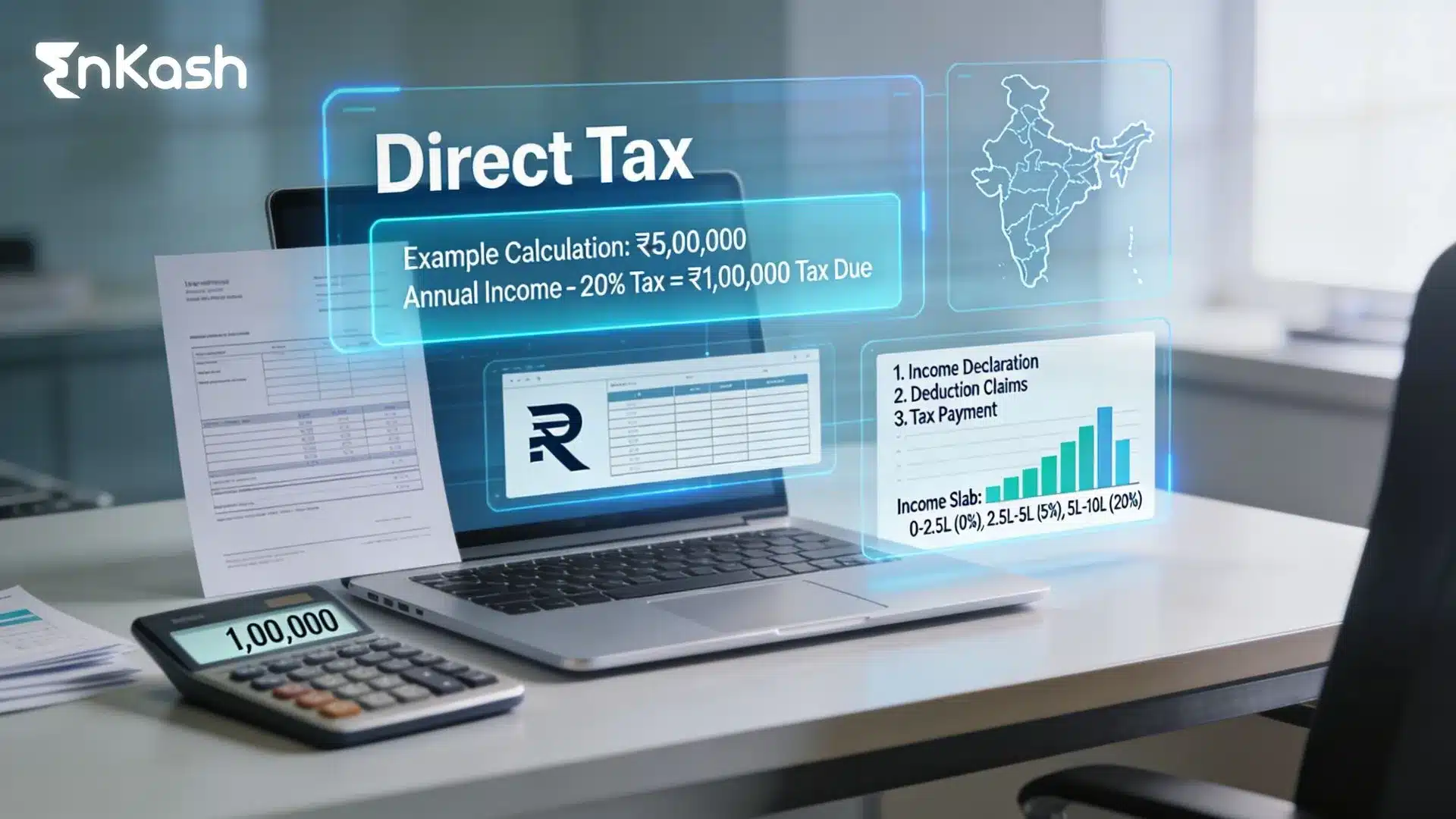
In India, tax computation is governed under the Income Tax Act, 1961, and the effective tax rate reflects the final liability after applying its provisions. It gives a practical reading of the burden after slabs, surcharge, cess, deductions, exemptions, and reporting adjustments have all played their part. For Indian readers, the number becomes useful when personal tax planning, company reporting, and business analysis need a single rate that reflects the final outcome. A simple definition does not answer what most readers need when they search for the ETR full form. They are usually looking for the formula, the step-by-step process, the income statement method, the distinction from the marginal tax rate, and the effect on business analysis. This blog answers these questions one by one.
Effective tax rate calculations are derived from tax liability computed under the Income Tax Act, 1961. The final tax payable includes base tax, surcharge, and health and education cess, as applicable. Corporate tax calculations also depend on the chosen regime under sections such as 115BAA and 115BAB. Official guidance and administration of these provisions are handled by the Central Board of Direct Taxes.
What is an Effective Tax Rate
An effective tax rate is the average rate at which tax is paid on total taxable income or profit. For an individual, it is the total tax liability divided by taxable income. For a company, it is generally read as income tax expense divided by profit before tax. This percentage provides a more complete picture than a slab rate, as it reflects the result after the full tax computation rather than the rate applied to the highest band alone.
In India, the percentage can move away from the headline company rate quite quickly. Domestic companies may fall under base rates such as:
- 25% (for companies with turnover up to prescribed limits under Section 115BA)
- 22% under Section 115BAA
- 15% under Section 115BAB (new manufacturing companies)
- 30% under the normal regime
Depending on turnover conditions or the chosen regime, the final burden can rise after surcharge and the 4% health and education cess.
How the Effective Tax Rate is Calculated
Start With the Right Numerator
The first step is choosing the correct tax figure. For an individual, the numerator is the total tax payable after the computation is complete. For a company, the numerator is the income tax expense for the period. In financial reporting, income tax expense includes current tax and deferred tax, which is why reported tax expense and cash tax paid can differ in the same year.
Identify the Correct Denominator
The denominator must match the tax figure used above it. For an individual, use taxable income. For a company, use profit before tax, which may also appear as profit before tax (PBT), sometimes referred to as earnings before taxes in explanatory material. Many people who calculate effective tax rates often go wrong at this stage by dividing tax by post-tax profit, revenue, or cash receipts rather than by the correct tax base.
The working method is direct. Individual ETR equals total tax divided by taxable income, multiplied by 100. Company ETR equals income tax expense divided by profit before tax, multiplied by 100. This provides the effective tax rate formula with its most accurate practical understanding by focusing on the average burden across total taxable income rather than on the final slab alone.
| Entity Type | ETR Formula |
|---|
| For an Individual | ETR = Total Tax ÷ Taxable Income |
| For a Corporation | ETR = Total Tax ÷ Earnings Before Taxes |
Adjust the Interpretation for India
The percentage still needs context after the arithmetic is done. In India, surcharge, 4% health and education cess, regime choice, exempt income, disallowances, and marginal relief near surcharge thresholds can all alter the final burden. Domestic companies under the normal regime face:
- 7% surcharge (₹1 crore–₹10 crore)
- 12% surcharge (above ₹10 crore)
Example of Effective Tax Rate
A slab-based illustration makes the concept easier to read. Assume the first ₹5 lakh is taxed at 5%, the next ₹10 lakh at 20%, and income above ₹15 lakh at 30%. Person A has a taxable income of ₹15 lakh. Person B has a taxable income of ₹25 lakh. Both taxpayers enter the 30% bracket, though their average burden still differs because only the final slice of income is taxed at the top rate.
For Person A, tax works out to ₹25,000 on the first ₹5 lakh and ₹2,00,000 on the next ₹10 lakh, which gives a total tax of ₹2,25,000. The average rate becomes 15%. For Person B, tax becomes ₹25,000, plus ₹2,00,000, plus ₹3,00,000 on the final ₹10 lakh, which gives ₹5,25,000. The average rate becomes 21%. This tax rate equation highlights the key point neatly: the effective rate captures the average tax burden, while the top bracket applies only to income at the upper end.
This is a simplified illustration and does not reflect current rebate provisions or the revised tax regime slabs applicable in India.
Effective Tax Rate vs Marginal Tax Rate
What the Effective Tax Rate Tells You
The effective rate tells you what share of total taxable income or profit went out as tax after the full computation. It is usually lower than the highest slab or statutory rate because lower bands of income are taxed at lower rates, and company tax expense can shift through reconciliation items such as exempt income, disallowances, or deferred tax adjustments.
What the Marginal Tax Rate Tells You
The marginal tax rate is the rate applied to the next rupee of taxable income. It helps with bonus planning, incremental profit analysis, and transaction decisions where the tax effect on additional income needs to be estimated. In India, the reading becomes sharper near surcharge thresholds because the next rupee can move the taxpayer into a higher combined burden.
Why do the Two Rates Diverge
The two rates diverge because they answer different questions. Progressive slabs create a lower average burden than the top bracket suggests for individuals. For companies, concessional regimes, exempt income, non-deductible expenses, losses, tax credits, and deferred tax can move the reported percentage away from the base rate. A large gap between the two numbers does not automatically signal an error. It usually signals a different analytical lens.
How is Marginal Relief Calculated
People asking how marginal relief is calculated are generally referring to a surcharge threshold. Marginal relief limits the increase at that point. For domestic companies, where total income exceeds ₹1 crore, total tax plus surcharge cannot exceed the tax on ₹1 crore by more than the excess income over ₹1 crore. A similar cap applies at ₹10 crore. This is why effective corporate tax can rise near a trigger without creating an excessive cliff effect.
How to Find the Effective Tax Rate on the Income Statement
Locate Profit Before Tax
Start with profit before tax on the income statement. This line appears above tax expense and represents accounting profit before income tax is deducted. It is the correct denominator when the rate is taken from published financial statements rather than a tax return.
Locate Income Tax Expense
The next step is identifying income tax expenses. Companies may label it as income tax expense, tax expense, or total tax expense. Under Ind IAS 12, that line includes current tax and deferred tax. This figure should be used as the numerator when the purpose is to compute the accounting rate reported for the period.
Divide Tax Expense by Profit Before Tax
Now divide tax expense by profit before tax and multiply by 100. A spreadsheet can function as an effective tax rate calculator, though the arithmetic itself is straightforward. The useful part is selecting the correct lines from the statement and avoiding substitutes such as post-tax profit, revenue, or tax paid in cash during the year.
Read the Tax Reconciliation Note
The face percentage rarely gives the full picture on its own. The reconciliation note explains why the reported number differs from the base rate. It may reflect concessional regimes, exempt items, disallowances, foreign operations, or deferred tax movement in the reporting period. This note is where the analytical value of the number really comes into its own.
How Does the Effective Tax Rate Impact Businesses
Profitability Analysis
A higher or unstable rate reduces post-tax earnings and changes how net margin, earnings quality, and trend lines are read. Analysts track this number because a tax-driven shift can alter earnings even when operating profit remains steady. This is where the effective tax rate for companies becomes a working analytical tool rather than a basic academic ratio.
Cash Flow and Planning
Tax rate movement affects budgeting, quarterly provisioning, dividend capacity, and internal forecasts. In India, the chosen corporate regime can alter the base burden before surcharge and cess are added. A planning model built on pre-tax profit alone can misread the cash consequences of taxation if the applicable regime or threshold position changes during the year.
Pricing, Investment, and Structure
Tax burdens influence project returns, payback periods, entity design, and the timing of deductions or incentives. A business evaluating capex or restructuring options needs a post-tax view of returns. In that setting, effective corporate tax becomes more useful than a headline rate because it reflects the burden that actually reaches the profit line after real-world adjustments.
Investor Reading of the Number
Investors compare the current rate with prior periods, peer companies, and the applicable base regime. A gap can point to incentives, disallowances, losses, deferred tax effects, or non-recurring items. The number is useful, though it should never be read in isolation from the tax note and the broader profit profile of the business.
Common Mistakes When Calculating Effective Tax Rate
- Using tax paid instead of tax expense for companies. Reported tax expense includes current tax and deferred tax, which is the correct figure for income statement analysis.
- Using post-tax profit instead of profit before tax. This distorts the percentage and produces a misleading average burden.
- Ignoring surcharge and cess in Indian calculations. A base rate alone does not reflect the final burden.
- Confusing the effective tax rate with the marginal tax rate. The two percentages answer different tax questions.
- Missing deferred tax adjustments in the company analysis. These can materially change the reported rate for a period.
- Treating a one-year figure as a stable trend without checking reconciliation notes, incentives, exemptions, losses, or non-deductible expenses.
- Mixing tax return logic with financial statement logic. The calculation base can differ depending on the purpose.
When Effective Tax Rate Can Be Misleading
An effective tax rate may not always reflect the long-term tax burden. One-time deferred tax adjustments, exceptional income, or tax credits can distort the percentage for a single year. Analysts, therefore, compare multi-year trends rather than relying on one reporting period.
Conclusion
An effective tax rate gives the most accurate view of how much income or profit is actually absorbed by tax after the full computation is completed. It pulls together slab impact, surcharge, cess, deductions, exemptions, deferred tax, and reporting adjustments into one number that can be used with confidence. For individuals, the right approach is to divide total tax by taxable income and check how the average burden differs from the marginal rate. For businesses, effective corporate tax becomes useful only when it is read alongside profit before tax, tax expense, reconciliation notes, and the applicable regime. The most useful takeaway is to accurately calculate the percentage, compare it with the income statement, study threshold effects such as marginal relief, and then apply it to planning, forecasting, pricing, and capital allocation.
FAQs
What is the ETR full form in tax?ETR stands for effective tax rate. It refers to the average rate at which tax is paid on taxable income or profit after all computations are completed.
How to calculate the effective tax rate for an individual?Divide the total tax liability by taxable income and multiply by 100. The result shows the average burden across the full taxable base rather than the rate applied only to the highest slab.
How to calculate the effective tax rate for a company?Divide income tax expense by profit before tax and multiply by 100. In financial reporting, income tax expense includes current tax and deferred tax for the period.
Why is the effective tax rate lower than the marginal tax rate?The effective tax rate is usually lower because income is taxed at multiple levels. The highest rate applies only to the last portion of taxable income, while earlier portions are taxed at lower rates. As a result, the overall average burden remains below the top marginal rate.
How to find an effective tax rate on an income statement?To find an effective tax rate on an income statement, start with profit before tax and then locate income tax expense for the same period. Divide tax expense by profit before tax and multiply by 100. After that, read the tax note to understand why the reported percentage differs from the headline rate.
What changes the effective tax rate for companies in India?The effective tax rate for companies in India can shift due to regime selection, surcharge, the 4% health and education cess, exempt income, non-deductible expenses, deferred tax adjustments, tax incentives, and one-time reconciliation items. A company’s reported rate may therefore differ materially from its base corporate tax rate.
Is the effective tax rate the same as the statutory tax rate?The effective tax rate and the statutory tax rate are different measures. The statutory rate is the legal rate set under the applicable tax law or chosen regime. The effective rate reflects the average burden after applying deductions, exemptions, surcharges, cess, and financial reporting adjustments.
How is marginal relief calculated when a surcharge applies?Marginal relief is calculated by checking whether the additional tax caused by the surcharge is higher than the additional income earned above the surcharge threshold. If the tax increase is excessive, relief is given to reduce the burden. This prevents a sharp jump in tax immediately after crossing the limit.
What is a useful benchmark for the effective tax rate for companies?A useful benchmark for a company’s effective tax rate comes from four places: the applicable statutory regime, the company’s own historical rate, peer-company trends, and the tax reconciliation note in the financial statements. A single percentage without context does not support a reliable analytical conclusion.
Can the effective tax rate be negative?A negative effective tax rate can appear in a reporting period when tax income is recognized instead of tax expense. This can occur due to deferred tax benefits, tax credits, recognition of losses, or reversals of earlier tax provisions. The tax note is needed to properly understand the reason.