Key Takeaways
- Connected bank access can bring balances, payment initiation, transaction status, and bank records into business software.
- Existing current accounts can remain the funding source when direct account-based payouts are supported.
- Prefunded payout arrangements require businesses to transfer money into a designated funding account or balance before payouts are processed. The location of funds and applicable controls depend on the provider's operating model.
- Payment automation still needs user permissions, approval limits, and bank authorization controls.
- Reconciliation improves when payment references and bank records return to the same business system.
- Provider evaluation should begin with banking coverage, available functions, and operating support.
Multiple bank relationships can create a wide banking footprint without giving the finance team one clear view of balances and transactions. Finance teams often switch between banking portals to check balances, release payments, verify transactions and download statements. Connected banking brings selected bank services into the software where finance teams manage payables and cash positions.
What Are Connected Banking APIs?
Payment initiation is only one part of the connection. Connected banking enables business software to access selected banking services through integrations supported by participating banks, subject to the required account permissions and authorisation procedures.
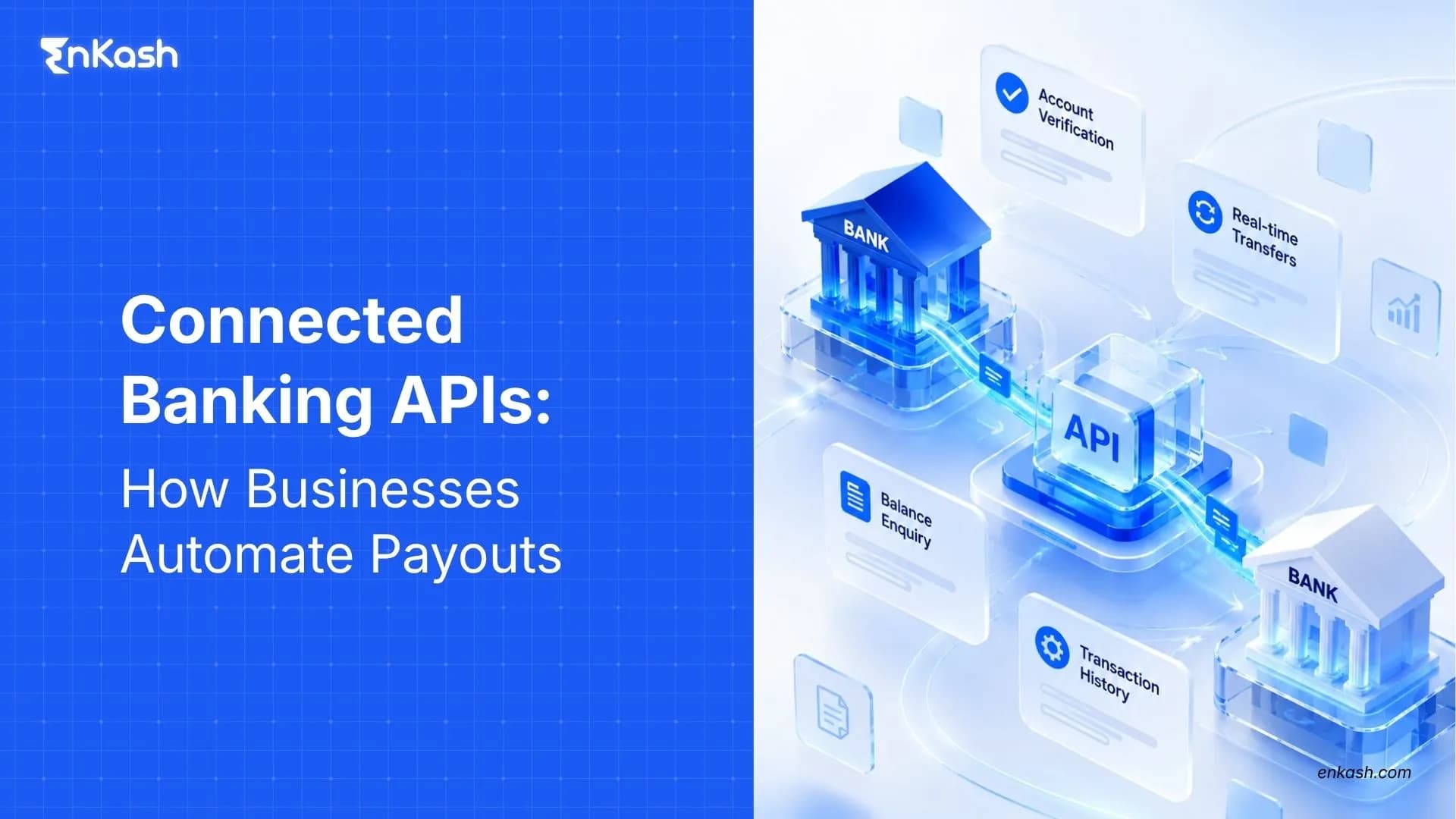
Depending on the available integration, the business application may retrieve account balances, obtain transaction records, initiate eligible payments, check transfer status, or pull bank statements. A connected banking API provides the software connection used for a supported banking function. The wider connected environment can combine several such functions around the same bank relationship.
A payout API primarily supports outgoing payment instructions, while connected banking can also provide account information and transaction records. It focuses on sending money, while the wider connection can also cover account information and post-payment records. Businesses may access supported banking services through direct bank APIs or technology platforms operating under arrangements with participating banks. The services available depend on the bank, account, and integration model
How Are Existing Business Bank Accounts Connected?
Entering account details into finance software does not create a live banking connection. The banking relationship has to support the service, and the business must authorize the access.
“Before linking an account, businesses should verify bank support, complete the required authorisation, and configure access permissions:
Eligible Banking Relationships
Confirm that the bank and account support the required APIs, including balance enquiries, payments and transaction reporting. API availability and transaction permissions can differ across banks, account types and corporate banking arrangements.
Account Authorisation and Bank Approval
The business must authorise account access through the participating bank's prescribed process. Depending on the arrangement, authorised signatories or administrators may need to approve API access, permissions and payment services. Registration, consent, and bank-side approval can be required before access becomes active.
Account Access and Permissions
A linked account may allow balance viewing without allowing payment initiation. Some integrations provide read-only access, while others permit payment initiation. Final release may remain subject to separate approvals or bank-side authorisation. Businesses should confirm which functions are enabled before considering the bank integration operational.
How Do Direct Bank Account Payouts Differ From Prefunded Payouts?
The main difference between direct and prefunded payouts is where the funds are held before the payment is processed. Connected banking can support direct payment from an eligible linked current account, while another payout setup may require money to be moved into a funded balance first.
| Comparison | Direct Bank Account Payout | Prefunded Payout Arrangement |
|---|
| Source of funds | Eligible linked business bank account | Previously funded payout balance |
| Before payment | Banking access and permissions must be active | Funds must be available in the payout balance |
| Cash position | Funds remain in the business's originating bank account until the bank processes the applicable debit. | Funds are transferred in advance to the designated funding account or balance under the provider's arrangement. |
| Operating dependency | Linked bank access and service availability | Available funded balance and payout service |
Both models require appropriate payment approvals, balance checks, transaction limits, and reconciliation controls. Their legal and operating structure depends on the arrangement being used.
How Do Linked Bank Accounts Automate Business Payouts?
Once the integration is active, authorised users or configured workflows can initiate eligible payouts from the connected business system. The payment instruction can be generated from an approved invoice or payable without entering the same details again in internet banking.
A connected banking payout typically follows these stages:
- Approve the Payment: A vendor invoice, partner settlement, reimbursement, or another obligation reaches the approved payment stage.
- An eligible funding account is assigned: The system associates the instruction with a connected account under the company's funding rules.
- Submit the Payment Instruction: Required beneficiary and transaction information travels through the approved banking connection.
- The bank receives the payment instruction: The connected bank then applies its own processing and authorization requirements.
- The transaction result comes back to the business: The application receives the available status or outcome information.
- Update the Payment Record: Where the integration preserves suitable payment references, the returned transaction information can be matched with the original payable for tracking and reconciliation.
A banking payouts API can support the payment leg within this flow. Payment initiation should remain separate from confirmed completion because an accepted instruction may still be processing.
Which Payment Methods Can Connected Banking Support in India?
Connected banking payout arrangements can support different domestic payment methods depending on the bank, beneficiary information, and enabled services.
| Payment method | Typical business use | Important considerations |
|---|
| UPI | Eligible vendor payments, reimbursements and smaller business transfers | UPI support, transaction limits and eligible recipient identifiers depend on the bank and use case |
| IMPS | Time-sensitive domestic payouts | Bank limits, beneficiary validation and account permissions apply |
| NEFT | Supplier payments, scheduled transfers and routine business payouts | Transfers use the NEFT settlement framework; banks may apply operating controls |
| RTGS | High-value business and treasury payments | Minimum ₹2 lakh per transaction, with applicable bank authorisation and transaction controls |
| Internal bank transfer | Transfers between eligible accounts at the same bank | Availability, limits and processing depend on the bank |
How Do Businesses Select Funding Accounts for Payouts
Businesses using multiple current accounts need clear rules for selecting the account from which each payment will be made.
Several factors can guide the decision:
Available Account Balances
The selected account must have sufficient available funds at execution, taking into account pending debits, holds, and other applicable restrictions. Bank balances can change between the balance enquiry and actual payment execution.
Payment Eligibility and Limits
Account permissions, payment types, transaction ceilings, and bank-specific restrictions can limit which account can support a particular instruction.
Internal Funding Policies
Treasury teams may assign certain expenses or business units to designated accounts. Vendor payments, payroll-related transfers, or branch expenses can follow separate source-account rules where the company requires that separation.
Rules-Based Account Selection
Where supported, connected banking platforms can select an originating account using predefined rules based on available funds, bank eligibility, transaction limits, or business-unit requirements. Balance conditions, entity mapping, payment category, or another approved criterion can guide the selection without requiring an operator to make the same decision repeatedly.
How Are Payout Permissions and Authorizations Controlled
Payment automation must preserve role-based access and approval controls so that only authorised users can initiate or release transactions. The connected setup works within the access rules established across the business system and the bank relationship.
Businesses should separate the following responsibilities:
- Authorized access should follow defined user roles. Only permitted employees should be able to use the banking functions assigned to them.
- Payment preparation and release can have separate owners. Different employees can handle these responsibilities where the control model requires separation.
- Transaction limits can restrict payment authority. User or account permissions can cap the value that may be initiated or approved.
- Bank authorization may add another release step. Additional confirmation can be required before a transaction moves for processing.
- Audit logs should identify who created, approved, modified, and released each payment instruction. Initiation and approval records should identify who performed the relevant action.
It does not remove the approval responsibilities that apply to the movement of company funds.
How Does Bank Connectivity Support Payment Reconciliation?
Finance teams need the final payment status and corresponding bank transaction record to close a payable accurately. Without automated bank feeds, finance teams may need to download statements and manually match transactions with ledger entries. A connected setup can bring bank transaction information back into the accounting workflow.
Retrieve Bank Transaction Records
Supported services can provide account statements, transaction details, balances, or payment-status information to the business system.
Match Payments With Business Entries
Transaction references, amounts, dates, and account identifiers give the system fields that can be compared with invoices, settlements, or other payable records.
Identify Unmatched Transactions
A bank debit may lack a matching ledger entry, while an internal payment can remain open without a related bank transaction. Unmatched transactions should be flagged for investigation, with their status, age, and assigned owner recorded.
Record the Reconciled Outcome
Where accounting integration is supported, verified transaction matches can update or close the related payable. Unmatched entries, reversals, and timing differences must remain available for investigation. Reconciliation is more reliable when the original payable, payment instruction, and bank transaction can be matched using consistent references.
What Is Required to Integrate Connected Banking APIs?
Integrating connected banking APIs requires more than activating access to a bank account. Businesses must ensure that payment instructions, account information, transaction statuses, and security controls work reliably with their existing finance systems.
The exact requirements vary by bank and integration provider, but the following components should be evaluated before going live.
| Component | What Businesses Should Verify |
|---|
| API Access and Authentication | Confirm supported bank APIs, required credentials, authentication methods, account permissions and access restrictions. |
| Beneficiary Management | Check the required beneficiary details, registration or validation processes, and supported payment methods. |
| Payment Initiation | Verify mandatory transaction fields, payment limits, approval requirements, and how payment instructions are submitted to the bank. |
| Transaction References and Duplicate Prevention | Maintain unique payment references and implement supported idempotency or duplicate-detection controls to prevent repeated payment instructions. |
| Payment Status Tracking | Confirm how the integration reports successful, failed, pending, and reversed transactions. Establish how uncertain payment statuses will be verified before retrying. |
| Bank Data and Reconciliation | Check the availability of account balances, transaction records, bank statements, and references needed to match payments with accounting entries. |
| Testing and Production Readiness | Test invalid requests, permission failures, duplicate instructions, timeouts and status updates. Confirm production credentials, monitoring, escalation and recovery procedures before launch. |
The integration must follow the participating bank's technical specifications and authorisation requirements. Not every connected banking provider offers the same APIs, payment methods or account-level permissions.
What Should Businesses Consider Before Choosing a Banking Connectivity Provider
A provider may support multiple banks without offering the same functions across every account. The real test comes from everyday banking work. One bank may support payment initiation, another may expose statements only, and a third may require a different operating arrangement. Compare total costs, including platform fees, bank charges, API usage, implementation, and ongoing support.
The provider assessment should reflect how the company actually banks and who will keep the connection working after launch.
Coverage Across Existing Bank Relationships
Finance should map its current accounts before comparing providers. Coverage matters at account level because a supported bank name does not automatically mean every required service is available. Balance access, transaction records, statements, payment initiation, and payment-status enquiries should be checked against the specific accounts the business expects to connect.
Ownership After the Connection Goes Live
Bank connectivity continues to need internal ownership after implementation. Someone has to coordinate technical changes, investigate connection problems, manage bank-side updates, and work with finance when expected data stops arriving. A company using several banks may also need clear responsibility for keeping permissions and integrations current across those relationships.
Cost and Service Conditions
Commercial review should include platform pricing, bank charges, transaction fees, implementation work, and ongoing support costs. Service terms need equal scrutiny because routine banking work can be affected by maintenance windows, outages, delayed responses, or account-specific limitations. Escalation channels and incident support should be understood before the connection becomes part of daily finance operations.
The right provider should support the banking relationships and operating workload the company actually has, without creating extra manual work elsewhere.
How EnKash Connected Banking Simplifies Business Payouts
EnKash Connected Banking allows businesses to connect supported existing bank accounts and initiate eligible payouts directly from those accounts, without first loading funds into a separate wallet.
Instead of managing payouts across multiple banking portals, finance teams can work through a connected platform with greater visibility into balances, outgoing payments, and transaction status.
Pay Directly From Existing Bank Accounts
Initiate eligible business payouts from supported linked bank accounts while keeping funds in the originating account until the payment is processed.
Connect Multiple Banking Relationships
Bring supported current accounts from different banks into a common view to improve cash visibility and payment management.
Use Supported Payment Rails
Initiate eligible payouts through payment methods such as UPI, IMPS, NEFT and RTGS, depending on the connected bank and account configuration.
Route Payments Using Defined Rules
Where supported, apply account-selection rules based on factors such as available balance, banking eligibility, and payment requirements.
Track and Reconcile Transactions
Access available transaction-status information and reconciliation records to help finance teams match completed payouts with their original payment instructions.
The supported banks, transaction limits, approval requirements, payment methods, and integration capabilities vary by arrangement.
Explore EnKash Connected Banking
Making Business Payouts More Efficient
Connected Banking is useful when a business wants bank activity to move closer to the systems where finance manages payables, cash, and accounting records. The connection works best when account access, funding rules, payment authority, and reconciliation responsibilities are defined before automation begins. A well-designed setup can reduce fragmented banking work while keeping the underlying bank accounts, permissions, and financial controls visible.
FAQs
Is Connected Banking Safe for Business Payments?
Connected banking can support secure business payments when the integration uses bank-approved authentication, restricted access, encrypted communication and appropriate transaction controls. A user checking balances does not need the same rights as someone releasing payments. Authentication, permissions, transaction limits, encrypted communication, and bank-side controls should reflect those roles.
Is Connected Banking the Same as a Payout API?
No. A payout API primarily enables businesses to initiate outgoing payments programmatically. Connected banking can provide broader access to supported bank-account functions, including balances, statements, payment initiation, and transaction information.
A connected banking platform may include payout APIs, but not every payout API uses the same funding arrangement. Some require prefunding, while others support direct payments from eligible linked bank accounts.
Can Connected Banking Initiate Payments Without Moving Money Into a Wallet?
Yes, where direct account-funded payouts are supported. The business can initiate eligible payments through its connected banking arrangement while funds remain in its existing bank account until the bank processes the debit.
Payment initiation remains subject to bank permissions, corporate approvals, transaction limits, and the available account balance.
Does Linking a Bank Account Move the Funds Elsewhere?
Linking an account normally leaves the money where it is, inside the business bank account. The connection gives approved software access to selected banking functions. Linking the account does not itself transfer funds to the connected platform. Payments initiated through the connection debit the originating account only when processed under the bank's applicable authorisation rules.
Can a Business Connect Several Bank Accounts?
A company may connect several eligible accounts when its banking setup supports them. Payroll could run from one account and vendor payments from another, for example. Each connection can retain separate limits, permissions, balances, and operating rules.
Does Connected Banking Require Internet Banking Passwords?
Internet banking passwords should not be passed around as a substitute for integration access. Authorized connections can use bank-approved authentication, consent, credentials, or other access mechanisms. The method depends on the bank and the connection being established.
Connected Banking can support read-only roles where the setup permits them. An employee who needs account information can work with balances, statements, and transaction history, while payment creation and approval remain unavailable to that user.
What Happens When a Connected Bank Service Stops Working?
Loss of connectivity can create a gap between what has happened at the bank and what the connected system shows. Recent transactions or balances may therefore be missing. Payment requests can also pause. If connectivity fails, finance should check available bank records or transaction-status services before retrying an uncertain payment. Unconfirmed instructions should remain under investigation until their final status is established.
How Current Is the Balance Shown Through Connected Banking?
Treat the displayed balance as the latest figure returned by the bank connection at that point in time. A later debit, incoming credit, hold, charge, or processing event can change the amount available before payment execution.
Can Connected Banking Reduce Reconciliation Work?
It can remove much of the routine statement handling when bank transactions reach the accounting system with usable references. Month-end work does not disappear, because reversals, timing differences, missing references, and unmatched entries can still need manual review.
Does Connected Banking Replace Corporate Internet Banking?
No. Connected banking can reduce reliance on corporate internet banking, but certain administrative activities, approvals, and exceptions may still require the bank's own channels. Finance can handle supported balances, transactions, and payments from its business system, then use internet banking for administrative tasks or exceptions that fall outside the connected permissions.
Can Connected Banking Work With Existing Accounting Software?
Yes, where a supported connector, API or middleware integration allows banking information and payment records to be exchanged with the accounting system. A native connector may be enough for some platforms. Other systems require middleware or custom development before bank data and payment instructions can pass between them.