Business payments in India are no longer low-volume, back-office transactions. Digital payments have become central to how many businesses collect, pay, refund, settle, and reconcile money. UPI alone crossed ₹314 lakh crore in transaction value in FY 2025-26, showing how quickly payment volumes are growing across the economy.
For businesses, this growth creates a new operational problem. Revenue may rise, customer orders may increase, and vendor networks may expand, but the payment process behind them often remains the same. A small finance team still checks bank statements, downloads gateway reports, follows up on failed payments, approves payouts over messages, and closes open items through spreadsheets.
Then transaction volume starts growing faster than the process behind it.
After a point, payments are no longer just money coming in and going out. Every transaction carries context: customer details, invoice numbers, order IDs, approval history, settlement timelines, bank references, refunds, charges, disputes, and accounting entries. When that context is scattered across systems and people, scale starts exposing gaps.
Why the First 100 Transactions Are Easier
The first 100 transactions are usually easier because the business still has a narrow operating surface. There are fewer customers, fewer vendors, fewer internal teams, fewer payment modes, and fewer exceptions to manage. At this stage, payment operations are often people-led.
A founder may personally know which customer has paid. A finance manager may remember which vendor invoice is pending. A sales or operations team member may follow up directly when a payment fails. A refund may be handled by checking the payment gateway dashboard, confirming the amount, and updating a sheet.
The process may not be perfect, but the volume is small enough for people to hold the system together.
At this stage, the business is usually running on memory, relationships, and direct ownership.
- Fewer payment sources: Most transactions come through one or two channels.
- Limited exceptions: Failed payments, refunds, disputes, and duplicate payments are still manageable.
- Direct approvals: Decision-makers are close to the transaction.
- Manual reconciliation still works: Bank entries, invoices, and payment reports can be matched with effort.
- Lower internal dependency: Fewer teams need payment updates.
- Context is easy to remember: Teams still know who paid, who approved, and what needs action.
This is why many early payment processes survive longer than they should. They do not fail immediately because the business is still small enough to absorb the inefficiency.
But this stage can also create a false sense of readiness. The business may assume its payment process is working well, when in reality it is working only because transaction volume is low and a few people are manually filling the gaps.
The real test begins when the same team, same spreadsheet, same approval habit, and same reconciliation method are expected to manage ten times the volume.
Across D2C, SaaS, education, travel, and marketplace businesses, one pattern is common: teams that manage early payment operations smoothly often delay building structure around them.
What Are Payment Operations?
Payment operations are the processes a business uses to manage how money moves across the company. This includes customer collections, vendor payouts, refunds, settlements, employee spends, approval workflows, reconciliation, reporting, and accounting records.
Payment operations begin where a basic payment transaction ends.
A payment may be processed successfully, but the business still needs to know what the payment belongs to, who approved it, whether it settled, whether any charges were deducted, whether a refund is linked to it, and whether the record is ready for accounting.
This is where payment operations become different from payment processing.
Payment processing is the act of moving money from one account or payment method to another. It confirms whether a transaction was successful, failed, pending, or refunded.
Payment operations look at the full business context around that transaction.
For example, a customer may pay ₹25,000 for an order. Payment processing confirms that the transaction succeeded. Payment operations check whether the payment is mapped to the right order, whether the settlement has reached the bank, whether gateway charges were deducted correctly, whether the invoice is updated, and whether finance can reconcile the entry later.
The difference becomes important as transaction volume grows. A business can process payments quickly and still struggle with payment operations if records, approvals, settlements, refunds, and reports remain scattered across systems and teams.
At scale, the question is not only whether money moved. The question is whether the business can see it, trace it, approve it, reconcile it, and explain it.
What Changes As Payment Volume Grows
The jump from 100 to 1,000 transactions is not only a volume jump. It is an operating model change.
You are no longer dealing with one payment flow. Money starts moving across customer collections, vendor payouts, refunds, employee reimbursements, utility payments, subscriptions, marketplace settlements, and branch-level expenses. Each payment now needs more context.
A customer payment has to match an order. A vendor payout has to match an invoice. A refund has to match the original transaction. A settlement has to match the amount received after charges. An employee spend has to match policy, approval, and purpose.
So your finance team stops asking only one question: did the money move?
They now need to know whether the right amount moved, whether it reached the right person, whether it was approved, whether it settled, whether any charge was deducted, whether a refund is linked to it, and whether the record can be traced later.
| Area | At 100 Transactions | At 1,000+ Transactions |
|---|
| Payment tracking | Manual checks work | Status gaps increase |
| Approvals | Informal approval works | Approval trail becomes important |
| Reconciliation | Spreadsheet matching works | Missing references delay closure |
| Refunds | Handled case by case | Support and finance need linked records |
| Settlements | Checked manually | Settlement visibility affects cash planning |
| Reporting | Basic reports are enough | Leadership needs usable payment data |
Your sales team wants instant payment confirmation. Your operations team wants vendor payments cleared on time. Your support team wants refund updates. Your finance team wants clean records. Your leadership team wants to know how much money is actually available.
The same payment means different things to different teams.
For sales, it confirms revenue. For operations, it moves work forward. For finance, it has to reconcile. For leadership, it affects cash planning.
At this stage, old habits start getting stretched. Teams still use spreadsheets. They still check bank portals. They still download reports. They still approve payments on messages. But now the number of open items keeps increasing.
One missed update becomes five follow-ups. One unclear payment status becomes a support ticket. One delayed settlement creates a cash planning gap.
For example, a D2C business processing 1,200 monthly transactions may receive payments through UPI, cards, wallets, and payment links. The payment gateway marks 1,150 transactions successful, 30 failed, and 20 pending. At the same time, the bank statement shows settlement credits after gateway charges, refunds are handled separately, and the support team is tracking customer complaints in a different sheet.
On paper, the business has collected revenue. In practice, finance still needs to match transaction IDs, order IDs, refund status, settlement amounts, gateway fees, and bank entries before it knows how much money is actually available. This is where payment operations start breaking. This is the stage where payment operations need more than effort. They need structure.
What Starts Breaking After 1,000 Transactions a Month
After 1,000 transactions a month, payment problems rarely appear as one big failure. They show up as small issues every day.
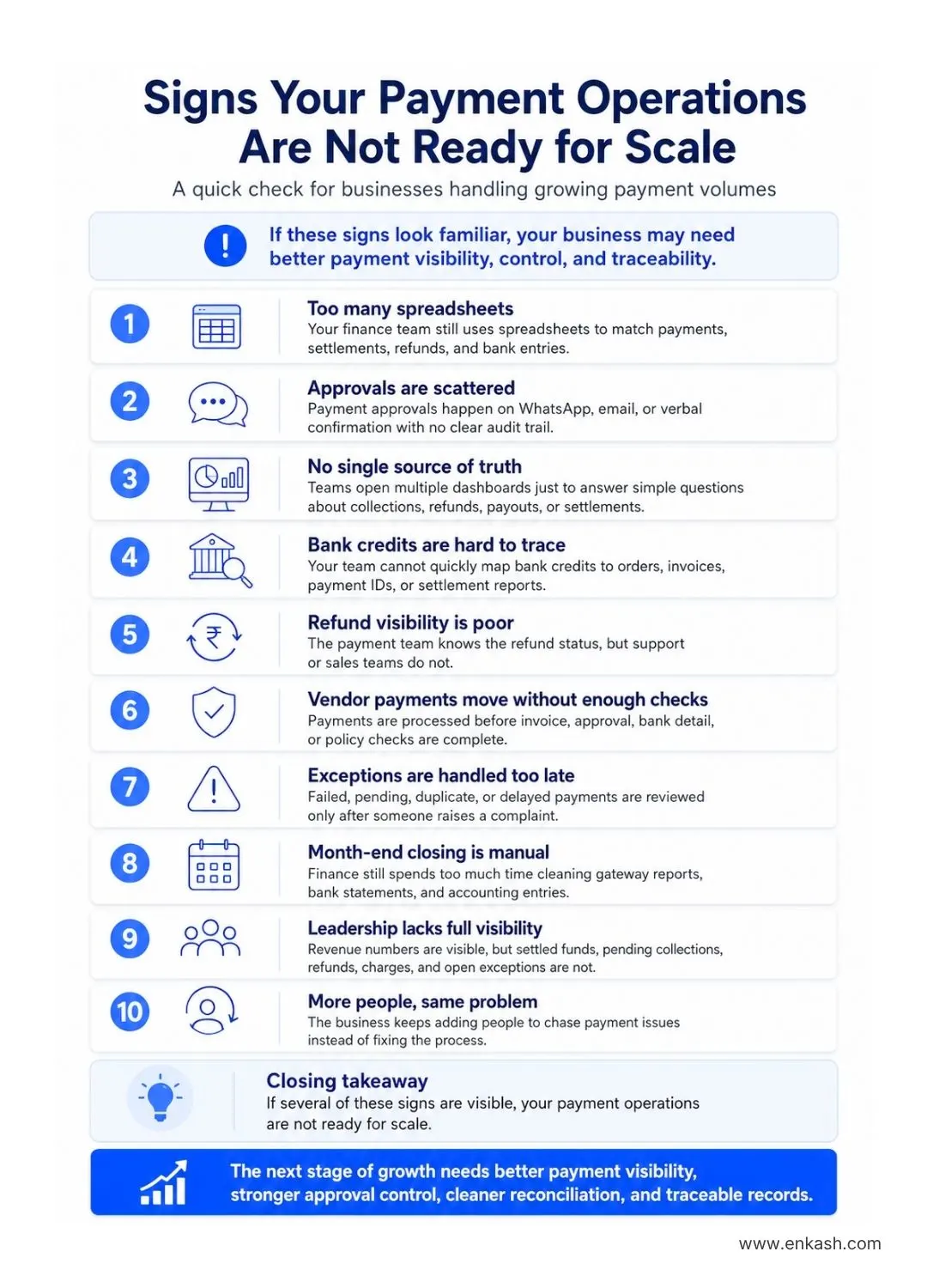
A failed payment. A delayed settlement. A refund stuck for too long. A vendor payment marked as done, but not easy to trace. A customer saying they paid, while your system shows pending. A finance team spending hours matching reports before closing the month.
None of this looks dramatic at first. But it slows the business down.
Visibility Becomes Scattered
Your payment data now lives in too many places. Bank portals, payment gateway dashboards, ERP systems, accounting software, spreadsheets, emails, and internal chats all carry different parts of the same payment story.
One system shows success. Another still shows pending. The bank statement shows the amount, but the order reference is missing. The settlement report shows a deduction, but the invoice record has not been updated. So your team knows money moved. But they do not always know the full story.
They struggle to answer basic questions quickly. How much did we collect today? How much has settled? Which payments failed? Which refunds are still open? Which vendor payouts are pending? Which settlements are delayed? When these answers need manual checking every time, visibility has already broken.
Approvals Become Harder to Control
At low volume, a quick approval message works. At scale, it creates risk. Someone approves the same invoice twice. Someone processes a payment without checking policy. Someone uses old vendor bank details. Someone marks a payment urgent and skips the normal process. This creates two problems.
Payments either slow down because everyone is chasing approvals, or they move too fast without enough checks. Both create risk. You need speed, but you also need control. Without a structured approval process, your finance team spends more time asking “who approved this?” than actually managing payments.
Reconciliation Becomes Heavier
At 100 transactions, your team can match payments manually. At 1,000+ transactions, that becomes painful.
Now every payment may have a payment ID, order ID, invoice number, UTR, settlement amount, gateway charge, refund status, customer or vendor name, bank entry, and accounting entry.
One missing reference can delay closure. One wrong entry can affect reports. One unsettled transaction can create confusion across sales, support, and finance.
Exceptions Eat Up Team Time
As volume grows, exceptions grow too. You will see more failed payments, duplicate payments, partial payments, delayed settlements, refund delays, status mismatches, vendor follow-ups, customer complaints, and disputes. Each case needs someone to investigate.
Your team checks reports, traces payment IDs, coordinates with another team, updates a sheet, replies to a customer, or follows up with a vendor. This is how hidden workload builds up. You may have automated the payment, but if exceptions are still handled manually, your team is still doing the hard part by hand.
Cash Flow Planning Becomes Less Reliable
At 100 transactions, your finance team can estimate collections and payouts manually. At 1,000+ transactions, guesswork creates problems.
You need to know what has been collected, what has settled, what is pending, what is stuck, what needs to be refunded, what vendor payouts are due, what charges were deducted, and what amount is actually available. This matters because payment delays do not stay inside finance. They affect vendor relationships. They affect refunds. They affect inventory planning. They affect salary cycles. They affect growth decisions.
Payment Data Becomes as Important as Payment Status
At low volume, payment status is enough. Successful, failed, pending, and refunded are useful labels when teams are closing individual transactions. At scale, status is only the starting point.
A failed payment can point to a checkout issue, a payment mode issue, a customer behaviour pattern, or a system delay. A refund can reveal gaps in fulfilment, pricing, product expectations, or communication. A delayed vendor payout can affect supply, service delivery, and trust. This is why finance teams need more than transaction records. They need payment intelligence.
At low volume, finance records what happened. At scale, finance has to explain what is happening. What is stuck? What is delayed? Where are exceptions increasing? Which teams need tighter controls? Which payment modes are creating friction?
A basic payment setup tells you whether a transaction succeeded. A stronger payment operations setup tells you why payments fail, where delays happen, what creates workload, and which patterns need action.
The Payment Operations Framework: Visibility, Control, and Traceability
Scalable payment operations need three capabilities: visibility, control, and traceability.
Visibility means your team can see what is happening across collections, payouts, refunds, settlements, and spends without opening multiple systems for one answer. If money has moved, your team should know its status, context, and next step.
Control means payments follow a clear process. Your business should know who requested a payment, who approved it, whether it followed policy, and whether the right vendor, account, or purpose was selected.
Traceability means every payment can be explained later. Your team should be able to connect the payment with the order, invoice, UTR, settlement amount, refund record, charges, bank entry, and accounting record.
These three capabilities matter because scale reduces the room for informal working. A missed update creates follow-ups. A missing payment reference delays reconciliation. An unclear approval becomes an audit risk.
Your payment operations should help you answer three questions quickly.
- Can we see the money?
- Can we trace the money?
- Can we explain the money?
If the answer is yes, your business has control. If the answer depends on a person, a spreadsheet, or a manual follow-up, the process still has risk.
Scalable payment operations are not only about faster transactions. They are about fewer gaps, fewer surprises, and fewer manual checks as the business grows.
Why Businesses Need To Fix Payment Operations Before The Next Stage of Growth
Many businesses try to fix payment problems only after they become visible. That is usually too late.
By then, your finance team is already spending time on manual reconciliation. Your operations team is already chasing payment status. Your support team is already answering refund queries. Your leadership team is already asking why cash visibility is not clear despite growing revenue.
The problem does not start at 1,000 transactions. It only becomes easier to see there. Most gaps begin much earlier. A missing approval trail. A manual settlement check. A refund updated in one sheet but not another. A vendor payout done from a bank portal without enough context. A payment report downloaded every week and cleaned manually before anyone can use it.
At low volume, these gaps feel manageable. At scale, they become repeat work. This is why payment operations need to be treated as part of business infrastructure. The same way companies invest in CRM for sales, HRMS for people operations, and ERP for accounting, they also need a more structured way to manage how money moves across the business. Because payments touch almost every part of the company.
A customer payment affects sales, delivery, accounting, and support.
A vendor payout affects operations, supply, and finance.
An employee spend affects policy, approval, reimbursement, and reporting.
A refund affects customer trust, cash flow, and reconciliation.
When payment operations are weak, every team feels it in a different way.
The finance team feels it is manual work. The operations team feels it is a delay. The support team feels it as customer pressure. The leadership team feels it is poor visibility.
Fixing this does not mean adding more people to chase more payments. It means reducing the number of things that need chasing in the first place.
The real question is not whether your business can process 1,000 transactions, but whether it can process, track, approve, reconcile, settle, refund, and report those transactions without constant manual effort.
How EnKash Supports Business Payments at Scale
As transaction volume grows, merchants need more than separate tools for collections, payouts, spends, approvals, settlements, and reports. They need payment operations that connect these workflows with less manual effort.
EnKash supports merchants across key payment workflows such as customer collections, business spends, settlement visibility, expense controls, and reporting.
For customer collections, EnKash Payment Gateway helps businesses accept digital payments and manage payment records, status updates, settlement details, and reports in a structured way. For higher transaction volumes, features such as instant settlements, SDKs, and bulk download records help reduce manual work around payment confirmation, fund availability, platform-led settlements, and reporting.
This matters for businesses where payment flows are complex. A marketplace may need split settlement or seller-level collection tracking, depending on its operating model. An education business may need to track fee payments, refunds, and settlement records. A travel business may need quick payment confirmation before confirming a booking. A D2C brand may need better visibility into failed payments, refunds, and settlements.
The same principle applies to internal business spends. As teams grow, expenses move through more people, departments, and use cases. Corporate cards, prepaid cards, expense management, and bill payment solutions from EnKash help businesses bring more control to employee spends, recurring business utility bills, and department-level expenses.
Conclusion
The first 1,000 transactions reveal whether a business has a payment process or only a payment habit.
At low volume, people can fill the gaps. They can remember context, follow up manually, update sheets, and fix issues one by one. At scale, the same habits create delays, errors, unclear ownership, and poor visibility.
Businesses that want to scale sustainably need payment operations that can keep up with growth. That means clear payment visibility, structured approvals, reliable reconciliation, faster exception handling, and usable payment data.
Processing payments is only the starting point. Managing them well is what helps finance, operations, support, and leadership move with confidence.