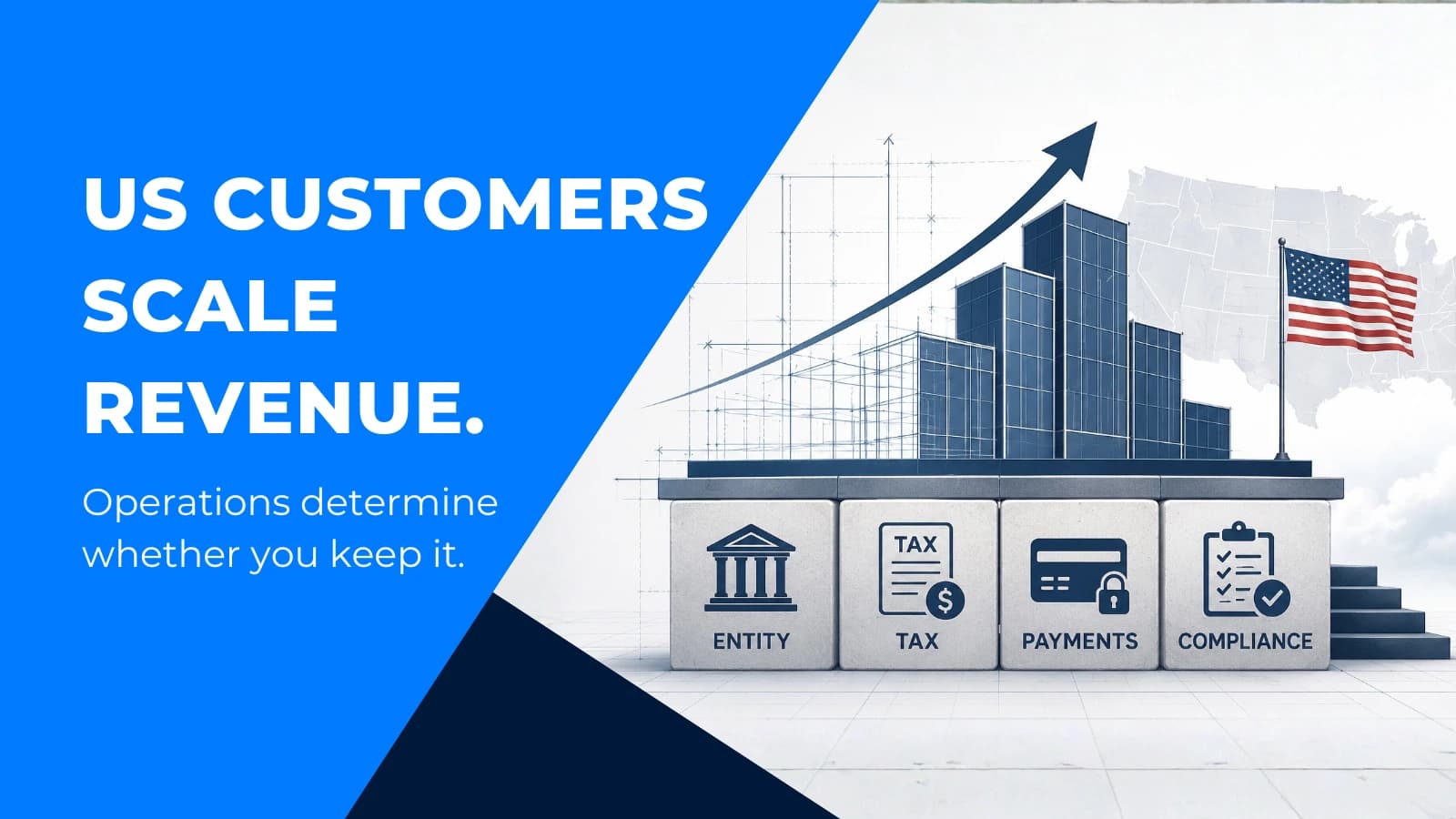
For a growing number of Indian SaaS companies, the United States is not a "someday" market. It is where a large share of early revenue already comes from. Self-serve products routinely sign up US customers long before the founding team has set foot there. The problem is rarely a demand. It is the operational layer underneath the revenue: which entity to open, when Indian outbound-investment rules apply, where US tax obligations start, and how money actually moves back home.
This checklist walks through that layer in the order it usually matters, so the sequencing decisions get made deliberately rather than in hindsight.
Step 1: Clear the India side before you incorporate abroad
Setting up a US entity funded from India is a regulated outbound investment. It is governed by the Foreign Exchange Management (Overseas Investment) Rules, 2022, along with the corresponding RBI Regulations and Directions, which took effect on 22 August 2022 and replaced the older FEMA 120/2004 framework entirely. If your knowledge of these rules predates 2022, it is out of date.
A few points founders most often get wrong:
ODI vs OPI. Setting up and controlling a US subsidiary is Overseas Direct Investment (ODI) – equity or instruments carrying control. A passive minority stake of under 10% with no control is an Overseas Portfolio Investment (OPI). The two are treated differently, and misclassifying is a compliance issue, not a formality.
The automatic route. An eligible Indian company can invest up to 400% of its net worth (as per its last audited balance sheet) in an overseas entity under the automatic route, without prior RBI approval. Investments above that cap, or in restricted categories, require the approval route.
Individual founders use LRS. If a founder invests personally rather than through the Indian company, that runs under the Liberalised Remittance Scheme, capped at USD 250,000 per financial year per individual.
Round-tripping is prohibited. Your US entity cannot be structured to invest back into the same or a related Indian company. Step-down subsidiaries are allowed, but only with genuine business substance.
Reporting is where people trip. Even sophisticated companies clear the investment limits and then miss the filings – the initial Form FC and the Annual Performance Report (APR) for each overseas entity. Late filing attracts fees and, over time, complicates every subsequent transaction.
Route the whole structure through your AD Category-I bank and a FEMA advisor before you form anything in the US. Fixing the sequence afterward is far more expensive than getting it right once.
Step 2: Choose and set up the right US entity
For an operating, fundraising-track SaaS business, the default is a Delaware C-corporation. This is less about tax and more about investor familiarity and settled corporate law – US and most international VCs expect it, and the paperwork is standardised.
Weigh the structure honestly:
C-corp: preferred for funded SaaS. It contains US tax liability at the entity level and keeps the foreign owner out of personal US filing, but adds entity-level tax and Delaware franchise tax.
LLC: simpler and cheaper, but a single-member LLC owned by a non-US person is a disregarded entity. It does not shield you the way founders assume, and it can create personal US tax exposure where the business has income effectively connected to the US.
Whichever you pick, the setup checklist is similar: appoint a registered agent, obtain an EIN from the IRS, open a US business bank account, and put an intercompany agreement in place between the Indian parent and the US entity.
The reporting trap for foreign-owned entities
This one catches almost everyone. A foreign-owned US disregarded entity must file a pro forma Form 1120 together with Form 5472 every year – even with zero income and no US customers. A US C-corporation that is 25% or more foreign-owned must also file Form 5472. The IRS penalty for failing to file, or filing incompletely, starts at USD 25,000, and an incomplete filing is treated as no filing at all. Put this obligation on the compliance calendar the day the entity is formed.
Step 3: Map your US tax obligations – income tax and sales tax are two different problems
Founders tend to think of "US tax" as one thing. There are at least two, and they are triggered by different events.
Corporate income tax
The federal corporate income tax rate is a flat 21%, set by the 2017 Tax Cuts and Jobs Act and unchanged for 2026 (the July 2025 tax legislation left the corporate rate intact). On top of that, most states levy their own corporate income tax, ranging from 0% to roughly 11.5% depending on where the company has an income-tax presence. This is why the state of incorporation and the state of operations are separate questions.
Sales tax and economic nexus – the part that surprises SaaS teams
Sales tax is not about your profit. It is about your obligation to collect tax from your customers once your activity in a state crosses a threshold and that obligation exists even if the company is unprofitable. Since the Supreme Court's 2018 decision in South Dakota v. Wayfair, states can require out-of-state sellers to register and collect based on economic activity alone, with no physical presence.
What that means in practice for 2026:
The standard trigger is USD 100,000 in sales into a state in the current or prior year. 41 states use this figure; California, Texas, and New York set it higher at USD 500,000, and Alabama and Mississippi at USD 250,000.
The old "200 transactions" test is being retired. As of early 2026, most states have moved to a revenue-only standard, though around 17 still count transactions – a trap for low-price, high-volume products that cross the count long before the dollar figure.
SaaS is not taxable everywhere. Several states tax software-as-a-service; others do not, and the list keeps widening (Maine expanded taxable digital services in 2026). Taxability has to be mapped state by state – there is no single national answer.
The compliance load here is genuinely operational: each state requires separate registration, collection, filing frequency, and remittance. Monitor sales by ship-to (or bill-to) state monthly, because the obligation is retroactive to the day you cross the line.
Step 4: Set up payments and money movement deliberately
Collecting in USD, staying compliant on sales tax, and getting funds back to India cleanly are three separate problems that founders often discover only after the first customers arrive.
Accepting payment. You need US-capable acceptance with strong authorisation rates and support for the methods US buyers actually use, plus recurring-billing logic that survives currency and renewal edge cases.
The sales-tax question, again. Standing up multi-state registration and remittance in-house is a real project. One alternative some founders use – particularly early, before committing to full in-house tax infrastructure – is to sell through a merchant of record (MoR). Under this model, the MoR becomes the seller of record on the transaction and can handle sales tax collection and remittance as the seller of record, across the US and other markets, so a small team can sell globally without building the entire compliance apparatus on day one. It is one option to weigh against doing it in-house – not a universal answer, and the trade-offs (margin, control, data ownership) are worth evaluating for your stage.
Repatriation and withholding. When the US entity sends money to the Indian parent – dividends, royalties, or service fees – US withholding tax can apply (a 30% default rate), typically reduced under the India–US tax treaty if the recipient files the correct documentation (Form W-8BEN-E) to claim treaty benefits. Price this into your intercompany and transfer-pricing planning early.
Step 5: Keep both compliance calendars running
Expansion is not a one-time setup; it is two recurring compliance cycles that run in parallel.
In India: the annual APR for each overseas entity, ongoing FEMA reporting, and transfer-pricing documentation for intercompany dealings.
In the US: the annual Form 1120 (or pro forma 1120 + Form 5472 for foreign-owned entities), federal and state corporate income tax filings, Delaware (or other state) franchise tax, and per-state sales tax registration, collection, and remittance wherever you have nexus.
Build a single calendar that holds both sides. The most common and most avoidable failures are missed filings, not bad strategy.
The takeaway
Indian SaaS companies rarely struggle to win US customers. Where they lose time and money is the ordering of decisions: incorporating before clearing the India side, discovering sales tax nexus after crossing it in a dozen states, or missing a USD 25,000 filing they never knew existed. Treat entity, tax, payments, and compliance as one sequenced workstream rather than four separate scrambles, and US expansion becomes an operational plan instead of a series of expensive surprises.
Disclaimer: This article is a guest contribution. The opinions and views expressed are solely those of the author and do not necessarily reflect the views, policies, or position of EnKash