Key Takeaways
- India has no single commercial electricity rate. State tariff orders decide the applicable category and price structure.
- Commercial bills can include energy, fixed, demand, time-based, statutory, and adjustment amounts.
- Bills above ₹1,000 must be paid online unless the State Commission fixes another threshold.
- Business users should track category, consumption, payable amount, and payment evidence across billing cycles.
A commercial electricity account is billed under the tariff linked to its connection. The category can depend on the type of premises, load, voltage, and approved use. At the end of the billing period, the utility calculates charges using the recorded consumption and, where applicable, demand. Applicable fixed charges, tariff adjustments and statutory levies may also affect the final amount. This blog explains how commercial electricity rates are set, which charges appear on the bill, how the amount is calculated, how domestic billing differs, and how businesses can complete online payment correctly.
What is a Commercial Electricity Bill
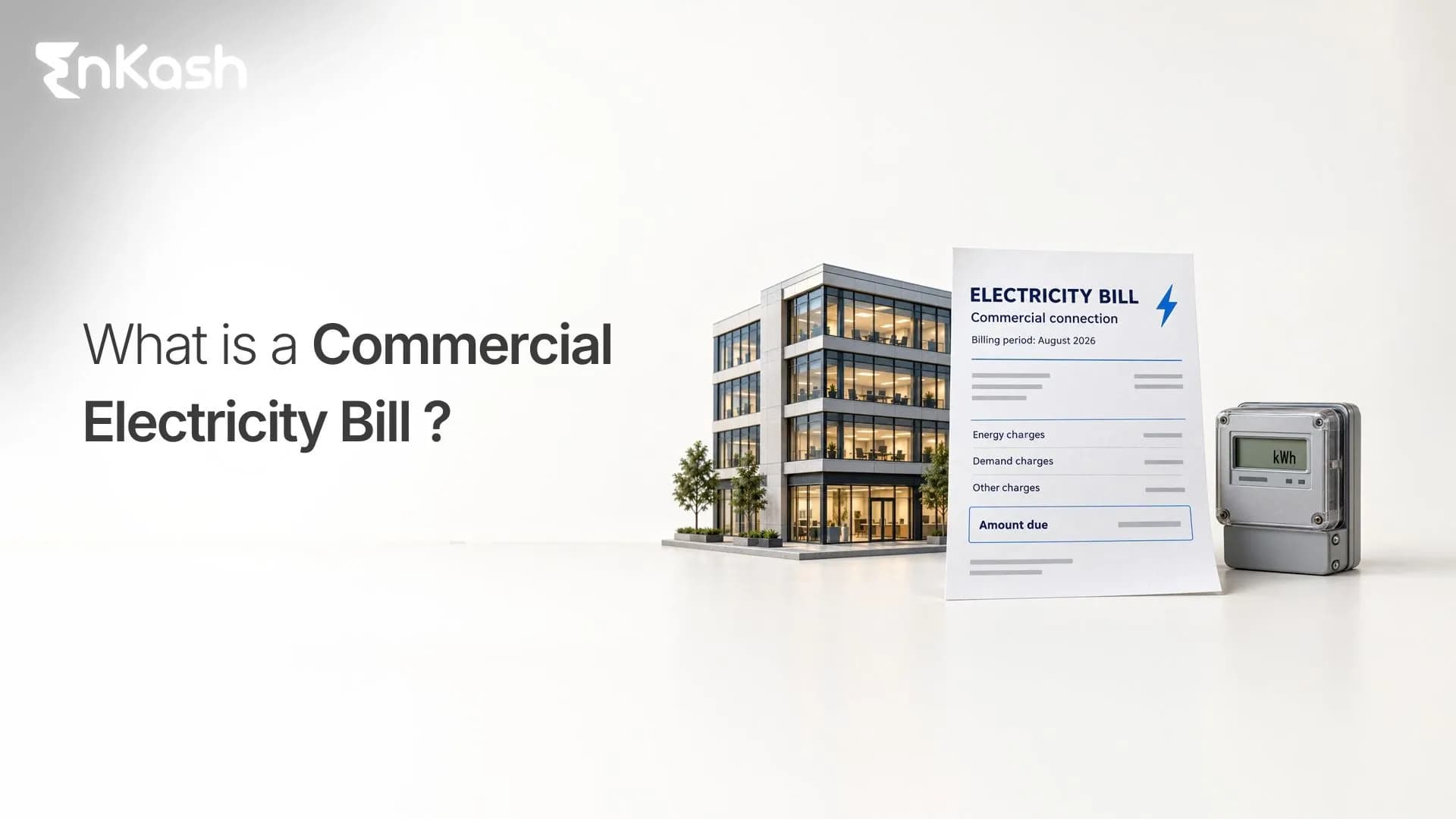
A commercial electricity bill is the periodic statement issued for an electricity connection classified under the applicable commercial or non-residential tariff category. It records electricity consumption, applicable charges and the amount payable for the billing period.. It records the liability raised for one billing cycle under that particular consumer account.
The bill usually identifies both the connection and the period being charged. Consumer number, service number, meter reference, due date, current payable amount, and an earlier outstanding balance may all appear on the statement.
The connection may serve a shop, office, restaurant, showroom or another establishment covered by the applicable commercial tariff.
Read more about general electricity bill
How to read a Commercial Electricity Bill?
To read the commercial electricity bill, you have to understand what a commercial electricity bill contains. A commercial electricity bill contains details of your business connection, electricity consumption, applicable charges, and payment amount. The exact fields and calculation methods vary by electricity distribution company (DISCOM) and tariff category.
- Consumer or Account Number: The unique identification number assigned to your business electricity connection.
- Billing Period: The start and end dates for which electricity consumption is charged.
- Tariff Category: The electricity pricing category assigned to the connection, based on its sanctioned use and applicable tariff rules.
- Sanctioned Load: The electrical load approved for the connection. It may affect the tariff category and fixed charges.
2. Energy Charges (Electricity Consumption)
- Electricity Units (kWh or kVAh): The billable electricity consumption recorded during the billing period. The unit used depends on the applicable tariff.
- Commercial Electricity Rate per Unit: The energy rate specified for your connection’s tariff category. Rates can vary by distribution area, load, and consumption band.
- Slab Rates: Different rates may apply to different consumption bands where the tariff uses slab-based billing.
- Time-of-Day (ToD) Charges: Applicable tariffs may charge different energy rates during peak, normal, and solar-hour periods.
3. Fixed & Demand Charges
- Fixed Charges: Recurring charges that may depend on connected load, sanctioned load or another basis specified in the tariff.
- Maximum Demand: The highest demand recorded during the billing period, measured according to the utility’s metering method.
- Contract Demand: The capacity agreed upon for the electricity connection. It may influence demand charges even when actual consumption is low.
- Excess Demand Charges: Additional charges that may apply if recorded demand exceeds the permitted limit, depending on the tariff.
4. Adjustments & Statutory Charges
- Fuel or Power-Purchase Adjustment: An additional charge or credit reflecting changes in electricity procurement costs under the applicable regulatory mechanism.
- Electricity Duty: A statutory levy imposed according to the relevant state’s rules.
- Power Factor Adjustment: A penalty or incentive that may apply under certain commercial tariff structures.
- Arrears and Previous Dues: Unpaid amounts carried forward from earlier billing periods.
- Rebates and Credits: Eligible deductions, such as prompt-payment rebates or adjustments for earlier excess payments.
5. Payment & Billing Details
- Total Amount Payable: The final amount due after applicable charges, previous dues, rebates and credits.
- Payment Due Date: The deadline for paying the bill without applicable late-payment charges.
- Late Payment Charges: Additional amounts that may apply when the bill remains unpaid beyond the specified date.
- Payment Reference: The receipt or transaction number used to confirm a completed payment.
For businesses operating across multiple branches, checking these details helps finance teams assign each electricity expense to the correct location, verify unusual charges, and avoid duplicate payments.
What Factors Determine Commercial Electricity Rates in India
Commercial electricity rates vary across India. State regulators approve tariffs for the distribution areas under their jurisdiction. The connection category then determines which schedule applies.
Electricity Rates Vary by State and Distribution Utility
Electricity pricing differs across states and distribution areas. A tariff approved in Gujarat cannot be treated as the applicable price for an office in West Bengal or a shop in Maharashtra.
For example, the Gujarat Electricity Regulatory Commission's FY 2026–27 tariff for Torrent Power's Surat distribution area specifies an energy rate of ₹4.35 per unit for eligible Non-RGP connections with connected load up to 10 kW. The rate is ₹4.55 per unit for connections above 10 kW and up to 15 kW. Fixed charges also apply according to the connected load.
These rates are specific to the stated distribution area and tariff category. Businesses should check their own distribution utility's current tariff schedule rather than applying these figures across India.
Connected Load and Demand Can Affect the Tariff
The commercial electricity rate per unit depends on the applicable tariff. Depending on the distribution utility and consumer category, the rate may vary by connected load, billing demand, consumption slab or Time-of-Day period. Sanctioned load, connected load, supply voltage and contract demand can influence the tariff category applicable to a connection. Billing demand may then determine the demand charges or energy-rate band within that category.
In the same Gujarat framework, non-residential connections above 15 kW move into a demand-based schedule. Billing demand then becomes part of the pricing structure. Larger business connections can face a different pricing method within the same distribution area.
A commercial category can cover different electrical arrangements. A small shop may fall under a low-tension non-residential schedule. A larger commercial establishment may fall under a demand-based tariff, depending on the applicable regulations.
Time of Use Can Change the Energy Cost
Time-of-Day pricing has direct relevance for commercial users. Under the Electricity (Rights of Consumers) Amendment Rules, 2023, Time-of-Day (ToD) tariffs for commercial and industrial consumers with maximum demand exceeding 10 kW were to take effect no later than 1 April 2024.
The rules specify that peak-period tariffs for commercial and industrial consumers must be at least 1.20 times the normal energy tariff, while solar-hour tariffs must be at least 20% lower. The State Electricity Regulatory Commission determines the applicable time blocks and tariff structure. State Commissions specify the actual time blocks. A business running heavy equipment during peak hours may face a different energy cost from a business using the same total units at other times.
How Is a Commercial Electricity Bill Calculated?
The final bill is built from the tariff attached to the account. The final amount can include energy charges, fixed or demand charges, Time-of-Day adjustments, statutory levies, and previous dues, less applicable credits.
Start With Billable Energy
The utility determines billable electricity consumption from the meter readings and any applicable metering adjustments. The energy charge is then calculated using the billable units and the rate specified in the relevant tariff.
A basic energy calculation looks like this:
Billable units × applicable energy rate = energy amount
Use the per-unit rate specified in the current tariff for the connection. Rates may change when the regulator revises the tariff.
Add Connection-Based Charges
Commercial tariffs may carry a fixed charge linked to connected or sanctioned load. Larger accounts can use demand charges based on billing demand. Demand billing deserves attention because the billed value may differ from the month's recorded maximum demand. For example, under Torrent Power's FY 2026–27 LTMD tariff for Surat, billing demand is the highest of the recorded maximum demand, 85% of contract demand, or 6 kVA. Other distribution utilities and tariff categories may use different billing-demand formulas.
Demand charges may still apply even when electricity consumption is low. A business with limited monthly consumption can still carry a meaningful demand-based amount when its tariff uses that structure.
Apply Time-Based and Regulatory Adjustments
An applicable ToD adjustment changes the energy amount for consumption during specified periods. Fuel and power-purchase adjustments may increase or decrease the bill, depending on the applicable mechanism.
State electricity duty or another statutory levy may also appear. Separate network or wheeling amounts can arise under tariff arrangements where those components apply. Arrears increase the payable balance. Approved rebates or credits reduce it. The applicable charges vary by tariff category and distribution area.
See How the Bill Is Calculated
Consider a hypothetical small commercial connection using 1,200 units in one month. Assume an illustrative energy rate of ₹7.50 per unit.
Energy amount:
1,200 × ₹7.50 = ₹9,000
Assume the same account has:
- ₹850 in fixed charges
- ₹420 in applicable tariff adjustments
- ₹280 in statutory charges
- ₹200 as an eligible credit
The amount becomes:
₹9,000 + ₹850 + ₹420 + ₹280 − ₹200 = ₹10,350
The example explains the calculation method using illustrative values. Actual rates, duties, adjustments, and connection charges depend on the applicable tariff and business account. Finance teams should check the tariff period during invoice review. A fresh tariff order or permitted adjustment can change the figures used in a later billing cycle.
Read more about how electricity bill is calculated?
What Is the Difference Between Commercial and Domestic Electricity Bills?
Domestic and commercial electricity accounts are classified around different sanctioned uses. The difference begins with the purpose attached to the connection and carries into the tariff schedule used for billing.
| Area | Domestic Electricity Bill | Commercial Electricity Bill |
|---|
| Sanctioned use | Residential use | Business or non-residential use |
| Typical premises | Houses and residential flats | Shops, offices, clinics, showrooms and business premises |
| Consumer category | Domestic tariff category | Commercial or non-residential tariff category |
| Tariff basis | Domestic schedule for the connection | Commercial schedule for the connection |
| Category review | Needed when the sanctioned use changes | Needed when business use or premises use changes |
How to Pay a Commercial Electricity Bill Online
The answer to how to pay a commercial electricity bill online depends on the payment channels enabled for the electricity account. Distribution utilities must maintain online access for bill payment and other consumer services.
Use this sequence:
- Open the authorized electricity payment portal or accepted digital channel.
- Select the electricity utility linked to the business connection.
- Enter the consumer number, service number, or account reference requested.
- Fetch the current bill linked to the account.
- Choose an available digital payment method and complete authentication.
- Complete the payment and save the acknowledgement and transaction reference.
Also, businesses can pay commercial electricity bills using the EnKash bill payments platform in bluk by single click.
High-value business payments may face bank or channel transaction limits. The payer should use the payment facility enabled for the electricity account. A bank debit can appear before the utility account posts the transaction. If payment status is pending, use the transaction reference to trace it before trying again. An immediate second attempt can create a duplicate debit.
What Should a Business Check Around Electricity Payment?
A successful payment can leave an accounting gap when records do not match. Internal controls should connect the electricity expense with the correct period, office, approval, and bank entry.
Before releasing funds:
- Enter the bill under the correct accounting month.
- Confirm the required approval owner has cleared the expense.
- Allocate the bill to the correct office, branch, store, plant, or cost center.
- Search the payment register for an earlier settlement of the same cycle.
After payment:
These checks help finance teams maintain a complete record from bill approval through payment and reconciliation.
Summing Up
A commercial electricity bill becomes easier to manage once you know what is driving the amount. The tariff category sets the billing framework, unit consumption creates the energy charge, and fixed, demand, time-based, or statutory charges can change the final figure. Commercial and domestic accounts also follow different use categories, which is why their billing cannot be compared only by units consumed. Before paying online, businesses should check the bill against the correct account, billing period, and internal records. Regular review also makes unusual cost changes easier to catch.
FAQs
What happens if a commercial electricity bill does not arrive?
A consumer who does not receive the original bill can request a duplicate copy. The consumer rules also permit self-assessed payment under the procedure approved by the relevant Commission. Any excess or deficit is adjusted through later billing.
Can a business receive provisional electricity bills?
Yes, but provisional billing is restricted. Under Rule 6(9) of the Electricity (Rights of Consumers) Rules, 2020, a distribution licensee cannot generate more than two provisional bills for a consumer in one financial year. If provisional billing continues beyond two billing cycles, except under specified extraordinary circumstances involving force majeure, the consumer may refuse to pay the dues until a bill based on actual meter readings is issued.
Where can a business challenge an incorrect electricity bill?
Billing complaints begin with the grievance channel identified for the electricity account. The bill and utility website must contain information about the authority handling billing complaints. Further escalation can move through the applicable consumer grievance framework.
What happens when a business vacates the premises?
A business vacating its premises can submit a written request to the distribution utility for a special meter reading and final bill. The final bill includes applicable dues up to the billing date. Under Rule 6(12) of the Electricity (Rights of Consumers) Rules, 2020, the utility must issue a No-Dues Certificate within seven days of receiving the final payment.
Is GST charged on a commercial electricity bill?
No GST is charged on the supply of electrical energy under HSN 2716 00 00. Specified incidental services supplied by electricity transmission or distribution utilities are also exempt under the applicable GST provisions. Other separately supplied goods or services may have different tax treatment and should be assessed according to their nature.
Can a business download older commercial electricity bills online?
Distribution utilities must keep the previous one year of billing details available on their websites. This gives businesses a practical way to retrieve recent billing records for reconciliation, audit checks, or comparison with earlier electricity costs.
Can a business request a meter check if consumption looks unusually high?
A consumer can raise a complaint when meter readings do not match expected electricity use. The distribution utility must test the meter within the period specified by the Commission, subject to a maximum of 30 days from receiving the complaint.