Building a successful eCommerce business today takes more than offering a great product, attractive packaging, or healthy profit margins. Customers, investors, and even employees are increasingly choosing brands that care about how they do business, not just what they sell.
This mindset shift has made way for sustainable commerce which is basically a business model that works keeping sustainability at the center of everything. From procuring raw materials to packaging to payment collection and delivering the product, sustainability is helping businesses operate in a socially responsible way.
In this blog, we will know how sustainable commerce works, why it matters, its key pillars, benefits and how businesses can build a sustainable future.
What is Sustainable Commerce?
Sustainable commerce is the practice of doing business in ways that minimize environmental impact while creating long-term economic and social value.
Rather than focusing only on revenue growth, businesses adopting sustainable commerce aim to:
Reduce carbon emissions
Minimize waste
Use resources efficiently
Support ethical supply chains
Promote responsible consumption
Improve transparency and governance
The objective is to create a business model that benefits customers, employees, communities, and the planet without compromising profitability.
Why Sustainable Commerce Matters?
Consumers are becoming more conscious of the environmental and social impact of their purchases. Businesses that embrace sustainability are increasingly seen as more trustworthy, innovative, and future-ready.
Sustainable commerce helps businesses:
Meet changing customer expectations
Reduce operational costs
Strengthen brand reputation
Attract environmentally conscious customers
Comply with evolving regulations
Improve long-term profitability
Build investor confidence
Sustainability has evolved from being a competitive advantage to becoming a business imperative.
Key Consumer Statistics
Consumer Trends | Statistic |
Sustainability matters when shopping online | 91% |
Want sustainable delivery information | 57% |
Prefer sustainable packaging | 53% |
Want less plastic packaging | 50% |
Willing to pay more for sustainable products | 45% |
Source: DHL eCommerce Trends Report 2025, IESE Business School
The Pillars of Sustainable Commerce
1. Sustainable Sourcing
It starts from businesses sourcing their materials from suppliers who follow ethical labor practices and are mindful when it comes to environmentally responsible manufacturing processes.
It includes:
2. Ethical Manufacturing
Manufacturers are reducing their carbon footprint through:
Waste reduction
Water conservation
Energy-efficient production
Renewable energy adoption
Circular manufacturing practices
3. Eco-Friendly Packaging
Environment friendly packaging contributes significantly to business waste.
Sustainable businesses focus on:
Reduced packaging size
Reusable packing
Recyclable materials
Compostable packaging
Minimal plastic usage
4. Green Logistics
Product delivery in business contributes to carbon footprint.
Businesses can improve logistics through:
Using local fulfillment centres
Optimizing their delivery routes
Involving electric delivery vehicles
Sustainable warehousing
5. Digital Payments
Digital transformation is helping businesses become sustainable.
Businesses can use:
These practices minimize paper consumption while enhancing operational efficiency.
How Technology Enables Sustainable Commerce
Technology has become one of the biggest drivers of sustainability.
Artificial Intelligence (AI)
AI helps predict demand, optimize inventory, and eliminate unnecessary production and waste.
Cloud Computing
The need for a physical infrastructure is eliminated with cloud platforms helping improve operational efficiency.
Internet of Things (IoT)
Businesses can use IoT devices to check energy usage, warehouse conditions, and equipment performance in real time.
Blockchain
Blockchain helps improve transparency in the supply chain by enabling businesses verify the movement of goods.
Digital Payment Solutions
Digital payments simplify financial operations, and improve transaction efficiency while supporting digital-first business models.
Benefits of Sustainable Commerce
From having a unique brand reputation due to saving on operational costs, businesses get many benefits due to sustainable operations.
Brand Reputation
Consumers prefer brands that consciously follow environmental and social responsibility.
Customer Retention
Customers are likely to stay loyal to businesses whose values align with their own.
Operational Expenses Cost Savings
Businesses can save their operational cost by reducing waste, optimizing logistics and improving energy efficiency.
Competitive Advantage
Adopting sustainable practices for their business makes them a differentiator in the marketplace and brings in environmentally conscious customers.
Investor Interest
Investors now evaluate businesses based on their Environmental, Social, and Governance (ESG) performance, which makes sustainable an important factor in attracting capital.
Challenges of Sustainable Commerce
Adapting sustainable commerce comes with its challenges.
High Initial Investment
The shift to sustainable operations requires huge investments in renewable energy, technology and supply chain management.
Supply Chain Complexity
It is difficult to ensure that every supplier follows sustainable practices because as a business you want to go 100% sustainable which involves processes at different stages.
Consumer Price Sensitivity
Affordability becomes a challenge for sustainably made products in a competitive market.
Measuring Impact
Companies need accurate data to track emissions, waste reduction and ESG performance to measure real impact.
Emerging Trends in Sustainable Commerce
Several trends are shaping the future of sustainable commerce.
3R’s
Businesses have understood the importance of sustainability and are reusing, repairing and recycling their unused products instead of dumping.
Digital Payments
Digital payment is the solution to eliminate paper based payments alongside streamlining financial operations.
Sustainable Resources
Businesses are consciously investing in renewable energy and other initiatives that help reduce their negative footprint.
Consumer Awareness
Today’s consumer is aware and prefers to be associated with a brand which has transparency when it comes to their ethics and has a moral responsibility to follow.
AI-Driven Sustainability
AI is enabling businesses to reduce waste, improve their operations, and work on their resource allocation and utilization.
Best Practices for Building a Sustainable Commerce Strategy
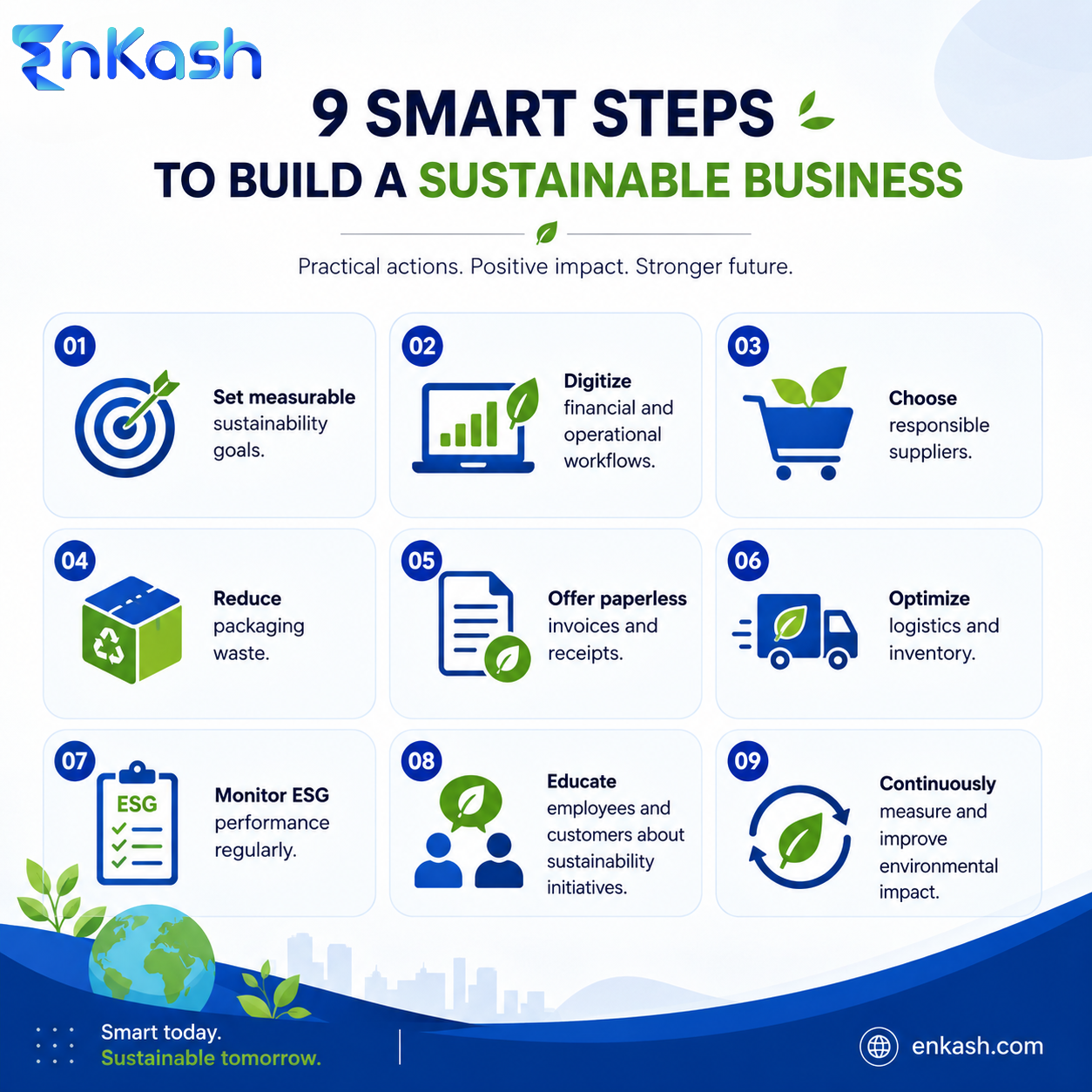
The Future of Sustainable Commerce
Sustainable commerce can be integrated into businesses of every size to meet customer expectations and build long-term resilience.
Companies can make sustainability a part of their growth strategy by adopting digital payments, optimizing their supply chains, and reducing operational waste. Every small change can contribute to a more responsible and efficient business ecosystem.
Sustainable commerce paves the way for businesses which are focused on innovation with a purpose for their future.
Conclusion
Sustainable commerce showcases the evolution of business where innovation and responsibility work together. Businesses can reduce their carbon footprint while creating money and stronger customer relationships by adapting to sustainable practices.
A strategic investment in integrating sustainability into commerce can prepare businesses for a future where growth also means having a positive impact on the environment.
FAQs
1. What is sustainable commerce?
Sustainable commerce is a way of doing business which has no negative impact on the environment in terms of production, packaging and delivery.
2. Why is sustainable commerce important for businesses?
It helps businesses minimize their operating costs, build their brand reputation and bring in customers who are environmentally conscious while meeting regulatory requirements.
3. How is sustainable commerce different from traditional commerce?
Traditional commerce is focused more on profitability and does whatever it takes to reach there.
Sustainable commerce on the other hand is a conscious way of doing business which means taking decisions which are environment friendly inclusive of product manufacturing to delivery.
4. What are the key pillars of sustainable commerce?
Sustainable commerce includes everything from responsible sourcing to reducing carbon footprint to efficient resource management, waste reduction and ethical labour practices.
5. How can businesses become more sustainable?
Businesses can adapt sustainability by using renewable energy sources, digitizing their operations, using environmentally friendly packaging, optimizing their supply chains, and being associated with responsible suppliers.
6. How technology helps in sustainable commerce?
Technology helps businesses streamline their logistics, automate manual processes, include digital payment solutions, minimize paper usage and manage inventory in a conscious way.
7. How digital payments contribute to sustainable commerce?
Digital payments eliminate the use of paper receipts, invoices and cash handling. A business’s financial processes are streamlined with digital payments while reducing operational costs.
8. How sustainable commerce benefits customers?
Environmentally conscious consumers find their values aligned with businesses that follow sustainable practices. They become loyal to the brand and that increases the customer’s return value.
9. Can sustainable commerce improve business profitability?
Sustainable commerce contributes to long-term profitability for a business. It reduces operational costs, improves resource efficiency, strengthens customer loyalty and creates new market opportunities.
10. What challenges do businesses face when adopting sustainable commerce?
Businesses may face initial implementation costs, complexity of supply chain, regulatory compliance and balancing short-term investments.
11. Which industries can benefit the most from sustainable commerce?
Every industry from retail to manufacturing to logistics to ecommerce and financial services can benefit from sustainable commerce.