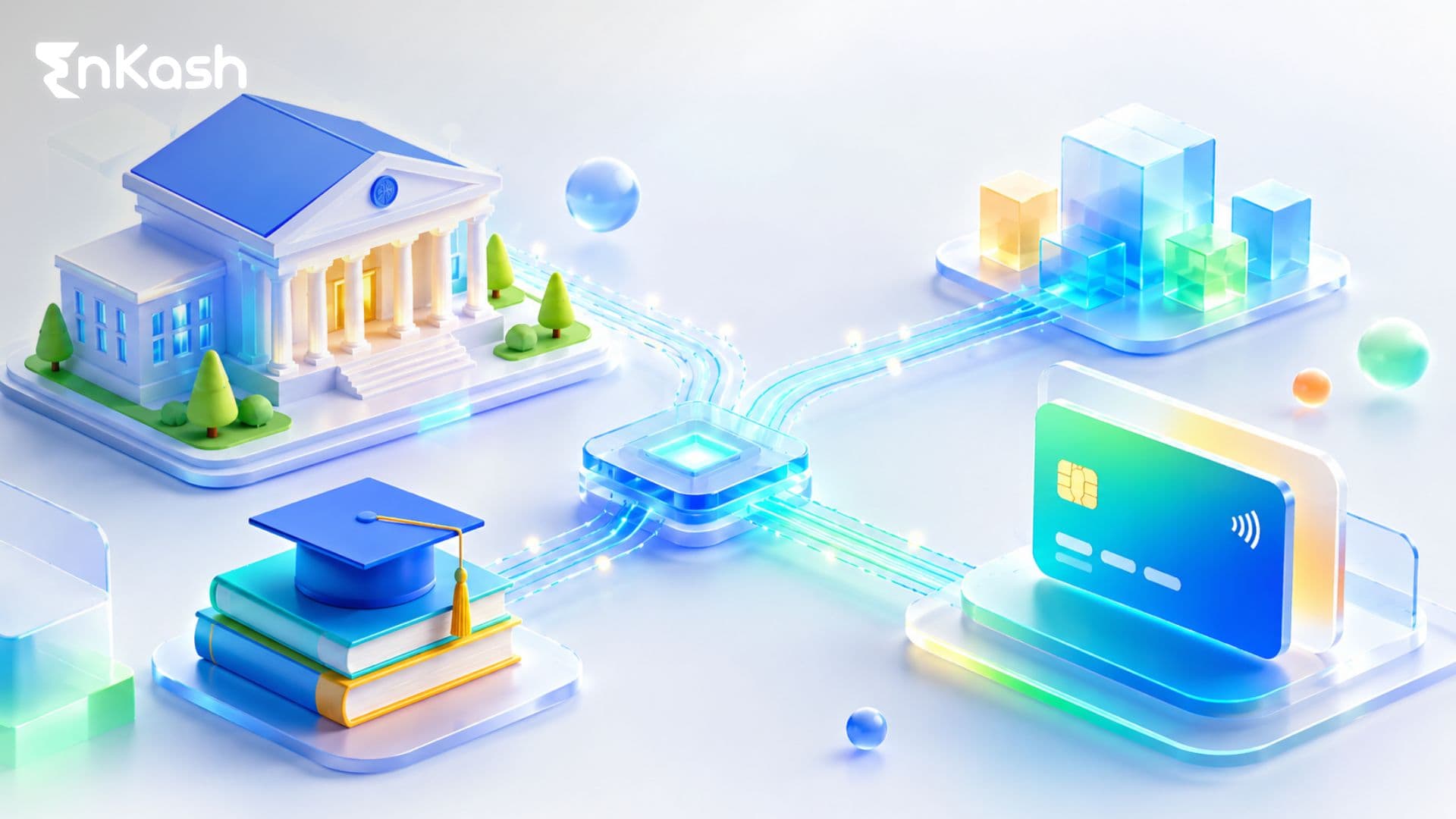
The Indian education sector is going through a massive structural shift. Driven by the National Education Policy (NEP), the rise of large EdTech platforms, and the rapid expansion of multi-campus K-12 groups and private universities, institutions are scaling up their digital infrastructure at an unprecedented rate. While classrooms have moved to hybrid models and student data has migrated to cloud platforms, a significant operational gap remains: institutional financial management.
In India’s fast-growing digital payment landscape, where the Unified Payments Interface (UPI) handles billions of transactions monthly, a visit to a typical administrative office often reveals a different reality. Accounts teams frequently struggle with manual ledgers, stacks of post-dated cheques (PDCs), and uncoordinated payment platforms.
The missing piece is an education payment gateway that integrates directly with the institution’s ERP. When payment rails exist independently of core student databases, institutions face operational vulnerabilities, revenue leakage, and administrative bottlenecks. This comprehensive guide outlines the architecture, regulatory considerations, and strategic advantages of embedding payment networks directly into an Indian institutional ERP.
Why Education Institutions Can No Longer Afford Disconnected Payment Systems
The Scale of the Problem
India processed ₹24.77 lakh crore in UPI transactions in March 2025, with 18.3 billion transactions. Yet many educational institutions, from K-12 schools to large universities, still operate with fragmented payment stacks. A parent pays online through a gateway, but the accounts team manually updates a separate fee register. Reconciliation happens weekly, errors surface at the end of the term, and disputes between parents and administrators are common.
The global education ERP market, valued at approximately $24.24 billion in 2025, is projected to reach $46.58 billion by 2030 at a CAGR of nearly 14%, according to Mordor Intelligence. A significant share of this growth is being driven by the demand for tightly integrated financial modules — particularly payment capabilities embedded directly into the ERP core.
The Complexity of Educational Fee Structures
Unlike retail or SaaS businesses, educational institutions manage unusually complex fee structures. A single student's account may involve tuition fees, transportation charges, library fees, examination fees, hostel dues, scholarship adjustments, and partial payment plans, all with different due dates, different heads, and different approval workflows.
This is why standard payment gateways often struggle in educational settings: they are built for single-product, single-checkout experiences, not for multi-head, recurring, and instalment-based billing that must map to individual student records.
SIS/ERP integration remains one of the hardest problems in the education payments market. Many vendors excel at the front-end checkout experience and transaction processing, but achieving deep, bidirectional sync with the student information system or ERP is far less common.
The "WhatsApp Screenshot" Reconciliation Trap
In many Tier-2 and Tier-3 cities across India, parents often pay fees via direct NEFT, RTGS, or IMPS bank transfers. They then take a screenshot of the transaction success page and share it with a class teacher or accountant via WhatsApp or email.
This creates a major administrative bottleneck. The accounting team must manually cross-reference bank statements with these screenshots, look up the Unique Transaction Reference (UTR) number, locate the student's physical register or standalone Student Information System (SIS) record, and manually generate a paper receipt.
Manual data operations can consume significant staff time every academic term, especially during admission and fee-collection windows, creating substantial administrative friction.
Cash Counter Bottlenecks & Post-Dated Cheques
Despite the growth of digital options, a notable portion of fee collection, particularly during peak admission windows in June and July, still occurs via cash or post-dated cheques at campus counters. Managing physical instruments alongside digital payments leaves institutions vulnerable to revenue leakage, tracking errors, and high operational costs.
How the Integration Works: A Technical Overview
Understanding the mechanics helps administrators and IT decision-makers evaluate solutions more confidently.
Step 1: Payment Initiation: A parent or student logs into the institution's fee portal (typically part of the ERP's student-facing interface) and selects the fee components they want to pay.
Step 2: Gateway Processing: The payment request is routed through the integrated gateway, which supports multiple payment modes — UPI, debit/credit cards, net banking, wallets, EMI, and Buy Now, Pay Later (BNPL). The gateway encrypts transaction data and communicates with the acquiring bank and card networks.
Step 3: Real-Time ERP Update: On payment success, a webhook or API callback triggers an automatic update in the ERP. The student's fee ledger is updated, a receipt is generated, and the outstanding balance is revised — all in real time.
Step 4: Reconciliation and Reporting: Settlement data from the gateway is automatically matched against the ERP's expected inflows. Any discrepancy is flagged for review. Finance teams get dashboards showing daily collections, outstanding dues, and payment mode breakdowns without manual data entry.
Step 5: Compliance and Audit Trail: Every transaction is timestamped and logged, creating an audit trail that simplifies GST compliance, regulatory reporting, and internal audits.
The key technical components enabling this are REST APIs, webhooks for event-driven updates, and SDKs that can be embedded into the ERP's existing tech stack. Modern solutions also offer no-code plugins for common ERP platforms, reducing the implementation burden on the institution's IT team.
Core Benefits of ERP-Integrated Payment Gateways in Education
1. Elimination of Manual Reconciliation
Manual reconciliation is one of the largest sources of wasted administrative time in educational finance teams. When a payment gateway operates independently of the ERP, every transaction must be manually matched to a student record. A busy institution processing thousands of payments per fee cycle can spend days on this task, with a higher risk of human error. Integration eliminates this entirely by automating the match at the moment of payment.
2. Real-Time Financial Visibility
Integrated systems connect campus payments, student billing records, and financial management workflows into one coordinated framework. Finance officers and CFOs can see real-time dashboards showing total collections, pending dues, head-wise breakdowns, and payment mode analysis — without waiting for end-of-day reports from multiple systems.
3. Improved Fee Collection Rates
Campuses using integrated digital fee portals report improved collection rates through automated reminders and seamless online payment experiences. When a parent receives a WhatsApp reminder with a direct payment link that opens a pre-filled checkout page mapped to their child's outstanding dues, the friction between intention and payment drops dramatically.
4. Better Student and Parent Experience
With a unified portal, students and families can view their complete fee history, download receipts, check due dates, and make payments — from a mobile phone, at any time. This level of transparency reduces disputes and inbound queries to the accounts office significantly.
5. Stronger Compliance and Audit Readiness
Educational institutions, particularly those receiving government grants or managing research funding, face complex compliance requirements. An ERP-integrated payment system ensures every transaction is recorded with a complete audit trail, supporting regulatory compliance, GST filings, and internal audit processes. PCI-DSS certified gateways — the global standard for payment security — also protect the sensitive financial data of students and parents.
6. Scalability During Peak Fee Cycles
Fee collection seasons create massive transaction spikes. A gateway that is not built for scale will fail precisely when it is needed most. ERP-integrated payment solutions designed for education are built to handle peak loads — admissions season, term-end deadlines, examination fee windows — without downtime.
Key Features to Look for in an ERP-Integrated Payment Gateway for Education
Not all payment gateways are built with educational needs in mind. When evaluating solutions, institutions should look for the following capabilities:
Bi-directional ERP/SIS Sync: The gateway must write payment data back to the ERP in real time — not in batch files. Bidirectional sync means fee waivers, scholarships, and adjustments made in the ERP are also reflected in the payment portal.
Multi-Head Fee Support: The solution must handle split payments across multiple fee heads (tuition, transport, mess, etc.) within a single checkout, mapping each amount to the correct ledger account.
Flexible Payment Options: Support for UPI, debit/credit cards, net banking, wallets, EMI, BNPL, and UPI AutoPay/e-NACH for recurring billing is essential. Indian families use a wide range of payment methods, and restricting options reduces collection rates.To reduce transaction drop-offs, the payment stack must support the diverse payment preferences of Indian consumers.
UPI Deep Linking & Intent Flows: Enabling payments through popular apps like Google Pay, PhonePe, Paytm, and BHIM.
RuPay Optimization: Ensuring compliance with national digital payment directives and reducing transaction costs.
Net Banking Grids: Direct integrations with major Indian public and private sector banks (including SBI, HDFC, ICICI, and Axis Bank) to support large-value fee transfers safely.
No-Cost EMI & Cardless Finance: Providing structured installment choices at checkout to make expensive courses or annual fees more accessible for parents.
Automated Reminders: Configurable reminder workflows that send payment due notifications via SMS, email, or WhatsApp reduce the administrative burden of chasing dues and minimize late payments.
Partial Payments and Installment Plans: Many families cannot pay full-term fees upfront. A good payment gateway integration supports partial payment mapping and instalment billing that tracks each payment against the student's account correctly.
PCI-DSS Compliance and Tokenization: Given India's RBI mandates on card-on-file tokenization (effective since October 2022), the gateway must comply with tokenization standards that replace stored card data with secure tokens.
Branded Payment Experience: White-labeled checkout pages that carry the institution's branding build trust with parents and reduce payment drop-offs.
Real-Time Analytics and Reporting: Finance dashboards that show collection rates, payment mode splits, outstanding dues, and daily settlement summaries enable data-driven financial management.
Developer-Friendly APIs and SDKs: For institutions with existing ERP platforms, robust API documentation and SDKs accelerate integration and reduce time-to-go-live.
Bharat Bill Payment System (BBPS) Integration: Integrating with the National Payments Corporation of India’s (NPCI) Bharat Bill Payment System (or Bharat Connect) allows institutions to list themselves as registered billers. Parents can easily search for the school or university on their preferred banking or digital wallet app, view outstanding dues pulled directly from the ERP, and complete payments instantly.
Common Challenges and How to Overcome Them
Legacy ERP Compatibility
Many educational institutions in India run on older, on-premise ERP systems that were not designed with API-first architectures. Integrating a modern payment gateway with these systems can require custom middleware or adapter layers. The solution is to work with payment providers that offer flexible integration methods — including file-based imports for legacy systems alongside real-time APIs for modern platforms.
Data Security Concerns
Parents and students understandably worry about the security of sharing card details and bank information online. Institutions should ensure their chosen gateway is PCI-DSS certified, uses secure encryption, tokenization where applicable, and PCI DSS-aligned controls, and complies with RBI guidelines for payment aggregators. Communicating these security credentials to parents is equally important for adoption.
Staff Training and Change Management
Even the best-integrated system fails if the administrative staff are not confident using it. Implementation must include structured training, role-specific user interfaces, and ongoing support — not just a one-time setup session.
Multi-Campus and Multi-Currency Requirements
Institutions with multiple campuses or international students need gateways that support multi-currency payments and can map transactions to the correct campus or cost centre within the ERP. This is an area where general-purpose gateways often fall short and education-specific solutions excel.
How EnKash Supports ERP-Integrated Payments for Education
For institutions looking for a payment infrastructure that can connect deeply with their existing ERP, EnKash offers a purpose-built approach. EnKash's payment gateway — authorised by the RBI as a licensed payment aggregator — supports native integrations with ERP platforms, accounting software, and CRM systems, allowing payment data to flow directly into institutional financial workflows.
For education specifically, EnKash provides analytics-powered fee collection forms, automated payment reminders, branded payment links, DIY payment pages, and split payment support — features designed to address the complexity of educational billing rather than simply process a transaction.
The platform's SDK and API architecture allows institutions to embed payment capabilities into their existing student portals without rebuilding them, and its support for 100+ payment modes ensures that parents can pay through their preferred method — from UPI to EMI. EnKash also offers real-time reconciliation and settlement tracking through its unified dashboard, giving finance teams the visibility they need without manual intervention.
What distinguishes a platform like EnKash in this context is not just the payment gateway itself, but its broader spend management ecosystem — which means institutions can also manage vendor payouts, staff reimbursements, and utility payments from the same platform, creating a genuinely unified financial operations layer.
Future Trends in Indian Institutional Finance
As institutions continue to adopt digital solutions, the role of integrated financial platforms is evolving from historical record-keeping to forward-looking strategic management.
AI-Driven Cash Flow Forecasting
By analyzing historical payment data, seasonal installment choices, and fee collection timelines across different courses, predictive models can help institutions anticipate future cash reserves. This allows finance leaders to forecast liquidity trends more accurately and optimize long-term operational budget planning.
Personalized Fee Plans and Smart Instalment Structuring
The next stage of development in fee management involves data-driven, flexible solutions. Modern ERP networks can analyze historical demographics, scholarship allocations, and past payment timelines to automatically configure customized installment plans for families who need them. This approach helps make quality education more accessible while ensuring steady, predictable cash inflows for the institution.
Conclusion
The integration of a payment gateway with an institution's ERP is no longer a technology project — it is a financial operations imperative. As digital payments become the norm for Indian families, educational institutions that continue to operate with disconnected payment and accounting systems will face mounting inefficiencies, revenue leakage, and parent dissatisfaction.
A well-integrated solution eliminates manual reconciliation, improves collection rates, provides real-time financial visibility, and creates the audit-ready infrastructure that modern institutions require. The key is choosing a payment partner that understands the unique complexity of educational billing — not simply one that can process a transaction.
As the education ERP market grows toward $46 billion by 2030, the institutions that invest in integrated financial infrastructure today will be the ones that operate with the agility and transparency that students, parents, and regulators increasingly expect.
FAQs
What is an ERP-integrated payment gateway?
It is a payment processing solution that connects directly to an educational institution's ERP or student information system, automatically syncing payment data, updating student ledgers, and enabling automated reconciliation.
Why do educational institutions need ERP-integrated payment gateways rather than standard gateways?
Standard gateways process payments but do not map them to student records, handle multi-head fee structures, or update institutional ledgers automatically. Education-specific integrations do all of this, dramatically reducing manual work and errors.
What payment methods should an education payment gateway support in India?
At minimum: UPI (including UPI AutoPay), debit and credit cards, net banking, wallets, EMI, and BNPL. Support for e-NACH for recurring instalment billing is also increasingly important.
Is PCI-DSS compliance mandatory?
Yes. PCI-DSS certification is the global standard for payment data security. Any gateway used by educational institutions should be PCI-DSS compliant, and the RBI's tokenization mandate (effective July 2022) requires that card-on-file data is tokenized rather than stored.
How long does ERP integration take?
For cloud-based ERPs with open APIs, integration typically takes four to six weeks from requirements to go-live. Legacy on-premise systems may take longer depending on the complexity of the existing architecture.
Can an integrated gateway handle partial payments and instalment plans?
Yes. This is one of the key advantages of education-focused integrations. The system can track partial payments against a student's total dues and manage instalment schedules automatically.