Have you ever stopped to think about how businesses determine the actual cost of the products they sell or services they offer? The answer lies in something called a cost sheet. Imagine you’re running a small boutique that specializes in handmade jewelry. Have you ever wondered how much it costs to craft each piece, from the intricate design to the precious materials and labor involved? A cost sheet contains a detailed breakdown of the cost of producing any goods and services. It provides a systematic breakdown of all expenses incurred during a specific period, offering a clear view of how much it costs to produce a single unit of output. By categorizing and summarizing these costs, a cost sheet helps businesses understand their cost structure, make informed pricing decisions, and identify areas for cost reduction and efficiency improvement.
What is a Cost Sheet?
A cost sheet is a complete document where an important feature is to record the effect of the entire expenditure incurred during the production of goods or services. It gives the facility of computing cost unit with which the cost is to be divided into direct and indirect elements. This might help an organization understand the cost incurred for producing a particular unit of output. A cost sheet usually includes raw materials, labor, overhead costs, and other minor costs to achieve a detailed picture of how costs are allocated. It means a financial blueprint that paves the way for managing available resources efficiently of prices and helps in maintaining the level of profitability.
Purpose of a Cost Sheet
- Cost Control: By providing detailed information about various cost elements, a cost sheet aids in monitoring and controlling costs
- Pricing Decisions: Helps in setting the selling price by providing a clear picture of the total cost involved
- Profit Planning: Facilitates profit planning by determining the cost of production and setting targets for cost reduction
- Budgeting: Assists in preparing budgets by providing historical cost data and projecting future costs
- Performance Evaluation: Acts as a benchmark for evaluating the performance of different departments and cost centers
Learn How To Budget and Optimize Business Expenses
Benefits of a Cost Sheet
Cost sheets are more than just accounting tools; they empower businesses to make informed decisions. Here are some key benefits they offer:
- Cost Control and Optimization: By pinpointing where your money goes, cost sheets help identify areas for cost reduction. You can analyze if raw materials are too expensive, if labor inefficiencies exist, or if overhead costs are bloated. With this knowledge, you can implement cost-saving measures and streamline production processes
- Pricing Strategies: Cost sheets are crucial for setting optimal selling prices. Knowing the precise cost per unit enables you to set a profitable margin while staying competitive in the market
- Informed Decision-Making: Cost sheets act as a springboard for strategic business decisions. You can compare costs across different products, production lines, or even between time periods. This knowledge empowers you to allocate resources effectively, prioritize investments, and make informed choices impacting production and sales
- Performance Monitoring: Tracking costs over time helps identify trends and assess the effectiveness of implemented cost-saving strategies. This allows you to refine your approach and continuously improve operational efficiency
- Inventory Management: Cost sheets highlight material costs, enabling you to optimize inventory levels. By understanding the true cost of holding inventory, you can minimize stockouts while avoiding overstocking, and reducing carrying costs
Types of Cost Sheets
Cost sheets can be categorized based on different criteria, such as the nature of costs, the period covered, and the level of detail. Here are some common types of cost sheets:
- Historical Cost Sheet
A historical cost sheet records the actual expenses incurred during a specific past period. It provides a retrospective view of expenses, which is useful for analyzing cost trends and evaluating past performance.
- Estimated Cost Sheet
An estimated cost sheet, as the name suggests, provides an estimate of the costs expected to be incurred in the future. This type of cost sheet is often used for budgeting, planning, and setting price quotes for new products or services.
- Standard Cost Sheet
A standard cost sheet outlines the standard costs that should be incurred for producing a product or service. These costs are based on predefined standards and serve as benchmarks for evaluating actual performance.
- Job Cost Sheet
A job cost sheet is utilized to monitor the expenses linked to a particular job or project. It provides detailed information about direct materials, direct labor, and overhead costs incurred for a particular job, making it useful for job costing and project management.
- Process Cost Sheet
A process cost sheet is used in industries where production involves multiple processes or stages. It details the expenses incurred at every step of the production process, aiding businesses in overseeing process efficiency and cost management.
Uses of a Cost Sheet
A cost sheet serves as an important tool not only for tracking expenditure in a business but to generate information that can aid in decision-making as well as strategic planning. Here are some of the main uses of a cost sheet:
Cost Control
A cost sheet is a better way for an organization to keep track of expenses and know where the money has been spent. With this view, an organization can identify areas where cost can be minimized or optimized, thereby helping overall cost control and prudent financial management.
Setting Prices
Cost per unit is the first of its inputs to price a product. Knowing all the costs related to production helps in ensuring that the pricing strategy covers all these costs plus some profit margin, thus ensuring that the products are ideally priced in the competition with markets but still maintaining their profit.
Budgeting
This cost sheet will also serve as one of the past cost data to make possible forecasts about the future expenses of the company. For more accurate forecasting of budgets, this type of data should be used to help spend financial resources most effectively and keep the organization from going outside its financial limits.
By reviewing and comparing cost sheets regularly, the organization monitors itself performance-wise. When expenses are comparatively as anticipated or expected, performance evaluation is made possible with this.
Profit Planning
A clear idea of the total production cost would help the business in estimating the future cost of production. It easily sets achievable profit targets, thus planning for profit, considering cost-down adjustments in cost and price adjustments.
Resource Allocation
A cost sheet helps businesses efficiently allocate resources by showing which departments or production processes incur the most significant costs. This insight allows businesses to direct resources where they are needed most, enhancing overall operational efficiency.
Also read: What is a balance sheet?
Difference Between Cost Sheet and Financial Statements
Many people confuse a cost sheet with financial statements. Both deal with numbers, but they serve different purposes.
| Basis | Cost Sheet | Financial Statements |
|---|
| Main Purpose | Shows detailed cost of production or service delivery | Shows overall financial position and performance |
| Focus Area | Cost control, pricing, profitability by product or job | Profit, assets, liabilities, cash flow |
| Prepared For | Internal management use | Management, investors, lenders, regulators |
| Time Period | Can be weekly, monthly, job-wise, batch-wise | Usually quarterly or yearly |
| Level of Detail | Breaks down materials, labour, overheads | Summary level reporting |
| Decision Use | Pricing, budgeting, cost reduction | Investment, compliance, financial review |
| Mandatory Requirement | Internal tool, not always mandatory | Required under accounting and legal standards |
Components of a Cost Sheet
A cost sheet typically comprises various components that provide a detailed breakdown of costs. Here are the main components of a cost sheet:
Direct Costs
- Direct Materials: These are the raw materials and components that are directly used in the production of goods or services. Examples include wood for furniture, steel for machinery, and fabric for clothing.
- Direct Labor: This includes the wages and salaries of employees who are directly involved in the production process. Examples include assembly line workers, machine operators, and craftsmen.
Indirect Costs
- Factory Overheads: These are the indirect costs associated with the manufacturing process, such as utilities, rent, depreciation, and maintenance of machinery.
- Administrative Overheads: These costs are related to the overall administration and management of the business. Examples include office rent, salaries of administrative staff, and office supplies.
- Selling and Distribution Overheads: These costs are associated with the marketing, selling, and distribution of products. Examples include advertising expenses, sales commissions, and transportation costs.
Cost of Production The cost of production is the sum of direct costs and factory overheads. It represents the total cost incurred in the manufacturing process up to the point where the goods are ready for sale.
Cost of Goods Sold (COGS) The cost of goods sold is the total cost of production adjusted for any changes in inventory levels. It indicates the expenses associated with the goods that were sold within a given timeframe.
Gross Profit Gross profit is determined by subtracting the cost of goods sold from total sales revenue. This metric reflects the profitability of the main business activities before considering additional expenses.
Net Profit Net profit is the final profit after all expenses, including administrative and selling overheads, have been deducted from the gross profit. It indicates the business's overall profitability.
A cost sheet format is a structured table used to record and organize all production and operational expenses involved in manufacturing a product or delivering a service. It helps businesses calculate the total cost per unit, monitor expenses, and determine profitability accurately. A standard cost sheet format generally includes the following sections:
1. Product and Cost Sheet Details
This section captures the basic information related to the product or service, such as:
- Product name
- Cost sheet number
- Date of preparation
- Quantity produced
- Unit of measurement
- Prepared by
2. Direct Material Cost
This includes the cost of raw materials and components directly used in production, such as:
- Raw materials
- Packing materials
- Consumables
The total of these expenses forms the Total Direct Material Cost.
3. Direct Labour Cost
This section records wages paid to workers directly involved in production, including:
- Skilled labour
- Semi-skilled labour
- Unskilled labour
These costs are grouped under Total Direct Labour Cost.
4. Direct Expenses
Expenses directly connected to production but not categorized under materials or labour are included here, such as:
- Power and fuel
- Repairs and maintenance
- Tools and dies
- Other production-related expenses
5. Factory or Works Overheads
Factory overheads represent indirect manufacturing costs required to run production operations, including:
- Indirect materials
- Indirect labour
- Utilities
- Depreciation
- Insurance
- Rent and factory maintenance
Adding direct costs and factory overheads helps calculate the Total Cost of Production.
6. Administrative Overheads
These are office and management-related expenses, such as:
- Administrative salaries
- Office rent
- Office supplies
- General administration expenses
7. Selling and Distribution Overheads
This section covers marketing and distribution-related expenses, including:
- Advertising
- Sales commissions
- Transportation
- Delivery expenses
8. Profit and Selling Price
After calculating all costs, businesses add the desired profit margin to determine the final selling price per unit. A properly designed cost sheet format gives businesses better visibility into spending patterns, improves pricing decisions, and helps identify areas where costs can be reduced without affecting operational efficiency. 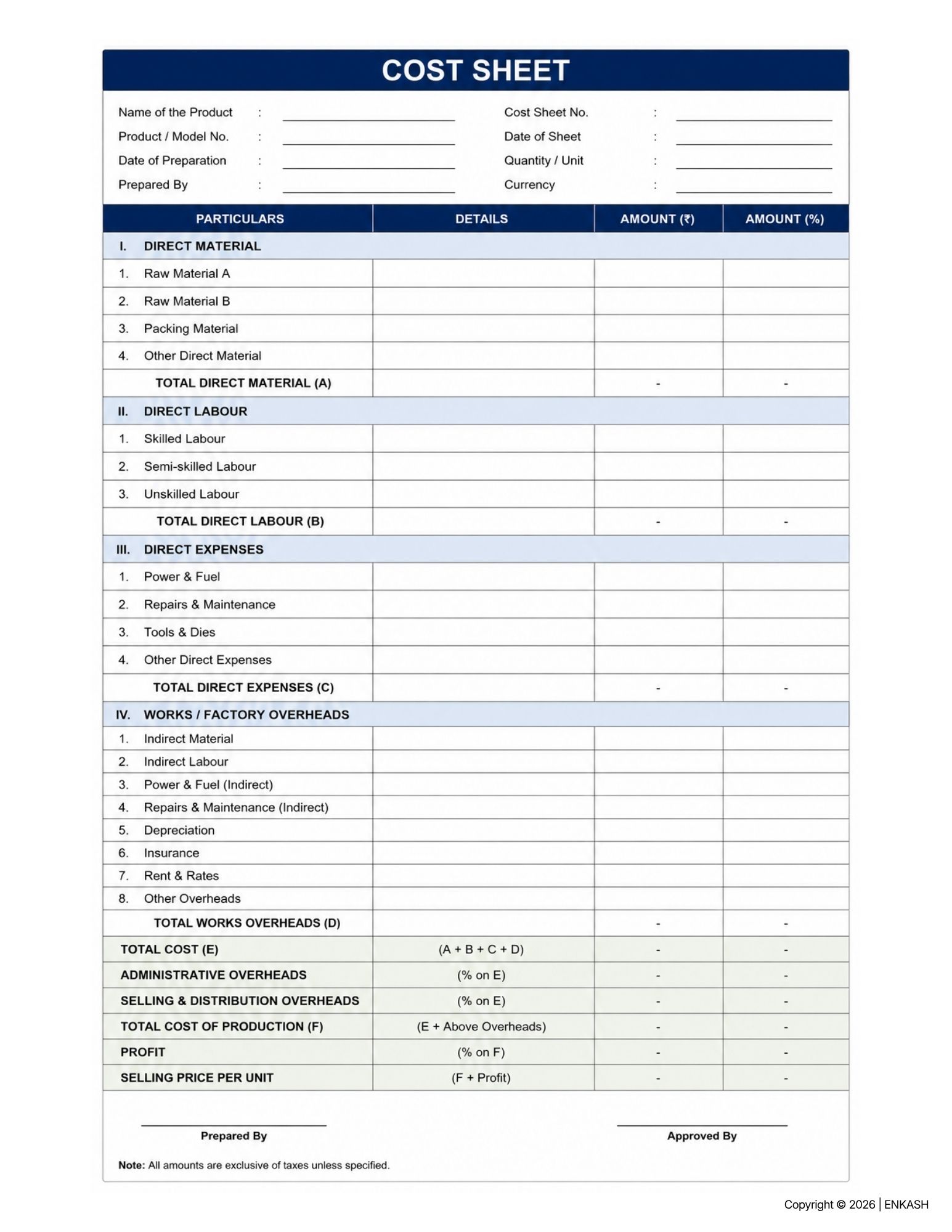
How to Prepare a Cost Sheet?
However, the process of the cost sheet involves various steps to calculate all important costs. Here's a simplified approach:
Identification of Direct Costs: First, carry out the calculation of direct materials (like raw materials, and components) and direct labor (that means wages and salaries of people directly concerned with production work), and sum these components to arrive at the total direct cost.
Factory Overheads: Include factory overheads and indirect manufacturing expenses like utilities, rent, and machinery maintenance for computing factory overhead costs.
Adding Administrative Overheads: Include such costs as rent of office buildings, salaries paid to all administration employees, and cost of office supplies.
Adding selling and distribution overheads: Include marketing costs, salesmen commission, transportation, and other costs that the company incurs in the process of selling the product.
Calculate cost of production: Direct costs are summed up with factory overheads to arrive at total production costs.
Cost of goods sold (COGS) is calculated depending on the level of inventory changes to derive the true cost of goods sold.
Compute Gross Profit: The cost of goods sold is subtracted from sales revenue.
Calculate Net Profit: Subtract all additional overheads from the gross profit to determine the final net profit. Each of these steps is crucial in providing a clear picture of the costs involved in producing goods or services.
Examples of Cost Sheets
To better understand the practical application of cost sheets, let's consider a few examples from different industries.
Example 1: Manufacturing Industry
ABC Manufacturing produces custom furniture. Here is a simplified cost sheet for one of their products, a wooden table.
Cost Sheet for Wooden Table
| Particulars | Amount (₹) |
| Direct Costs | |
| Direct Materials (Wood, Nails, etc.) | 2,500 |
| Direct Labor (Carpentry, Finishing) | 1,500 |
| Total Direct Costs | 4,000 |
| Factory Overheads | |
| Utilities (Electricity, Water) | 500 |
| Rent and Depreciation | 300 |
| Maintenance | 200 |
| Total Factory Overheads | 1,000 |
| Cost of Production | 5,000 |
| Administrative Overheads | |
| Office Rent | 200 |
| Salaries (Administrative Staff) | 300 |
| Office Supplies | 100 |
| Total Administrative Overheads | 600 |
| Selling and Distribution Overheads | |
| Advertising | 200 |
| Sales Commissions | 150 |
| Transportation | 100 |
| Total Selling and Distribution Overheads | 450 |
| Total Cost | 6,050 |
| Sales Revenue | 7,000 |
| Gross Profit | 950 |
| Net Profit | 350 |
Example 2: Service Industry
XYZ Consulting provides IT consulting services. Here is a simplified cost sheet for one of their projects.
Cost Sheet for IT Consulting Project
| Particulars | Amount (₹) |
| Direct Costs | |
| Direct Labor (Consultants, Developers) | 3,000 |
| Direct Materials (Software Licenses, etc.) | 500 |
| Total Direct Costs | 3,500 |
| Administrative Overheads | |
| Office Rent | 300 |
| Salaries (Administrative Staff) | 400 |
| Office Supplies | 100 |
| Total Administrative Overheads | 800 |
| Selling and Distribution Overheads | |
| Marketing | 200 |
| Sales Commissions | 100 |
| Total Selling and Distribution Overheads | 300 |
| Total Cost | 4,600 |
| Project Revenue | 5,500 |
| Gross Profit | 900 |
| Net Profit | 900 |
Example 3: Retail Industry
PQR Retail operates a chain of grocery stores. Here is a simplified cost sheet for one of their stores.
Cost Sheet for Grocery Store
| Particulars | Amount (₹) |
| Direct Costs | |
| Direct Materials (Inventory) | 10,000 |
| Direct Labor (Store Staff) | 3,000 |
| Total Direct Costs | 13,000 |
| Administrative Overheads | |
| Store Rent | 2,000 |
| Salaries (Administrative Staff) | 1,000 |
| Office Supplies | 300 |
| Total Administrative Overheads | 3,300 |
| Selling and Distribution Overheads | |
| Advertising | 500 |
| Sales Commissions | 400 |
| Transportation | 300 |
| Total Selling and Distribution Overheads | 1,200 |
| Total Cost | 17,500 |
| Sales Revenue | 20,000 |
| Gross Profit | 2,500 |
| Net Profit | 1,300 |
Challenges and Limitations of Cost Sheets
Cost sheets, while valuable tools, do have some limitations to consider. Here's a closer look at some of the key challenges you might encounter:
Data Accuracy and Availability:
- Incomplete or Inaccurate Data: Cost sheets rely heavily on accurate data for every cost component. Manual data entry can be prone to errors, and gathering data from different departments can be challenging. Inconsistent data collection methods can also lead to skewed results
- Estimating Indirect Costs: Allocating overheads to individual units can be complex. Methods like labor hours or machine usage might not always accurately reflect the true cost associated with each unit
Focus on Monetary Factors:
- Overlooking Non-Monetary Factors: Cost sheets primarily focus on monetary costs. However, other crucial factors like product quality, customer satisfaction, and employee morale can significantly impact business success. These aspects aren't readily captured in a cost sheet
Limitations in Predicting the Future:
- Static vs. Dynamic Environment: Cost sheets represent a snapshot of costs at a specific point in time. However, business environments are dynamic. Fluctuations in material costs, labor rates, and overheads can quickly render cost sheets outdated
Complexity and Implementation:
- Complexity for Small Businesses: Developing and maintaining cost sheets can be complex and resource-intensive, especially for smaller businesses with limited accounting expertise
Case Studies and Examples
ABC Manufacturing - Furniture Industry: ABC Manufacturing prepares a cost sheet for every product it manufactures custom furniture. A cost sheet of a wooden table, for example, includes direct costs, factory overheads, and selling and distribution costs. Net profit, after all costs are accounted for, from selling a table is indicative of the ability of ABC to manage costs and value it for profitability.
XYZ Consulting - Service Industry: XYZ Consulting has prepared a cost sheet for each project. An IT consulting project would have a direct consultant fee and software license under direct costs. There are administrative overheads, like office rent, and staff salaries, and selling and distribution overheads like marketing and sales commissions on the project. The net profit from the project is calculated after deducting these costs, allowing the company to ascertain the profitability of almost each of its projects.
PQR Retail - Retail Industry: PQR Retail prepares a cost sheet for each of its grocery stores. Direct costs are the costs associated with inventories and labor. Administrative costs are the costs associated with office rent and salaries for the staff of the office,. Selling and distribution costs comprise advertising and transportation costs, among others. Using the cost sheet versus sales revenue, the company will know the performance of every store and its optimization areas.
Future Trends in Cost Analysis
Cost analysis is rapidly evolving as technology continues to shape the way businesses manage and track their finances. The following are some of the key trends that businesses can expect to see in the future:
Automation of Cost Sheet Preparation
Automated tools and advanced software are redefining the process of preparation for cost sheets. These tools facilitate the reduction and elimination of repetition, as compared to previous constructs that bring human error within reach. Greater efficiency, speedier processing schedules, and the reality of more accurate results allow companies to focus instead on strategic decision-making.
AI and Machine Learning Integration
The ruling types of technology that reread the potential of cost analysis involve artificial intelligence (AI) and machine learning tech. These help businesses predict what their future costs are going to be, analyze spending profiles, and identify potential cost savings that are hidden from visibility. AI machines process very high amounts of data very quickly and turn them into action-oriented insights, thereby letting companies optimize resources.
Real-Time Cost Analysis
Reaction occurred at that moment when the real-time analytics tools are incorporated into the business and the cost sheets are updated immediately as they generate costs. Such a modern trend will bring precision to a wider understanding by the companies to make their decisions with great immediacy. Moreover, it would help identify any discrepancies or inefficiencies immediately through real-time tracking of costs that later call for corrective action as and when required.
Cloud-based Solutions
Cloud-based accounting solutions have been deliberately going towards cost analysis. It is the easiest and most inclusive method of accessing cost analysis. By using cloud technology, businesses can create, update, and manage cost sheets anytime and from anywhere and ensure collaboration between teams. It secures storing and easy retrieving data, thus enabling seamless operations across departments.
Focus on Sustainability
With sustainability being one of the business priorities, cost sheets will emerge to incorporate environmental costs. Cost categories specific to eco-friendly practices, waste management, and energy consumption will be included for effective cost analysis and to help organizations with their possibility to track, manage, and account for sustainability-related expenses.
Conclusion
A cost sheet is a very important tool when it comes to cost accounting, offering businesses a detailed view of their cost structure. By systematically categorizing and summarizing expenses, cost sheets enable better cost management, informed decision-making, and enhanced profitability. The insights derived from cost sheets can drive operational efficiency and financial growth for every business be it small or large. By leveraging cost sheets effectively, businesses can stay ahead in an increasingly competitive marketplace.
FAQs
What is the main purpose of a cost sheet?
The primary purpose of a cost sheet is to break down costs that are going into production or service delivery into their specific components so that a business can manage expenses optimally, price its products or services rightly, and maximize profits.
How often should a cost sheet be prepared?
It could be prepared on a monthly, quarterly, or annual basis depending on organizational requirements and the detail of costing to monitor every expense.
Can a cost sheet be used for service-based businesses?
Yes, Cost sheets are also required for service-based businesses, whereby costs such as wages earned, overhead costs, and materials would also be recognized for the service delivery.
What are the challenges in preparing a cost sheet?
Challenges include gathering accurate data, estimating indirect costs, and ensuring the information is up-to-date in a dynamic business environment.
How can a cost sheet improve profitability?
Being an indicator of high-cost areas, a cost sheet also assists businesses to undertake cost reduction and price optimization measures, hence increasing profitability.
What is the difference between direct and indirect costs in a cost sheet?
Direct costs are directly related to production (e.g., raw materials, labor), while indirect costs include overheads like utilities, rent, and administrative expenses.
What is a standard cost sheet?
Standard cost sheet provides understanding in terms of comparing the actual performance by determining whether the actual cost is higher or lower than standard cost in terms of cost incurred in producing goods or services.
How does a cost sheet help in pricing decisions?
A cost sheet gives a complete breakdown of costs for all items involved in production, which can then be used as a basis for setting prices just above costs to gain profit.