The business environment changes quickly, which can make it harder for stakeholders to judge financial health from a single period’s balance sheet, by merely looking at its static data at the end of an accounting period. A comparative balance sheet is a financial statement that is prepared by comparing financial data from two or more periods. It helps stakeholders track the trends of a company’s growth and performance by comparing critical components like assets, liabilities, and equity.
It plays an important role in strategic decision-making, optimizing processes, and long-term growth. A comparative balance sheet analysis provides insight into changes in debt levels, working capital, and asset growth. Let’s look at what a comparative balance sheet is, its format, formulas, and techniques for effective analysis.
What is a Comparative Balance Sheet?
A financial statement that showcases a company’s assets, liabilities, and equity for two or more accounting periods is a comparative balance sheet. The primary purpose of this balance sheet is to analyze changes in a company's financial position over time.
A comparative balance sheet enables businesses, investors, and analysts to compare the present year’s balance sheet with previous years to see growth trends, declines, or structural changes in finances.
How a Comparative Balance Sheet Differs from a Normal Balance Sheet
| Basis | Comparative Balance Sheet | Normal Balance Sheet |
| Time Period | Shows two or more periods | Shows one accounting period |
| Focus | Change and trend analysis | Financial position at a point in time |
| Columns | Previous year, current year, change, % change | Assets, liabilities, and equity only |
| Decision Use | Strategic planning and analysis | Statutory reporting |
What is Included in a Comparative Balance Sheet?
A comparative balance sheet displays the same information as the standard version but for multiple accounting periods, facilitating comparison of data across financial years. Let’s explore these financial components in more detail.
Current Assets
Current assets are those that are expected to be converted to cash or consumed during the next 12 months. A company’s current assets typically consist of:
- Cash: Liquid assets available for immediate use, usually held in checking or savings accounts.
- Accounts Receivable: Money owed by customers to the company for goods or services already delivered.
- Inventory: Goods or products that the company has in stock for sale.
- Prepaid Expenses: Amounts paid in advance to obtain some future service, such as insurance premiums or rent.
Long-Term Assets
Long-term assets represent those resources whose value to the company is expected to last longer than one year. They aid in a company’s long-term growth.
- Fixed Assets: Tangible assets like property, plant, and equipment used in daily operations.
- Long-Term Investments: Stocks, bonds or real estate to be held by the company for a long time.
Current Liabilities
Current liabilities are debts payable within one year. These liabilities include:
- Accounts Payable: Money the company owes to vendors for items or services it has taken but not yet paid for.
- Accrued Expenses: Charges against a business that are due but not yet paid, such as salaries.
- Notes Payable: Short-term loans or debts that must be repaid within the year.
Long-Term Liabilities
These are debts that are due over a year in the future. These liabilities include:
- Bank Loans: Long-term financing arrangements with banks or financial institutions.
- Other Long-Term Debts: Loans and bonds that have longer repayment periods.
Shareholders’ Equity
Equity represents the share of the company that remains once all debt and other obligations have been subtracted. It includes:
- Common Stock: Equity investments made by shareholders.
- Retained Earnings: The portion of profits that the company has retained for reinvestment into the business, as opposed to paying out dividends.
Comparing these components over several periods helps stakeholders see at a glance where the financial needle is moving and how well the company is performing.
Comparative balance sheet formats are organized in a way that makes comparing figures of different periods easy. Normally, this report compares two periods, but it may have additional periods added for a more detailed analysis.
Rows depict the balance sheet items, and columns refer to the financial data over different periods of time. The format helps easily observe the way each item is transformed over time. In some cases, percentage changes are also shown to highlight the magnitude of movement between periods.
Comparative Balance Sheet Example
Here is an example of Company ABC’s Comparative Balance Sheet for the years 2022 and 2023:
| Item | 2022 | 2023 | % Change |
| Assets | | | |
| Cash | ₹10,000 | ₹12,000 | +20% |
| Accounts Receivable | ₹8,000 | ₹9,000 | +12.5% |
| Inventory | ₹15,000 | ₹14,000 | -6.67% |
| Total Assets | ₹33,000 | ₹35,000 | +6.06% |
| Liabilities | | | |
| Accounts Payable | ₹5,000 | ₹6,000 | +20% |
| Short-Term Debt | ₹2,000 | ₹1,500 | -25% |
| Total Liabilities | ₹7,000 | ₹7,500 | +7.14% |
| Shareholders’ Equity | | | |
| Common Stock | ₹20,000 | ₹20,000 | 0% |
| Retained Earnings | ₹6,000 | ₹7,500 | +25% |
| Total Equity | ₹26,000 | ₹27,500 | +5.77% |
| Total Liabilities & Equity | ₹33,000 | ₹35,000 | +6.06% |
Here, Company ABC saw a 20% increase in cash. It saw a 12.5% increase in accounts receivable, which may indicate higher sales on credit or slower collections. Liquidity impact depends on collection efficiency.. Inventory went down by 6.67%. This could reflect higher sales, tighter inventory control, supply-side constraints, or planned stock reduction. Interpretation depends on the sales and procurement context. Retained earnings increased by 25%, which can indicate profitability and profit retention. The 7.14% rise in liabilities may reflect higher borrowings or payables and should be assessed alongside cash flows and revenue. The format helps stakeholders compare and analyze the company’s performance over time, which enables them to make a data-driven decision.
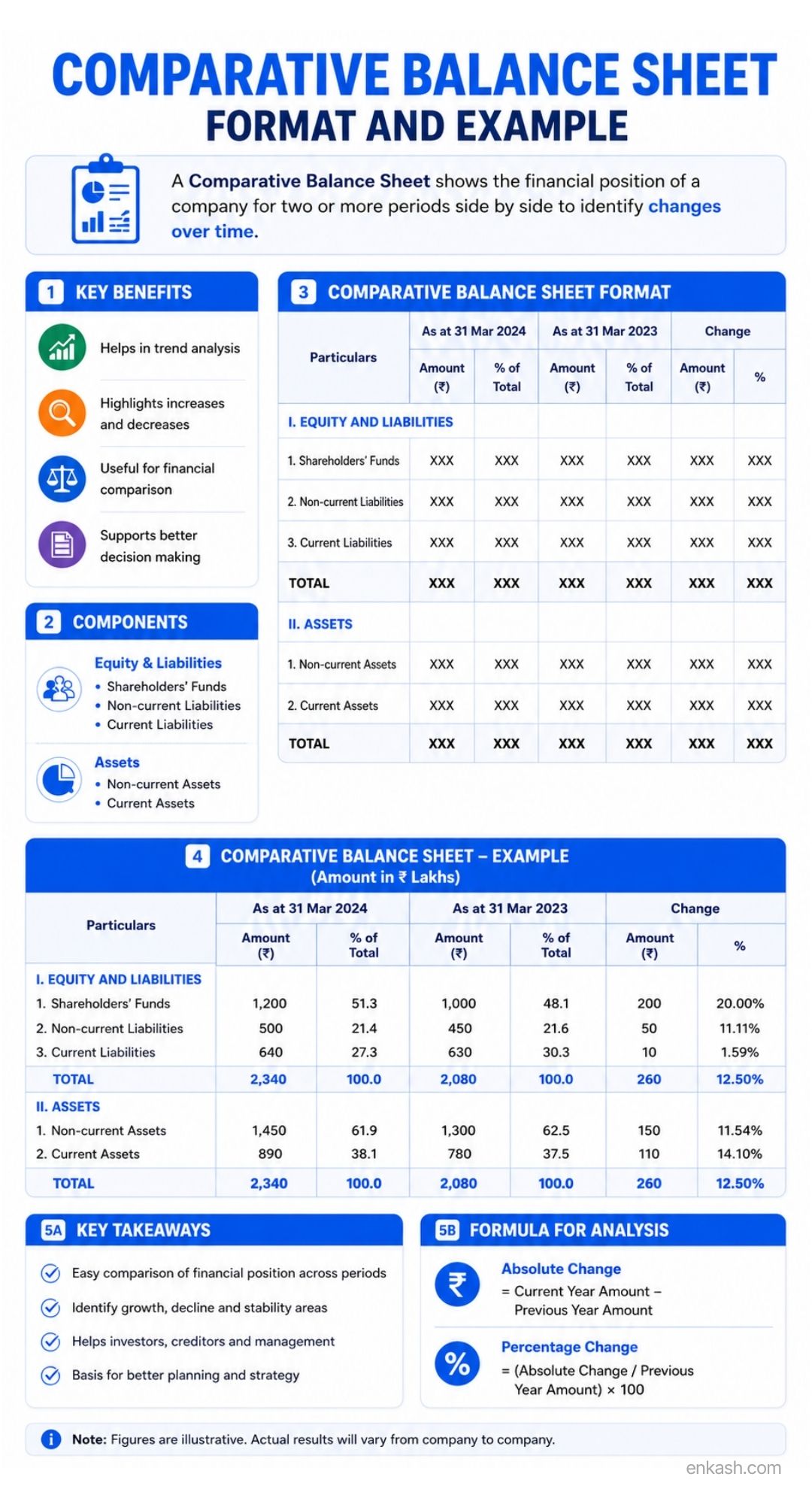
Comparative balance sheet analysis focuses on identifying changes in a company’s financial position over different accounting periods. By applying standard formulas and percentage calculations, businesses and analysts can clearly understand growth trends, financial strength, and potential risk areas. This analysis is especially useful for year-on-year comparison, strategic planning, and informed financial decision-making.
The absolute change shows the numerical increase or decrease in each balance sheet item between two periods.
Formula: Absolute Change = Current Year Amount − Previous Year Amount Example: If total assets were ₹10,00,000 last year and ₹12,00,000 this year: Absolute Change = ₹12,00,000 − ₹10,00,000 = ₹2,00,000 increase
Why it matters: This formula highlights how much a specific asset, liability, or equity component has changed in actual value.
The percentage change indicates the rate of increase or decrease relative to the previous period.
Formula: Percentage Change = (Absolute Change ÷ Previous Year Amount) × 100 Example: Percentage Change = (₹2,00,000 ÷ ₹10,00,000) × 100 = 20% increase
Why it matters: Percentage calculations make it easier to compare growth across different balance sheet items, regardless of size.
| Particulars | Previous Year (₹) | Current Year (₹) | Absolute Change (₹) | Percentage Change (%) |
| Total Assets | 10,00,000 | 12,00,000 | +2,00,000 | +20% |
| Total Liabilities | 6,00,000 | 7,00,000 | +1,00,000 | +16.67% |
| Shareholders’ Equity | 4,00,000 | 5,00,000 | +1,00,000 | +25% |
This structured format is widely used in comparative balance sheet analysis because it offers both numerical and proportional insights.
Key Insights from Comparative Balance Sheet Analysis
- Identifies financial growth or decline over time
- Highlights changes in capital structure and liquidity
- Helps evaluate solvency and operational efficiency
- Supports management, investor, and lender decisions
Objectives of Comparative balance sheet
Changes in Companies Accounting: To analyze changes in assets, liabilities, and shareholders' equity over different accounting periods
Financial Position: To facilitate easy interpretation and presentation of financial information and identify the increase or decrease in the financial position of a business.
Growth Pattern: To evaluate the trend and growth pattern of the company and to assess the company's liquidity and solvency position. And to determine the effectiveness of financial policies and resource utilization.
Decision Making: To help management and investors make informed financial decisions.
Future Planning: To provide a basis for future planning and forecasting.
Importance of Comparative Balance Sheet
Tracks Financial Changes Over Time
Helps compare assets, liabilities, and shareholders' equity across periods to identify growth or decline in the company's financial position.
Enables Trend Analysis and Forecasting
Reveals long-term financial patterns, making it easier to plan strategies and predict future performance.
Supports Better Decision-Making
Assists management in identifying strengths and weaknesses, evaluating business policies, and making investment or financing decisions.
Improves Financial Assessment for Stakeholders
Helps investors, creditors, and other stakeholders assess the company's financial stability and understand its overall performance with greater transparency.
Advantages of a Comparative Balance Sheet
Comparative balance sheets help companies identify trends, assess financial efficiency, and make informed investment decisions.
Trends and Patterns: The comparative balance sheet helps identify long-term changes in a company's financial progress.
Financial Performance: The balance sheet shows how effectively the company is using its resources and whether profits are being reinvested for growth.
Strengths and Weaknesses: Businesses are able to check areas of financial stability or concern by checking their assets, liabilities, and equity.
Efficiency and Productivity: Businesses can manage their receivables, payables, and other operational finances using the comparative balance sheet.
Better Decision-Making: It provides insights to businesses to plan their investments, control their costs, and explore financing opportunities better.
Financial Stability: Companies can track their overall financial health and adjust their strategies when required with the balance sheet data.
Benchmark Setting: Businesses can compare key financial ratios and performance with industry peers to identify their competitive edge.
Limitations of a Comparative Balance Sheet
Although the insights from comparative balance sheets are many, there are few caveats for their use in analyzing financial data.
Financial Data: Comparative balance sheets focus only on financial data and do not account for external factors like market conditions, competition, or economic changes that may affect performance.
Time Lag: The comparative balance sheet analysis is based on historical data, so there’s a possibility that figures may not accurately reflect the company's current financial position.
Seasonal Changes: The seasonal demand patterns show distorted results, which makes comparisons between periods misleading.
Inflation and Exchange Rate: The value of a company’s assets and liabilities changes depending on the inflation and currency exchange rate which affects the comparison.
Accounting Policies: Financial figures change when the accounting methods or standards change over time.
Non-Standardized Formats: The classification of balance sheet items can impact meaningful comparison across periods.
Additional Analysis: When using comparative balance sheets, it is better to use other financial instruments such as economic indicators and industry trends to get a better view of the company's financial health.
Conclusion
A comparative balance sheet is one of the most useful tools in a company’s kit bag for assessing how different financial lines, or accounts, perform over time. A comparative balance sheet helps assess how assets, liabilities, and equity change over time. Side-by-side periods make it easier to spot shifts in liquidity, leverage, and capital structure. It has its shortcomings such as delay, inflation, seasonal variations and incomparability with respect to non-monetary elements, but the benefits clearly exceed the drawbacks. Comparative balance sheets enable businesses to track their financial health, take timely decisions and plan ahead for future expansion. Combining a comparative balance sheet with the other financial statements and external factors can help businesses gain a clear picture of their financial situation, and begin devising a plan to achieve long-term prosperity.
FAQs
1. What is a comparative balance sheet?
It’s a financial report that allows the business to view their financial condition over two or more time periods. It depicts assets, liabilities, and shareholders’ equity for all periods together so you can immediately spot underlying patterns and shifts in the company’s cash flow.
2. What is the difference between a comparative and a regular balance sheet?
A regular balance sheet provides a snapshot of a company’s financial position at a specific point in time, focusing on a single accounting period, including details like assets, liabilities, and equity. In contrast, a comparative balance sheet compares financial data across multiple periods, typically two or more, allowing businesses to analyze how their financial position has changed over time.
3. What components are included in a comparative balance sheet?
A comparative balance sheet includes components such as assets (accounts receivable, inventory), liabilities (bank loans, bonds), and shareholders’ equity (common stock, retained earnings).
4. How does a comparative balance sheet help in decision-making?
A comparative balance sheet aids decision-making by providing insights into a company’s financial performance over time. By comparing financial data from multiple periods, business owners and managers can spot trends, assess whether financial strategies are working, and make informed decisions about future investments, cost-cutting measures, or expansions.
5. What are the advantages of using a comparative balance sheet?
Some of the advantages of using a comparative balance sheet are spotting trends, assessing financial performance, identifying strengths and weaknesses, and facilitating decision-making.
6. What limitations should be considered in comparative balance sheet analysis?
While comparative balance sheets are useful, they have some limitations. Some of these are time lag, seasonal variations, inflation, or changes in exchange rates, and the exclusion of non-financial factors.
7. How can investors benefit from using comparative balance sheets?
Investors use comparative balance sheets to evaluate a company’s financial stability and growth potential. For instance, a growing trend in retained earnings or assets may signal a healthy and expanding business, making it more attractive to investors. On the other hand, increasing liabilities or declining assets could be red flags, prompting further investigation before making an investment decision. It also helps investors assess a company’s ability to pay dividends and reinvest in growth opportunities.
8. How are percentage changes calculated in a comparative balance sheet?
Percentage changes in a comparative balance sheet are calculated using the following formula: Percentage Change = ((Current Year Value – Previous Year Value) / Previous Year Value) * 100. For example, if a company’s cash balance increases from ₹20,000 in the previous year to ₹22,000 in the current year, the percentage change would be: (22,000 – 20,000) / 20,000 * 100 = 10%.
9. How does a comparative balance sheet help a business grow?
Comparative balance sheets provide a clear picture of financial trends. Businesses can capitalize on growth opportunities as they know their strengths, for example, increasing retained earnings or cash in the bank. Similarly, spotting weaknesses like growing liabilities or declining assets allows companies to take corrective action before these issues worsen. They can also enable better resource allocation, guiding businesses in deciding where to invest for maximum return.