Key Takeaways
- The company’s negotiating position becomes clearer once spend data from different branches, teams, and categories is viewed together.
- Not every piece of data supports a price reduction. Order volume, price history, buying frequency, contract terms, and supplier performance may point toward different commercial improvements.
- Vendor negotiation should begin with the outcome the buyer wants, followed by the evidence that makes the request credible.
- Possible gains can sit in pricing, freight, rebates, minimum-order requirements, service levels, payment conditions, or volume commitments.
- Payment terms for eligible Micro and Small Enterprise suppliers must remain within the delayed-payment limits applicable under the MSMED Act.
- Once new terms are live, compare them with invoices and actual buying to see whether the expected savings were really achieved.
A vendor may receive orders from several branches and see each one as a separate sale. Procurement can make the same mistake when purchasing records remain split across offices, plants, teams, or legal entities. Once those transactions are brought together, the commercial picture can change. Annual volume may be larger than expected, identical items may carry different prices, or repeated orders may reveal predictable demand.
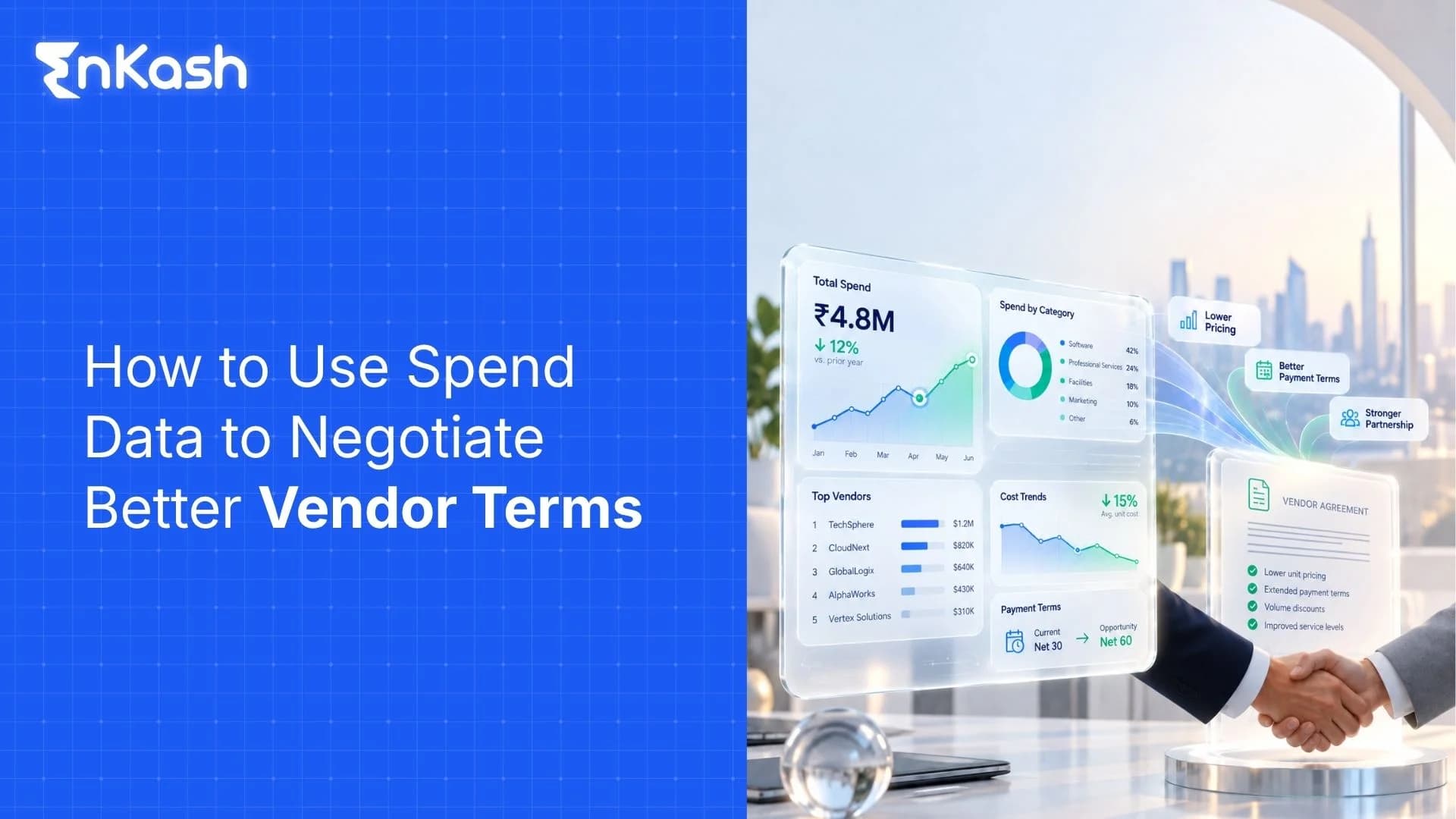
Consolidated spend data turns those scattered purchases into one supplier-level view. It gives procurement a factual base for deciding what to ask for and when to reopen the commercial discussion. Spend consolidation can reveal negotiating leverage that is invisible when purchasing is analysed branch by branch.
Where Fragmented Spend Weakens Your Negotiating Position
Fragmented purchasing data can hide the scale, cost, and performance of a supplier relationship. Before procurement looks for leverage, it needs to know where the buying picture is incomplete.
Several common gaps can weaken the commercial position:
Purchases Split Across Locations
A supplier may serve multiple plants, branches, or offices through separate purchase orders. Each team sees its own demand, so total annual volume can remain hidden. Consolidating those purchases can reveal a larger account than any single location suggests.
Duplicate Supplier Records
The same supplier may appear under different legal names, trading names, or vendor codes. Duplicate supplier records can understate total spend with the vendor and hide the true scale of the commercial relationship.
Different Rates Across Teams
Separate teams may pay different prices for comparable products or services. Freight, pack size, geography, or volume can explain some variance. Unexplained gaps are worth isolating before a pricing discussion.
Late deliveries, quality complaints, returns, and invoice errors may live in different systems. Combining them shows what the supplier delivers against the money spent.
Local Buying That Dilutes Volume
Similar requirements may be spread across several suppliers. That can reduce the volume presented to each vendor and weaken the case for stronger commercial terms, although consolidation should be weighed against supplier concentration, continuity and resilience risks.
What Spend Data Should You Use in a Vendor Negotiation?
A useful vendor spend analysis needs invoice totals plus context. Procurement should connect spend with what was purchased, how often it was ordered, what the contract promised, and how the supplier performed.
A negotiation-ready dataset should include the following areas:
Total Vendor Spend
Capture organisation-wide spend for a period that reflects normal purchasing patterns, typically at least one full buying cycle and often 12 months where seasonality permits.
Category and SKU Spend
Break the total into products, services, categories, and key items. This shows where commercial value is concentrated.
Volume and Order Frequency
Record units, average order size, recurring demand, and order count. Ordering behavior can change the supplier economics behind the same annual spend.
Price History
Track previous prices, revisions, location-level rates, freight, and recurring charges.
Existing Commercial Terms
Record rebates, minimum order quantities, freight conditions, credit periods, discounts, contract dates, and volume commitments.
Add delivery, quality, returns, service, and invoice accuracy. Strong procurement data should show both commercial value and supplier execution.
Identify the Spend Patterns That Create Negotiating Leverage
Consolidated information becomes useful when it reveals a change in the supplier relationship. Procurement should look for patterns that support a specific request.
Look for patterns such as these:
Consolidated Spend Is Higher Than Expected
Company-wide aggregation may reveal a larger annual relationship than individual teams realized.
Purchase Volume Has Increased
Actual unit volume may have moved well above the level used when current rates were agreed. The increase can support a discussion around volume tiers or rebates.
Internal Price Variance Exists
Comparable purchases at different rates can point to an opportunity for price harmonization across locations or business units.
Demand Has Become Predictable
Repeated buying can reveal a monthly, quarterly, or seasonal pattern. The buyer gains a clearer forecast and the supplier gains better demand visibility.
Supplier Overlap Exists
Spend analysis may show similar purchases spread across several vendors. Procurement can assess whether part of the category can be consolidated without creating supply risk.
Spend Is Rising Faster Than Usage
Higher spend may come from price changes, freight, surcharges, or product mix instead of higher demand. Separating price effects from usage growth sharpens the starting point.
Larger orders paired with weaker delivery, quality, or service can support a contract review.
Price Increases Exceed the Underlying Cost Change
Historical pricing can show whether vendor increases are materially higher than movements in relevant input costs, freight, exchange rates, or other agreed price drivers. Where the contract or category supports such comparison, this can create a factual basis for reopening the price.
Match Spend Evidence to the Vendor Term You Want to Negotiate
Each data point should support a defined commercial request. A supplier is more likely to engage with a case that links evidence to one clear change. Different spend signals can support different discussions.
| Spend Evidence | What It Reveals | Vendor Term to Discuss |
|---|
| High annual spend | Large organization-wide relationship | Volume pricing |
| Rising purchase volume | Account value has increased | Tiered rates |
| Predictable demand | Better demand visibility | Annual pricing agreement |
| Internal price variance | Comparable purchases carry different rates | Price harmonization |
| Similar spend across vendors | Part of the category may support consolidation | Preferred-supplier pricing |
| Repeat volume crosses thresholds | Recurring demand has measurable value | Volume rebate |
| Consistently early payment | Supplier receives cash earlier and with greater predictability | Early-payment discount |
| High freight cost | Ordering pattern may be driving logistics cost | Freight terms |
| Service failures | Actual service falls below agreed or expected performance | SLA revision, corrective action or service credits |
The request should follow the evidence. Pricing needs commercial proof, while service changes need performance proof.
Prepare the Vendor Negotiation Around the Evidence
Share only the evidence required to support the commercial request; sensitive internal forecasts, margins, or cross-supplier information should not be disclosed unless there is a clear reason and appropriate approval. It needs the evidence that explains what changed and why a new commercial term is reasonable.
Structure the discussion in this order:
- Set the baseline: Record the current rate, spend, volume, contract position, and term under review.
- Show what changed: Present the relevant pattern, such as higher volume, predictable demand, price variance, or weaker service.
- State the request: Put a defined proposal on the table, such as a revised rate, rebate, freight term, or service commitment.
- Show what the supplier receives in return: Present any volume commitment, improved forecast, larger share of spend, simplified ordering, or longer agreement available in return.
- Prepare alternatives: Define the acceptable alternatives before the meeting: another pricing structure, rebate, freight change, service commitment, payment arrangement, volume tier, or sourcing option.
This makes the negotiation specific: what changed, what the buyer wants, and what the supplier receives in return.
Check Indian MSME Rules Before Negotiating Payment Terms
Payment terms need a separate compliance check when the supplier qualifies as an eligible Micro or Small Enterprise. The commercial discussion must remain within the delayed-payment framework that applies to qualifying MSE suppliers.
Complete these checks before changing the payment period:
Verify Supplier Classification
Confirm the supplier's current Micro or Small Enterprise classification, Udyam registration details, and whether the supplier falls within the delayed-payment provisions applicable to the transaction. Procurement and finance should verify eligibility rather than relying only on the vendor's commercial label.
Check the Permitted Payment Period
Where a written payment period is agreed with an eligible Micro or Small Enterprise supplier, it cannot exceed 45 days from the day of acceptance or deemed acceptance of the goods or services. Where no payment period is agreed in writing, the MSMED Act's appointed-day framework applies, which is linked to 15 days from acceptance or deemed acceptance. Payment beyond the applicable period can attract compound interest with monthly rests at three times the bank rate notified by RBI, as provided under the MSMED Act.
Section 43B(h) of the Income-tax Act affects the timing of deduction for sums payable to Micro or Small Enterprises when payment goes beyond the period allowed under Section 15 of the MSMED Act. Finance and tax teams should review the effect before procurement agrees to a longer cycle.
Consider Receivables Financing Where Relevant
TReDS can help eligible MSME suppliers obtain earlier liquidity by discounting accepted trade receivables through participating financiers. It may be relevant where supplier cash flow is part of the commercial discussion without requiring the buyer to simply shorten every contractual payment term.
Choose the Right Moment to Reopen Vendor Terms
Even a strong negotiation case can be less effective if it is raised at the wrong point in the commercial cycle. Contract renewal, an approved forecast, or a sourcing event can create a better opening.
Useful moments include the following:
- A contract or rate agreement is approaching renewal.
- A sourcing cycle is about to begin.
- Forecasts for the next period have been approved.
- A major future requirement can now be quantified.
- Procurement centralization has changed how purchases will be managed.
- A new budget cycle creates a point to revisit commercial assumptions.
Timing works best when the evidence and commercial event support the same request.
Track Whether the New Vendor Terms Deliver Real Value
Actual transactions show how much negotiated value the business captured. Tracking should cover commercial compliance and supplier execution.
The main measures are listed below:
Price Compliance
Compare purchase-order and invoice prices against the contracted rate, including agreed freight, discounts, and other recurring charges. Variances should be identified before they repeat across several billing cycles.
Purchasing Compliance
Measure what share of eligible purchases was placed with the negotiated supplier and under the agreed contract, rather than through off-contract vendors or rates.
Rebate Realization
Track qualifying purchases and confirm that credits, rebates, or incentives are received.
Compare actual demand with any volume commitment used to secure the commercial terms.
Track delivery, quality, and service measures after the agreement changes.
Better Negotiations Start With Better Spend Visibility
Vendor negotiations become stronger when procurement and finance can work from a consistent view of actual business spend. Centralised records across employee expenses, corporate card transactions, branch-level spending and other business payments can make it easier to identify recurring vendors, compare categories, track transaction patterns and verify whether negotiated terms are being followed.
EnKash's Expense Management capabilities help businesses track and analyse expenses across teams, departments, projects and locations, while Corporate Cards provide transaction-level visibility and configurable controls for business spending. For procurement-related purchases, EnKash can also help businesses track vendor-wise spending and control how allocated funds are used.
The objective is not simply to collect more spend data. It is to make that data structured enough for procurement and finance teams to use when reviewing supplier relationships, preparing negotiations, and measuring the value captured afterward.
Bottom Line
Good spend data gives procurement a clearer view of what the company buys, how the supplier relationship has changed, and which commercial request can be defended with evidence. The value comes from using the right signal at the right time, then checking whether the agreed terms appear in real transactions. In India, payment-term decisions also need to account for the rules that apply to eligible MSE suppliers.
FAQs
How Much Historical Spend Data Should Be Reviewed?
Look far enough back to separate routine buying from temporary spikes. For many categories, twelve months gives a useful view of volume, pricing, and recurring demand. Strongly seasonal purchases may need comparison with the same buying periods from earlier years.
Can Spend Data Help With a Sole-Source Vendor?
Yes. When there is no practical alternative supplier, the discussion may move away from unit price. Spend patterns can support stronger terms around delivery, warranties, inventory commitments, forecasting, service response, escalation, and contract design.
Does Higher Spend Automatically Mean Better Pricing?
Large spend creates a reason to reopen the commercial discussion, but it does not guarantee a price reduction. Supplier capacity, raw-material costs, order complexity, available competition, and the buyer’s ability to switch all influence the result.
Should Every Location Receive Identical Vendor Terms?
A central agreement can set the commercial baseline without forcing every site into identical terms. Freight, order size, delivery conditions, and service requirements may create legitimate differences. Procurement needs to identify which variations have a clear reason and which do not.
What is the Difference Between Negotiated and Realized Savings?
Negotiated savings are the improvement agreed against a defined baseline and reflected in the commercial terms. Realised savings are the portion that actually appears in purchases, invoices, rebates or other measurable transactions. Missed rebates, incorrect invoices, weak contract adoption, lower committed volumes, or supplier performance issues can reduce what the business finally captures.