Businesses do not always record quantities in the same language. A trader may write kg on one invoice, kilograms in stock records, and kgs inside billing software. Another team may use pcs, pieces, nos, bottles, cartons, or rolls for daily entries. GST reporting requires standardised quantity data because invoices, returns, e-invoices, and movement records read unit fields in a fixed format.
An incorrect unit entry can result in filing corrections, failed uploads, or review issues during GST work. An invalid UQC issue may appear minor at the invoice level, yet it can disrupt return preparation and item-level reporting. The sections ahead cover UQC meaning, the approved code list, frequent unit-code mistakes, and the right way to manage mapping inside billing software.
What is UQC in GST
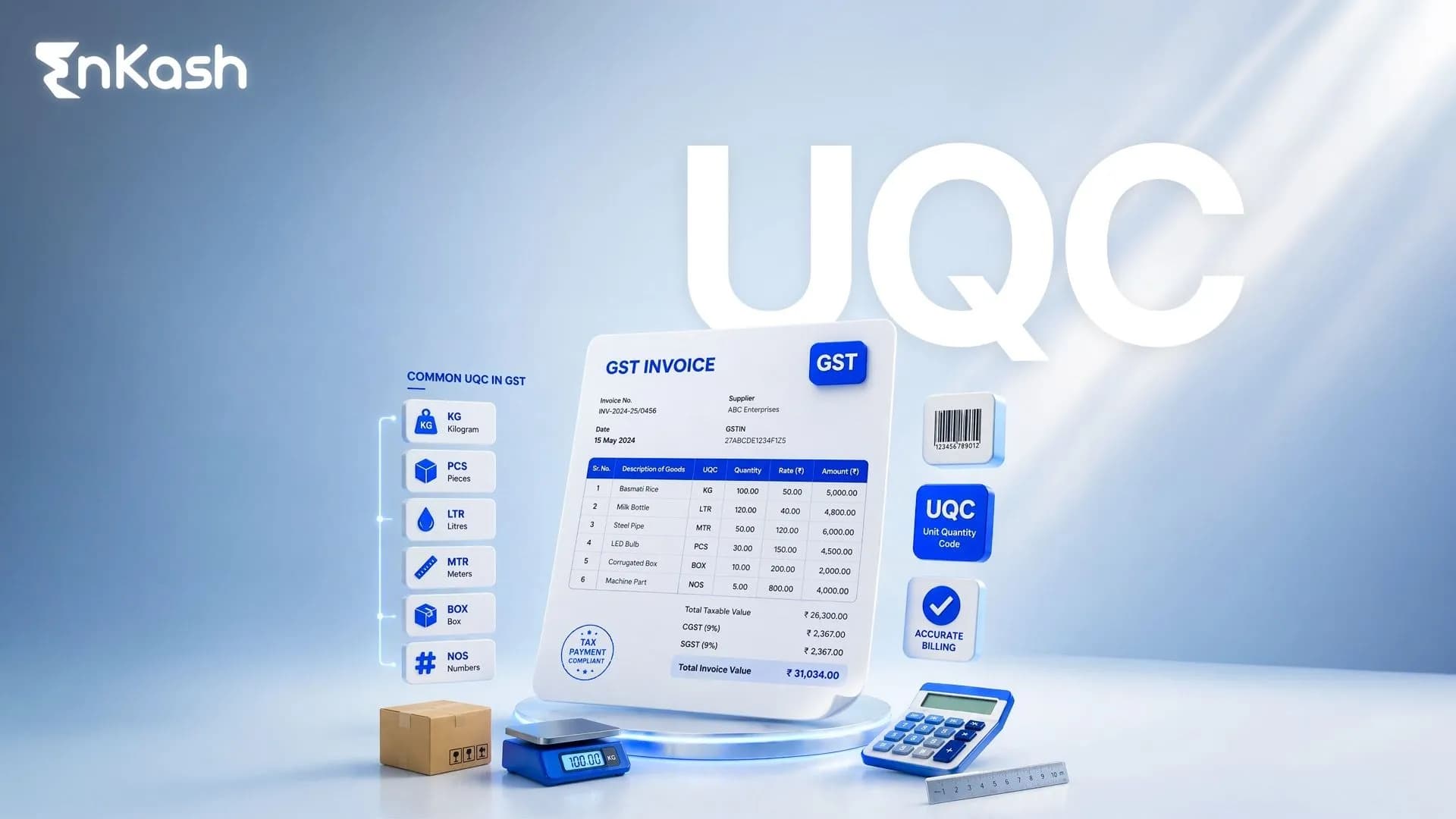
UQC's full form is unit quantity code. It refers to the GST-approved code used to identify the measurement unit of a supply. The code tells the GST system how the reported quantity should be interpreted, whether the item is sold by weight, length, volume, count, area, packaging, or another accepted basis.
The UQC code's meaning can be understood through normal business transactions. If rice is sold by kilograms, the unit code would be KGS. If fabric is sold by the meter, the code would be MTR. If spare parts are sold individually, the code would be PCS. These codes remove confusion between casual internal labels and GST-ready reporting fields.
A business can still keep familiar unit names inside its inventory records. Staff may use kg, roll, box, strip, bottle, or packet while managing stock. The GST entry, however, must use the accepted code from the prescribed unit list. This distinction becomes important when invoice data is moved to returns, e-invoice systems, e-way bill records, or
HSN summaries.
Why Correct UQC Mapping Matters for GST Compliance
It Creates One Standard Unit Language
Business records can carry many local unit habits. A textile seller may enter meter in one place, mtr in another, and running meter in a stock sheet.
GST reporting requires a fixed unit code because quantity data must remain readable across invoices, returns, and linked records.
This removes guesswork from unit descriptions. A length-based supply must carry the accepted code for that measurement, rather than an internal billing team abbreviation. Cleaner unit language reduces manual review and prevents confusion during data preparation.
It Supports System-Level Validation
GST data moves through structured fields. Quantity, unit, taxable value,
tax rate, and classification details are checked separately before the record can move through digital reporting. A missing or unsupported unit entry can disrupt this flow because the system cannot read the item's measurement basis.
Correct use of UQC in GST helps the data pass field-level checks with fewer corrections. It gives the system a recognized unit value instead of a loose description. This becomes important when invoice data is prepared through software, uploaded in bulk, or generated through connected GST utilities.
It Strengthens Reconciliation and Audit Clarity
A correct unit entry makes records easier to compare. Buyers, sellers, accountants, and reviewers can match quantity details without having to interpret internal naming conventions. If one document records a supply in pieces and another uses a vague pack reference, the numbers may need manual explanation later.
Clean unit coding improves audit trails because the measurement basis remains visible at the item level. It helps finance teams read transaction history with greater confidence, trace supply records more quickly, and handle review queries without rebuilding basic quantity details from supporting documents.
Where You Need UQC in Your Filings
Tax Invoices, Debit Notes, and Credit Notes
GST documents need quantity details that match the item supplied. The unit field should reflect the way the item is measured, sold, or transferred. A fabric invoice should use a length-based unit, while a chemical supply invoice may use a volume-based unit. The same discipline applies when issuing debit notes or credit notes for quantity-linked adjustments.
GSTR-1 HSN Summary
GSTR-1 HSN reporting groups outward supplies by classification. Quantity details need the correct unit where the reported HSN data requires it. This helps the return reflect supply volume in a structured format rather than relying solely on
taxable value. The unit used in the summary should align with the product’s actual measurement basis.
E-Invoicing
E-invoice data is built through item-level fields. Each line needs the required product, quantity, value, tax, and unit details before the invoice can be processed cleanly. A blank or incorrect unit field may create a generation issue. The unit entry should be checked before the invoice data is pushed for e-invoice creation.
E-Way Bills
E-way bills connect goods movement with quantity and unit details. The unit should describe what is physically being transported. Bulk goods, packaged goods, countable items, and liquid supplies need different unit codes. A transport record becomes clearer when the quantity and unit describe the consignment without forcing later interpretation.
Common UQC Code List for GST
The official UQC list works as the reference point for
GST unit reporting. Businesses should compare their internal unit names with this list before billing, filing, or generating linked GST records. A local unit short form may help staff during stock entry, but the GST output should carry the accepted code. OTH should be used with care when no closer listed code applies.
| UQC Code | Unit Description | Common Business Use | Category |
|---|
| BAG | Bags | Cement, grains, packaged goods | Packaging |
| BAL | Bale | Cotton, textile bundles | Packaging |
| BDL | Bundles | Rods, sticks, grouped items | Packaging |
| BOX | Box | Boxed goods, retail packs | Packaging |
| BTL | Bottles | Beverages, chemicals, liquids | Packaging |
| BUN | Bunches | Flowers, grouped agricultural items | Packaging |
| CAN | Cans | Paints, oils, packed liquids | Packaging |
| CBM | Cubic Metres | Bulk volume measurement | Volume |
| CCM | Cubic Centimetres | Small volume measurement | Volume |
| CMS | Centimetres | Length measurement | Length |
| CTN | Cartons | Shipping cartons, packed items | Packaging |
| DOZ | Dozens | Items sold in sets of twelve | Count |
| DRM | Drums | Industrial liquids, chemicals | Packaging |
| GMS | Grams | Small weight items | Weight |
| GRS | Gross | Items counted in 144 units | Count |
| KGS | Kilograms | Food grains, metals, bulk goods | Weight |
| KLR | Kilolitres | Large liquid volumes | Volume |
| KME | Kilometres | Distance-based supplies | Length |
| LTR | Litres | Liquids, oils, beverages | Volume |
| MLT | Millilitres | Small liquid quantities | Volume |
| MTR | Metres | Fabric, cable, pipe | Length |
| MTS | Metric Tonnes | Heavy goods, bulk commodities | Weight |
| NOS | Numbers | Individual countable items | Count |
| OTH | Others | Use when no listed code applies | Other |
| PAC | Packs | Packaged retail items | Packaging |
| PCS | Pieces | Parts, components, units | Count |
| PRS | Pairs | Shoes, gloves, paired goods | Count |
| QTL | Quintals | Agricultural and bulk goods | Weight |
| ROL | Rolls | Fabric rolls, paper rolls, cables | Packaging |
| SET | Sets | Kits, grouped product sets | Count |
| SQF | Square Feet | Area measurement | Area |
| SQM | Square Metres | Area measurement | Area |
| SQY | Square Yards | Area measurement | Area |
| TON | Tonnes | Heavy goods, industrial materials | Weight |
| TUB | Tubes | Tube-packed goods | Packaging |
| UNT | Units | General unit-based supplies | Count |
| YDS | Yards | Fabric, length-based supplies | Length |
UQC Errors
Invalid UQC
An invalid UQC is a unit entry that GST systems cannot accept. This can happen when the field is blank, incorrectly entered, unsupported, or differs from the approved code list. Common mistakes include KG instead of KGS, PC instead of PCS, METER instead of MTR, and LITRE instead of LTR. These errors create avoidable correction work during digital reporting.
Wrong Internal Unit Mapped to GST Unit
Many businesses keep stock in practical terms such as jars, strips, cartons, packets, rolls, or boxes. Problems begin when these internal labels are linked to the wrong GST code inside the product master. A carton may represent packaging, while the actual supply may be counted by pieces. Poor mapping can distort how quantity appears in GST-ready data.
Missing UQC During E-Invoice Generation
E-invoice generation needs item-level unit data. If the unit field is empty, the invoice record may fail validation before the invoice reference can be generated. This issue is different from choosing the wrong code. Here, the system receives no unit value, leaving the quantity without a defined measurement basis.
Quantity and Unit Mismatch
A mismatch happens when the quantity and unit describe different measurement types. Liquid goods entered with PCS, weight-based goods reported with NOS, or flooring material entered with MTR instead of SQM can create inconsistent records. The quantity may be numerically correct, but the unit makes the supply difficult to read accurately.
How to Avoid Errors
Use the GST Unit List Instead of Internal Abbreviations
GST-facing data should use the accepted unit codes exactly as listed. Informal labels can remain inside warehouse notes, purchase planning, or staff-facing stock records, but reporting files need the correct unit code. Entries such as KGS, PCS, NOS, LTR, MTR, SQM, and OTH should be selected with care. Self-created abbreviations increase the chance of rejection.
Create a Product-Wise UQC Mapping Sheet
A product-wise mapping sheet gives finance and operations teams a shared reference. The sheet should include product name, HSN, internal unit, GST UQC, invoice unit, reviewer name, and last updated date. This control is useful when product masters are edited by different users. It creates ownership and reduces casual unit changes before billing.
Review High-Risk Unit Pairs Before Filing
Certain units need closer checking because they are easy to confuse during data entry. PCS and NOS, KGS and GMS, LTR and MLT, MTR and SQM, CTN and BOX, and PAC and PCS should be reviewed before filing, uploading, or generating. These pairs may look close in daily use, but they can change how the supply is interpreted.
Validate Data Before Upload or Generation
Final validation should happen before
GST return uploads, e-invoice generation, or e-way bill creation. Finance teams should review export files, JSON files, and software validation reports before submission. This step catches missing unit values, unsupported codes, and item-level inconsistencies before they become filing issues. A short review can prevent longer correction cycles later.
Mapping UQC in Your Accounting Software
Accounting, ERP, billing, and inventory systems should carry unit mapping inside the product master. Each item record should include the product name, HSN, internal UOM, GST UQC, and tax rate. This setup allows daily billing teams to use familiar product labels while GST exports carry the approved unit code.
Bulk SKU imports need careful review before upload. If a spreadsheet carries old unit names or blank unit fields, the same issue can spread across many products at once. A controlled import template reduces this risk.
Invoices, e-invoice exports, e-way bill exports, and GSTR-1 data should use the same unit value from the same master record. This avoids separate unit decisions at each reporting stage. New products should be checked for UQC in GST mapping before they are made active for billing.
Conclusion
Correct unit coding is a small but important part of clean GST reporting. A single unit-code error can require corrections across invoices, return data, e-invoice records, or transport documentation. Businesses can reduce these issues by using the accepted GST unit list, carefully mapping every product, and reviewing export files before filing or generation.
A strong UQC process does not need to be complicated. It needs ownership, correct product masters, and routine checks whenever new items are added. Treating unit codes as part of GST data hygiene helps finance teams maintain consistent, readable records that are easier to review.
FAQs
What is the UQC Full Form in GST?
UQC stands for Unit Quantity Code. It identifies the unit used to report quantity under GST. The code helps GST records read quantity details in a fixed format across invoices, returns, e-invoices, and movement documents.
What is UQC in GST with an example?
UQC in GST refers to the standard code used for quantity measurement. For example, a liquid supply measured in liters should use LTR, while flooring material measured by area may use SQM.
What does Invalid UQC mean?
Invalid UQC means the unit code entered does not match the approved GST unit list. The issue may involve a missing field, an unsupported entry, a spelling error, or an informal unit name entered in a GST-facing record.
Where is UQC used in GST filing?
UQC appears in invoice records, GSTR-1 HSN summaries, e-invoice data, and e-way bill records. It helps link the reported quantity with the correct measurement unit across key GST compliance documents.
How should a business select the correct Unit Code?
The correct Unit Code should match the product's or supply's actual measurement basis. Businesses should map internal unit names to the accepted GST list inside billing or accounting software before generating GST records.
Can OTH be used for every unclear GST unit?
OTH should be used only when the accepted UQC list has no suitable unit for the supply. Using OTH as a default option can weaken item-level reporting and may create review issues during
reconciliation.
How do I fix a wrong UQC in GST records?
A wrong UQC should be corrected at the source record first, such as the invoice, product master, or accounting entry. After correction, the revised data should be checked before return filing or document generation.
Is UQC required for services under GST?
UQC is mainly relevant where quantity reporting applies. UQC is mainly relevant where quantity reporting applies. For services, businesses should follow the unit accepted by their GST software, e-invoice schema, or return utility. Where no specific unit applies, OTH may be used if supported and appropriate.
Can internal stock units differ from GST UQC?
Internal stock units can differ from GST UQC if the accounting software correctly maps them. For example, staff may use “box” internally, but GST output must carry the accepted code linked to the actual supply unit.
Why does a UQC mismatch happen in the GST software?
A UQC mismatch occurs when product masters, invoice templates, or imported spreadsheets contain different unit details. It can also occur when new products are activated without first checking the GST unit field.