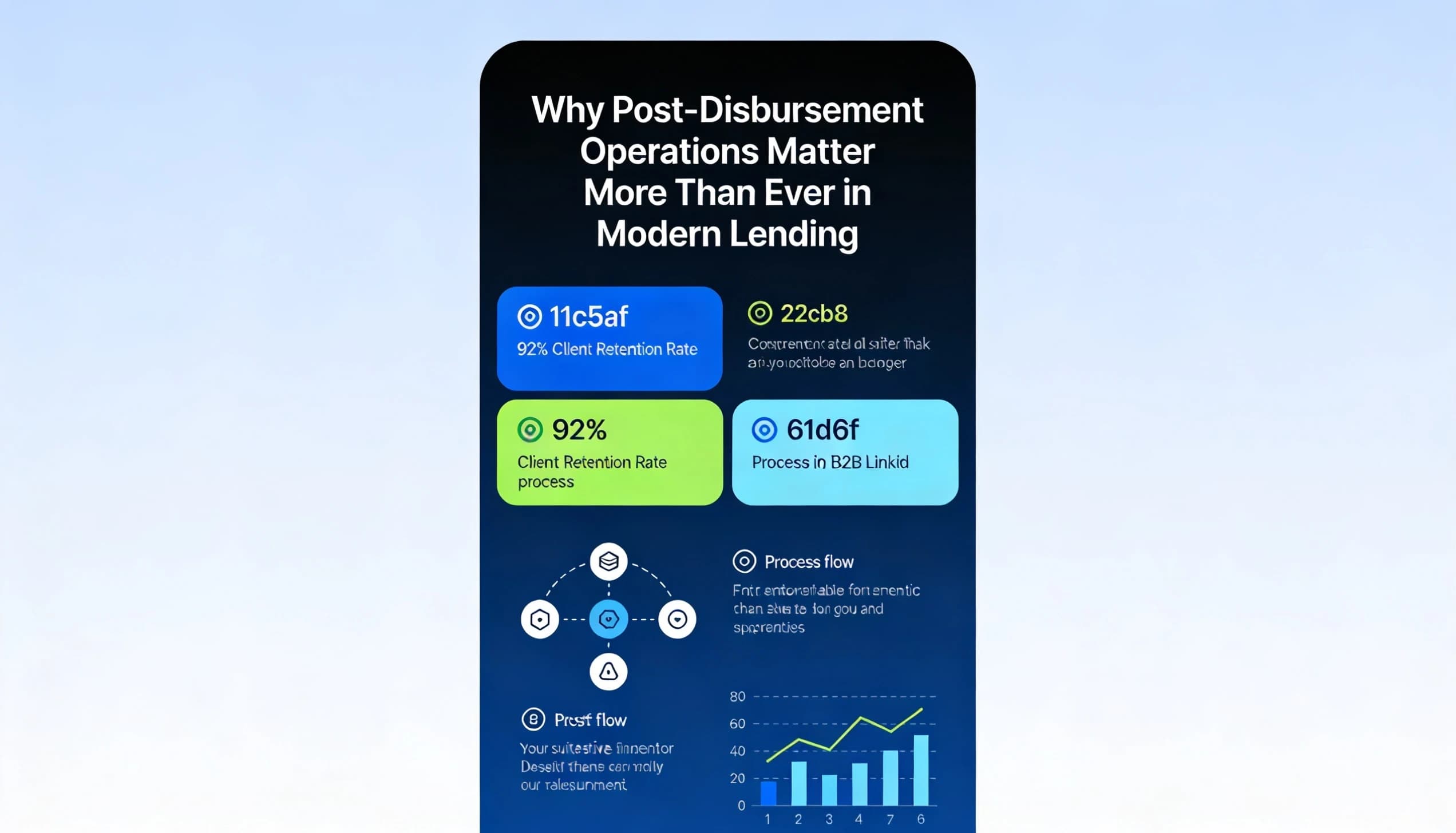
The equipment finance industry treats disbursement as the finish line. Approve the $500,000 excavator loan, transfer funds, and celebrate. But origination purchases a risk. Servicing manages it. Post-disbursement operations determine 80% of portfolio lifetime value through ongoing monitoring, payment management, and borrower engagement over the 60 months that follow.A commercial lender often dedicates most of their technology budget to origination, while servicing runs on spreadsheets and legacy systems. Payment exceptions surface weekly, including late payments, modification requests, and covenant breaches. Manual processes turn each exception into hours of work across disconnected systems. Missed communication windows delay repayments, manual interventions drift from policy, and exceptions become habits. What looks like operational noise can result in gradual profit erosion that quarterly reports miss until defaults force recognition. Lenders need loan servicing software that detects risk early and scales with portfolio complexity. Credit risk no longer spikes at approval. It grows during execution, and that’s why loan servicing execution matters as much as origination speed.
The loan servicing market reached $2.92 billion in 2025, projected to grow to $6.26 billion by 2030 at 16.5% CAGR, outpacing origination software growth. The economics are clear: A $75 million portfolio losing 3% to servicing inefficiency bleeds $2.25 million annually.Traditional servicing can't eliminate this friction because borrowers experience their financial reality continuously while lenders observe it episodically. Covenant tests are executed weekly. Risk reports are generated monthly. Portfolios silently deteriorate between reporting cycles, forcing reactive restructures that origination excellence cannot offset. When monitoring operates on quarterly snapshots rather than continuous signals, lenders discover covenant breaches and payment stress too late.
How Modern Loan Servicing Software Eliminates Operational Friction
Consider a $500,000 excavator loan with seasonal payments. Three months after disbursement, the borrower requests a six-month deferral. Traditional servicing requires pulling files, manually recalculating schedules, documenting approvals, and updating general ledgers across three systems. Automated loan servicing software processes this in minutes: recalculates payment schedules, generates approval workflows, updates financial records, and sends borrower communications. Here’s how loan servicing intelligence offers benefits:Unified data architecture breaks down the wall between origination and servicing: Account details, payment history, covenant status, and modification records live in one system. The servicing team sees the original credit memo. The sales team sees payment behavior. Collections specialists see complete borrower relationships without pulling files from three departments.
Automated payment processing eliminates manual overhead: A $75 million portfolio with 150 loans generates 1,800 payments annually. Manual processing at 15 minutes per payment consumes 450 hours. Automation reduces that to 50 hours for the 8% requiring human judgment.
Real-time covenant monitoring detects risk before default: Instead of quarterly reviews, the system continuously tracks borrower metrics. When a $300,000 crane's utilization drops below 60% for two consecutive months, the system flags the covenant breach automatically. The account manager receives alerts before the borrower misses a payment, enabling proactive outreach. Early intervention often prevents default and a simple rate adjustment solves cash flow timing issues before they escalate.
Automated collections workflows reduce delinquency through systematic follow-up: At 10 days late, the loan servicing intelligence system triggers automated outreach. At 20 days, it escalates to phone contact. At 30 days, it generates a formal notice and adjusts risk ratings.
Servicing becomes a revenue engine, not a cost center: When a borrower pays down 40% of their equipment loan and utilization shows heavy use, the platform automatically prompts relationship managers: "Customer qualifies for pre-approved upgrade." Cross-sell opportunities surface systematically. Expanding existing relationships costs far less than winning new ones.
Customer portals enable self-service access: Borrowers view balances, payment schedules, and transaction history. They schedule payments, set up autopay, and submit modification inquiries without calling customer service.
Post-Disbursement Is Where Modern Lending Wins
Post-disbursement operations determine whether you can scale portfolio complexity without operational collapse. The competitive advantage doesn't come from faster approvals; it comes from eliminating friction that makes borrowers refinance elsewhere, detecting covenant breaches that predict default, and spotting upsell opportunities before competitors do.Can you spot risk before it defaults? Can you spot revenue before competitors? None of this happens at origination. Modern loan servicing software is the system that turns approved loans into profitable assets or unexpected losses. Origination acceleration makes sense only when local servicing keeps up with the momentum.
Disclaimer: This article is a guest contribution. The opinions and views expressed are solely those of the author and do not necessarily reflect the views, policies, or position of EnKash