India has made payments work at scale. A QR code works in a tea stall and in a supermarket. Money moves within seconds for most users. Credit still feels harder to access and harder to integrate. A small business may see a loan offer inside an app, share details, upload documents, and then wait while multiple systems align. Many journeys look smooth on the screen, yet the same steps get repeated across different partners behind the scenes. This is where OCEN fits into the picture.
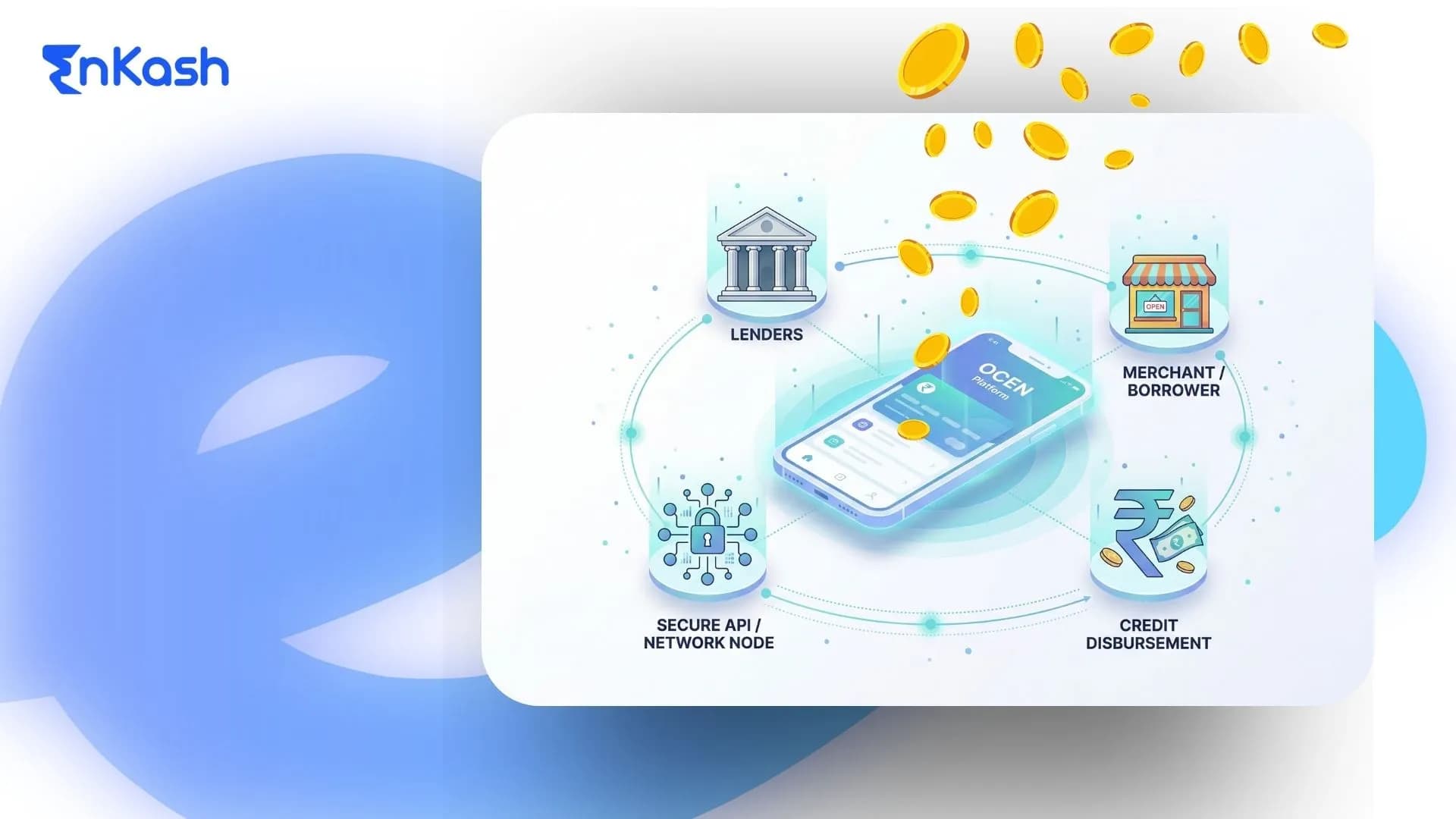
OCEN is a framework of open standards developed within the India Stack ecosystem to help participants in a loan journey communicate through a common structure. It is supported by contributions from iSPIRT and participants across India’s digital lending industry. However, it does not issue loans to borrowers. It does not approve or reject applications. It helps platforms and lenders exchange credit requests, offers, and servicing updates consistently, without building a new integration for each partnership. The larger idea is open credit, where credit can appear inside real business moments like paying a supplier, raising an invoice, or managing purchases, while the regulated lender still owns the loan.
In this blog, you will understand what OCEN means in plain terms, how it supports digital lending in India, and why it helps businesses access credit with fewer integration gaps. You will also see how an OCEN-enabled flow works step by step, who the key participants are, and which checks keep the journey clear for borrowers.
What is OCEN
OCEN stands for Open Credit Enablement Network. It is a framework of open standards that allows platforms, lenders, and service providers to exchange credit information through a common digital structure. Think of it like a shared template for how a credit request is raised, how an offer is returned, and how updates move during the life of a loan.
The meaning of OCEN becomes clearer when you picture a real lending journey inside an app. A platform may help a borrower start an application, a lending partner may manage parts of the journey, and a regulated lender finally issues the loan. Without shared standards, each connection can become a custom build, with different fields, different message formats, and different steps. OCEN reduces that mismatch by standardising how these interactions are described and passed between participants.
OCEN does not lend money to anyone. OCEN does not set interest rates or decide eligibility. OCEN does not replace banks or NBFCs, and it does not act like a regulator. The regulated lender still retains ownership of the credit decision and the loan contract. OCEN focuses on plumbing that enables credit journeys to work smoothly across different platforms and partners.
OCEN in Digital Lending
Most people understand digital lending as borrowing through an app. You fill in details, upload a few documents, and get an offer. The hard part is what happens behind the screen. Many lending journeys involve multiple parties, and each may use different systems and data formats. When every new partnership needs custom tech work, digital lending scales more slowly than it should.
This is where digital lending connects with OCEN in a practical way. OCEN helps credit journeys follow a consistent structure when they move between participants. A platform can start the journey, a partner can manage parts of the process, and a regulated lender can issue the loan, while the underlying messages stay aligned. That alignment reduces friction, reduces repeated integration work, and improves consistency across multiple lender partnerships.
OCEN is sometimes discussed alongside payments because credit often appears at the moment a payment is being made, even though OCEN itself operates in the lending workflow rather than the payment rail. Credit often appears at times when payments are already being made. A borrower may need short-term credit to pay a supplier, purchase inventory, or settle an invoice. In these situations, the user experience feels linked to a payment action, even though the credit product is separate from the payment rail. OCEN helps make this kind of embedded credit journey easier to integrate and run across multiple lenders.
In India, this fits a larger pattern of building interoperable digital rails. UPI made payments usable across apps. Consent-based data-sharing frameworks enable financial data to flow with permission. OCEN adds a workflow layer for credit interactions, enabling credit journeys within everyday business and commerce flows. OCEN India is often mentioned in the context of India’s broader move toward interoperable digital finance systems.
Importance of OCEN India for Businesses
Businesses do not think in protocols or standards. Businesses think in terms of time, cash flow, and predictability. When credit is difficult to access, the impact appears within days. Stock runs low, supplier cycles tighten, and expansion plans pause. Digital credit can help, but it works best when the journey is consistent across lenders and platforms.
Embedded Credit Works When the Journey is Consistent
Many platforms want to offer credit where business activity already happens. An invoicing tool may offer working capital right after an invoice is raised. A procurement platform may offer short-term credit at the point of purchase. A merchant app may offer credit tied to sales patterns. These ideas slow down when every lender partnership needs a fresh integration and a new process map.
Why Open Credit Reduces Integration Friction
This is where open credit becomes useful for businesses. Credit can be offered inside a real workflow, using a predictable structure for how requests and offers move between participants. Platforms can connect borrowers with multiple lenders with less rebuild work, expanding borrower choice and reducing dependence on a single relationship. The borrower journey also becomes easier to keep consistent when a lender changes.
How Digital Lending Becomes Easier to Scale
Faster integrations support faster rollout across cities, industries, and borrower segments. Cleaner handoffs reduce errors during application, servicing, and repayment updates. A shared structure also supports clearer responsibility boundaries and better audit trails. These factors help businesses trust the credit journey and operate it at scale under digital lending models in India.
Read more: Features and Benefits of Working Capital Loans
How OCEN Works: End-to-End Flow
A borrower begins inside a platform they already use for business. This can be an invoicing app, a procurement tool, or a commerce platform. The credit option appears next to a real action, such as paying a supplier or raising an invoice. The borrower does not need to move to a separate loan portal.
The borrower shares identity details and the reason for the credit. The platform captures the range of amounts and a preferred tenure. These inputs become the initial credit request package. The package is structured, which reduces missing fields and follow-up requests.
The Request Moves Through OCEN Standards
The platform routes the request in accordance with OCEN standards for credit interactions. This keeps the request and response formats consistent across different lender partnerships. A platform can expand to more lenders without rebuilding the same integration each time. The borrower experience also stays consistent when the lender changes.
Consented Data Access can Support Underwriting When Required
Some lenders need verified financial information before they prepare an offer. In such cases, the journey can use consent-based data sharing. An Account Aggregator licensed under the RBI’s NBFC-AA framework can support this step by allowing the borrower to approve which financial data is shared. The borrower should see a clear consent screen before any data moves.
The Lender Evaluates and Returns an Offer Through the Same Structure
The regulated lender runs underwriting and decides eligibility. The lender prepares an offer with terms such as the amount, tenure, and charges. The platform receives the offer in a standard response structure. The borrower then views the offer inside the same platform flow.
A Disclosure Checkpoint Appears Before the Borrower Accepts
Before acceptance, the journey should clearly present the Key Fact Statement. This checkpoint helps the borrower review charges, tenure, repayment schedule, and other key terms. Acceptance should happen only after the borrower has seen this disclosure. Clear disclosure reduces confusion and disputes later.
After acceptance and required confirmations, the lender disburses funds to the borrower’s account. The platform receives a status update that confirms completion. The borrower sees the disbursement confirmation without leaving the platform journey.
Repayments and Servicing Updates Remain Consistent During the Loan Period
Repayment reminders, receipts, and schedule updates follow structured events. If a repayment fails or a schedule changes, the borrower receives clear updates through the same journey. Servicing support can also be coordinated with fewer handoff gaps. This keeps the borrower informed through the full loan lifecycle.
Delinquency Touchpoints Stay Visible and Traceable
If an account becomes overdue, the journey records status updates and communication triggers. The borrower should still see the lender's identity and escalation path clearly. This visibility reduces confusion when stress levels are higher. Traceable events also support better operational control across participants.
Key Participants in OCEN Framework
- Borrower: The individual or business applying for credit and providing consent where required.
- Platform: The app where the credit journey begins, such as invoicing, commerce, or procurement software.
- Regulated Lender: The bank or NBFC that underwrites the application, approves the loan, and owns the loan contract.
- LSP: A partner that supports parts of the journey, like onboarding, application flow, or servicing support under the lender’s arrangement.
- Data Sharing Participant: A consent-based data provider layer used when verified financial data is needed for underwriting.
Role of LSP in OCEN Digital Lending
LSP full form in banking is Lending Service Provider. In a digital lending setup, an LSP supports parts of the borrower journey on behalf of a regulated lender. The LSP may handle customer onboarding, application flow, document collection, and basic servicing support, based on the lender arrangement. The lender still owns the underwriting, approval, and the loan contract.
What an LSP Does Inside an OCEN Journey
In an OCEN-enabled flow, the LSP helps maintain a consistent journey across platforms. It can coordinate data capture, status updates, and communication touchpoints using structured messages. This reduces confusion when multiple partners are involved. The borrower should always know who the lender is, what charges apply, and where support escalates.
A Quick Borrower Check
The borrower should verify the lender's identity, the clarity of disclosures, and the grievance contact details before accepting any offer.
How OCEN is Different from Traditional Lending
Comparison Table
| Parameter | Traditional Lending | OCEN-style Lending |
|---|
| Integration approach | Separate build for each partnership | Standard structure across partnerships |
| Time to launch | Longer onboarding cycles | Faster setup once standards are used |
| Journey ownership | Lender-led portals are common | Platform-led journeys are common |
| Role visibility | Roles can blur across parties | Roles are easier to define |
| Offer exchange | Formats vary by lender | Offer format stays consistent |
| Disclosures | Can differ across channels | Checkpoints can be standardised |
| Servicing updates | Often fragmented across systems | Events can follow a common pattern |
| Audit trail | Data spreads across teams | Messages can be logged consistently |
Benefits of OCEN
For Borrowers
Borrowers can complete a credit journey inside familiar platforms with fewer handoff gaps. Offers and updates follow a clearer structure across partners. This reduces confusion during acceptance, repayments, and support requests.
Platforms can add lender partners without the need for repeated integration work. Credit options can appear within real workflows, such as invoicing and procurement. This supports faster rollout across business segments.
For Lenders
Lenders can distribute credit through more platforms without rebuilding the same pipes. Standardised interactions help improve process consistency across channels. Operational monitoring becomes easier when messages follow predictable formats.
For the Ecosystem
Common standards improve interoperability across participants.. This strengthens trust, improves auditability, and supports responsible scaling of digital credit in India.
OCEN and Digital Lending Compliance in India
Standards Versus Lending Compliance
The open credit enablement network provides a structured way for participants to exchange credit journey messages. Compliance, however, is driven by RBI expectations for digital lending. A regulated entity remains responsible for the loan, even when partners support parts of the journey.
Disclosure Discipline Through the Key Fact Statement
Borrowers must receive clear, upfront disclosures before accepting a loan. The Key Fact Statement required under RBI Digital Lending Guidelines presents charges and key terms in a standard, easy-to-check format. This reduces hidden fee disputes and improves borrower understanding in open credit journeys.
Role Clarity, Consent, and Grievance Visibility
The borrower should always see the lender's identity and official grievance contact details. Consent-based data sharing must be explicit when used. Clear role disclosure helps reduce mis-selling risk and improves servicing clarity across participants.
Read more: The Role of Fraud Prevention in Modern Payment Gateway Security
Challenges and Risk in OCEN
Role Confusion and Mis-selling Risk
When multiple parties appear on a single journey, borrowers can get confused about who is lending and who is supporting. If lender identity is not visible at every key step, the risk of mis-selling increases. Clear screens and consistent labels reduce this risk.
Consent Fatigue and Weak Data Clarity
Borrowers may grant permissions without understanding what data is being shared or why it is needed. Vague consent screens create distrust and increase complaint volume. Short, plain language consent prompts improve understanding.
Collections Behaviour and Communication Abuse
Overdue cases can trigger aggressive outreach if controls are weak. Borrowers may face excessive calls or unclear escalation paths. Strong monitoring and documented communication rules reduce harm.
Fraud and Operational Breakdowns
Fake apps, identity misuse, and incomplete verification can lead to losses. Poorly logged journey events also weaken audits and dispute handling. Structured logs and tighter checks reduce these breakdowns.
Conclusion
India proved that a simple standard can change behaviour at scale. Credit now needs the same treatment. OCEN brings order to a space where platforms, partners, and lenders have long worked through patchwork connections. With a shared structure, credit journeys become easier to launch, easier to monitor, and easier for borrowers to understand from the first screen to final repayment. The strongest value shows up when transparency is built into every step, with clear lender identity, clean disclosures, and predictable support routes. That is why OCEN India is more than a new term in fintech circles. It is a practical foundation for Open credit journeys that align with real business activity, rather than forcing borrowers into broken handoffs. As credit moves closer to commerce actions, OCEN in payments will continue to appear in everyday user journeys.
FAQs
Is OCEN a lender?No. OCEN is not a lender. It is a set of open standards that helps platforms, lenders, and service providers exchange credit information during a loan journey.
Who created OCEN and who maintains it today?OCEN was conceptualised by iSPIRT as part of the India Stack ecosystem, with contributions from fintech firms, lenders, and digital infrastructure participants. It is maintained through open documentation and ongoing collaboration among participating institutions and builders. The direction of updates typically reflects what lenders, platforms, and regulators need to keep digital credit reliable.
What types of borrowers benefit most from OCEN-enabled journeys?Borrowers who already transact through digital platforms tend to benefit most, such as small merchants, MSMEs, gig workers, and self-employed professionals. When their business activity is visible through legitimate digital records, lenders can evaluate them faster and offer credit with fewer manual steps during processing.
What should a borrower verify on the offer screen before accepting a loan?A borrower should verify the lender’s legal name, the total cost of borrowing, all charges, tenure, repayment frequency, and the exact repayment schedule. They should also check the grievance contact details and the support path for disputes. Screens should be clear enough to screenshot and store.
How does consented data sharing change underwriting decisions in digital lending?Consented data sharing lets lenders review verified financial information instead of relying on self-declared inputs. This can reduce delays and improve accuracy of risk assessment. It also helps lenders tailor limits and repayment schedules closer to actual cash cycles, when the borrower approves sharing the required data.
What does "interoperability" mean in credit, in practical terms?Interoperability means a platform can connect to multiple lenders using a consistent structure for requests and responses. It reduces custom integrations and makes credit journeys more predictable. For borrowers, it can translate into similar application steps even when the credit provider changes behind the platform experience.
How can platforms avoid confusing borrowers when multiple parties are involved?Platforms can avoid confusion by keeping lender identity visible at every key step, using consistent labels for partner roles, and presenting disclosures in plain language before acceptance. Support routing should also be explicit, showing who handles repayments, who handles service issues, and where escalations go when problems occur.
What operational controls reduce risk in partner-led digital lending journeys?Strong controls include strict partner onboarding, logged journey events, monitored communications, and audited consent flows. Clear approval gates for disclosures and acceptance screens also reduce disputes. Lenders should review partner scripts, call practices, and notification templates, because customer harm risk increases when controls are weak.
How does OCEN affect time-to-market for launching embedded credit on a platform?Time-to-market improves when platforms reuse a standard structure instead of rebuilding integrations for each lender. Teams spend less time mapping fields, reconciling formats, and rewriting workflows. The result is faster onboarding of additional lenders, smoother scaling across segments, and fewer process breaks during servicing and repayment events.
What should businesses track to measure success after enabling embedded credit?Businesses should track application completion rate, offer-to-acceptance conversion, disbursement turnaround time, repayment success rate, and complaint volume by category. They should also monitor drop-offs at disclosure screens, support resolution time, and repeat borrowing behaviour. These metrics reveal whether the journey is clear and reliable.
What are common borrower complaints in digital lending, and how can they be reduced?Common complaints include unclear charges, unexpected deductions, repeated calls, confusing lender identity, and poor grievance handling. These reduce when disclosures are clear before acceptance, charges are shown upfront, lender identity remains visible, consent screens use simple language, and escalation paths are easy to access at any time.