A sales manager can spend hours checking call reports, listening to recordings, following up with reps, and trying to understand why one salesperson is consistently outperforming another.
The problem is that most of this happens after the work is already done.
By the time a manager discovers that a rep is making too few calls, spending too much time on unproductive conversations, or failing to follow up with prospects, valuable opportunities may already be lost.
This is where real-time call analytics makes a difference in the way sales teams are managed.
Rather than waiting until after the day's work for a summary of activity or analyzing weekly results, managers have an opportunity to observe activity in real time and respond accordingly.
What Is Real-Time Call Analytics?
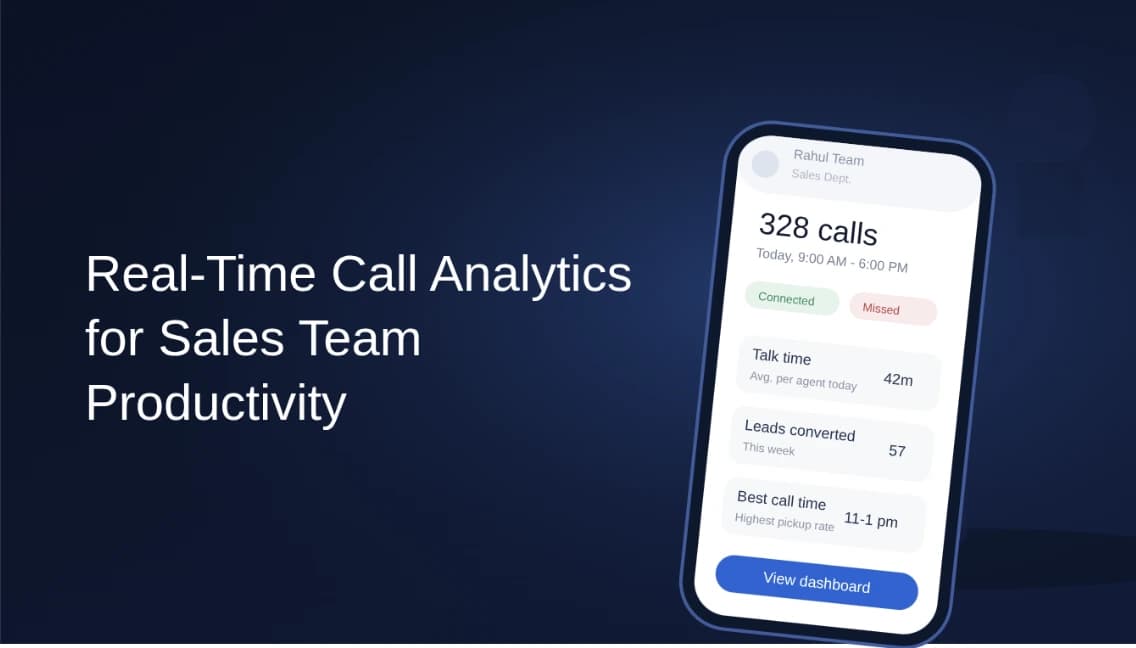
Real-time call analytics is the process of collecting and analysing call activity as it happens, or shortly after a call takes place.
It can give managers visibility into metrics such as:
- Number of calls made and received
- Connected and missed calls
- Call duration and talk time
- Individual rep activity
- Response and connection rates
- Follow-up activity
- Calling patterns across different periods
More advanced systems can also analyse what happens during conversations, including objection patterns, talk-to-listen ratios, customer sentiment, keywords, and behaviours linked to successful outcomes.
The important point is that the data is useful only when it helps a manager make a better decision.
A dashboard showing hundreds of numbers does not improve productivity on its own. The real value comes from identifying what needs attention and acting on it quickly.
5 Ways Real-Time Call Analytics Improves Sales Team Productivity
1. Managers can identify productivity gaps earlier
A daily report might tell you that a salesperson made 35 calls yesterday. That number alone does not tell you whether those 35 calls were productive. With real-time visibility, a manager can spot unusual patterns during the working day. A rep may have made very few calls by lunchtime, have a high number of unanswered calls, or be spending considerably more time on calls than the team average.
This gives managers an opportunity to investigate while there is still time to correct the problem.
Instead of asking at the end of the week, “Why were your numbers low?”, the conversation can happen when the issue first appears.
2. Coaching becomes based on evidence, not assumptions
Sales coaching often depends on a manager listening to a handful of calls and forming an opinion about a rep’s performance. The problem is that a few calls may not represent the rep’s overall performance.
Sales call analytics gives managers a much broader view. They can identify recurring patterns across a larger number of conversations and use those patterns during coaching.
For example, if a rep consistently has long conversations but a low conversion rate, the issue may not be call volume. It could be poor qualification, weak objection handling, or difficulty moving the prospect toward the next step. That creates a much more useful coaching conversation.
Every sales team has people who consistently perform better than the rest. The usual response is to call them “good salespeople” and move on. Analytics can help managers go one step further.
They can compare activity and conversation patterns between high-performing and low-performing reps.
- Are top performers connecting with prospects faster?
- Are they making more follow-ups?
- Are their calls shorter because they qualify better?
- Are they spending more time with high-intent leads?
Finding these patterns can help managers turn individual best practices into team-wide processes.
Instead of telling other reps to “sell like your top performer,” managers can show them what that actually means.
4. Follow-ups become easier to manage
A lead rarely converts because of one phone call.
Sales can sometimes depend on the follow-ups made after the initial conversation. Not following up on the promise to call back, failure to follow up with a lead or making them wait for a response can influence conversion. This is why call activity should not be viewed separately from lead management.
Real-time call analytics helps to identify leads who have been called upon, missed calls, and sales reps who lag behind with their follow-ups.
This becomes highly important for those sales teams that deal with a considerable number of leads and may easily miss some opportunities because of lack of proper tracking."
Managers can also use a structured telecalling daily call report analysis approach to identify recurring gaps in daily calling activity rather than relying only on end-of-month performance numbers.
5. Managers spend less time preparing reports
It is important for the sales managers to focus on increasing sales rather than creating spreadsheets by themselves. However, preparing such reports manually can take several hours, as the managers have to record call information, compare the performance of individual salespeople, compute totals, and create the report.
Automated dashboards reduce much of this work. The manager gets access to current performance information without waiting for a salesperson to submit a report or an operations team to compile one.
This also creates consistency. Everyone is evaluated using the same data instead of different spreadsheets or manually maintained numbers.
Which Metrics Should Sales Managers Track?
More data does not necessarily mean better management.
The right metrics depend on the sales process, but a useful dashboard should generally cover four areas:
- Activity: Calls made, calls connected, missed calls, and follow-ups.
- Efficiency: Average talk time, connection rate, and time spent on calls.
- Performance: Rep-level trends, lead response and conversion-related activity.
- Quality: Call outcomes, objection patterns, customer responses and behaviours associated with successful conversations.
The goal is to connect these metrics.
For example, a rep making 100 calls is not necessarily more productive than someone making 60. If the second rep has a significantly higher connection rate and converts more qualified prospects, simply rewarding call volume could encourage the wrong behaviour. That is why call analytics software should help managers understand the relationship between activity and outcomes, rather than simply displaying more numbers.
Turning Call Data Into Action
The biggest mistake managers can make is treating analytics as a reporting tool.
The real value comes from creating a simple feedback loop:
Monitor → Identify → Coach → Measure → Improve
A manager notices that one rep’s connection rate has dropped. They investigate the calling pattern, identify the problem, discuss it with the rep, make a change, and then monitor the results.
That process can be repeated across the team. Over time, this creates a more data-driven approach to management where coaching is based on actual behaviour rather than assumptions. For teams that want to go deeper into call activity and performance reporting, a structured sales call tracking software approach can also help connect individual call activity with broader sales processes.
The Goal Is Better Decisions, Not More Data
Real-time call analytics cannot ensure the productivity of a sales team by the mere availability of a dashboard. It helps managers recognize the problem early enough, identify the causes, and act on the problem to avoid its impact on the pipeline. If managers have the ability to know who needs help, what is working well, where follow-ups are not done, and how top performers are making a difference to achieve better results, then productivity can become a continuous management function, not a monthly measurement.
In a sales department that depends on calls, it could make quite an impact. For sales teams that depend on phone conversations, that shift can be significant.
The question is no longer just, “How many calls did the team make?”
It becomes, “What can we learn from today’s calls, and what can we improve tomorrow?”
And that is where sales team productivity starts becoming a measurable process rather than a vague performance goal.
Disclaimer: This article is a guest contribution. The opinions and views expressed are solely those of the author and do not necessarily reflect the views, policies, or position of
EnKash.