There is a moment most online retail founders know intimately. You stare at your ad dashboard; your monthly spend is climbing, but the revenue curve has gone flat. You have tried new creatives, refreshed your product pages, and even dabbled with a new bidding strategy. Yet nothing quite clicks. That feeling — equal parts frustration and quiet panic — is not a sign that your product is wrong or your market has dried up. It is usually a sign that your operational infrastructure has simply outgrown what your current team was built to handle.
Permanent success within competitive online marketplaces does not come from working harder inside a broken system. It comes from building the right system in the first place — one grounded in structured data control, accurate catalog segmentation, and smart bidding logic. Many e-commerce brands reach a point where internal teams struggle to manage expanding product inventories, campaign structures, and feed accuracy. And when that ceiling arrives, it shows up not as a dramatic crash but as a slow, expensive plateau.
The Financial Case for Getting Your Architecture Right First
Most conversations about e-commerce growth start with marketing tactics. But the smarter conversation — the one that actually moves revenue — starts with account structure. Because the way you organize your back-end data and campaign logic is, in effect, a financial decision. Get it right, and every penny you spend acquires a clearer return signal. Get it wrong, and you are essentially pouring budget into a bucket with holes.
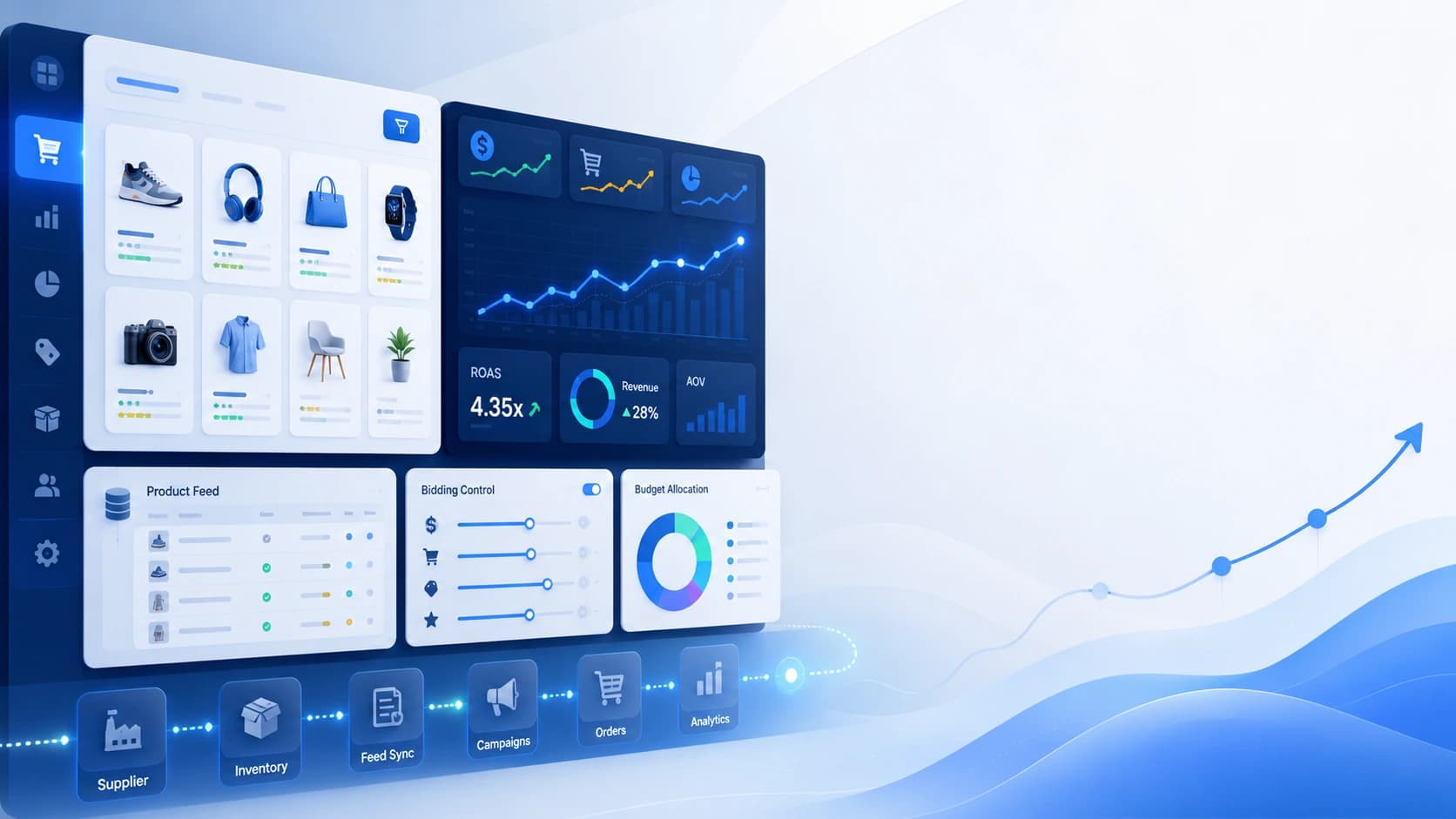
Achieving complete e-commerce growth requires a comprehensive understanding of data feeds, innovative campaign structures, and technical tracking parameters. These are not abstract IT concerns. They directly determine how efficiently capital is deployed across your catalog. Moving away from reactive management towards a systematic framework can stabilize performance and create a highly dependable customer acquisition engine — one that produces consistent, forecastable returns rather than unpredictable spikes and dips.
This matters enormously when you are trying to justify ad spend to a CFO, attract outside investment, or simply plan inventory purchases with confidence. Predictable performance is not just operationally satisfying. It is financially valuable.
Why the Technical Account Structure Secures the Main Business Economics
Here is something that does not get talked about enough in e-commerce circles: the way your campaigns are structured is not a marketing decision — it is a capital allocation decision. When your account structure is poorly designed, budget flows to products indiscriminately. High-margin SKUs compete for budget alongside slow-moving, low-margin items. Your best performers get cannibalized by noise.
Through expert analysts creating sophisticated database designs, multiple levels of marketing effort have been established to identify individual catalogs through performance history, margin range, and seasonal interest. Think of it as segmenting your catalog the way a portfolio manager segments assets — by risk profile, expected return, and time horizon.
By utilizing the expertise of a Google Shopping ads agency, businesses are creating well-designed automated guardrails around target return on investment (ROI). These guardrails act the way stop-loss orders work in trading: they prevent underperforming segments from quietly draining your budget while appearing superficially active. Properly configured guardrails will result in greater isolation of performance signals, leading to optimized functionality and faster, more consistent budget-scaling determinations.
When you can see, with clarity, exactly which products are generating return, and which ones are quietly bleeding margin, you are in a fundamentally stronger financial position. You make smarter purchasing decisions. You negotiate better with suppliers. You allocate working capital with intention rather than hope.
Leveraging Mid-Funnel Real Estate for Impacting Advanced Purchasing Decisions
Most e-commerce brands spend their energy at the extremes — either trying to capture attention at the top of the funnel or pushing hard for conversion at the bottom. The middle is where quiet fortunes are made or lost.
As mid-funnel digital shoppers search for and evaluate multiple retail options, check product prices, and look for credible indicators of trust in your e-commerce company, use clear, professional product images and easily understood pricing. Clearly marked promotions will help your products stand out from the competition.
The mid-funnel is where shoppers are essentially auditing you. They are weighing your offer against three others they have open in separate tabs. They are reading your reviews with genuine skepticism. They are checking whether your price reflects real value or inflated margin padding. Every element of your presence at this stage either builds trust or erodes it.
There are a few specific levers worth prioritizing:
- Surface high-end ratings and reviews within an active ad unit directly to minimize customer hesitation. Social proof is not decoration — it is a conversion mechanism, and in the mid-funnel it carries real financial weight.
- Continuously improve the data feed attributes to capture specific, high-intent long-tail search terms. These searches may have lower volume, but they carry dramatically higher purchase intent. The economics are usually better.
- Maintain consistent product visibility across touchpoints to efficiently reinforce brand familiarity. A shopper who sees your product three times before buying costs less to acquire than one who stumbles across it once and needs to be re-educated about who you are.
- Sync the customer-facing trust markers accurately with merchant data to shorten the overall conversion cycles. When your ratings, pricing, availability, and shipping timelines are reliably accurate, shoppers move faster — and that velocity has a measurable impact on your revenue per day of ad spend.
Each of these is both a trust-building action and a financial optimization. The two are inseparable once your operation reaches scale.
Recognizing the Precise Financial Tipping Point for Expert Integration
E-commerce companies often find that increasing their advertising budget does not directly translate into higher retail sales revenue. This is one of the more confusing and demoralizing moments a brand can face. You have the budget. The market is there. But the incremental return keeps shrinking instead of growing.
This is rarely a demand problem. It is almost always an infrastructure problem — specifically, the lack of appropriate technology or feed rules to manage large, ever-changing product inventories. Without that infrastructure, brands cannot keep up with their competition. Their bids become reactive rather than strategic. Their catalog grows unwieldy and starts to work against them.
Several reliable signals indicate a business has crossed the threshold where outside expertise becomes not just helpful but financially necessary:
- Integrating expert systems to track all discrepancies can compromise the basic precision of your information when done haphazardly. If your internal reporting is starting to feel unreliable — if you find yourself unsure whether your data reflects reality — that is a red flag with real financial consequences.
- Implement external specialized management before undertaking intricate expansions into a new territorial market. International expansion is a high-stakes capital move. Doing it without airtight feed management is like opening a new office without accounting controls.
- Change accountability when the daily feed maintenance drains the internal creative resources completely. Your most talented people should be focused on products, brand, and customer experience — not manually managing spreadsheets of product attributes.
- Use expert oversight when automation appears to be running smoothly, but performance has stalled, or margin is declining. Automation is powerful, but it can also be good at hiding problems. If your automated campaigns appear to be running smoothly but performance has quietly stalled, that is a sign you need a human expert looking at the underlying structure — not more automation layered on top.
These tipping points are, at their core, financial inflection points. Missing them is expensive. Catching them early protects margin and creates room to grow.
Conclusion: Turning Catalog Complexity into Reliable Revenue
Converting an intricate, large product catalog into an effective revenue stream requires a certain level of mechanical performance and technical accuracy. This is not a creative challenge — or at least, it is not only a creative challenge. It is a structural one.
By using a certified Google Shopping ads agency to implement your retail strategy, you can shift from uncertain, visual-only approaches to a consistent, predictable, revenue-producing process. And in a business environment where investors, lenders, and stakeholders increasingly demand demonstrable unit economics, that predictability is itself a competitive advantage.
E-commerce companies need to continually test their creative assets, strictly enforce the use of feeds, and apply structured intent segmentation to their products. By making sure that both your data is clear and your processes are technically precise, you will create a platform for your company to grow at a stable, profitable rate in the future.
The brands that scale well are not always the ones with the best products or the biggest ad budgets. They are the ones who build systems that turn data into decisions and decisions into margin. That is the financial discipline that separates brands that survive from the ones that sustain.
The right partner should understand product feed architecture, bidding logic, campaign economics, and margin protection. For scaling retail brands, that combination can turn catalog complexity into a measurable growth advantage. You can count on them for customized solutions that align with your requirements, objectives, and company vision. Finding the right partner — one who understands both the technical architecture and the financial logic underneath it — may be the single most leveraged move your business makes this year.
Disclaimer: This article is a guest contribution. The opinions and views expressed are solely those of the author and do not necessarily reflect the views, policies, or position of EnKash